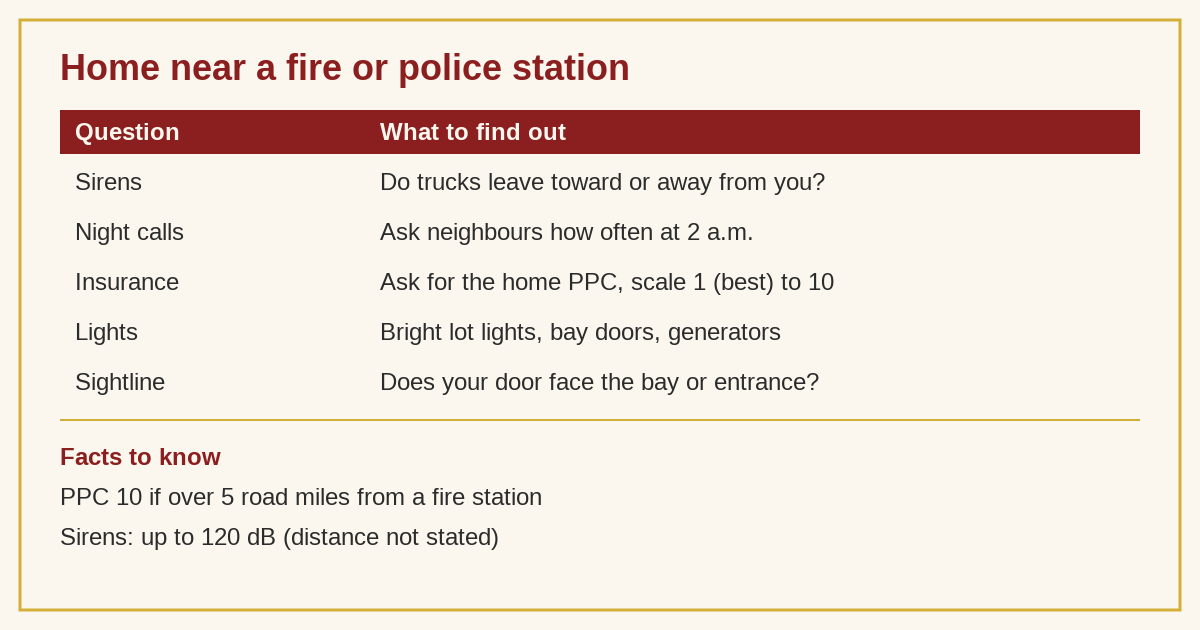
A house near a fire or police station is not bad feng shui by default. Practitioners read a fire station as fire energy and a police station as metal, authority and alarm, both strong and sudden. For a buyer, the measurable part is night sirens and bright lights, plus one possible upside: a fire station nearby can help the home's insurance fire rating.
Facts checked on 23 November 2026. Other neighbours buyers ask about are in our real estate and home buying guides.
On this page
- Key facts at a glance
- What the feng shui tradition says
- Insurance: the part that can work in your favour
- Sirens and sleep
- Emergency station buyer scoring sheet
- Remedies you can actually do
- When to walk away
- Four mistakes buyers make near a station
- FAQ
- First the quote, then the visit
- Sources
Key facts at a glance
| Item | Figure or rule | Source |
|---|---|---|
| Public Protection Classification (PPC) scale | 1 to 10; 1 is superior fire protection, 10 means the community does not meet the minimum criteria | Texas Department of Insurance |
| Distance to a fire station | A building more than five road miles from a fire station has a PPC of 10, unless an automatic aid agreement applies | Texas Department of Insurance |
| Split classes | A first number applies within five road miles of a station and within 1,000 feet of a creditable water supply; a second (X or Y) applies if water is farther | Texas Department of Insurance |
| Who uses it | Most home and business insurers use the score when setting premiums | Texas Department of Insurance |
| Siren sound level | "As high as 120 dB" (no distance stated) | TSI emergency responder noise page |
| Recommended 8-hour exposure limit | 85 dB; each 3 dB more halves the safe time | NIOSH, as summarised by TSI |
What the feng shui tradition says
Practitioners describe a fire station as concentrated fire energy and urgent movement, and a police station as metal, order and alarm. The general advice is:
- Do not face the entrance or bay doors. Practitioners worry most about a door that looks straight into a bay opening, which they read as a line of sha qi. See poison arrows and sha qi.
- Balance with calm. In the tradition, water or earth in the home's colours and materials balances fire, so practitioners suggest calmer, cooler tones on the station side.
- Protection is also a reading. Some practitioners call a nearby station protective, since help is close. That is a traditional reading. The insurance rating below is the practical version of the same idea.
None of this predicts luck or safety.
Advertisement
Insurance: the part that can work in your favour
US insurers commonly use the Public Protection Classification, a 1 to 10 score from ISO (Verisk). The Texas Department of Insurance says a building more than five road miles from a station is a 10 unless automatic aid applies, and that the split classes depend on water supply within 1,000 feet. A Verisk article says PPC is "nine times more predictive of fire loss experience" than distance to the nearest station, so living next door does not guarantee a good class.
Before you offer, ask the insurer what class the home has and get a quote for that exact address. A nearby hydrant or station may help, but distance alone does not decide the class. Canadian insurers use a different system, which we have not been able to check against a source, so ask your broker.
Sirens and sleep
A TSI summary says sirens can reach as high as 120 dB, though it gives no distance. NIOSH's recommended limit is 85 dB over eight hours. The only real test is your own. Ask the fire or police station how many calls go out at night, which way trucks turn, and whether the station uses sirens on departure. Neighbours on the same street know more than the listing. A hospital ambulance route raises the same night-noise test, set out in feng shui house near a hospital.
For checks inside the bedroom itself, see feng shui bedroom sleep environment.
Emergency station buyer scoring sheet
| Item | 0 | 1 | 2 |
|---|---|---|---|
| Door or bedroom faces the bay or entrance | No | Angled | Direct |
| Night calls you can hear | None | Occasional | Frequent |
| Bright lot or bay lights into the bedroom | None | Some | Strong |
| Generator or equipment noise | None | Occasional | Frequent |
| Insurance class for your address checked | Good | Unknown | Poor |
| Street traffic from the station | None | Some | Heavy |
Worked example with stated inputs: a house scores 0 for sightline, 1 for occasional night calls, 1 for lot lights, 0 for equipment, 0 for a good insurance class and 1 for some traffic. Total 3 out of 12. That is an ordinary result: get the insurer quote and make a night visit.
Remedies you can actually do
- Block the light. Blackout curtains or blinds on windows facing the station lights. See windows, curtains and light.
- Upgrade the glazing on the station side.
- Move the bedroom to the far side of the house.
- Screen the sightline with planting, or a fence as tall as local rules allow.
When to walk away
Walk away if frequent night calls reach the bedroom and the fix costs too much, or if the insurance quote for the address is far above comparable homes. Of everything here, the insurance cost is what can change your monthly payment.
Four mistakes buyers make near a station
- Assuming proximity gives a good fire rating.
- Buying without an insurer quote for the exact address.
- Visiting only in the daytime.
- Treating the 120 dB figure as the level indoors.
FAQ
Is living near a fire station bad feng shui?
Practitioners describe fire stations as strong fire energy and sudden movement, and advise not facing the bay doors and balancing with calmer tones. Some read the station as protective. Neither is a guarantee.
Does living near a fire station lower home insurance?
It can, but not always. Most insurers use a Public Protection Classification from 1 to 10, and a Verisk article says the class is more predictive of fire loss than distance to the nearest station. Ask an insurer for a quote on the address.
How loud are fire station sirens?
A TSI summary says sirens can reach as high as 120 dB without stating a distance. What you hear indoors depends on distance, glazing and how the station uses sirens. Test at night.
What about living near a police station?
The tradition treats it as metal and authority, and the checks are similar: sirens, lights, the sightline to the entrance and street traffic. We found no source on price effects, so we give none.
Should I check the insurance before I buy?
Yes. Ask for a quote for the exact address, including the PPC class, before you make an offer.
First the quote, then the visit
Get an insurance quote for the address before anything else. Then take the feng shui home buying checklist with you on the visit, and browse the rest of our real estate and home buying guides for other neighbours.
Sources
Checked November 2026.
- Texas Department of Insurance, Public Protection Classification FAQ
- Verisk, going the distance and more to rate fire protection
- TSI, noise exposure limits for emergency responders
We looked for, but could not confirm, Canadian fire rating rules, a police-station price study and the hydrant distance in Verisk's own white paper. No figure on this page comes from them.
Editorial note: Lucky Properties presents feng shui as a cultural and design tradition, and this guide is for general information. Confirm insurance and legal questions with a licensed broker or professional.