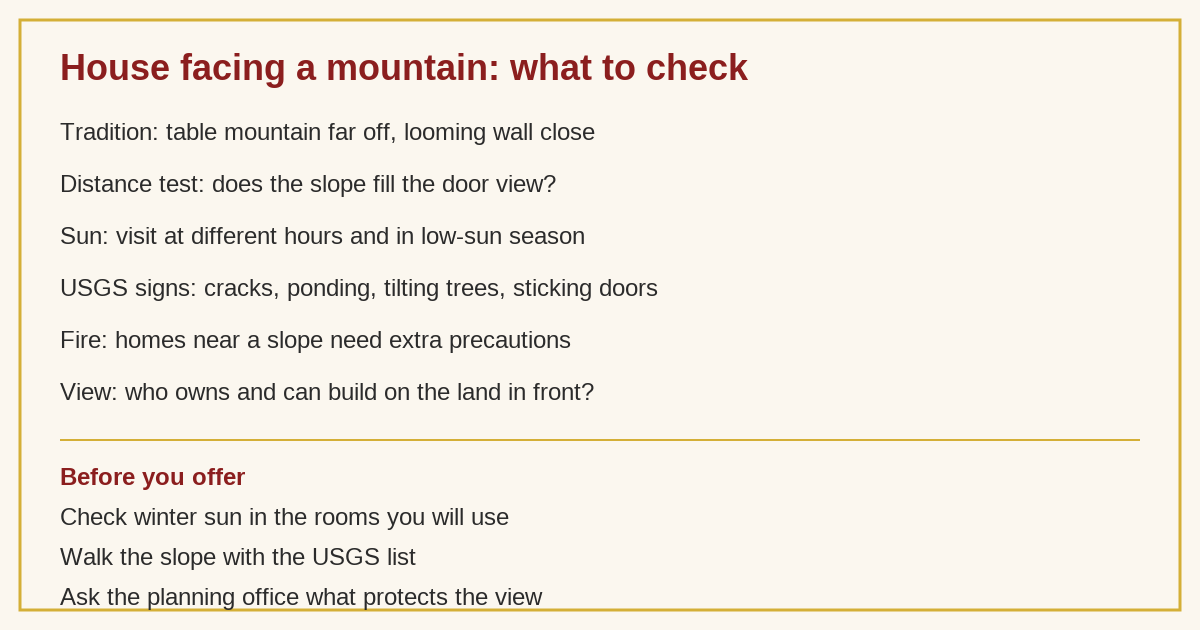
In Form School, a mountain in front of the house is a "table mountain" or "desk" when it stands at a respectful distance, and a looming wall when it is too close. Whether to buy depends on more practical things: how much sun the house loses, what runs down the slope toward you, and the risk of fire and landslides.
Safety and permit sources checked: 23 November 2026
The mountain or large hill here stands in front of the house. A hill behind you is covered in feng shui for a house on a hill, and a house at the foot of a slope in feng shui for a house at the bottom of a hill. Both sit with our other real estate and home buying guides.
| Hazard or rule | What the source says | Source |
|---|---|---|
| Slope warning signs | New cracks or bulges, water flowing or ponding on a slope, tilting trees or poles, sticking doors and windows, structures pulling from foundations | USGS |
| Fire and slope | Fire travels faster up a slope; homes above a vegetated slope sit "in a chimney" | FireSafe San Mateo County |
| Setback to a slope | A home within 15 feet (one storey) or 30 feet (two storeys) of a slope needs extra precautions | FireSafe San Mateo County |
| Cold air | Cold air flows downhill and gathers in low areas | University of Georgia climate post |
| Local rules for a natural feature | In Toronto, a permit is needed to work in a ravine or natural feature or to remove a protected tree | City of Toronto |
On this page
- What the tradition says
- Near or far: a distance test
- Sun, shade and winter light
- What comes down the mountain
- The view is not a title
- Mountain-front scoring sheet
- Remedies and when to walk away
- FAQ
What the tradition says
Form School reads the land in front of a house as the place where qi (energy) gathers, called the bright hall. In the classic ideal, high ground rises behind the house and open, lower ground lies in front, with a modest rise beyond it that acts as a table or desk for the household to face. Read this way, a gently shaped mountain a good way off, with open ground between, is a favourable "table mountain".
Practitioners warn about the other case. A steep, tall mass close to the front door is described as pressing down, blocking the bright hall and cutting off light and prospects. Jagged or bare peaks are called sharp, rounded wooded ones gentle. Some teachers also dislike a notch or cleft in the ridge that lines up with the door. These are traditional images, not guarantees of wealth, career or health, and practitioners don't agree on every detail.
Advertisement
Near or far: a distance test
The tradition sets no measured distance, so we give none. Practitioners judge it by what you see from the door, and a buyer can run the same test in a few minutes:
- Stand at the front door and look up. Can you see the whole mountain without tilting your head far back, or does the slope fill your view?
- Is there open ground (a street, a field, a yard) between your door and the foot of the slope?
- Does the mountain fill the sky at the hour you leave for work, or does it frame the horizon?
- Is it rounded or broken, wooded or bare?
Practitioners call a mountain that fills the whole view from the door oppressive, and one that frames the horizon a "desk". Your answers describe how the view will feel day to day. They are not a ruling.
Sun, shade and winter light
A large mass in front can take sun from that side of the house, most of all in winter when the sun sits low. How many hours you lose depends on the height of the slope, its distance and your latitude, so no general figure applies. You can check it yourself. Visit at different times of day, and if possible in the season when the sun is lowest; a sun-path tool will also show where the sun falls on an address through the year. Note which rooms get morning light, where you would work, eat and sleep, and whether the front yard stays shaded or icy for long stretches.
Then there is cold air. The University of Georgia notes that cold air flows downhill and gathers in low ground. A house in the mouth of the valley, facing the mountain, can be colder than its neighbours up the road, with frost that clears later.
What comes down the mountain
A big slope in front of the house sends water, soil and rock your way, and sometimes fire. Two checklists help, one from the US Geological Survey and one from FireSafe San Mateo County.
- Ground movement. The USGS warning signs are new cracks or bulges, water flowing or ponding on the slope, tilting trees and poles, sticking doors and windows, and structures pulling away from their foundations. If you see them, the agency recommends a geologist or engineer.
- Fire. FireSafe San Mateo County explains that fire travels faster up a slope and that homes above a vegetated slope sit in a chimney. The chimney warning applies most to a house above the slope. If the house sits below a wooded mountain, ask your fire department and your insurer how the area is rated and what clearing is expected there.
Where slopes and streets meet at the lot line, see feng shui for corner lots, cul-de-sacs and slopes.
The view is not a title
You usually don't own the mountain view. Ask who owns the slope and what can be built on it, because a rezoned hillside, a new road or a quarry changes the view for good. In Toronto, for example, work in a ravine or natural feature and removal of a protected tree both need a permit, which also limits what neighbours may do. Other cities differ, so ask your local planning office what protections cover the land in front of the lot, and whether a view easement or height limit exists. If you plan to cut your own trees to open the view, read the local tree rules first.
Mountain-front scoring sheet
Use 0 where you found a problem, 1 where you do not know yet and 2 where it is settled in writing. Below 8 of 12, treat the view as unproven and keep asking.
| Check | 0 | 1 | 2 |
|---|---|---|---|
| Distance and shape | Slope fills the door view | Close but rounded | Frames the horizon with open ground between |
| Sun in main rooms | Dark in winter | Not checked | Seen at several hours and seasons |
| Slope signs (USGS) | Seen | Not checked | Walked the slope, none seen |
| Fire exposure | Dense fuel above or below the house | Unknown | Clearing in place, insurer confirmed |
| Who owns the view | Unknown, buildable | Probably protected | Protected land or recorded easement |
| Cold air and frost | Frost pocket | Unknown | Neighbours report mild winters |
Remedies and when to walk away
- Brighten the entry with light paint, a well-lit porch and a clear, open path to the door. Practitioners would say this opens the bright hall, and it helps a shaded front either way.
- Put the main sitting and work areas in rooms where the mountain is a view rather than a wall, looking to the horizon and not straight at the slope.
- If drainage allows, use a water feature or an open lawn in front to put some "ground" between the door and the slope.
- If the front is dark, add skylights or large windows on the sunny side.
Walk away when the slope shows the USGS signs with no engineer's report, when insurance cannot be bound, or when the view you are paying for sits on land that could be built on next year.
Where mountain-view buyers slip
- Paying for a view without checking who owns the land in front.
- Visiting only in summer, when the sun is high.
- Treating a mountain as scenery instead of a source of water, soil and fire.
- Reading feng shui by the peak's shape while ignoring a retaining wall that is cracking.
FAQ
Is it good feng shui to face a mountain?
It depends on the distance and shape. In Form School a rounded mountain a respectful distance away reads as a table or desk, while a steep mass close to the door reads as pressing down. Judge how the view feels from the door, then check sun, slope stability and fire.
What is a table mountain in feng shui?
It is a modest rise in front of the house that acts like a desk the household faces, set back from the door with open ground between. It is a traditional image, not a guarantee of luck.
Is living at the foot of a mountain bad feng shui?
Practitioners say a mountain that looms close to the front can block light and feel oppressive, while one behind the house reads as support. A buyer's practical checks are sun in winter, slope signs and fire exposure.
Will a mountain in front block the sun?
Often some of it, especially when the sun is low in winter. How much depends on the slope's height and distance. Visit at different hours and seasons, or use a sun-path tool for the address, and note which rooms get light.
Can I cut trees to open up a mountain view?
Not always. Many places protect certain trees and natural features. For example, Toronto requires a permit to remove a bylaw-protected tree or work in a ravine or natural feature. Ask your local planning office before cutting.
Two visits to plan
Visit the house in the low-sun season or use a sun-path tool, and ask the planning office who owns and can build on the land in front of the lot. Then walk the rooms themselves with the feng shui home buying checklist.
Sources
Checked November 2026.
- US Geological Survey: landslide warning signs
- FireSafe San Mateo County: topography and wildfire guidance
- University of Georgia climate post: cold air flows downhill
- City of Toronto: permit page for trees, ravines and natural features
We did not consult a neutral study of mountain-view prices or sun-path data for any latitude, so no price or sun-hour figure appears above. Toronto's permit rules and the San Mateo fire guidance are examples, not national rules.
Editorial note: Lucky Properties presents feng shui as a cultural and design tradition. This guide is educational. Confirm slope stability, fire exposure, view protection and insurance with a geotechnical engineer, your insurer, your local planning office and a licensed professional.