Practitioners say a house at the foot of a hill is sheltered but collects whatever flows down to it, and some read that as stagnant or draining energy. For a buyer, the real questions are water, the flood zone, insurance and cold air. Settle those before any compass reading.
FEMA, USGS and climate sources checked: 23 November 2026
Here we look at the house at the base of a slope. A house partway up has different problems, covered in feng shui for a house on a hill, and the rest of our real estate and home buying guides cover the purchase itself.
| What to know | The rule or finding | Source |
|---|---|---|
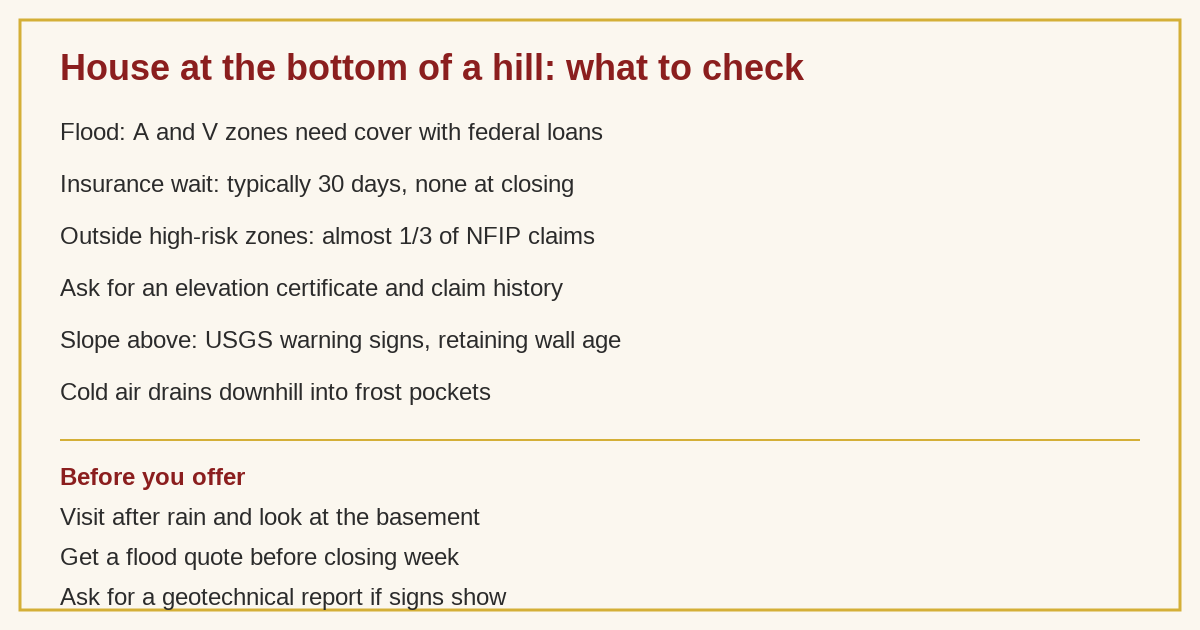
| High-risk flood zones | Zones A and V are Special Flood Hazard Areas; flood insurance is required for government-backed mortgages there | FEMA, National Flood Insurance Program real estate brochure |
| Waiting period | Typically 30 days before a policy takes effect; none when the policy is tied to a mortgage closing | FEMA, NFIP real estate brochure |
| Claims outside high-risk zones | Almost one-third of NFIP claims from 2014 to 2024 were outside high-risk areas | FEMA, NFIP real estate brochure |
| Elevation certificate | Optional in many cases, and can lower premiums | FEMA, NFIP real estate brochure |
| Seller's policy | A flood policy can be transferred to the buyer | FEMA, NFIP real estate brochure |
| Slope warning signs | Water flowing or ponding on a slope, new cracks or bulges, tilting trees or poles, sticking doors and windows | USGS |
| Cold air | Cold air flows downhill and gathers in low areas, forming frost pockets | University of Georgia climate post |
On this page
- What the tradition says
- Water: where the hill sends it
- Flood zones and insurance
- The slope above you
- Cold air and light
- Valley floor scoring sheet
- Remedies and when to walk away
- FAQ
What the tradition says
In Form School, a house at the foot of a hill sits low, with higher land rising behind or beside it. That can resemble the armchair, the sheltered seat practitioners prefer, and some teachers call a protected hollow a place where qi (energy) gathers and stays. Others warn about the opposite. If the hill is steep and close, they say it presses down on the house and looms over its front. If the hollow collects water, mist or cold air, they say it makes the place damp and stagnant, and the household can feel hemmed in.
The tradition, then, reads the foot of a hill two ways. Which reading applies depends on how steep and how near the hill is, whether it rises behind the house or in front of it, and whether water has a way out. Take all of it as a description of how the site feels, not a forecast of luck or wealth.
Advertisement
Water: where the hill sends it
Whatever the tradition says about qi, rain runs downhill. A lot at the bottom of a hill takes runoff from the slope, the road and the lots above. Ask these questions at a viewing, ideally after rain:
- Does water pond in the yard, the window wells or the driveway?
- Is there a swale, French drain, culvert or sump, and who maintains it?
- Where do the neighbours' downspouts discharge?
- Does the basement or crawlspace show tide lines, efflorescence (white salt marks), a musty smell or a sump pump?
The US Geological Survey lists water flowing or ponding on a slope as a warning sign of ground movement. That matters for a lot below the slope as much as for one on it.
Flood zones and insurance
FEMA's real estate brochure for the National Flood Insurance Program explains that A and V zones are Special Flood Hazard Areas, and flood insurance is required for government-backed mortgages in them. A policy typically takes 30 days to start, though there is no wait when it is tied to a mortgage closing, so get the quote moving well before closing day. The brochure also says almost one-third of NFIP claims from 2014 to 2024 came from outside the high-risk areas. Being outside the mapped zone does not make a low lot safe.
The same brochure has two more points a buyer can use. An elevation certificate is optional in many cases and can lower premiums, so ask the seller if one exists. And a seller's flood policy can be transferred to the buyer, so ask what the seller has been paying and what it covers.
All of this is US guidance. In Canada, flood rules, maps and insurance differ by province, and we checked no Canadian source for this guide, so we give no Canadian figures. Your agent or lender can point you to the local flood map and tell you what coverage is available.
How the tradition reads water in a garden is a separate subject, covered in feng shui garden water features.
The slope above you
If the house sits right at the foot of a steep slope, look up. The USGS warning signs apply here too: new cracks or bulges, water flowing or ponding, tilting trees or poles, sticking doors and windows, and structures pulling away from their foundations. A retaining wall behind the house raises its own questions. Who built it, and when? Was there a permit, and what drains behind it? If you see any of the signs, ask for a geotechnical report; the USGS recommends calling a geologist or engineer.
Cold air and light
The University of Georgia notes that cold air flows downhill and collects in low areas, so frost pockets form at the bottom of a slope. In the hollow, that can mean planting later in spring, more frost on the driveway and a cooler yard. How much colder it gets depends on the shape of the valley and on the night, so ask the neighbours when frost usually clears. Practitioners also say a house below a high hill can be dim and damp. Put plainly, the hill casts shade. Visit at different times of day and see where the sun falls in the rooms you will use most.
Valley floor scoring sheet
Rate each line 0 (problem found), 1 (not checked yet) or 2 (checked and documented). A low lot that scores under 8 of 12 needs more answers, ideally after a rainy-day visit.
| Check | 0 | 1 | 2 |
|---|---|---|---|
| Flood map zone | In an A or V zone, no coverage quote | Unknown | Zone known, insurance quote in hand |
| Water at the lot after rain | Ponds at the house | Not seen in rain | Drains away, system documented |
| Basement and crawlspace | Tide lines, mould smell or pump running | Unclear | Dry, with records |
| Slope above | USGS signs present | Not checked | Checked, none seen |
| Elevation certificate | None, in a mapped zone | Exists, not shared | Provided |
| Light and cold air | Shaded and a frost pocket | Unknown | Sun in main rooms |
Remedies and when to walk away
- Fix the drainage before the décor. That means gutters and downspouts that discharge well away from the house, ground graded to slope away, and a sump if the site needs one.
- Keep the side facing the hill solid and uncluttered, and keep the large trees on the slope healthy. Practitioners say this steadies the back of the house, and healthy trees are also less likely to fall.
- Bring more light inside. Pale walls, good lamps and clean glass make up for a shaded site.
- Plant frost-tolerant species, since the hollow runs cool.
Walk away when the lot is in a high-risk zone and no insurance can be bound, when water pools at the foundation with no working remedy, when the slope above shows the USGS signs without an engineer's report, or when the seller will not provide flood claim history where the law requires it.
Where buyers of low lots go wrong
- Assuming a house outside a mapped flood zone stays dry. A low lot collects runoff whatever the map says.
- Viewing in a dry week. Water problems show after rain.
- Leaving the flood quote until closing week.
- Accepting "it has never flooded" with no document to back it.
FAQ
Is a house at the bottom of a hill bad feng shui?
There is no single verdict. Practitioners say a sheltered hollow can feel protected, but a steep hill pressing close, or a damp and dim hollow, reads as heavy and stagnant. The practical checks, water, flood insurance and the slope above, matter more than the compass.
Do houses at the bottom of a hill flood more?
They receive runoff from higher ground, so drainage matters, but FEMA notes almost one-third of NFIP claims from 2014 to 2024 came from outside high-risk areas. Check the flood map, the claim history and the water after rain.
Do I need flood insurance for a house in a low area?
If the property is in a Special Flood Hazard Area (A or V zone) and has a government-backed mortgage, yes, in the US. Outside those zones it is optional. FEMA says there is typically a 30-day wait, but none when the policy is tied to a mortgage.
What is an elevation certificate?
It is a document that records a building's elevation compared with flood levels. FEMA says it is optional in many cases and can lower premiums, so ask the seller whether one exists.
Does cold air collect at the bottom of a hill?
Yes. Cold, dense air drains down slopes at night and pools in the lowest ground, which is why frost often lingers in a hollow after it has cleared higher up. Neighbours can tell you how late in spring frost still settles.
This week's next step
Ask your lender or agent for the flood zone and a flood insurance quote this week, then visit the lot after rain with the checklist above. When the lot passes, take the feng shui home buying checklist to the second viewing.
Sources
Checked November 2026.
- FEMA, National Flood Insurance Program: questions and answers for real estate professionals (brochure, August 2025)
- US Geological Survey: landslide warning signs
- University of Georgia climate post: cold air and frost pockets
We did not consult FEMA's flood zone glossary or any Canadian flood map or insurance guidance, so no Canadian figures appear above. FEMA rules are US rules.
Editorial note: Lucky Properties presents feng shui as a cultural and design tradition. This guide is educational. Confirm flood zone, insurance and drainage questions with your lender, an insurance agent, a home inspector and a licensed professional.