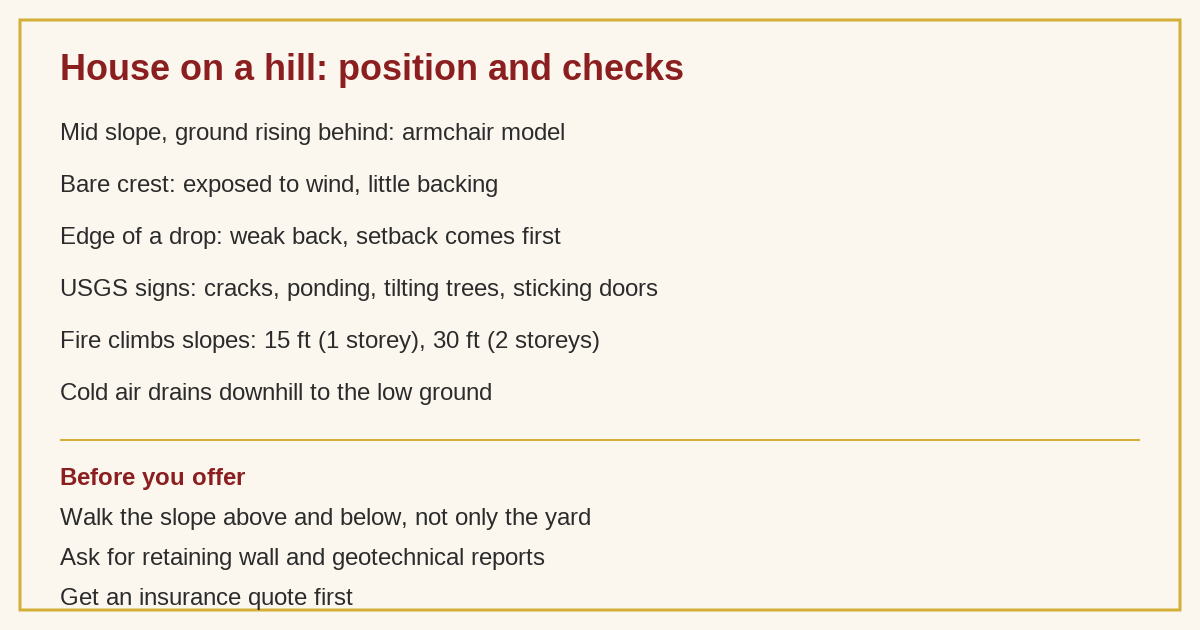
Practitioners say a house partway up a slope with higher ground behind it is the classic supported site, while a bare hilltop is exposed to wind and a house perched at a steep edge feels precarious. Whether to buy depends on things you can check: slope stability, how fire behaves on the slope, drainage and access.
Sources rechecked: 23 November 2026
Our real estate and home buying guides split hill sites three ways, and this one is about the house that sits on the hill. A house at the base has its own guide, feng shui for a house at the bottom of a hill, as does one that faces a big peak: feng shui for a house facing a mountain.
| Slope hazard | Figure or rule | Source |
|---|---|---|
| Slope warning signs | New cracks or bulges, water flowing or ponding on the slope, tilting trees or poles, sticking doors and windows, structures pulling from foundations; call a geologist or engineer | USGS |
| Fire and slope | Fire travels faster up a slope; a home atop a vegetated slope "sits in a chimney" | FireSafe San Mateo County |
| Setback to a slope | Homes within 15 feet (one storey) or 30 feet (two storeys) of a slope need extra precautions | FireSafe San Mateo County |
| Cold air | Cold air flows downhill and collects in low areas, so frost pockets form at the bottom, not on the upper slope | University of Georgia climate post |
On this page
- What the tradition says
- Where on the hill matters
- Stability: the signs to look for
- Fire on a slope
- Water, drainage and cold air
- Access, stairs and daily life
- Hillside scoring sheet
- Remedies and when to walk away
- Mistakes hillside buyers make
- FAQ
What the tradition says
Form School reads the land first. Its classic favourable site is the armchair: higher ground behind the house (the backing mountain), lower ground on each side, and open space in front. By that picture, a house on the lower or middle part of a slope, with the hill rising behind it, has the support the tradition prizes. A house on the very top of a hill, practitioners say, has nothing behind it and is open to wind on every side, so the household can feel exposed and its energy (qi) is said to scatter. A house right at the lip of a steep drop is called precarious for a similar reason: a weak back and a hard fall in front.
These readings describe how a site feels and works. They guarantee nothing about luck or wealth, but they happen to line up with ordinary caution. Exposed sites carry more wind, more fire and more erosion, and a weak edge is a stability question first.
Advertisement
Where on the hill matters
| Position | Tradition's reading | What it means in practice |
|---|---|---|
| Upper third, near the crest | Exposed, little backing | Wind exposure, long views, fire climbs toward you from below |
| Middle of the slope, ground rising behind | Closest to the armchair model | Check the slope above you: drainage, rock fall or soil creep come toward the house |
| Lower slope | Protected, but collects what runs down | Water and cold air arrive here (see the bottom-of-hill guide) |
| Edge of a steep drop | Weak back and a hard fall in front | Setback and stability checks come first |
The direction the slope faces matters too. A south-facing slope in the northern hemisphere catches more sun than a north-facing one. How much more depends on latitude and the steepness of the slope, so check shade at the address with a sun-path tool in different seasons.
Stability: the signs to look for
The US Geological Survey lists warning signs that a slope may be moving: new cracks or bulges in the ground or pavement, water flowing or ponding on the slope, tilting trees, fence posts or poles, doors and windows that start to stick, and structures pulling away from their foundations. If you see any of them, the agency recommends calling in a geologist or engineer.
At a viewing, walk the whole slope above and below the house, not only the yard. Look at retaining walls for bulges or cracks, at the base of tall trees for leaning, and at the foundation for new gaps. Ask for the seller's disclosure and any geotechnical or retaining wall reports. Where a report exists, note who wrote it, when, and what it says about drainage. Where none exists and you have seen any of the signs above, make your offer conditional on one.
Fire on a slope
FireSafe San Mateo County explains that fire moves faster up a slope, and that a home atop a vegetated slope "sits in a chimney". It says homes within 15 feet of the slope for one storey, or 30 feet for two storeys, need extra precautions. For a hillside buyer, that raises four questions. What grows on the slope below, and who owns it? How much clearing do local rules ask of you? And can a fire truck reach the house on the access road in one pass?
Ask your insurer early. Some insurers treat slope and brush differently, and a quote before you commit costs less than a surprise afterwards.
Water, drainage and cold air
Water runs downhill. On a hillside, ask where rain goes from the road above and from the lot above, where the downspouts discharge, and whether any of it ends up behind a retaining wall. USGS lists water flowing or ponding on a slope as a warning sign in its own right.
Cold air also moves. The University of Georgia notes that cold air flows downhill and gathers in low areas, forming frost pockets. So a garden on the upper slope may see frost later than one at the bottom, though it takes more wind. If you garden or spend time outdoors, that affects where the beds and seating go.
Access, stairs and daily life
A steep driveway, a long run of exterior stairs or a narrow switchback road becomes a daily cost: groceries, strollers, a parent with a walker, snow and ice. Practitioners count a smooth, safe approach as part of good feng shui for exactly that reason: a hazardous one wears on the people who live there. Try the route with your arms full, and in the evening. Ask how winter maintenance works on the road and who pays.
Corner, cul-de-sac and sloping lots at street level are covered in feng shui for corner lots, cul-de-sacs and slopes.
Hillside scoring sheet
Mark each line 0 (a problem), 1 (not yet known) or 2 (clear, with paperwork). A lot that totals less than 8 out of 12 needs more answers before you offer.
| Check | 0 | 1 | 2 |
|---|---|---|---|
| Position on the hill | At the lip or bare crest | Mid slope, little backing | Mid slope with ground or trees rising behind |
| Slope warning signs (USGS) | One or more seen | Not checked | Walked above and below, none seen |
| Reports | None and signs present | None, no signs | Recent geotechnical or retaining wall report |
| Fire clearing and truck access | Dense fuel, narrow road | Unknown | Clear space and a road for trucks |
| Drainage | Water ponds or runs at the house | Unknown | Roof and surface water carried away |
| Daily access | Steep and icy | Manageable | Gentle, lit and maintained |
Remedies and when to walk away
- Add trees or a solid planting bank behind the house if it sits near the crest. Practitioners would call it a backing mountain, and it also breaks the wind.
- Keep the side that faces the drop solid and grounded: a deck with a clear railing rather than a house wall at the edge.
- Fix drainage first. On a hillside, a water problem outweighs any directional reading.
- Fit handrails on outdoor steps, light them well and give them a non-slip surface.
Walk away when the USGS signs are present and no engineer has looked, when a retaining wall you cannot inspect holds up the house, or when insurance cannot be bound.
Mistakes hillside buyers make
- Buying for the view and ignoring what is uphill from the lot.
- Treating a retaining wall as a minor feature. Ask its age, who built it and whether it was permitted.
- Expecting the seller's agent to judge slope stability. That takes an engineer.
- Reading a feng shui compass over a site that moves.
FAQ
Is a house on a hill good feng shui?
It depends on where. Practitioners favour a house partway up the slope with higher ground behind it. A bare hilltop is described as exposed, and a house at a steep edge as precarious. These are traditional readings, and slope stability and fire exposure matter more to a buyer.
Is it bad luck to live at the top of a hill?
Practitioners say a crest has no backing and is open to wind, so the household may feel exposed. The tradition suggests trees or a wall of planting behind the house. None of this is a prediction. The practical issues are wind, fire and access.
How do I know if a hillside is stable?
Look for the signs the US Geological Survey lists: new cracks or bulges, water flowing or ponding on the slope, leaning trees or poles, sticking doors and windows, and structures pulling from foundations. If you see any, ask a geologist or engineer to assess it.
Are hillside homes harder to insure?
No neutral figure applies everywhere. Slope, brush and road access can affect underwriting in fire-prone areas. Ask your insurer for a quote before you make an offer.
Why does fire matter more on a slope?
FireSafe San Mateo County explains that fire travels faster up a slope and that a home atop a vegetated slope sits in a chimney. Homes within 15 feet of a slope for one storey, or 30 feet for two, need extra precautions.
Walk the slope, then ask for the reports
Take the USGS list and walk the whole slope above and below the lot. Then ask your agent for the seller's disclosure and any retaining wall or geotechnical report. The house itself is covered by the feng shui home buying checklist.
Sources
Checked November 2026.
- US Geological Survey: landslide warning signs
- FireSafe San Mateo County: topography and wildfire guidance
- University of Georgia climate post: cold air flows downhill and collects in low areas
We did not consult a neutral study of hillside resale prices or insurance underwriting, so no price or premium figure appears above. Fire guidance comes from one county's fire safe council and is an example, not a national rule.
Editorial note: We present feng shui as a cultural and design tradition, and this guide is general information. Confirm slope stability, insurance and building rules with a geotechnical engineer, your insurer, your local planning office and a licensed professional.