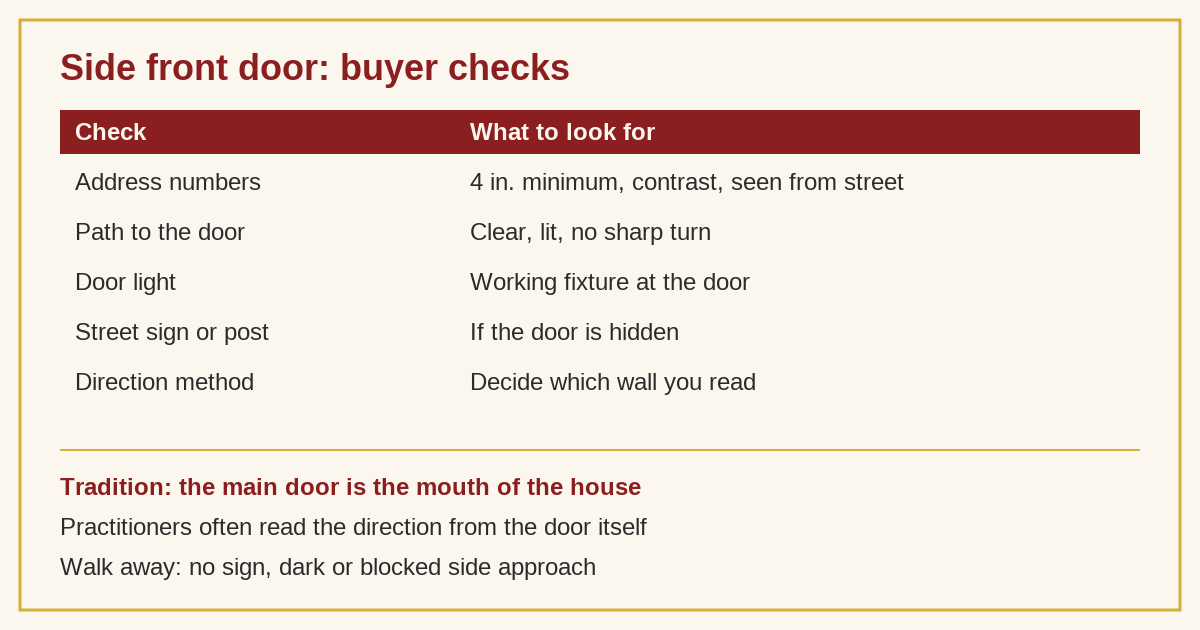
Feng shui does not treat a front door on the side as a defect. Practitioners call the main door the mouth of the house wherever it sits, and then judge the path to it, the light, and how it looks from the street. For a buyer the real risk is that people cannot find it. Guests and emergency crews both need to, which is why the fire code sets sizes for address numbers.
Addressing standard checked: 23 November 2026
We deal here with a main door that is not on the street-facing wall. Choosing the door itself is covered in front door replacement, one of our real estate and home buying guides.
| Requirement | Napa's figure or rule | Source |
|---|---|---|
| Address numbers, base size | At least 4 inches high with a 1/2 inch stroke (fire code section 505.1 as applied by Napa) | City of Napa |
| Address numbers 36 to 50 feet from the street | 9 inches high, 1/2 inch stroke | City of Napa |
| Address numbers over 50 feet | 12 inches high, 1 inch stroke | City of Napa |
| Colour | Numbers must contrast with their background | City of Napa |
| Building not visible from the public way | A monument sign or other approved means identifies it at the public way | City of Napa |
On this page
- What the tradition says
- The buyer issue: can people find the door?
- Viewing checklist
- Decision table: how to read your house
- Remedies practitioners suggest
- Three ways a side door gets lost
- When to walk away
- FAQ
- Start from the street
What the tradition says
In most schools the main entrance is where energy and visitors come in, on a side wall as much as on the front. Practitioners want an entrance you can recognise, with good light and a clear path to it. What they dislike is a door tucked down a narrow side passage. The "mouth" is hard to find there, and the approach feels cramped.
Then there is the question of which direction the house faces. Teachers differ: some read the house by the wall that faces the street, others by the wall the main door is on. Both methods are explained in house facing versus door direction and the compass versus front door bagua method. Whichever you pick, use it for the whole house rather than switching halfway through a floor plan.
Advertisement
The buyer issue: can people find the door?
Side entrances are common on corner lots, on duplexes, on houses with a long driveway and on homes with a garage at the front. The trouble is that visitors, couriers and emergency services all look for the address from the street.
The addressing standard of the City of Napa, California applies fire code section 505.1. Address numbers must be at least 4 inches high with a 1/2 inch stroke, larger as the distance from the street grows (9 inches high from 36 to 50 feet, 12 inches high with a 1 inch stroke beyond 50 feet), and in a colour that contrasts with the background. Where a building is not visible from the public way, a monument sign or other approved means identifies it at the public way. The 4 inch minimum comes from the model fire code. The larger sizes by distance are Napa's own, and your city may set different ones, so check with your fire department or building office. We have not verified the residential building code text on address numbers, so we quote none of its figures.
What the tradition says about the number itself is in our house numbers guides.
Viewing checklist
- Stand on the street. Can you read the number and see which way to walk to the door?
- Walk the approach. Is it clear, even and wide enough for two people?
- If the viewing runs past dark, check the lighting at the door and along the path.
- Note what faces the path, whether a neighbour's windows, a garbage area or a fence.
- Look for a covered entry at the door, a landing and somewhere to leave a parcel.
- See whether the street-facing wall has a decorative door nobody uses. Visitors often go to the wrong one.
Decision table: how to read your house
| Situation | Tradition view | Practical view | Action |
|---|---|---|---|
| Door on side, visible from street, clear path | Fine, and the door wall can set the direction | Easy to find | Add a light and the number |
| Door on side, hidden behind a fence | The mouth is hard to find | Couriers and emergency crews may miss it | Put the number at the street, and move the gate or fence |
| Two doors, one at front used rarely | Practitioners read the one in use | Guests go to the wrong door | Decide which is the main door and mark it |
| Door on side of a corner lot | Often accepted | Seen from two streets | Put the number on both visible faces |
Remedies practitioners suggest
- Fit a warm, working fixture at the door and along the approach.
- Make the route wide, straight or gently curved, with plants that do not close in on it.
- Put a house number at the street, and use a small sign or a coloured door so the entrance reads as the main one. Door colours are covered in front door colors by direction.
- A porch or roof over the door gives shelter and, teachers say, a place to pause.
- A mat and a spot to take off shoes make the door feel like a real entrance.
Three ways a side door gets lost
- The direction is read from the street wall for one part of the plan and from the door wall for another.
- A fence, hedge or gate hides the door or blocks the number.
- Small decorative numbers cannot be read from the street.
When to walk away
A side door alone is no reason to walk away. Offer less, or think again, if the approach is dark, blocked or unsafe, if there is nowhere to put the number where it can be seen, or if the entry has no landing or cover and you cannot add one.
FAQ
Is a front door on the side of the house bad feng shui?
No fixed rule says so. Practitioners treat the main door as the mouth of the house wherever it is and look at the path, light and visibility. A hidden, dark or cramped side approach is the thing they dislike.
Which direction does my house face if the door is on the side?
Teachers differ. Some read the wall that faces the street; others read the wall the main door is on. Pick one method and apply it to the whole floor plan.
How big should house numbers be?
Napa's addressing standard, applying fire code section 505.1, sets a minimum of 4 inches high with a 1/2 inch stroke, 9 inches high from 36 to 50 feet, and 12 inches high with a 1 inch stroke beyond 50 feet. The larger sizes are Napa's local rule; your city may differ.
What if the house is not visible from the street?
The Napa standard says a monument sign or other approved means identifies the structure at the public way. Ask your local fire department what applies.
How can I make a side door feel like the main entrance?
Add a light, a clear path, a visible number at the street, a mat and a cover over the door. Practitioners also suggest a distinct door colour that suits the direction you use.
Start from the street
At your next viewing, stand on the street and look for the number and the door before you walk in. Afterwards, use the feng shui home buying checklist to compare the shortlist.
Sources
Checked November 2026. The address figures are one city's version of the model fire code; confirm with your own fire department.
Editorial note: Feng shui is presented here as a cultural and design tradition, not as a guarantee of any outcome. Confirm legal, financial and inspection questions with a licensed professional in your area.