To replace a front door with feng shui in mind, pick the material and finish by the direction the door faces (practitioners link wood to east and southeast, metal to west and northwest), keep the size in proportion to the house, and prefer an inward swing and partly frosted glass. Then check the legal minimums and your local permit rules before you order.
Last checked: 17 November 2026
This guide is part of our renovate with feng shui guide. It covers buying and replacing the door; for the colour chart see front door colors by direction.
| Key fact | Figure or rule | Source |
|---|---|---|
| Egress door width | At least one required exterior egress door must be 32 inches minimum width (2018 IRC R311.2 as cited) | North Carolina Office of State Fire Marshal |
| Egress door height | 78 inches minimum height | North Carolina Office of State Fire Marshal |
| Other exterior doors | Other exterior egress doors need not meet the 32 inch width | North Carolina Office of State Fire Marshal |
| Replacement permit (example) | San Diego exempts replacement doors in existing openings when the rough opening is not altered; work must still meet code | City of San Diego |
| Same-size replacement (example) | San Diego allows a no-plan permit when doors are the same size and type with no change to the opening | City of San Diego |
| Door energy rating | ENERGY STAR door criteria depend on climate zone and glazing level and use NFRC ratings | ENERGY STAR |
On this page
- Material by direction
- Size and proportion
- Single, double or sidelights
- Glass and privacy
- Swing, hardware and threshold
- The legal and practical checks
- Decision table
- Worked example: an east-facing house
- Checklist for the contractor
- FAQ
Material by direction
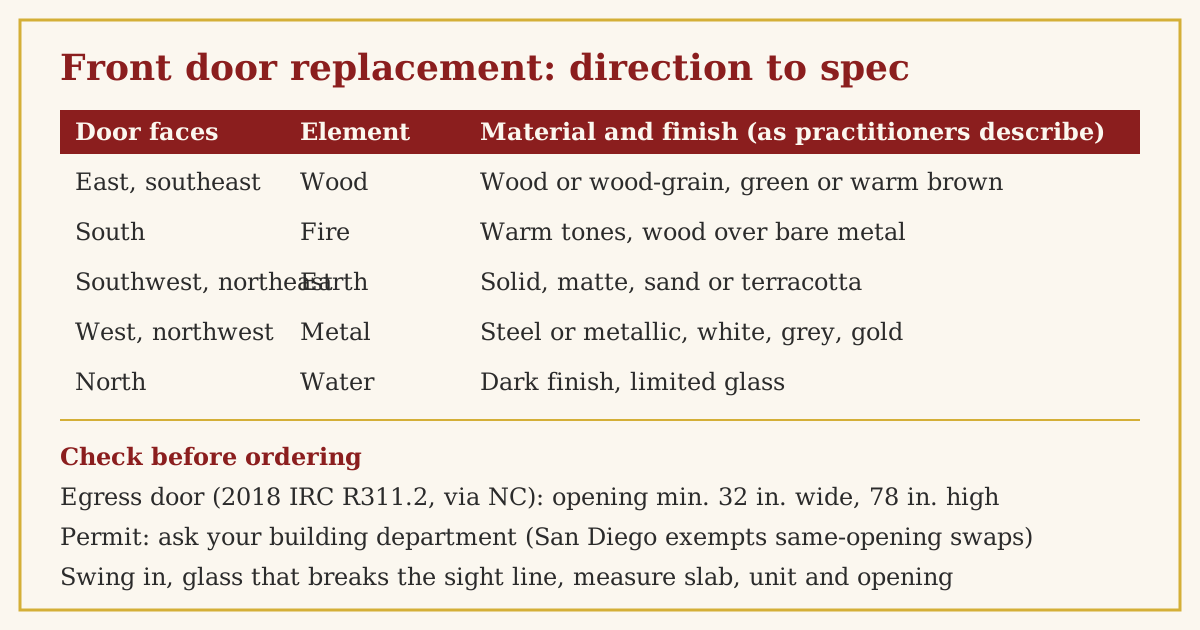
Practitioners match a door to the element of the direction it faces, the same logic as the colour chart in front door colors by direction. Material is a softer rule than colour: most teachers care more that the door is solid, sound and welcoming than about the substance. Treat the table below as how the tradition is usually described, not as a requirement.
- Wood (east, southeast): a wood or wood-grain door, in green or warm brown tones.
- Fire (south): wood or a warm-toned painted door; practitioners often avoid heavy metal here because metal is said to be at odds with fire.
- Earth (southwest, northeast, centre): solid, matte, earth-toned doors; a plain steel or fiberglass slab painted in sand or terracotta fits.
- Metal (west, northwest): steel or a metallic finish, white, grey or gold hardware.
- Water (north): dark finishes; glass in moderation is often accepted because it is linked to water.
For the practical side, the material that is best for your house is the one that suits your climate, your budget and your security needs. Each of wood, steel, fiberglass and glass-heavy doors behaves differently in weather and heat, so ask the maker for the door's rated performance rather than relying on a general claim.
Size and proportion
The tradition says the main entrance should look like the main entrance: larger and more prominent than the other doors, and in proportion to the facade. A very small door on a large house is described as pinching the flow of arrival; a huge door on a small house is described as overwhelming it. There is no official feng shui dimension, so this guide gives none. What you can state precisely is the legal floor.
North Carolina's fire marshal page, citing the 2018 International Residential Code section R311.2, says the required exterior egress door must be at least 32 inches wide and 78 inches high, and that other exterior egress doors need not meet the 32 inch width. Treat these as minimums for the door opening as the code measures it, not as a slab size to order: the frame, stop and open leaf all narrow the opening, so a door sold as 32 inches wide can come out under the figure. Ask your building department how width is measured where you live before choosing a narrow door. Codes differ by city, state and country, and Canadian rules are different again.
Advertisement
Single, double or sidelights
Practitioners say a single door suits a modest facade and a double door or a door with sidelights suits a wider one, as long as the entry still looks balanced. The practical points are separate from the tradition. A double door usually has one leaf you use daily, and the second leaf needs bolts that stay secure. Sidelights add light but also glass beside the lock, so ask about the glass type.
Changing from a single to a double door means changing the opening, which changes the permit picture below.
Glass and privacy
Practitioners often say that a clear line of sight from the front door to the back door lets energy rush through, which our front door and back door alignment guide covers. Frosted, reeded or partial glass gives light while breaking that line, and it also gives privacy from the street. This is a design preference rather than a safety claim: for break-in resistance, ask the maker about the glass type and the lock, not the feng shui reading.
Swing, hardware and threshold
In the tradition, and in most US homes, the door opens inward, ideally hinged so it opens against a solid wall and does not hit furniture or a coat rack. Practitioners also say to keep the door quiet and the lock smooth, because a sticking door or noisy hinge is the first thing a visitor meets.
The threshold is described as the line between outside and inside. Make it level and clean, and keep the landing clear. Whether you can change the swing depends on your landing and your local code, so confirm with your contractor.
Related reading: if you are planning the work around a date, see choosing a renovation start date with the Chinese almanac, and the direction question is explained in house facing versus door direction.
The legal and practical checks
Permit. Many cities treat a like-for-like replacement differently from a changed opening. The City of San Diego's information bulletin exempts replacement doors in existing door openings when the existing rough opening is not altered, in detached houses, duplexes and townhouses, and says the work must still meet all applicable codes. It also notes that work on a historic resource or in a historic district may still need a permit. A same-size, same-type replacement can instead qualify for a no-plan permit. This is one city's rule: yours may differ, so call your building department.
Measuring. There are three different measurements, and mixing them up is the common error: the existing door slab (the leaf only), the prehung unit (slab plus frame), and the rough opening (the framed hole in the wall). If you replace only the slab you match the old slab; if you replace the whole unit you order a prehung door sized to the rough opening. We could not find a government or manufacturer-neutral page to cite for the detailed steps, so this guide gives no measuring figures. Ask the installer to measure and to put the dimensions on the order in writing.
Energy rating. ENERGY STAR's door criteria depend on your climate zone and the door's glazing level, using NFRC ratings, and the figures sit in a table on its site. We could not open that table today, so we state no U-factor values. Look up your zone on energystar.gov and ask for the door's label.
Decision table
| Situation | What the tradition suggests | What to check first |
|---|---|---|
| East or southeast facing | Wood or wood-grain, green or warm brown | Climate rating, frame and weather seal |
| South facing | Warm tones; wood preferred over bare metal | Heat gain on a sunny face |
| West or northwest facing | Steel or metallic finish, white, grey, gold hardware | Dent and finish care |
| North facing | Dark finish, limited glass | Cold and condensation at the threshold |
| Southwest or northeast facing | Solid, matte, earth tones | Weight and hinge strength |
| Hollow-core or damaged door | Replace with a solid, well-fitted door | Whether the frame is sound |
| Changing the opening width | Same proportion rules | Permit and framing |
Worked example: an east-facing house
Inputs: a house facing east, the existing exterior door is a hollow-core door that is warped and has gaps, the opening is a standard single door opening, and the owner wants to change nothing structural.
What the tradition suggests: east belongs to wood, so practitioners would favour a wood or wood-grain finish in green or warm brown tones, an inward swing hinged against a clear wall, and partial frosted glass if the back door lines up with the front. See front door colors by direction for the colour.
What to order: because the opening is unchanged, order the same size and type as the existing unit, confirm with the installer that the measured opening and the order match, and check that the door is not smaller than the legal minimum for a required egress door (a 32 inch minimum width and 78 inch minimum height per the North Carolina page, measured as your code measures the opening, not the slab; confirm your local figure). Because there is no change to the rough opening, a city like San Diego would exempt it, but this example does not apply to your city: ask first. Add an ENERGY STAR label for your climate zone if you want one.
What this example does not decide: the exact material, since wood-grain fiberglass, wood and steel all read as wood by finish in many practitioners' view. Pick for climate and security.
Checklist for the contractor
- Ask whether a permit is needed for the opening size you want, in writing.
- Ask them to measure slab, unit and rough opening separately and write all three on the order.
- Confirm the door meets the egress minimums if it is a required exit.
- Ask for the door's NFRC and ENERGY STAR label for your climate zone.
- Agree the swing, the hinge side and where the open door lands.
- Agree the glass type and whether it breaks the sight line to the back door.
- Confirm the threshold is level and sealed, and who disposes of the old door.
Advertisement
FAQ
What is the best front door material for feng shui?
There is no single best material. Practitioners usually match material to the element of the door's direction: wood for east and southeast, metal for west and northwest, and earth-toned or solid finishes for southwest and northeast. In practice, choose a solid, well-fitted door that suits your climate and security needs, then let the tradition guide the finish.
What size should a feng shui front door be?
Practitioners say the door should be in proportion to the house: the main door is usually the largest and most prominent door, neither tiny against a big facade nor oversized for a small one. The only hard figures in this guide are legal ones: under the 2018 IRC as cited by North Carolina, at least one required exterior door needs a 32 inch minimum width and a 78 inch minimum height, measured as the code measures the opening rather than as the slab size.
Is a single or double front door better for feng shui?
The tradition does not rank them. Practitioners say a double door suits a large, wide facade and a single door suits a modest one, with the main concern being proportion and an open, welcoming entry. Choose the one that fits your opening and your house, and keep the active leaf easy to open and clear of clutter.
Is a front door with glass bad for feng shui?
Not by rule. Practitioners often suggest glass that gives light without letting a stranger see straight through the house to the back door, so frosted, textured or partial glass is a common compromise. Privacy and safety are the practical reasons to agree with that advice, and you can read the alignment problem in our front door and back door guide.
Which way should a front door swing?
In the tradition, and in most US homes, the front door opens inward so that the home receives what comes through it, ideally hinged so it opens against a solid wall rather than into a cramped corner. Whether you can change the swing depends on the space, local code and your landing, so confirm with a contractor and your building department.
Do I need a permit to replace a front door?
It depends on your city. San Diego exempts replacement doors in existing openings when the rough opening is not altered, and still requires the work to meet code. Changing the opening size or the framing usually needs a permit. Ask your local building department before you order.
Where to go next
Choose the colour next with front door colors by direction, then look at the wider exterior in feng shui exterior house colors. Our renovation hub lists the rest of the project guides.
Sources
Checked November 2026.
- North Carolina Office of State Fire Marshal, exterior egress door dimensions (2018 IRC R311.2)
- City of San Diego, No-Plan Building Permit information bulletin 203
- ENERGY STAR, residential windows, doors and skylights key product criteria
Sources we wanted but could not open today: the ENERGY STAR door criteria table (PDF) and a neutral measuring guide. We state no figures from them.
Editorial note: Lucky Properties presents feng shui as a cultural and design tradition. This guide is educational. Measure your opening and confirm any permit with your building department before ordering a door.