Practitioners treat a fireplace as concentrated fire, so the south and the earth sectors (southwest, northeast, centre) are described as comfortable for it, while the metal sectors, west and northwest, are the ones most often flagged. There is no single agreed answer. The building side is firmer: the flue, clearances, a carbon monoxide alarm and the permit matter more than the compass.
Last checked: 26 November 2026
| Key fact | What the source says | Source |
|---|---|---|
| Avoid-list in one Flying Star source | Northwest and west are the default sectors to avoid for open fire, because both are metal; north is avoided where possible | FengShuied, "The Rules Of Fireplace Feng Shui" |
| Position follows the star chart | A fireplace is permanent, so it is placed by the house's own mountain and water stars, not the annual 5 Yellow | FengShuied |
| Bagua-style reading | South is the natural home of fire; southwest and northeast are earth sectors; fire in west or northwest is said to drain metal, remedied with earth materials | Direct Fireplaces, "Fireplace feng shui for a balanced home" |
| Level 2 chimney inspection | Required when any change is made to the system, on the sale or transfer of a property, and after an event likely to have caused damage | Chimney Safety Institute of America |
| Carbon monoxide alarms | On every level of the home, outside sleeping areas | U.S. Consumer Product Safety Commission |
| Flue inspection | Fireplace flues and chimneys inspected by a professional before the heating season | U.S. Consumer Product Safety Commission |
On this page
- What fire means in the bagua and in Flying Star
- Fireplace by sector: what practitioners say
- A fireplace facing the front door
- Mirrors, pictures and the wall above the mantel
- Wood, gas or electric: what each one needs
- Chimney inspection, clearances and permits
- Planning a new or replacement fireplace
- FAQ
- Sources
What fire means in the bagua and in Flying Star
Two methods give two different answers, and many pages mix them up. A bagua-map reading assigns each sector an element and asks how fire gets along with it. Fire belongs to the south, so a fireplace there is "at home". Earth is fed by fire, which is why the southwest, northeast and centre are usually described as comfortable. Wood feeds fire, so a fireplace in the east or southeast is read as burning through that sector's energy. Metal is melted by fire, which is the reason the west and northwest get the warnings. For how to lay the map over a plan, see the bagua map floor plan guide.
Flying Star adds a time layer. FengShuied writes that a fireplace is a permanent fixture, so it should follow the house's own mountain and water stars, set by the year it was built and the direction it faces, and not the star that moves every year. In its worked example, a house built in 1981 and facing west, the 5 Yellow sits in the north as the water star, so the north is avoided. The same page puts the fireplace in the southeast, where the 8 White sits. That example belongs to one house. Yours will have a different chart.
Fireplace by sector: what practitioners say
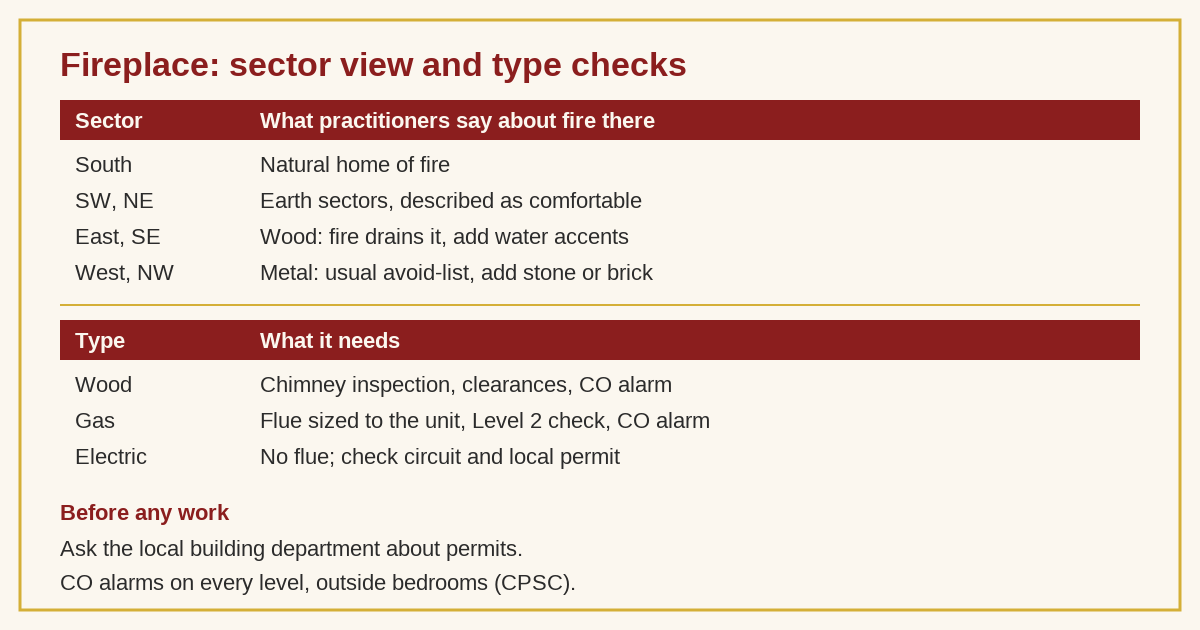
The table gathers the two sources opened for this guide. It is a record of what each says, not a ruling, and the two do not always agree.
| Sector | Element | What the sources say about fire there |
|---|---|---|
| South | Fire | Natural home of fire; described as the most auspicious spot in the bagua reading |
| Southwest, northeast | Earth | Described as beneficial in the bagua reading; FengShuied says the very careful avoid the southwest and west, where it places the sickness star 2 |
| North | Water | Elemental clash; the remedy offered is a mirror above the mantel, though FengShuied avoids north where possible |
| East, southeast | Wood | Fire can drain wood; add water through blue or black accents or water imagery |
| West, northwest | Metal | FengShuied's default avoid-list; in the bagua reading, add earth through stone, brick or ceramics |
The southwest is comfortable in one source and a place to avoid in the other. With that much disagreement, sector advice works best as a tiebreaker. If the only workable position for the chimney is northwest, the cost of moving it will almost always outweigh a tradition that itself offers a remedy.
Advertisement
A fireplace facing the front door
Neither practitioner page opened for this guide mentions a fireplace facing the front door. What they and many others do discuss is the general rule about a long straight line from the front door, which practitioners apply to stairs, hallways and rear doors. A fireplace on the wall opposite the entrance is the same situation with a fire at the end of the line.
The remedies that come with that general rule are practical ones: a console, a bench or a rug in the entry, a screen, or a change to the furniture so the route bends before it reaches the hearth. If you want the compass reading too, the compass versus front door method guide explains which sector the hearth falls in under each way of laying out the map.
One point that has nothing to do with tradition: a fire close to the way out is worth planning around. Keep the exit clear, keep seating and furniture off the hearth's clearance zone, and place the carbon monoxide alarm outside the bedrooms, as covered below.
Mirrors, pictures and the wall above the mantel
A mirror above the mantel is the cure repeated most often for a fire-and-water clash. FengShuied says it does not know where the mirror cure came from. The idea is that the reflective surface stands for water controlling fire, and the page asks why that is accepted when a sink beside the stove is a standard warning. So the mirror is a widespread habit, not a settled rule.
The same page prefers a brick wall over the fireplace, on the reasoning that earth contains fire, and advises against family photographs there. For a mirror you do plan to hang, the bagua mirror guide covers placement.
Wood, gas or electric: what each one needs
The feng shui view barely separates the three. One fireplace retailer's guide states the fire element is the same whether the flame is gas or LED. The practical differences are large.
| Type | Flue or vent | Safety checks | Before you buy |
|---|---|---|---|
| Wood-burning, masonry | Chimney and flue liner | Chimney inspection; clearances from the chimney to combustibles; carbon monoxide alarm | Ask the building department whether a permit and an inspection apply |
| Gas insert or gas log set | Existing flue, or a new vent sized to the appliance | Level 2 inspection when the fuel changes; carbon monoxide alarm; gas line work by a licensed installer | Give the installer the unit's rated input; in the US, gas venting falls under NFPA 54, the National Fuel Gas Code |
| Electric | None, because nothing burns | Circuit capacity and wiring; the clearances in the maker's manual | A hardwired unit on a new circuit may need an electrical permit; check locally |
Chimney inspection, clearances and permits
The Chimney Safety Institute of America describes three inspection levels. Level 1 is for a chimney and appliance that continue in service unchanged. Level 2 is required when any change is made to the system, such as a switch of fuel, a relined flue or a new appliance. It is also required when a property is sold or transferred, and after a chimney or building fire, an earthquake or severe weather. It adds a video scan of the flue liner and a look at the parts of the chimney in the attic, crawl space and basement, including clearances from combustibles. Level 3 is for a suspected hidden hazard and can mean removing the crown or part of an interior wall.
NFPA 211, the US standard for chimneys, fireplaces and vents, uses the same Level I and Level II split for existing chimneys, according to the committee papers for its 2026 revision (a draft, not adopted text). What binds you is the edition your city has adopted, with its local amendments.
CPSC's winter advice is plainer: have fireplace flues, chimneys and other fuel-burning appliances inspected by a professional before the heating season, and put carbon monoxide alarms on every level, outside sleeping areas.
Permits are the local piece. Many jurisdictions require one for a new fireplace, a new chimney or flue, a gas line, or an insert into a masonry fireplace. Rules differ from one city to the next, so check with your local building department or a licensed contractor before any work. Work started without a required permit can be stopped: the City of Chicago example in our renovation start-date guide is a stop-work order until the permit is issued.
Planning a new or replacement fireplace
If you are still choosing, here is a sequence that keeps the building and the tradition from fighting each other.
- Ask the building department what is required for the fuel you want, and whether the existing flue can be reused.
- Book a Level 2 chimney inspection if you are changing fuel or the appliance, or if you bought the house recently and nobody has looked at the flue.
- Mark the chimney or vent on the floor plan, then see which bagua sector it falls in. If it falls in west or northwest, decide whether you want to apply the earth-material remedy (stone, brick or ceramic surround).
- Check the line of sight from the front door. If the hearth is straight ahead, plan an entry piece or a furniture change that bends the route.
- Decide the wall above. FengShuied prefers brick; a mirror is optional.
- Fit carbon monoxide alarms outside the bedrooms on each level before the first fire.
For other renovation decisions around the same project, the renovation dos and don'ts covers sequence and cautions, and the renovate and build pillar lists the rest. If the fireplace sits in a combined living area, the open floor plan layout guide shows how to define the seating around it.
FAQ
Where is the best place for a fireplace in feng shui?
There is no single agreed spot. In the bagua reading, fire is at home in the south, and the earth sectors (southwest, northeast and the centre) are described as comfortable for it. Flying Star practitioners add that the position should also follow the house's own star chart. Where the fireplace already is, the usual advice is to adjust the surroundings, not move the chimney.
Is a fireplace in the northwest bad feng shui?
FengShuied, a Flying Star practitioner site, calls the northwest and west taboo for open fire because both belong to the metal element, which fire is said to destroy. The bagua-style reading treats it as fixable: add earth materials such as stone, brick or ceramics around it. No tradition says the position makes a fireplace unsafe, and its building-code status is the same in every sector.
What if the fireplace faces the front door?
None of the practitioner pages opened for this guide addresses it by name. It is usually discussed under the general idea of a direct line from the front door, and the common response is to break that line with furniture, a rug or a screen. Separately from feng shui, a fire close to the entry route is worth a second look for clearances and for how people leave the house in an emergency.
Is a gas or electric fireplace better for feng shui?
One fireplace retailer's guide says the fire element is the same whether the flame is gas or LED, and the practitioner pages opened for this guide set no preference. The practical difference is mostly venting: a wood or gas unit needs a flue and a carbon monoxide alarm, while an electric unit has no combustion and no flue.
Do I need a permit to add or replace a fireplace?
Usually yes for anything that burns fuel or changes a chimney or gas line, and often for a new electric circuit. The rules differ by city and country, so ask your local building department before you buy the unit. Working without a required permit can lead to a stop-work order.
Should I have the chimney inspected before using an old fireplace?
Yes. The Chimney Safety Institute of America describes a Level 2 inspection, which adds a camera scan of the flue, as the one needed after a change of fuel or appliance, or when a property is sold. CPSC recommends a professional inspection of fireplace flues and chimneys before the heating season.
Sources
- FengShuied: The Rules Of Fireplace Feng Shui, for the northwest, west and north avoid-list, star-chart placement and the mirror and photo comments. Checked 26 November 2026.
- Direct Fireplaces: Fireplace feng shui for a balanced home, a retailer's bagua-style sector reading and the gas versus LED remark. Checked 26 November 2026.
- Chimney Safety Institute of America: The three levels of chimney inspection, for Level 1, 2 and 3 triggers. Checked 26 November 2026.
- NFPA: Committee Input statements for NFPA 211, 2026 revision cycle (Chapter 15, inspection of existing chimneys), a draft that describes the inspection levels for existing chimneys. Not adopted text. Checked 26 November 2026.
- U.S. Consumer Product Safety Commission: Seasons change but fire and carbon monoxide safety is year round (2022), for pre-season professional inspection and CO alarm placement. Checked 26 November 2026.
- Lucky Properties: Auspicious date to start renovation, which cites the City of Chicago stop-work order rule for work without a permit.
Sources we wanted but could not open today: the adopted text of NFPA 211 and NFPA 54 (paid standards) and a classical Form School text on fire in the entry line.
Editorial note: Lucky Properties presents feng shui as a cultural and design tradition. This guide is educational and does not promise any outcome. Building, gas and permit rules vary by place, so check with your local building department or a licensed professional before work.