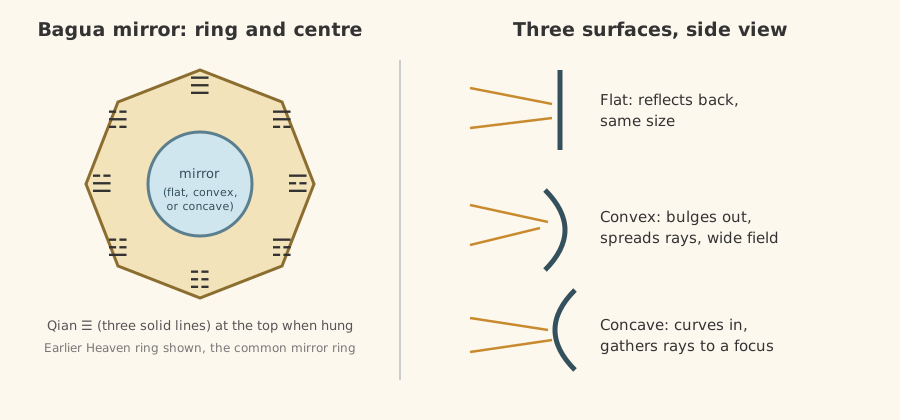
Walk a residential street in Taipei, Hong Kong, or any Chinatown and you will see them above doors: small octagons, most no wider than a hand, ringed with short stacked lines and a mirror the size of a coin at the centre. That is a bagua mirror, one of the few feng shui objects a passer-by can identify on sight. It is also one of the most casually bought. Shops stock three different mirror surfaces for it, flat, convex, and concave, and listings rarely explain that the surfaces point the object in opposite directions, in plain optics as much as in traditional teaching.
This guide works through the object properly. It starts with the ring of trigrams, because two different rings exist and they put the same trigrams in different places. It then takes the three surfaces one at a time, separating what a curved mirror physically does (checkable, and the reason convex mirrors guard blind driveways) from what feng shui tradition says it does (reported here as tradition, mainly from a Taoist explainer published by Longhu Mountain, the Jiangxi mountain seat of the Celestial Masters tradition). It finishes with the placement rules, a worked hanging, and the situations where the right answer is no mirror at all.
The ring first: eight trigrams, two arrangements
The octagon carries the bagua, the eight trigrams. Each trigram is three lines, each line solid (yang) or broken (yin), and the eight combinations are the figures the I Ching is built from. The standard reference table gives each one a name, a natural image, and a family place: Qian (three solid lines) is heaven and the father, Kun (three broken lines) is earth and the mother, and the other six, Zhen (thunder), Xun (wind), Kan (water), Li (fire), Gen (mountain), and Dui (lake), are their sons and daughters.
The complication is that the ring comes in two classic orders.
- Earlier Heaven (Xiantian), attributed to the legendary sage Fu Xi, arranges the trigrams as balanced opposites: heaven faces earth, fire faces water, and the pattern describes an ideal cosmic order before things move.
- Later Heaven (Houtian), attributed to King Wen of Zhou, rearranges the same eight to describe the world in motion, through seasons and time. This is the arrangement feng shui floor-plan work uses, the one behind this site's bagua floor-plan guide.
Direction by direction, the two rings differ like this:
| Trigram | Image | Earlier Heaven direction | Later Heaven direction |
|---|---|---|---|
| Qian | Heaven | South | Northwest |
| Kun | Earth | North | Southwest |
| Li | Fire | East | South |
| Kan | Water | West | North |
| Zhen | Thunder | Northeast | East |
| Xun | Wind | Southwest | Southeast |
| Gen | Mountain | Northwest | Northeast |
| Dui | Lake | Southeast | West |
The Longhu Mountain explainer states that most bagua mirrors sold in feng shui stores are Earlier Heaven mirrors. That single fact clears up a common confusion at the shelf: a mirror whose ring does not match your floor-plan bagua is not a defective mirror. It is wearing the other ring, the protective one, and floor-plan mapping was never its job. The working check before hanging is simpler than either chart. Find Qian, the trigram of three unbroken lines, and hang the mirror with Qian at the top.
The three surfaces, in optics and in tradition
Strip the ring away and a bagua mirror is a small mirror in one of three shapes, plus a fourth option with no mirror at all. The physics below is ordinary optics, the same behaviour described for any mirror of these shapes. The traditional use is what the Longhu Mountain explainer and the wider teacher literature assign to each shape. The two columns agree on the direction of travel, scatter versus gather, which is part of why the tradition settled the way it did.
| Surface | What it physically does | Use in feng shui tradition |
|---|---|---|
| Flat | Reflects an image the same size, reversed left to right; sends a beam back at the angle it arrived | Reflects or absorbs depending on the situation, in the Longhu account; used against sharp corners, roads, and angular buildings outside the house; not for indoor use |
| Convex | Bulges outward; reflects a wide field in a smaller upright image and spreads reflected rays apart | Deflects, disperses, and neutralises; the strong-source choice, used against sharp corners, road intersections, lamp posts, and power poles; never indoors, never aimed at people |
| Concave | Curves inward; gathers reflected rays toward a focal point; a close object appears magnified, a distant one inverted | Absorbs and gathers; used to draw back energy read as leaking away, such as at a door facing a downward staircase, and by shops to draw in street activity; teachers warn it needs knowledge, and should not be used to absorb a strong outside influence |
| No mirror (plain bagua) | Nothing to reflect; the ring alone | The indoor variant: hung inside to support a sector, and worn by Taoist priests, per the Longhu explainer; placement is matched to the person’s five elements in that teaching |
Two physical notes are worth carrying into the shop. First, the convex safety mirror is not a metaphor. The wide-field, small-image reflection that tradition reads as scattering is exactly what a driver needs at a blind corner, which is why the convex shape, scaled up and stripped of trigrams, is the standard traffic and warehouse mirror. Second, a concave mirror has a focal length, and anything closer than that focal point is magnified while anything beyond it flips upside down. Hold a pen in front of each surface in the shop and you can sort a mislabelled bin in seconds: smaller and upright at any distance means convex, magnified up close means concave, life-size means flat.
Advertisement
First, name the problem the mirror is meant to answer
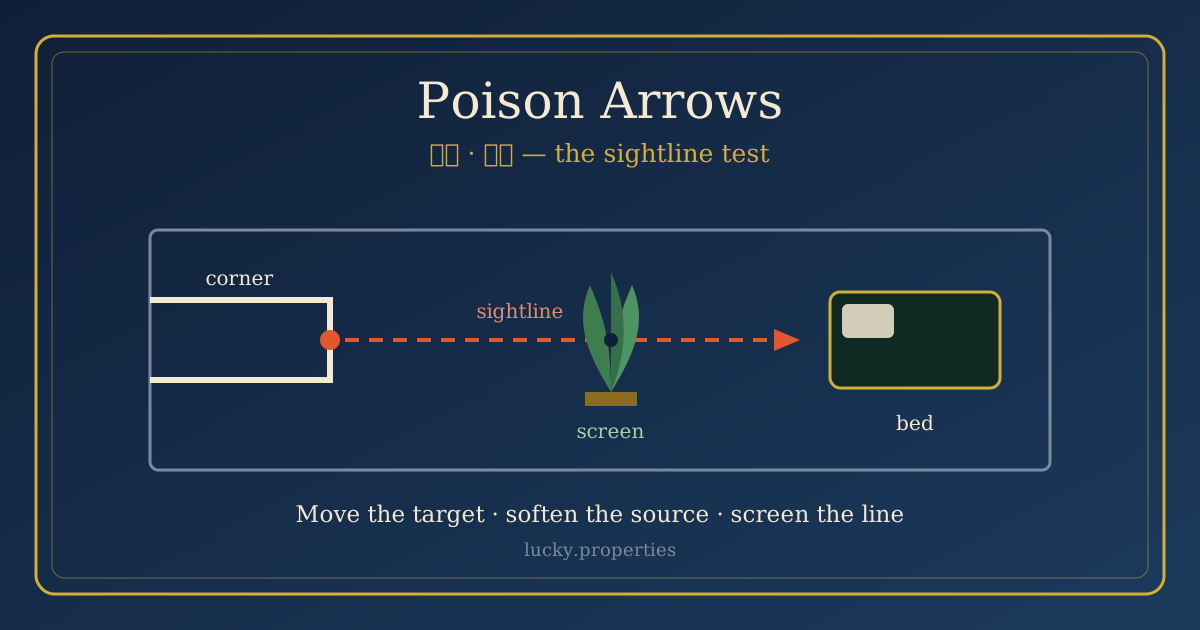
Every traditional use above starts from a named feature outside the home. The Longhu Mountain list runs: sharp structures, power poles, transformers, roads, iron towers, sewage drains, and chimneys. The wider literature adds the cases this site has covered in depth: a road running straight at the house (the T-junction pattern) and the sharp corner of a neighbouring building aimed at a door or window, the classic poison arrow covered in the sha qi guide.
That ordering matters, because a mirror is the last step in the traditional sequence, not the first. Form comes first in form-school teaching: a fence, a hedge, a screen, or a curtain changes what actually reaches the door, light, wind, headlights, and the sightline of a pointing road included. A mirror changes none of those physical things. It is a symbolic answer layered on top of a physical situation, and the tradition's own caution underlines the point. The Longhu explainer warns that a convex mirror hung where there is no negative influence outside can reflect the household's good energy outward instead. Translated out of the tradition's vocabulary, the practical reading is the same: do not hang a deflecting object with nothing to deflect.
So the pre-purchase test is one sentence long. Stand at your front door, look outward, and name the feature the mirror would face. If the sentence comes out vague (a feeling, a run of bad luck, a room that feels flat), a bagua mirror is not the tool its own tradition prescribes. The cures guide works through the wider cure families, most of which act inside the home and none of which require a target across the street.
Where tradition hangs it
The placement rules repeat across sources with unusual consistency, which makes them easy to state as the tradition gives them:
- Outside the house. Mirrored bagua belong outdoors, on an eave or an exterior wall, facing outward. The plain bagua with no mirror is the indoor object.
- Above the door or window that faces the feature. The mirror answers a specific opening, the one the road, corner, or pole is aimed at, and it is centred over that opening.
- Facing the source, at nobody. The mirror's face is turned toward the feature it answers. It is never turned toward a neighbour's door, and a convex mirror is never aimed at people.
- One per direction, three per house at most. The Longhu rule caps the count; a house ringed with mirrors is, in the tradition's reading, over-treated, and to any passer-by it reads as a feud in progress.
- Qian at the top. Three solid lines, top centre, checked before the fixing is tightened.
To those, add a check that belongs to optics rather than tradition. A mirror reflects real light. Before you fix the position, stand where the feature is, at the road or opposite corner, at the times of day when low sun or headlights strike your facade, and look at what the mirror throws back. If it puts glare into the eyes of drivers on the road it faces, or into a neighbour's window, move it, tilt it, or choose the fence. This is the step most listings skip and the one your neighbours will actually judge.
A worked hanging, end to end
The following case is a labelled hypothetical, built to run the rules above in order. No real household is described.
A semi-detached house stands where a side street ends at its front garden, so the front door faces a short T-junction, and the corner of the house opposite points at the same door from a slight angle. The household wants to know whether to buy a mirror, and which.
- Name the sources. Two, from one direction: the road running at the door, and the neighbour's corner. Both are on the Longhu list of things a bagua mirror is used to answer, and both face the front door, which fixes the hanging position if a mirror is used at all.
- Do the form work first. A low hedge across the garden edge already breaks the road's sightline and its headlights at door height. After the hedge, the remaining item is symbolic: the household still wants the traditional answer at the door itself. That is a coherent place to stop and buy, and it is also a coherent place to stop entirely.
- Choose the surface. The road is the stronger source, and tradition's strong-source choice is convex: deflect and disperse. Flat would be the milder pick for the corner alone. Concave is wrong here by the tradition's own rule, since it gathers, and what it would gather is the junction. One mirror, convex, answers the direction; the cap of one per direction rules out a second mirror for the corner.
- Hang it. Centred above the front door, outside, Qian at the top, face turned square to the junction.
- Run the glare check. At dusk, standing in the side street where drivers turn in, the mirror shows a small bright disc when headlights sweep it, visible but not aimed at eye height in any approach lane. It passes. Had it failed, the fix would have been a few degrees of tilt, not a bigger mirror.
- Tell the neighbour. The mirror faces the junction, not the house opposite, and a short conversation covers the rest. The corner it partly answers belongs to that neighbour, and hearing about the mirror from its owner beats discovering it from the street.
Notice what the case never needed: a compass reading, a birth date, or a second object. Bagua mirrors sit in the form-school end of the practice, aimed at shapes in the street. Compass work is a different layer of feng shui, and this site's compass reading guide covers it on its own terms.
Apartments, renters, and doors you cannot drill
The rules above assume a householder who owns an exterior wall. Many readers do not, and the tradition has less to say to them, which is worth stating plainly rather than papering over.
An exterior fixing in a strata or condominium building usually needs body-corporate or landlord approval, and in many buildings reflective objects on facades are restricted outright. Check the building rules before buying, because a mirror ordered online and refused at the lobby is a common ending. Renters face the simpler version of the same problem: no drilling into a facade that is not yours.
What remains available is real, and it is mostly indoor work. A plain bagua plaque with no mirror is the indoor object in the Longhu teaching. Ordinary mirrors inside follow the placement rules in this site's mirror placement guide, including the warnings against reflecting a bed or a front door. And the form-school first step travels indoors without permission from anyone: a curtain or screen at the window that faces the sharp corner changes the light and the sightline, which were the physical parts of the problem all along.
Buying one: size, material, and the two-minute shop check
No source read for this guide gives a traditional size rule, and listings that claim a diameter in centimetres will fix a problem are adding a rule the tradition does not print. What size actually governs is visibility, and that is geometry, not symbolism. A mirror hung over a door is read, in the tradition's framing, by whatever faces it, and in plain optics it is simply an object in a sightline. A coin-sized mirror on a house that stands well back from its road is a very small object in that road's view; the same mirror on a door two metres from a lane fills far more of the frame. If you are buying for a set-back house, the mid sizes exist for this practical reason. Nothing in the sources supports paying more for the largest frame on the shelf.
Material is a weather question. The frame lives outside, in sun and rain, so a sealed wood or metal frame outlasts a glued composite one, and a glass mirror keeps its surface longer than a thin acrylic disc, which scratches when it is wiped and clouds sooner in ultraviolet light. Turn the piece over in the shop: the back should be sealed against driven rain, and the hanging point should be metal, not a glued loop, because the whole object hangs from it over a doorway people walk through.
The two-minute check then runs in order. First, the ring: find Qian, three solid lines, and confirm the ring is the Earlier Heaven order using the table above, if that is what you meant to buy. Second, the surface: run the pen test from the optics section, because bins get mixed and labels fall off, and a concave sold as convex is a working error, not a cosmetic one. Third, the mirror itself: sight along it for ripples, check the edges for backing already lifting, and confirm the face is clean enough to reflect a readable image. A bagua mirror with a wavy, half-peeled centre is not a weaker version of the object. It is a broken one, in both columns of the table.
Second-hand pieces turn up in antique shops and market stalls, sometimes with genuinely old frames. The same three checks apply, plus one more: old mirrors can carry mercury amalgam backing, which is a handling and disposal concern if the backing is flaking. If the back of a vintage mirror is shedding grey dust, leave it in the shop.
Care, damage, and taking one down
A bagua mirror lives outdoors, so its working life is weather. Cheap frames split, mirror backing delaminates at the edges, and a surface that has gone cloudy reflects little of anything, in either column of the table above. Wipe it with a soft cloth when you clean the door glass; check the fixing after storms, because a small octagon on a single screw can rotate, and a rotated mirror quietly breaks the Qian-at-the-top rule it was hung by.
If the mirror cracks, replace it rather than living with it. Part of that advice is plain safety and weatherproofing. Part of it is the tradition's handling rule, reported here as such: objects of this kind are treated with respect at the end of their use, wrapped rather than tossed loose into household rubbish. Readers who follow the tradition also tend to take a mirror down when the feature it answered disappears, a demolished pole, a re-routed road, on the same logic that put it up: the object answers a named thing, and the named thing is gone.
What a bagua mirror cannot do
The reflection is real. A convex bagua mirror genuinely shows your doorstep a wide, small image of the street, and it genuinely throws light around in ways you can photograph. Everything past that, the deflection of sha qi, the gathering of prosperity, the protection of the household, is a claim of the tradition, presented in this guide as the tradition states it and not as a measured effect. No study read for this guide tests a bagua mirror against any outcome, and the object's long history as a Taoist talisman, which is documented, is a fact about the tradition rather than about mirrors.
Two real effects deserve the last word, because they are the ones your household will actually live with. Glare is real, and a badly aimed mirror can annoy drivers and neighbours daily. Neighbour relations are real, and an object that reads, fairly or not, as aimed at the house opposite can start the exact friction it was bought to ward off. Hang it by the rules, name the feature first, and keep the conversation with the people across the street in better shape than the mirror. That part needs no tradition behind it at all.
Sources and further reading on this site
The composition, surface types, uses, and placement rules in this guide come from “The Use and Purpose of Taoist Ba Gua Mirrors Explained”, published by the Longhu Mountain store and attributed to Master Longyin's teaching, with an author note from Paul Peng, a Zhengyi Taoist priest of Longhu Mountain, Jiangxi; read in full for this guide in October 2026. The trigram names, images, family places, and the Earlier Heaven and Later Heaven direction table come from the standard Bagua reference article and the I Ching trigram table it reproduces. Mirror behaviour (wide field and small upright image for convex, focal point and magnification for concave) is standard optics for curved mirrors, the same behaviour that makes the convex form the standard traffic safety mirror.
On this site, the poison arrows guide catalogues the pointing shapes a mirror is traditionally asked to answer, the T-junction guide works the road case in full, and the cures guide puts the mirror in its place among the wider cure families, including where schools disagree about symbolic objects.