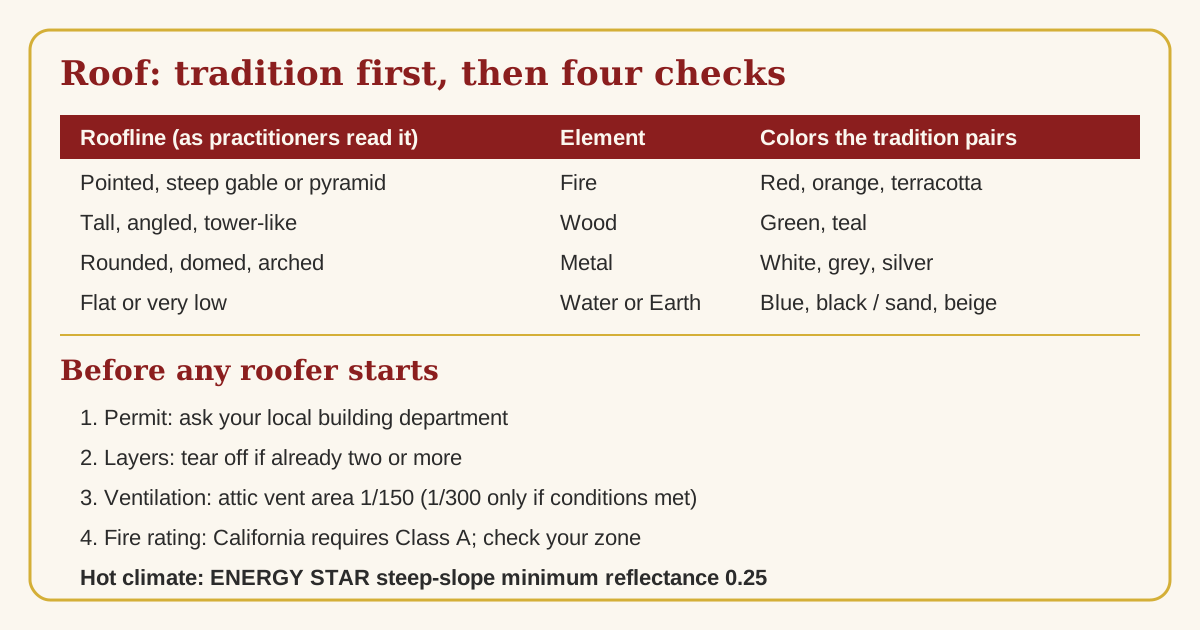
In feng shui, practitioners read a roofline by shape (pointed as fire, tall as wood, rounded as metal, flat as water or earth) and pair roof colors with the same five elements. A re-roof also has practical limits: a permit, a layer count, attic ventilation, fire rating and, in hot climates, how much sun the color reflects. Settle those first, then choose within them.
Last checked: 17 November 2026
| Key fact | Figure or rule | Source |
|---|---|---|
| ENERGY STAR for roofs | The roof products program ended on 1 June 2022; its figures below are a benchmark, not a current label | Cool Roof Rating Council |
| Where rated reflectance is listed now | CRRC Rated Roof Products Directory (solar reflectance, thermal emittance, SRI) | Cool Roof Rating Council |
| Steep-slope roof | Slope greater than 2:12 (2 units of rise per 12 of run) | Former ENERGY STAR roof products specification |
| Reflectance, steep slope | Initial solar reflectance at least 0.25; at least 0.15 three years after installation | Former ENERGY STAR roof products specification |
| Reflectance, low slope | Initial at least 0.65; at least 0.50 after three years | Former ENERGY STAR roof products specification |
| Cool-colored roofs | A roof reflecting 35% of sunlight stays about 12 C (22 F) cooler than a look-alike reflecting 10% on a typical summer afternoon | Berkeley Lab Heat Island Group |
| Fire rating in California | CAL FIRE states that roof coverings and assemblies must be Class A-rated | CAL FIRE |
| Permit | Building permits are required for re-roofing existing dwellings (example: one Minnesota city; rules vary) | City of Plymouth, MN |
| Layers | All coverings come off if the roof already has two or more applications (that city's guide; check yours) | City of Plymouth, MN |
| Attic ventilation | Standard minimum 1/150 of the vented space; 1/300 only if a vapor retarder and upper-vent conditions are both met (IRC R806, as summarized) | City of Plymouth, MN |
This page is part of our renovate and build with feng shui guide. Most pages on roof feng shui stop at "green roofs bring growth." That is no help when a roofer asks which shingle you want, so this guide keeps the tradition short and attributed, then covers what a homeowner can check.
On this page
- What roof shape means in feng shui
- Roof colors by element
- Overhangs, neighbouring roof corners and skylights
- Roof pitch terms
- Color, heat and the cool roof facts
- Rules that can override your color choice
- Decision table
- Worked example: a south-facing ranch in a hot climate
- Questions to ask a roofer
- FAQ
What roof shape means in feng shui
Form School practitioners treat a building's outline as a shape with an element, using the same five-element scheme explained in our five elements balancing guide. The reading is by silhouette:
- Pointed or steep (gable peaks, pyramids, spires): fire.
- Tall, columnar or angled upward: wood.
- Rounded, domed or arched (barrel and curved roofs): metal.
- Flat or very low: water or earth, depending on the practitioner.
Practitioners say a roof is rarely one pure shape. A house with a steep gable over a low wing reads as mixed, and the usual advice is to balance by color and surroundings rather than rebuild. These are readings from the tradition, not tested claims about luck, money or health, and no source we found shows roof shape changing outcomes.
Roof colors by element
The site uses one color table throughout: wood is green and teal; fire is red, orange and terracotta; earth is beige, sand and yellow; metal is white, grey and silver; water is blue and black. Practitioners suggest picking a roof color from an element that supports the house, for example earth tones (sand, clay) under a fire-shaped steep roof, because earth is what fire generates in the productive cycle. Others match the roof to the house element. Traditions disagree, so treat any single rule as one school's view. Our exterior house colors guide covers walls, trim and the whole facade.
Advertisement
Overhangs, neighbouring roof corners and skylights
- A neighbour's roof corner or ridge pointing at your house. Practitioners call a sharp edge aimed at a door or window "sha" (harmful or cutting energy). Common remedies are screening with a tree or fence, or a curtain or blind. Nothing structural is required.
- A heavy overhang or low eave over the entrance. Practitioners say it feels oppressive over a door. Practically, an overhang also shades and protects the doorway, so weigh the two.
- Skylights over a bed. Practitioners advise against sleeping under an open sky-facing window or a sharp beam. For beams see our ceiling beams over the bed guide. If you have a skylight over a bed, a shade is the simple fix.
Related reading: feng shui renovation dos and don'ts covers the order of work for a whole project.
Roof pitch terms
Pitch is written as rise over run, such as 6:12 (the roof rises 6 units for every 12 units of horizontal run). The former ENERGY STAR roof specification defined a steep-slope roof as greater than 2:12; anything at or under that is low slope, which has different reflectance minimums and usually different materials. Ask your roofer for the pitch in this form so you compare like with like.
Color, heat and the cool roof facts
Berkeley Lab's Heat Island Group defines solar reflectance as the share of sunlight reflected, from 0 to 1. A cool roof needs high reflectance and high thermal emittance. It reports that a clean white roof reflecting 80% of sunlight stays about 31 C (55 F) cooler than a grey roof reflecting 20%. Cool-colored roofs keep a traditional look by reflecting more near-infrared light; one reflecting 35% stays about 12 C (22 F) cooler than a look-alike reflecting 10%, and switching to a matching cool color can raise reflectance by as much as 0.4. Those are the group's figures for a typical summer afternoon, not a guarantee for your home.
ENERGY STAR stopped certifying roof products on 1 June 2022, so a new roof will not carry an ENERGY STAR roof label. Its last specification is still a handy benchmark: steep-slope products needed an initial solar reflectance of at least 0.25 (0.15 after three years); low-slope products 0.65 (0.50 after three years). For the exact color you are considering, ask the maker for its rated solar reflectance or look it up in the Cool Roof Rating Council's Rated Roof Products Directory, which lists solar reflectance, thermal emittance and SRI. This is where tradition and physics meet: many tradition colors (terracotta, sand, white, grey) can be had in high-reflectance versions, while dark blue, black and deep green tend to be low.
Rules that can override your color choice
- Permit. Many places require a building permit to re-roof; one Minnesota city says so outright and sets its own fees. Ask your local building department.
- Layers. In that city's guide, if the roof already has two or more applications of covering, all of it must come off, and heavy coverings such as slate and tile also trigger removal. Your jurisdiction may differ; the model code is the International Residential Code, adopted with local amendments.
- Ventilation. The standard attic minimum is 1/150 of the vented space area (net free area); 1/300 applies only if both a vapor retarder and a high/low vent split are met. Re-roofing is the moment to check it, because trapped heat shortens a roof's life.
- Fire. CAL FIRE's home hardening page states that California requires Class A-rated roof coverings and assemblies; ask your building department how that applies at your address. CAL FIRE lists asphalt shingles, tile and metal panels as common Class A coverings and warns about untreated wood shakes. Outside California, wildfire-area rules still vary by county.
- HOA and historic districts. Covenants and historic commissions often fix approved colors and materials. We did not find a single national rule, so get approval in writing before ordering.
Decision table
| House or tradition reading | Roof shape or color the tradition pairs | Practical checks |
|---|---|---|
| Steep gable (fire shape) | Earth tones (sand, clay) to temper, or fire colors if matching | Pitch above 2:12 is steep slope; use the former ENERGY STAR floor of 0.25 as a benchmark and ask the rated figure |
| Low, flat roof (water or earth) | Blues and blacks (water) or sand and beige (earth) | Dark flat roofs run hot; the former ENERGY STAR low-slope benchmark was 0.65 initial reflectance |
| Domed or curved (metal) | White, grey, silver | High reflectance is easy here; check local fire rating and wind |
| Tall, angular (wood) | Greens and teals | Dark greens absorb heat; ask for a cool-colored version |
| Neighbour's ridge aimed at you | Screening with a fence or tree | Check setback, height and HOA rules before planting |
| Skylight over a bed | Shade or relocate the bed | Check skylight flashing and permit if replaced |
Worked example: a south-facing ranch in a hot climate
Inputs (illustrative, not a real or measured house): a single-storey ranch with a low-pitched gable roof, say 4:12, facing south; the owner reads the house as fire-shaped because of the long ridge, and a practitioner suggests earth tones; the climate is hot with a long cooling season; the roof has one existing layer of shingles.
- Pitch. 4:12 is above 2:12, so the roof counts as steep slope, and the benchmark from the former ENERGY STAR specification is initial reflectance 0.25.
- Tradition. The earth-family colors (sand, warm beige, clay) fit the suggestion.
- Heat. Berkeley Lab's figures show that a cool-colored roof can reflect far more than a traditional look-alike (35% against 10% in its example). So ask the shingle or panel maker for the rated reflectance of two sand or clay options, and pick the higher, as long as it meets the 0.25 benchmark or better.
- Rules. Confirm the permit, that one layer means an overlay may or may not be allowed (ask locally; the shingle maker's overlay instructions apply), the ventilation ratio (1/150 as the baseline) and, if in California, a Class A covering.
- Result. The tradition color and the reflectance goal agree here, which is common with light earth tones. If the owner had wanted deep terracotta red, the same steps would show whether a cool version reaches 0.25.
Advertisement
Questions to ask a roofer
- Is your licence number valid here, and can I see your insurance certificate?
- Who pulls the permit and schedules inspections?
- How many layers are on now, and will you tear off or overlay?
- What is the attic ventilation calculation, in net free area?
- What is the pitch (rise over run), and what changes if I choose a different covering?
- What is the rated solar reflectance of this exact color, and the fire class?
- What is the written warranty, and what voids it?
FAQ
What shape of roof is best for feng shui?
There is no best shape. Practitioners read pointed roofs as fire, rounded as metal, tall as wood and flat as water or earth, and suggest balancing a strong shape with color. Choose the shape your climate, budget and local codes support; none of these readings is proven to affect outcomes.
What is the best roof color for feng shui?
It depends on the school. Many practitioners suggest earth tones (sand, clay) for a steep fire-shaped roof, and white, grey or silver for metal. In a hot climate, also check the rated solar reflectance: the former ENERGY STAR roof specification (retired 1 June 2022) set 0.25 initial reflectance as its floor for steep-slope products, and rated values are now listed in the Cool Roof Rating Council directory.
Does roof color affect how hot my house gets?
Yes. Berkeley Lab's Heat Island Group reports that a cool-colored roof reflecting 35% of sunlight stays about 12 C (22 F) cooler than a look-alike reflecting 10% on a typical summer afternoon. Actual savings depend on your attic, insulation and climate.
Do I need a permit to replace a roof?
Often yes. One Minnesota city states that building permits are required for re-roofing existing dwellings, with fees and inspections set locally. Rules differ by city and country, so ask your local building department before work starts.
What if my neighbour's roof corner points at my house?
Practitioners call this sha and suggest screening it with a tree, fence or curtain. It is a tradition reading, not a code issue, so nothing needs to be rebuilt.
Common mistakes
- Choosing a color from an element chart before checking HOA or historic rules.
- Ordering a dark cool-climate color for a hot, south-facing roof without asking for its reflectance.
- Assuming a second layer is allowed without asking the building department.
- Ignoring attic ventilation during a re-roof.
- Treating tradition as a promise of luck or money.
Where to go next
Roof color sits inside the whole facade, so open our exterior house colors guide next to see how walls, trim and door fit the roof you chose.
Sources
- ENERGY STAR Program Requirements for Roof Products (final draft v3), for the steep-slope (greater than 2:12) definition and the 0.25 / 0.15 and 0.65 / 0.50 reflectance figures. The program has since ended, so these are benchmarks. Checked November 2026.
- Cool Roof Rating Council: ENERGY STAR roofing program sunsets, for the 1 June 2022 end date and the Rated Roof Products Directory. Checked November 2026.
- Berkeley Lab Heat Island Group: Cool Roofs, for the definition of solar reflectance and the 80% versus 20% and 35% versus 10% temperature comparisons. Checked November 2026.
- CAL FIRE: Home hardening, for the California Class A roof requirement and common Class A coverings. Checked November 2026.
- City of Plymouth, MN: re-roofing guide, for permit, two-application removal rule and the R806 1/150 and 1/300 ventilation summary. It is one city's guide; yours may differ. Checked November 2026.
Sources we wanted but could not confirm today: the IRC R908 text itself (we did not state the section number or a layer limit as national law) and a national HOA color rule (none found).
Editorial note: Lucky Properties presents feng shui as a cultural and design tradition. This guide is educational. Roofing materials, fire ratings and ventilation follow your local code and the manufacturer; ask your roofer and permit office.