Neither position wins by rule. Practitioners describe a corner unit as bright and open but exposed, and a middle unit as steadier but with less light. What decides it for a buyer is noise on two sides, window area, heat lost through the extra exterior wall, sound through shared walls, and price. Score both units on the same sheet.
Reviewed: 23 November 2026
We deal only with where the unit sits on the floor here. Floor height and unit numbers are covered in the condo floor and unit number buying guide, and more buying topics in our real estate and home buying guides.
| Corner or middle | What to know | Source |
|---|---|---|
| Walls shared with neighbours | A middle unit usually shares walls with units on both sides; a corner unit shares fewer and has more outside wall | Building layout, not a code figure |
| Sound between homes | The US model building code sets a minimum sound rating (STC 50) for walls between dwelling units (not verified since November 2026) | International Building Code, chapter on sound transmission |
| Exterior wall exposure | More exterior wall and glass usually means more heat gain and loss, so ask for past utility bills | US Department of Energy, Energy Saver guidance |
| Building documents | Ask for the reserve fund study, recent meeting minutes and any special assessment before you bid | Ontario status certificate and BC Form B are the Canadian versions (not verified since November 2026) |
| Feng shui reading | Form School looks at what presses on a unit from outside and what supports it behind | Traditional teaching, no scientific test |
On this page
- What the tradition says about position
- Corner unit: what a buyer can verify
- Middle unit: what a buyer can verify
- Scoring sheet: worked example
- Resale and price
- Where condo buyers go wrong on position
- FAQ
What the tradition says about position
Practitioners in Form School read a home by what surrounds it. A corner unit sits at the edge of the building, so they say it takes in more from outside: wind and traffic noise on two sides, and a view that may be wide open or may include a sharp building edge pointing at a window. Teachers often call that exposure "more yang". It is lively, bright and busy, and harder to keep calm in a bedroom.
A middle unit, in the tradition's terms, is supported on both sides by neighbours, which it links to stability, privacy and less energy leaking away. The same teachers admit the downside: less light, a narrower outlook and, in a deep floor plan, a dark middle to the home. Science has not measured any of this. Use it to prompt good questions at a viewing, not to predict anything about money or health.
Advertisement
Corner unit: what a buyer can verify
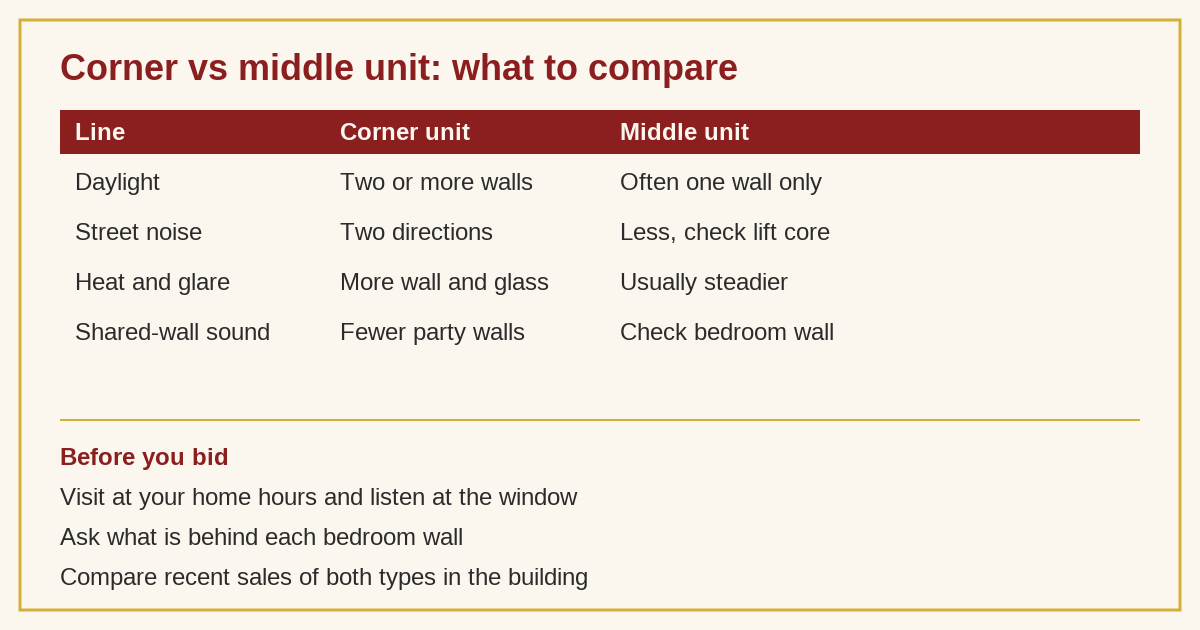
Stand in the unit and count the windows, the walls they are on and the compass directions they face. Two exterior walls usually bring cross-ventilation and daylight from two sides, and many buyers value that above any symbolic point. They also cost something: more wall and glass to lose heat in winter and gain it in summer, and noise from two directions.
Go at the hours you would normally be home. At the window, listen for the street, a loading dock, a nearby train or a rooftop fan. Then look at the corner of the building from outside for a sharp edge, a lane, a driveway ramp or a light pole aimed at your windows. A west-facing unit is worth a late-afternoon visit, when the heat and glare are at their worst. Our guide on feng shui in glass condo buildings covers glare and heat in glass towers.
Middle unit: what a buyer can verify
Sound through shared walls comes first. Tap and listen, ask which walls are party walls, and find out what is next door: another household, a lift core, a stairwell or a mechanical room. A bedroom wall backing onto a neighbour's living room or a lift shaft is a bigger problem than a corner position will ever be.
Light comes second. With windows on one side only, a middle unit depends on that single direction. Note which way it faces, and look at the floor plan for a dark centre, a deep kitchen or a windowless bathroom, then check that interior bathrooms and kitchens have working ventilation. Our apartment viewing checklist for renters works just as well for buyers.
In a middle unit the entry is often closer to the core, so a front door facing the lift is more likely. Apartment door facing the elevator or corridor covers that layout.
Scoring sheet: worked example
Score from what you saw and heard, not a gut feeling. In this example, two hypothetical units sit on the same floor of the same tower, with the same size and a similar asking price. Unit A is a corner unit with windows facing south and west. Unit B is a middle unit with windows facing south only. Each line is scored from 1 (poor) to 5 (strong) after a visit at the buyer's usual home hours.
| Line | What to check | Unit A (corner) | Unit B (middle) |
|---|---|---|---|
| Daylight | Windows and directions | 5 | 3 |
| Street noise | Listen at the window, doors shut | 2 | 4 |
| Shared-wall sound | What sits behind each bedroom wall | 4 | 3 |
| Heat and glare | Afternoon visit, window area | 2 | 4 |
| Privacy | Sightlines from other towers | 3 | 4 |
| Feng shui exposure | Sharp edges, road pointing at unit | 3 | 4 |
| Total | 19 | 22 |
All the totals show is that this buyer, who cares about quiet and heat, would lean towards Unit B. Someone who works from home and wants light might count daylight double and reverse the result. That is the point of the sheet: set the weights for your own life, then compare.
Resale and price
Corner and end units are often marketed as premium, and some buyers do pay more for them. Others mark them down for noise and bills. Rather than assume either way, ask your agent for recent sales of corner and middle units in the same building, and compare price per square foot, days on market and condition. Your agent can pull these from the local listing service.
Where condo buyers go wrong on position
- Choosing a corner for the view without visiting at night and in the afternoon.
- Taking "supported by neighbours" as a reason to skip the sound check on shared walls.
- Ignoring what is directly above and below, which affects noise as much as position does.
- Paying a premium for a position without comparing recent sales in the same building.
- Rearranging furniture around a structural problem such as a lift shaft behind the bedroom wall. That is a reason to walk away, not something a remedy fixes.
FAQ
Is a corner unit better for feng shui?
Not by a fixed rule. Practitioners describe corner units as bright but exposed to outside influence, and middle units as steadier but darker. Use the tradition to ask questions about noise, sightlines and light, then decide on the facts you can check at a viewing.
Are corner condos louder than middle units?
Often, since noise can arrive from two exterior directions, but it depends on what each side faces. A middle unit can be louder if a bedroom wall backs onto a lift shaft, a stairwell or a neighbour's living room. Visit at the hours you would be home and listen.
Do corner condos cost more to heat and cool?
They usually have more exterior wall and glass, which tends to raise heat loss and gain. Ask the seller for a year of utility bills and the window specification instead of relying on position alone.
Do corner units resell for more?
Sometimes, but there is no general figure. Ask your agent for recent sales of corner and middle units in the same building and compare price per square foot and time on the market.
What feng shui problem is common in a middle unit?
Practitioners mention a dark or windowless centre and an entry close to the lift or stair core. For light, use layered lamps and mirrors placed to reflect a window. For the entry, see our guide on doors facing elevators.
Where to go next
Print the scoring sheet and visit both units at the hours you are usually home. Score them before anyone talks price, then work through the feng shui home buying checklist.
Sources
Checked November 2026. Before relying on any rule marked "not verified since November 2026", read the current text at its source.
- International Code Council, International Building Code, sound transmission provisions for walls between dwelling units
- US Department of Energy, Energy Saver, insulation and air sealing guidance
- Ontario Condominium Act status certificate and British Columbia Strata Property Act Form B information certificate
- Traditional Form School teaching on exposure and support, as described by practitioners
Editorial note: Feng shui is presented here as a cultural and design tradition. Confirm legal, financial and inspection questions with a licensed professional.