A safe Chinese housewarming gift is something auspicious and useful: fruit such as oranges or tangerines, a plant, tea, or money in a red envelope. Commonly cited gifts to avoid are clocks, sharp objects, pears and umbrellas, because their names sound like words for endings or separation. Customs vary by family and region, so if you are unsure, ask the host.
Sources checked 23 November 2026.
This is the guest's side of a move. The household's side, from the first night to the first month, is in first 30 days in a new home, with more in our real estate and home buying guides.
| Gift or custom | What the source says | Source |
|---|---|---|
| Fruit in the home | Oranges are among offerings in one Hong Kong-learned moving-in ceremony | USC Digital Folklore Archives |
| Pomelo | Described by the informant as meaning "blessing" in Chinese and used in cleansing | USC Digital Folklore Archives |
| Red packet | In that account, a red packet goes under the pillow on the first night | USC Digital Folklore Archives |
| Region | The archive entry says these housewarming traditions are native to Southeast Asia and were learned in Hong Kong | USC Digital Folklore Archives |
| Clocks, pears, umbrellas | Avoided because "song zhong" (giving a clock) sounds like seeing someone off at death, pear sounds like parting and "san" (umbrella) sounds like scatter | South China Morning Post, 1 July 2025 |
| Four, black and white | Four sounds like the word for death; black and white are linked with funerals | South China Morning Post, 1 July 2025 |
| Variation | Customs differ by family, region and generation | Editorial |
On this page
- How gift customs work
- Gifts commonly seen as good
- Gifts commonly avoided
- Give or avoid table
- Red envelopes, colour and numbers
- Worked example
- Gift slips hosts notice
- FAQ
How gift customs work
Most Chinese gift taboos are wordplay. When an object's name sounds like an unlucky word in Mandarin or Cantonese, people avoid giving it. It is a cultural habit rather than a rule, and plenty of families ignore it. Our avoid list follows a South China Morning Post explainer on Chinese gift taboos (1 July 2025). The "give" list comes from a moving-in ceremony recorded by the USC Digital Folklore Archives, so it shows what one household actually used.
Advertisement
Gifts commonly seen as good
- Fruit. The moving-in ceremony described by the USC Digital Folklore Archives uses oranges among its offerings, and the informant says the Chinese word for pomelo means "blessing", which is why the fruit is used. That is part of why a basket of oranges or tangerines is such a common housewarming gift.
- Plants. A healthy plant is usually welcome; see feng shui plants by element and lucky plants for what each is said to mean. First make sure the host has the light for it and that it is safe around their pets.
- Tea or food. Something to eat or drink gets used up, so nobody has to find room for it or pretend to like it.
- Money in a red envelope. Red is the colour of luck and celebration; see red in Chinese culture.
Gifts commonly avoided
Each item below comes with the reason usually given, and the South China Morning Post's July 2025 explainer lists the same items and reasons:
- Clocks. "To give a clock" (song zhong, 送钟) sounds like 送终, seeing someone off at the end of their life, in both Mandarin and Cantonese. Watches and other timepieces are often avoided for the same reason.
- Sharp objects such as knives and scissors. There is no wordplay here: a blade is said to imply cutting the relationship.
- Pears. The word for pear (li, 梨) sounds like the word for leaving or parting (离).
- Umbrellas. In Mandarin the word (san, 伞) sounds like "scatter" or "separate" (散). Fans are avoided for a similar reason.
- Sets of four, because four sounds like death in several East Asian languages; see number 4 in East Asia.
- White or black wrapping or items, long associated with funerals; red or gold is the usual choice.
Give or avoid table
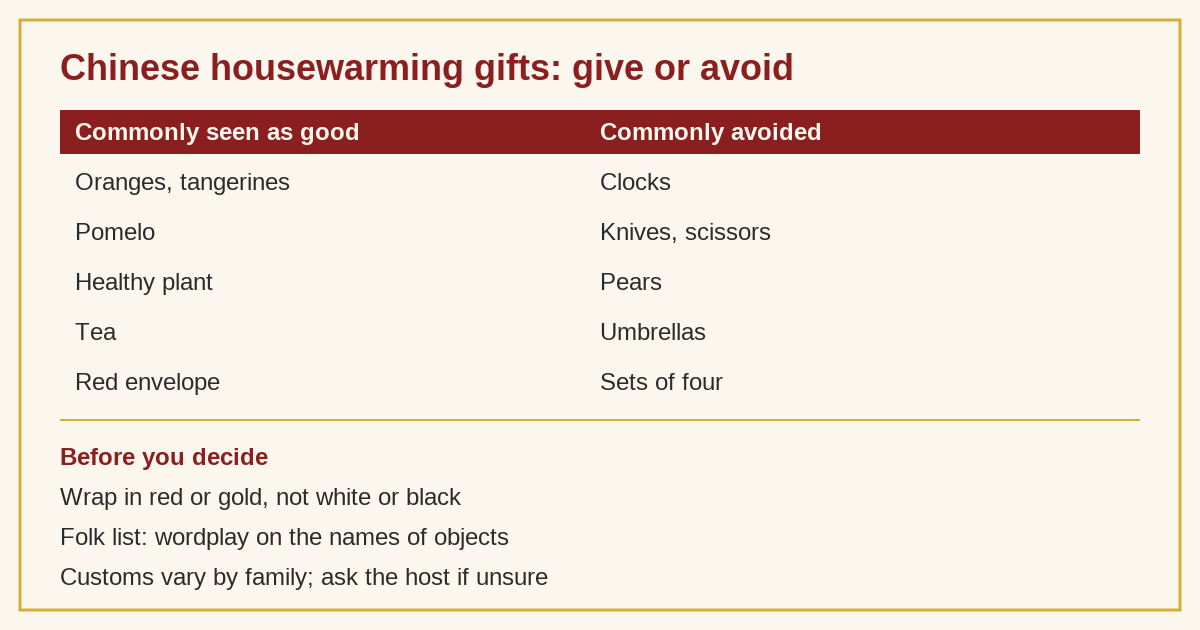
| Gift | Common view | Tip |
|---|---|---|
| Oranges, tangerines | Auspicious | Pick fresh fruit without blemishes |
| Pomelo | Auspicious ("blessing") | Often seen at a moving-in |
| Healthy plant | Welcome | Ask about light and pets first |
| Tea | Welcome | A sealed tin in plain packaging |
| Red envelope | Welcome | Ask the host what amounts the family expects |
| Wall clock, watch | Avoided | Choose another gift |
| Knife set, scissors | Avoided | Choose another gift |
| Pears, umbrella | Avoided | Choose another gift |
| Four of anything | Avoided | Give three, or five, instead |
Habits around amounts and wrapping are family practice, not sourced rules, so ask the host if you can.
Red envelopes, colour and numbers
Eight is widely seen as lucky (see why 8 is lucky) and four is not. The SCMP explainer advises against red packet amounts with a four in them, such as 40. How to hand over or open a gift also varies by family, and we leave that etiquette aside.
Worked example
A colleague has invited you to their housewarming. You don't know how their family does things, or what they would like.
Bring a basket of oranges and a small plant in a pot with good drainage, wrapped in red paper. The clock-shaped ornament you first thought of stays in the shop, and so does the knife block. If you would rather give money, put a new bill in a red envelope, in an amount with no four in it.
Before you buy the plant, ask a mutual friend, or the colleague, whether there are pets or allergies in the house. A quick question beats a guess.
Gift slips hosts notice
- Treating the folk list as a universal rule when the family may not follow it at all.
- Picking a decorative clock because it seems like a nice, neutral present.
- Wrapping in white because it looks clean.
- Giving a plant that is toxic to the host's pets.
FAQ
What are good Chinese housewarming gifts?
Fruit such as oranges or tangerines, a healthy plant, tea, or money in a red envelope are all commonly seen as good choices. A moving-in ceremony described by the USC Digital Folklore Archives uses oranges, and its informant says the Chinese word for pomelo means "blessing". Customs vary by family and region, so ask if you can.
What should you not give as a Chinese housewarming gift?
Common customs avoid clocks, sharp objects, pears, umbrellas and sets of four. Clock, pear, umbrella and four sound like words for death, parting or scattering, and blades suggest cutting ties. Not every family keeps these customs, so treat them as habits rather than rules.
Is it bad to give a clock?
By common custom, yes: song zhong, giving a clock, sounds like the phrase for seeing someone off at death. Some families do not mind, but if you do not know the family well, choose another gift.
What colour should I wrap a housewarming gift in?
Red and gold are commonly seen as lucky. White and black are associated with mourning, so many people avoid them for gifts. See our guide to red in Chinese culture for the background.
Do I bring a gift to a house blessing ceremony?
Often yes, because a ceremony is a celebration. Bring something modest and auspicious, such as fruit, and follow the host's lead. For what the ceremony itself involves, see our house blessing guide.
Choosing yours
Pick one gift from the "give" side of the table and wrap it in red, checking about pets and allergies before you buy. If you are the one moving in, our house blessing ceremony guide is the place to start.
Sources
Checked November 2026.
- USC Digital Folklore Archives, Moving Ceremony (China)
- South China Morning Post, Gifts you must avoid giving in Chinese culture, from clocks and shoes to pears, and why (1 July 2025, as syndicated by The Korea Times)
Editorial note: Lucky Properties presents feng shui as a cultural and design tradition. Gift customs vary by family, region and generation; this guide is a starting point, not a rulebook.