Short answer
Ce Zi, 测字, is divination from a single written character. A seeker writes one character, or points at one, and a reader takes the fortune from the character itself: its parts, its sound, its stroke count, and the way the hand wrote it. No birth time is needed, no coins are cast, no chart is drawn. The character is the oracle.
That is what sets Ce Zi apart from the other Chinese methods on this site. BaZi reads a birth moment. The I Ching coin method builds a hexagram line by line. Liu Yao and Da Liu Ren cast charts from the moment of the question. Ce Zi skips the chart. It reads the word in front of it.
The method is old, and it is still practiced. The China Culture overview of the practice puts it plainly: Ce Zi was prevalent in ancient China, and it is still practiced in some rural areas today. Its history runs from the Qin and Han dynasties through the Song, when it matured into a street-corner profession, into the Ming and Qing, when its manuals were printed. This guide works through how a sitting runs, the six tools a reader uses, the master who made the method famous, the three characters of the Chongzhen legend, and a worked example. Everything is reported as tradition, with the limits stated plainly at the end.
Why a character can carry a reading
A Chinese character is three things at once, and Ce Zi uses all three. It is a picture, built from strokes that once drew the thing itself. It is a sound, spoken the same way as other words. And it is a meaning, fixed by centuries of use. A reader works all three layers, and the reading comes from where they agree or pull apart.
The tradition gives writing a high origin. The old story credits the legendary Cangjie with inventing characters, and says that when writing appeared, the heavens rained grain and the ghosts wept at night, because a secret had been given away. Whether or not the story is believed, it states the premise the method needs: writing is not a neutral code. Each character carries something of the world it names, and a person writing one in a charged moment lets something of that moment into the strokes.
That premise has a saying attached to it in the tradition: characters arise from the mind. The character a seeker writes first, without deliberation, is treated as a sample of the seeker's state, the way a coin cast is treated as a sample of the moment. A character chosen after long thought is a weaker signal, because the choosing itself has done the work the character was supposed to do.
Three cautions belong at the start. First, Ce Zi reads one character for one question. A second character for the same question is a second reading, not a confirmation. Second, the reading follows the question. The same character written by two seekers about two different matters is read twice, and the two readings can disagree. Third, the method is a folk tradition, not a measurement. No evidence shows that a character predicts anything, and the stories in this guide are stories, some recorded by named witnesses, some retold until their edges wore smooth. The guide says which is which.
A sitting, step by step
A Ce Zi sitting has a simple shape, and the shape has barely changed since the Song. The seeker states a question, writes one character, and the reader works it. The variations are in the details.
The question comes first, and it should be one question. Career, a lost object, an exam, a move, a marriage: the tradition accepts any of these, but it wants one matter per character. A reader asked two questions from one character will usually ask the seeker to write a second character for the second question.
Then the writing. The seeker writes the character by hand, usually with a brush or pen, on paper, in the reader's presence. The first character that comes to mind is the one to write. The reader watches the writing itself, not just the finished form: the pressure of the strokes, the slant, a dry brush starved of ink, a stroke written out of order, a hesitation before a difficult part. All of that is read as information about the moment, and the story of the official who wrote 申 about his illness turns on exactly this: the middle stroke came out dry, and the reading followed the dryness, not the dictionary meaning.
For seekers who cannot write, the tradition has an old workaround. Xie Shi, the Song master this guide returns to below, hung a sheet with more than a thousand characters on the wall of his hall in the capital, and an illiterate seeker could point at one. The choice then carries the reading instead of the handwriting. The same principle appears in the Zhuge oracle branch, where the seeker writes three characters and the stroke counts pick a lot poem.
Once the character is down, the reader works it with the six tools in the next section, and then gives the reading: what the character seems to say about the question, in the tradition's terms, and what to watch for. A careful reader points at the evidence as they go: this stroke, this split, this sound. A reader who gives conclusions without showing the character behind them is giving nothing to weigh, and the methods comparison on this site makes the same point about BaZi and Zi Wei readers.
One rule governs the whole sitting. The reading is about the question asked, in the moment asked. It is not a life verdict. A character read for an exam says nothing about a marriage, and a character read today says nothing about next year. Readers who stretch one character into a full destiny are working outside the method.
The six working tools
A Ce Zi reader has six tools, and a good reading usually uses two or three of them on the same character. They are worth learning separately, because each one shows a different way a character can speak.
1. Splitting, 拆字
Splitting is the center of the method, and it gives Ce Zi its other name. The reader breaks the character into smaller components and reads those components as words. The components can be radicals, recognizable parts, or strokes grouped into new characters.
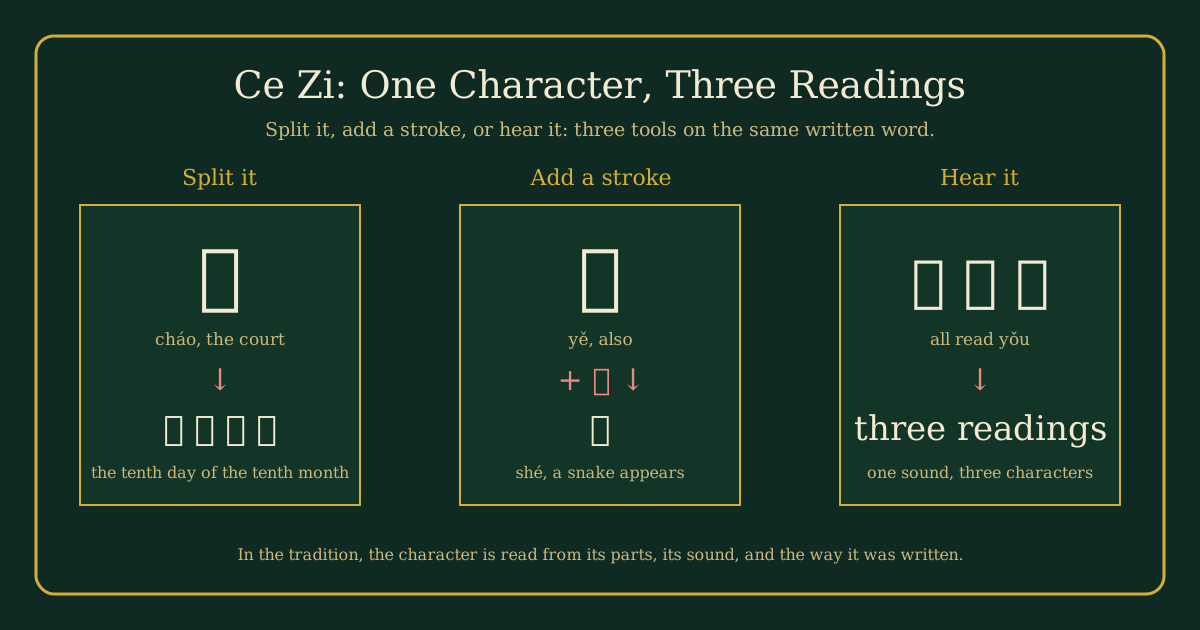
The most famous split in the tradition is 朝, the character for the imperial court, or morning. Split it and it becomes 十, 月, 十, 日: ten, moon, ten, sun. Read as a date, that is the tenth day of the tenth month. In the Xie Shi story below, that date was the emperor birthday, and the split named the man who wrote it.
Splitting can also run the other way, assembling a meaning from the parts. The character 安, peace, is a roof, 宀, over a woman, 女. Read as a picture, it is a person sheltered under a roof, and the tradition reads that as settled and safe. The worked example at the end of this guide uses 安 for exactly this reason: the split and the meaning agree.
2. Adding and removing strokes, 加笔减笔
The reader adds a stroke, or takes one away, and watches what the character becomes. The change is the reading.
Add the insect radical 虫 to 也, also, and it becomes 蛇, snake. In the Xie Shi story of the official wife with the overdue pregnancy, that single addition turned a plain word into the snake the reader said was behind the trouble. Take a stroke from 朱, vermilion, and it becomes 失, lost, or something close to it: a character missing a stroke reads as a thing missing. In the pearl-crown story, also below, the missing stroke pointed at a relative surnamed Zhu.
The tool has a strict form. The addition or removal must produce a real character, and the reader must be able to say which stroke and why. Adding strokes at random until something ominous appears is not the method. It is wordplay with a menacing tone.
3. Homophones, 谐音
Characters that sound alike are read as connected. A character with an unlucky homophone reads badly; one with a lucky homophone reads well. This is the same logic behind the lucky numbers and lucky colors traditions: the sound carries the meaning sideways.
The Chongzhen legend below is built entirely on homophones. Three characters, 有, 友, and 酉, are all pronounced yǒu, and the diviner read all three in sequence. The sound was the same. The characters were different, and each one gave a different piece of the same bad news.
Homophones also explain why some readings are about the seeker rather than the character. A character that sounds like a word in the seeker's own dialect, or in the dialect of the place the question concerns, can matter more than the dictionary sound. Readers who work across regions ask where the seeker is from before they trust a homophone.
4. Combined meaning, 会意
Some characters are built from parts whose meanings combine into a sentence. The reader states the sentence plainly and applies it to the question.
The character 好, good, is a woman, 女, beside a child, 子: a mother with her child is the picture of good. The character 家, home, is a roof, 宀, over a pig, 豕: livestock sheltered under a roof is the picture of a household. These are the dictionary meanings, not inventions, and the reader uses them the way they stand. The combined-meaning tool is the most conservative of the six, because it cannot stray far from what the character plainly shows.
5. Stroke count, 笔画
Count the strokes of the character, and the number feeds the number methods. In the plum-blossom method, the stroke count of a written character fixes a trigram, and the plum-blossom guide on this site works through that arithmetic in full. In the Zhuge oracle branch, the seeker writes three characters, the stroke counts are added, and the total picks one of 384 lot poems, matching the 384 lines of the 64 hexagrams.
Stroke counting has one rule that matters for modern readers: the tradition counts traditional forms. The simplified 测 has eight strokes. The traditional 測 has twelve. A count taken from the wrong form gives the wrong number, and the reading that follows is built on it. The FAQ below goes into the simplified-versus-traditional question in full.
6. Five elements, 五行
Each component of a character carries an element, and the reader weighs which element dominates. A character heavy in 金, metal, strokes reads differently from one heavy in 木, wood, or 水, water. The elements follow the same generating and controlling cycles the five-elements guide on this site sets out: Wood feeds Fire, Fire makes Earth, Earth bears Metal, Metal carries Water, Water nourishes Wood, and each element controls one other in turn.
The element tool is usually the last one used, not the first. It confirms or complicates a reading the splitting already gave, rather than producing a reading on its own. A character that splits badly and counts heavily toward the element the question needs is a mixed reading, and the tradition reports it as mixed rather than forcing it one way.
| Tool | Chinese | What the reader does | Best example in this guide |
|---|---|---|---|
| Splitting | 拆字 | Breaks the character into parts and reads them | 朝 into 十月十日 |
| Adding and removing strokes | 加笔减笔 | Adds or takes a stroke and reads the new character | 也 plus 虫 becomes 蛇 |
| Homophones | 谐音 | Reads a character through a word that sounds the same | 有, 友, 酉, all yǒu |
| Combined meaning | 会意 | States the sentence the parts make together | 家, roof over livestock |
| Stroke count | 笔画 | Counts strokes and feeds the number methods | 安, six strokes, Kan trigram |
| Five elements | 五行 | Weighs which element the components carry | Confirming a split reading |
Advertisement
From street stalls to printed manuals
Ce Zi has no single founding text. It grew the way folk practices grow: a technique here, a story there, a manual when the technique got complicated enough to need one.
Its beginnings are usually traced to the Qin and Han dynasties, when prophecy texts and apocrypha were widely read and folk practitioners began dissecting character radicals and rearranging strokes to read the trend of events. The old reverence for writing sits behind that: characters were treated as powerful things, not as a neutral code, and a character written in a charged moment was worth reading closely.
By the Tang dynasty the practice had a name of its own, po zi, 破字, breaking characters, and it was established enough to be named in the divination literature. The Song is where it matured. Character divination became a folk activity popular across court and common society, with stalls on the streets of Bianliang, the Northern Song capital, and the master who defined it, Xie Shi, working there in the Xuanhe era, 1119 to 1125.
The Ming and Qing dynasties took the method into ordinary households and into print. Manuals on the method circulated, including the Secret Manual of Character Divination, and the most studied of them, the Zichu, 字触, Character Touch, by the scholar Zhou Lianggong, 1612 to 1672. The Zichu is a literary work as much as a manual: its six chapters move from the theory of writing, through meaningful correlations between characters and fate, hidden messages and prophetic songs, the coincidences of time, person, and form, and worked examples, to prophetic dreams, misreadings, witty banter, and the etymologies of characters. Anne Schmiedl's study of the book, Chinese Character Manipulation in Literature and Divination, published by Brill in 2020, is the first thorough study of the Zichu in English, and it traces how the educated elite used character manipulation as a literary game while practitioners used the same techniques to read fortunes.
That double life, game and divination at once, is part of the method's identity. The same splitting that reads a fortune can also make a riddle, settle a wager, or carry a hidden message in a poem. Readers who know the game use the same tools as readers who believe the divination, and the line between the two has always been thin.
Xie Shi, the master of the Song
Every method has a master attached to it, and for Ce Zi the master is Xie Shi, 谢石, courtesy name Runfu, a native of Chengdu. The stories about him come from Hong Mai's Yijian Zhi, Records of the Listener, a Song collection of strange tales, and the most important of them carry a named witness: Hong Mai's elder brother Hong Shi, who says he saw two of the readings himself. Later retellings embroidered the stories, and this guide says where the embroidery starts.
Xie Shi was already famous in Chengdu when he came to the capital, Bianliang, in the Xuanhe era, and opened a hall in the center of the city. He hung a sheet with more than a thousand characters on the wall, so that seekers who could not write could point at one. His fame reached the emperor, and the first story is the one that made it.
The character 朝
Emperor Huizong, wanting to test the man, wrote the character 朝 and had a courtier carry it to Xie Shi. Xie Shi looked at the character, looked at the courtier, and said the character had not been written by the man carrying it. Then he split it: 朝 becomes 十, 月, 十, 日, the tenth day of the tenth month, the emperor's birthday as the story gives it. Only the Son of Heaven, he said, would write a character that holds his own birthday. The courtier ran back to report, and the next day Xie Shi was summoned to the palace, where the palace ladies wrote characters for him and he answered each one. The court rewarded him with the low military rank of Chengxinlang.
The story is told as a test passed, and its mechanics are the whole method in miniature: a split, a date, and a deduction about the writer. The retellings differ on the birthday detail, and the story survives the difference because the split itself is exact.
The character 一
After the Song court moved south, Xie Shi came to Lin'an, present-day Hangzhou, in 1138. Emperor Gaozong, on a private visit in ordinary clothes, met him on the street and wrote the single stroke 一 on the ground with his crutch, asking for a reading. Xie Shi looked at the stroke and said it read as 君, ruler, from either side, so the man who wrote it must be the emperor. Gaozong brought him into the palace and gave him a post.
The story is the shortest of the Xie Shi tales, and it shows the method at its most compressed: one stroke, one reading, and the reading is about the writer, not the stroke.
The character 家
A young wife, married three months, whose husband had gone away to earn money, wrote 家 and asked when he would return. Xie Shi read the character as a person beside two elevens, and two elevens are twenty-two: the husband would come on the twenty-second day of the month. The story says he did. The split is a folk one, treating the lower part of the character loosely, and it is worth saying so: the dictionary split of 家 is a roof over a pig, not a person beside two elevens. The story keeps the folk split because the folk split is what the reading used.
The character 申
An official wrote 申, asking about an illness. The middle horizontal stroke came out dry, the brush starved of ink. Xie Shi looked at the character, said the center was dry and the man would die the next day, and the story says he did. Hong Shi, the witness, records it as one of the two readings he saw himself. The story matters because the reading came from how the character was written, not from what it means. 申 means to state or to extend. The dry stroke said the rest.
The character 失
An official wife lost a pearl crown and wrote 失, lost. Xie Shi asked whether the family had a relative surnamed Zhu: 失 is 朱 with a stroke missing, a Zhu with something gone. He also spoke of twenty-eight, a number the retelling itself says is hard to reconstruct from the split, and said the crown was not stolen and could be found. It was found in a box, under a hat the wife brother-in-law, called twenty-eight in the family, had borrowed and returned without opening the box. The crown had been misplaced, not stolen, and the reading had said so.
Five stories, five different tools: a split, a single stroke, a folk split, the handwriting, and a missing stroke. That is why Xie Shi is the master the tradition points to. He did not use one trick. He used whichever tool the character in front of him offered.
Advertisement
The three characters of Chongzhen
The most told Ce Zi story of all belongs to the last Ming emperor, and it is also the one to treat with the most care. It is widely told, and it may be a later attribution. This guide tells it as a legend, and says so.
In 1643, with the Ming dynasty falling, the Chongzhen Emperor is said to have disguised himself as a commoner and gone out to find a diviner. He wrote three characters in sequence, all pronounced yǒu, and the diviner read all three.
First he wrote 有, to have. The diviner said the character breaks into 大 above and 月 below, and 月 is half of 明, bright, the name of the dynasty. The Great Ming, the reading went, has already lost half of itself.
Then he wrote 友, friend, choosing a homophone to try again. The diviner shook his head. Inside 友 sits 反, rebel, with its head sticking out: the rebel has raised his head. The reading was worse than the first.
Then he wrote 酉, the tenth earthly branch, another homophone. The diviner sighed. 酉 is 尊, the dignity of the Nine-Five, the emperor, with its head and its feet cut away. The emperor, the reading went, is gone. Three characters, one sound, and every one of them an ill omen.
The story ends with the diviner refusing payment. He would not take the money of a dead man, he said. Within months, Beijing fell to Li Zicheng, and Chongzhen hanged himself on Coal Hill.
The history around the story is real. Chongzhen, Zhu Youjian, came to the throne in 1627 at sixteen, and in April 1644 Li Zicheng's army entered Beijing. The divination is the part no record confirms, and the story shape, three tries, each worse, ending in a refusal of payment, is the shape of a tale told many times until it is smooth. Its value is not as evidence. Its value is as the clearest statement of what Ce Zi claims to do: take one written character, split it, hear it, and read the moment through it.
A worked example, labelled hypothetical
The example below is invented for this guide. The seeker, the question, and the character are hypothetical, and the point is the order of the work, which is the same order a practitioner follows.
The seeker and the question. A hypothetical renter in her thirties, deciding whether to sign a two-year lease on a flat she likes but is unsure about, writes one character about the move: 安, peace, safety, to settle.
Step 1, split it. 安 breaks into 宀, a roof, over 女, a woman. The picture is a person sheltered under a roof. Read as a sentence, it is: there is a roof, and someone is under it. For a question about a lease, the split answers the question in its own terms: the flat is a roof, and the roof is intact.
Step 2, check the strokes. 安 has six strokes in the traditional count, three for the roof and three for the woman. Nothing is missing, nothing is added, and the character is written whole. A reader working the adding-and-removing tool finds nothing to add and nothing to take away, which is itself a reading: the character does not ask to be fixed.
Step 3, hear it. 安 sounds like 庵, a small temple or hut, and like 鞍, a saddle. Neither homophone is close enough to carry the reading, and a careful reader says so rather than forcing one. The sound of 安 is its own meaning here: peace, safety, to settle. The homophone tool stays in the box.
Step 4, count it. Six strokes feeds the number branch. In the plum-blossom method, the early-heaven numbering turns six into the Kan trigram, Water, for the upper half of a cast, and the full arithmetic is worked through in the plum-blossom guide. The stroke count agrees with the split: Water settles low, and a lease is a settling decision.
Step 5, weigh the elements. The roof radical 宀 is a covering, and the woman 女 is a person. The tradition reads the character as Earth-sheltered, a roof over a person, with Water from the stroke count underneath. No element is missing, and no element dominates. The reading is balanced, and a balanced reading is reported as balanced.
The reading. In the tradition terms, the character answers the question it was written for: the roof is whole, the person is under it, and nothing in the character asks to be changed. That is a reading in favor of signing, and it is a reading about the character, not a promise about the flat. The lease still needs its own checks: the landlord, the rent, the exit clause, the damp. The character says the move is settled in the seeker mind. The paperwork says whether the flat is.
What would change the reading. If the seeker had written 安 with the roof radical broken, a missing stroke in 宀, the split would read differently: a roof with a hole in it. If she had written it while asking about a marriage rather than a lease, the woman under the roof would be read for the marriage, not for the flat. And if she had written 愁, worry, instead, with its 秋, autumn, and 心, heart, the reading would start from a heavy heart in a fading season. The character is half the reading. The question is the other half.
Ce Zi beside its cousins
Ce Zi is one method among many, and it is easy to confuse with its neighbors. The table below sets it against the methods on this site that share its raw material, a character, a number, or a moment.
| Method | What it reads | What the seeker gives | Where it is covered |
|---|---|---|---|
| Ce Zi | One written character, its parts, sound, and strokes | A character, written in the moment | This guide |
| Plum Blossom, Meihua | A hexagram computed from numbers | Numbers, a date and hour, or a character stroke count | Meihua guide |
| Liu Yao | A hexagram cast from coins, read line by line | Six coin tosses | Liu Yao guide |
| Zhuge oracle | One of 384 lot poems | Three characters, by stroke count | In the stroke-count section above |
| Da Liu Ren | A chart of heaven, earth, and humanity plates | The date and hour of the question | Da Liu Ren guide |
| Tai Yi | A chart of sixteen palaces for state and timing | The date and hour, often for collective questions | Tai Yi guide |
| Xiao Liu Ren | A quick finger calculation | The date and hour, counted on the fingers | Xiao Liu Ren guide |
| BaZi | Eight characters from a birth moment | Birth year, month, day, and hour | BaZi guide |
| Five-grids name analysis | Stroke grids from a fixed name | The full name as written | Name analysis guide |
| Kau Chim | One of a hundred numbered sticks | A shaken stick from the temple cylinder | Kau Chim guide |
| Zhou Gong dreams | Dream symbols from the dream dictionary | A dream, told in the morning | Dream guide |
Two distinctions in that table do the most work. First, Ce Zi and the plum-blossom method both start from a written character, but they go different ways: Ce Zi reads the character itself, while Meihua turns the character stroke count into a hexagram and reads the hexagram. Second, Ce Zi and name analysis both count strokes, but a name is fixed and a Ce Zi character is chosen for one question on one day. Confusing the two is the most common mistake a beginner makes with this method.
The methods comparison guide on this site sets BaZi, Zi Wei, face reading, and palm reading side by side with the same question: which method fits which kind of question. Ce Zi belongs in that comparison as the method for a single, specific question asked right now, where the seeker wants an answer from the moment rather than from a birth chart or a decade cycle.
Advertisement
What a careful reader does
A Ce Zi reading is only as good as the reader, and the tradition has a clear picture of what a careful reader does.
A careful reader shows the trail. They point at the stroke, the split, or the sound behind each claim, so the seeker can see the work. Xie Shi did this in every story: the split is shown before the conclusion is given. A reader who offers conclusions without pointing at the character is asking to be believed rather than followed.
A careful reader takes one character for one question. They do not read a second character to confirm the first, and they do not stretch one character into a life reading. The method is narrow by design, and a reader who widens it is selling something else.
A careful reader reports mixed readings as mixed. A character that splits well but counts badly, or sounds well but was written with a broken stroke, is a mixed reading, and a careful reader says so. The tradition has no rule that a reading must come out clean.
A careful reader does not promise outcomes. No character on this page predicts money, health, or a marriage. The readings in the stories are presented as what the tradition says the characters showed, and the guide reports them that way. A reader who promises a result, sells a cure for a bad character, or charges for a second character to fix the first is outside the method and inside a sales pitch.
And a careful reader knows the limits of the tools. The splitting depends on traditional forms, so simplified characters change the splits. The homophones depend on the sound, so a reader working in the wrong dialect can mishear the connection. The handwriting depends on the hand, so a tired or injured hand writes a different character from a rested one. A reader who does not ask about these things is not being careful.
Limits, stated plainly
Ce Zi is a folk tradition for reading a moment through a written character. No evidence shows that a character predicts anything about a person's future, and no reading on this page should be used to make a decision about money, health, work, or a relationship. The stories are the tradition's own evidence, and they are stories: some recorded by named witnesses in Hong Mai's Yijian Zhi, some retold until their edges wore smooth, one, the Chongzhen tale, probably a later attribution. The guide labels each one as it goes.
The disagreement in the sources is printed rather than resolved. The Xie Shi stories disagree with each other on small points, like the exact date of Huizong birthday, and the retellings disagree on the mechanics of individual readings, like the twenty-eight in the pearl-crown story. The Zichu is a literary work and a manual at once, and its chapters do not always agree on whether character manipulation is a game or a divination. The scholarly study of the method is recent, and it treats the practice as cultural material, not as a validated technique.
The value of the exercise, if there is one, is the attention it pays to a single word. Writing a character slowly, looking at its parts, hearing its sound, and asking what it says about the question in hand is a way of thinking about the question. The character does not answer it. The person writing it does, by choosing the character and by hearing what the reader makes of it. That is a thinner claim than the stories make, and it is the one this guide stands behind.
Sources and further reading
The definition of Ce Zi, its prevalence in ancient China, and its continued practice in some rural areas follow China Culture, Characters and Augury, as carried by the ASEAN-China Center, read for this guide. The Zichu, its author Zhou Lianggong, 1612 to 1672, its six chapters, and the place of character manipulation in literature and divination follow Anne Schmiedl, Chinese Character Manipulation in Literature and Divination, Brill, 2020, as catalogued by Stanford, read for this guide. The Xie Shi stories, the 朝, 一, 家, 申, and 失 readings, the thousand-character card, the palace summons, and the Chengxinlang reward follow the accounts drawn from Hong Mai's Yijian Zhi, as retold in the Song Dynasty Warlock Xie Shi split words and companion pieces, read for this guide, with the pearl-crown story attributed to Yijian Zhi supplement volume nineteen and witnessed by Hong Shi. The Chongzhen three-character story, 有, 友, and 酉, and the diviner's refusal of payment follow the widely told legend as carried in the Chongzhen character-divination retellings, read for this guide, with the later-attribution caution the same sources state. The Zhuge oracle branch, three characters and 384 lot poems matched to the 384 lines of the 64 hexagrams, follows the Longhu Mountain account of Zhuge Divine Calculation, read for this guide. The I Ching background, 64 hexagrams and the coin method, follows this site's own I Ching casting guide and the plum-blossom guide, which covers the stroke-count-to-trigram arithmetic used in the worked example. The five-elements cycles follow this site's own five-elements guide. The methods comparison and the question of which method fits which question follow this site's own fortune-telling methods comparison.