The short answer
Xiao Liu Ren (小六壬) is a casting method with no equipment at all. No coins are thrown, no sticks are shaken, no chart is drawn. Six points on three fingers of one hand stand for six palaces, and a reader counts three numbers around them: the lunar month, the lunar day, and the double-hour of the present moment. The palace where the count stops at the hour step is the principal result in the tradition, and each palace has a short traditional reading attached to it. The whole count takes less than a minute once the finger positions are learned, which is the point of the method. Among the casting systems on this site, kau chim needs a temple cylinder and a book of slips, and the I Ching coin method needs three coins and six casts. Xiao Liu Ren needs a hand.
One framing note runs through everything below. The readings attached to the six palaces are the tradition's readings, reported here as tradition states them. A landing is a piece of folk arithmetic. It is not a measurement of a situation, and nothing in this guide presents it as one.
The names, and the legend that travels with them
The name parses plainly. Liu Ren is the six ren, a name it shares with the large classical system Da Liu Ren. Xiao means small. Xiao Liu Ren is the small six ren, and its other common name describes how a cast begins: the report-the-hour casting method (报时起课法, bao shi qi ke fa), because the person asking reports the current time and the reader counts from it. A third name appears in folk use, Ma Qian Ke (马前课), the lesson before the horse, and that name carries the legend.
Folk tradition attributes the method to Zhuge Liang, the strategist of the Three Kingdoms period, and says he used it before battle, counting on his fingers because a commander in the field has no table, no almanac, and no time. The Chinese sources that tell this story introduce it with xiang chuan (相传), tradition holds, which is the standard marker of legend rather than record. Read it the way this site reads the attribution of Cheng Gu to Yuan Tiangang: as the name a tradition gives its own past. A famous name attached to a quick method tells you the method was valued and much used. It does not document an inventor, and the plain statement about origin is the short one: the exact origin of Xiao Liu Ren is not certain.
What can be said plainly is what the method is built from. Its six palaces, its lunar counting, and its double-hours all belong to the shared furniture of Chinese calendar practice. The same twelve double-hours drive the hour table in the birth hour guide and the weighing tables in Cheng Gu. Xiao Liu Ren takes that furniture and reduces it to the smallest working form: six points, three counts, one landing.
The six palaces, in order
The count runs through six palaces in a fixed order. The order never changes, and learning the method means learning this sequence before anything else.
| Step | Palace | Characters | Short traditional reading |
|---|---|---|---|
| 1 | Da An | 大安 | Stability. Matters settle. Read as favourable |
| 2 | Liu Lian | 留连 | Delay and entanglement. Matters drag |
| 3 | Su Xi | 速喜 | Quick news, timely joy. Read as favourable |
| 4 | Chi Kou | 赤口 | Sharp words, disputes. Watch speech |
| 5 | Xiao Ji | 小吉 | Small gains, help from others. Read as favourable |
| 6 | Kong Wang | 空亡 | Emptiness. Plans not formed, things missing |
Three notes belong with this table. First, the second palace is written three ways across published texts: 留连 in the common form used here, and also 流连 and 留恋 in some printings. The palace, its position, and its reading are the same under all three spellings. When a source you meet uses a different character set for this palace, it is a spelling variant, not a seventh palace and not a different system.
Second, the tradition sorts its own six outcomes. Da An, Su Xi, and Xiao Ji are counted inside the tradition as the three favourable landings, Liu Lian and Kong Wang as the dragging and empty ones, and Chi Kou as the palace of friction. That sorting is the system describing itself, in the same spirit as the light and heavy bands later writers apply to Cheng Gu totals. It is printed here so a reader can follow a traditional reading when they meet one, not as a grade this guide assigns to anyone's day.
Third, the readings in the table are deliberately short, because the traditional readings are short. Each palace carries a compact set of associations that readers expand in a sitting, and the fuller traditional picture for each palace is set out further down this guide, worded the way the tradition words it.
The finger map
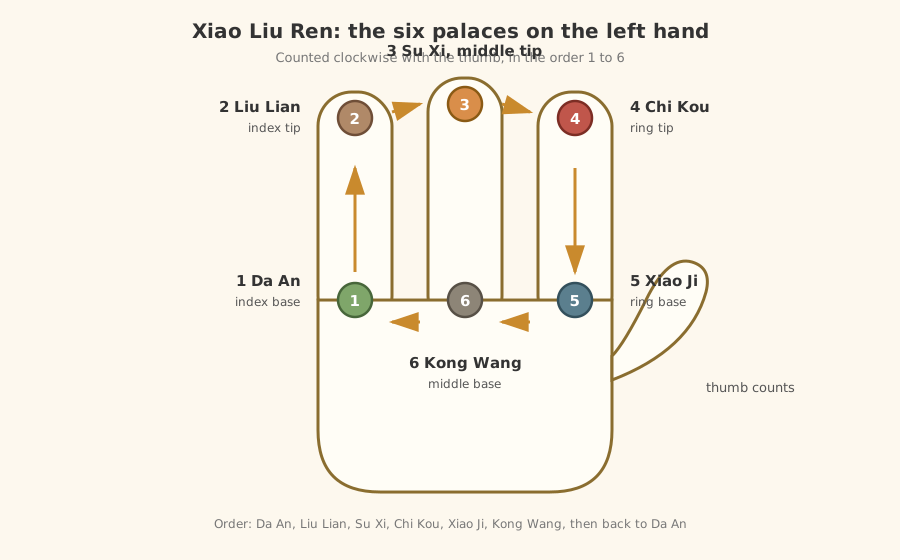
The six palaces sit on the fingers of one hand, the left hand in most tutorials, and the thumb does the counting, touching each point as the count passes it. The positions use the base and the tip of three fingers, and the route between them runs clockwise in the tutorials this guide follows.
| Palace | Finger position |
|---|---|
| Da An | Base of the index finger |
| Liu Lian | Tip of the index finger |
| Su Xi | Tip of the middle finger |
| Chi Kou | Tip of the ring finger |
| Xiao Ji | Base of the ring finger |
| Kong Wang | Base of the middle finger |
Read the map as a loop. The count starts at the base of the index finger, climbs to the index tip, crosses to the middle tip, crosses again to the ring tip, drops to the base of the ring finger, and finishes at the base of the middle finger, which sits next to the starting point. After Kong Wang the next count lands back on Da An, and the loop repeats for as long as the number being counted requires. A count of seven returns to the palace it started from, because the seventh position sits six steps on, a count of eight moves one palace past it, and every longer count is just the loop walked again. Readers who already know the palm as a reading surface from this site's palm guides will notice the difference in kind: palm reading reads lines and mounts that are printed on the person, while Xiao Liu Ren borrows the hand as a counting frame and reads nothing from its shape at all. The same hand could be anyone's. What changes from cast to cast is only the numbers counted across it.
The counting method, step by step
A cast has three steps, and all three are lunar. The month step and the day step fix a starting palace from the date, and the hour step counts from that palace to the moment of asking. The three landings can be read as a sequence, and many readers do read them that way, but the hour landing is the principal result, the one a traditional reading is built on.
Step 1, the month. The first lunar month starts at Da An. Count forward one palace per month: month 1 Da An, month 2 Liu Lian, month 3 Su Xi, and so on around the loop until you reach the lunar month in question. The palace you stop on is the month landing.
Step 2, the day. Day 1 of the month starts at the month landing, not back at Da An. Count forward one palace per day to the lunar day in question. The palace you stop on is the day landing.
Step 3, the hour. The Zi double-hour starts at the day landing. Count forward one palace per double-hour through the twelve traditional double-hours until you reach the double-hour of the present moment. The palace you stop on is the hour landing, and the cast is complete.
The double-hours, with their clock times, are the shared branch clock used across this site:
| Double-hour | Branch | Clock time |
|---|---|---|
| 1 | Zi | 23:00-01:00 |
| 2 | Chou | 01:00-03:00 |
| 3 | Yin | 03:00-05:00 |
| 4 | Mao | 05:00-07:00 |
| 5 | Chen | 07:00-09:00 |
| 6 | Si | 09:00-11:00 |
| 7 | Wu | 11:00-13:00 |
| 8 | Wei | 13:00-15:00 |
| 9 | Shen | 15:00-17:00 |
| 10 | You | 17:00-19:00 |
| 11 | Xu | 19:00-21:00 |
| 12 | Hai | 21:00-23:00 |
The arithmetic under all three steps is the same, and it is worth stating once in plain form, because it lets any reader check any published example. Each step counts around a loop of six, so only the remainder matters. A step whose target number is 7, 13, or 31 lands where it started, because reaching those numbers means moving 6, 12, or 30 steps, whole loops with nothing left over. A step whose target number is 11 lands four palaces on from its start, because reaching 11 means moving 10 steps, one full loop of 6 plus 4. Every worked example below can be re-run from that one observation, and a tutorial whose examples cannot be re-run this way has a copying error in it, the same test this site applies to the Cheng Gu tables.
One boundary needs care, and it is the same boundary that appears in the birth-hour material. Zi straddles midnight, running from 23:00 to 01:00. Tutorials for this method differ in how they assign a late-evening cast near that boundary to a lunar day, and a careful reader states the date they used alongside any result they quote. The counts in this guide use the lunar date of the moment as the almanac prints it, and the examples avoid the boundary so the counting itself stays in view.
Advertisement
Worked examples
A source-checked count, in two steps. The count carried in Chinese tutorials for this method runs as follows. The eleventh lunar month: count from Da An at month 1, through Liu Lian, Su Xi, Chi Kou, Xiao Ji, and Kong Wang, and around the loop again, and month 11 lands on Xiao Ji. Now the day step. The tenth day of that month starts counting at Xiao Ji, because day 1 sits on the month landing. Day 1 Xiao Ji, day 2 Kong Wang, day 3 Da An, day 4 Liu Lian, day 5 Su Xi, day 6 Chi Kou, day 7 Xiao Ji, day 8 Kong Wang, day 9 Da An, and day 10 lands on Liu Lian. A reader who then asked during a given double-hour would count the hours onward from Liu Lian, Zi at Liu Lian, Chou at Su Xi, and so on. The two landings shown here, Xiao Ji for the month and Liu Lian for the day, can be checked against the loop in seconds: month 11 sits 10 steps onward from Da An, one full loop plus 4 steps, Liu Lian, Su Xi, Chi Kou, Xiao Ji, and day 10 sits 9 steps onward from Xiao Ji, one full loop plus 3 steps, Kong Wang, Da An, Liu Lian.
A second source-checked count, compressed. The third lunar month lands on Su Xi, counted directly: month 1 Da An, month 2 Liu Lian, month 3 Su Xi. The twenty-third day of that month starts at Su Xi, with day 1 sitting on Su Xi itself. Reaching day 23 means moving 22 steps onward from Su Xi, which is three full loops of 6 plus 4 steps. The 4 steps run Chi Kou, Xiao Ji, Kong Wang, Da An, and the twenty-third day lands on Da An. Readers re-running this count should walk it on the finger map rather than trusting any printed landing, this guide's included. The discipline of re-running is the method's own built-in check, and it is the same discipline the Liu Yao guide applies to a built hexagram: the cast is only as good as the count that produced it.
A labelled hypothetical, all three steps. Take a cast made on the fifteenth day of the eighth lunar month, during the Mao double-hour, early morning. This example is constructed for teaching and is labelled hypothetical; no real consultation is described. Step 1, the month: month 1 Da An, 2 Liu Lian, 3 Su Xi, 4 Chi Kou, 5 Xiao Ji, 6 Kong Wang, 7 Da An, and month 8 lands on Liu Lian. Step 2, the day: day 1 starts at Liu Lian. Counting forward, day 7 returns to Liu Lian, day 13 returns to Liu Lian again, day 14 lands on Su Xi, and day 15 lands on Chi Kou. Step 3, the hour: Zi starts at Chi Kou, Chou lands on Xiao Ji, Yin on Kong Wang, and Mao, the fourth double-hour, lands on Da An. The sequence of landings reads Liu Lian for the month, Chi Kou for the day, and Da An for the hour, and the principal result, the hour landing, is Da An. In the tradition's own terms that is one of its three favourable landings, read there as stability and matters settling. In this guide's terms it is the end of a count the reader can verify three times over, once per step, which is the part of the example that transfers to any other date and hour.
Reading the six palaces, as the tradition gives them
A traditional reading takes the hour landing first and the month and day landings as the ground it stands on. The six short readings below are the standard traditional associations of each palace, expanded slightly from the table near the top of this guide. Each one is written as the tradition states it, and each one should be read with that framing held in place.
Da An, stability. The tradition reads a Da An landing as stillness in a good sense: matters settled, people in their places, nothing pressing. It is the palace readers inside the tradition hope for on questions about keeping what one has, waiting out a disturbance, or travelling a familiar road. The image attached to the palace in the verse tradition is of things at rest and in order.
Liu Lian, delay. Liu Lian is the palace of things that drag. In the tradition, a Liu Lian landing speaks of entanglement, of a matter that will not finish on the first attempt, of waiting for someone who is slow to arrive or slow to answer. It is read less as refusal than as drag: the matter moves, but it moves the way a traveller moves through mud. Spellings of the name vary across texts, as noted above, while the reading stays the same.
Su Xi, quick news. Su Xi is speed and timing. The tradition reads it as news arriving soon, a message on its way, a meeting that falls into place quickly, joy that comes without a long wait. It is one of the three landings the tradition counts as favourable, and its character is the opposite of Liu Lian: where Liu Lian drags, Su Xi arrives early.
Chi Kou, sharp words. Chi Kou, the red mouth, is the palace of the tongue. In the tradition it warns of disputes, quarrels, gossip, and words that cut, and a reader working inside the tradition treats a Chi Kou landing as counsel to watch speech, keep papers in order, and avoid signing or promising in haste. It is the one palace whose traditional reading is mostly a warning about the asker rather than about the world.
Xiao Ji, small gains. Xiao Ji is modest good fortune in the tradition's scale: small gains rather than large ones, a helpful person appearing, a matter that resolves through someone else's goodwill. It is the third of the tradition's favourable landings, and its modesty is part of its definition. The palace promises, in the tradition's own telling, a little help and a small improvement, not a transformation.
Kong Wang, emptiness. Kong Wang means an empty void, and the tradition reads the palace as plans not yet formed, things missing, arrangements that turn out to be hollow when reached for. A Kong Wang landing is read there as a sign that the matter asked about has no substance yet, that something expected is absent, or that the question itself was aimed at a thing that is not there. Of the six, it is the landing most often read as no answer rather than as a bad one.
The verse associations, and where tables disagree
Each palace also carries a set of associations in the classic palace verses: an element, a direction, and in some verses a creature of the four images. The verse-based set most often printed runs as follows. Da An is tied to Wood, the east, and the Azure Dragon. Liu Lian is tied to Water and the north, and to Xuan Wu, the dark warrior of the north. Su Xi is tied to Fire and the south. Chi Kou is tied to Metal and the west. Xiao Ji appears as Water in some tables. Kong Wang appears as Earth and the centre in some tables.
This guide prints that paragraph in that hedged form on purpose, and the hedge is the content. Published tables for this method disagree with each other about the elements and directions of several palaces. Xiao Ji is the clearest case: some modern tables assign it Water and the north, others assign it differently, and the same is true in smaller ways across the set. So the table below is labelled for exactly what it is, one common modern mapping, printed so a reader can recognise the pattern when they meet it in a tutorial, and not a settled fact of the tradition.
| Palace | One common modern mapping | Note |
|---|---|---|
| Da An | Wood, east, Azure Dragon | The most consistently printed of the six |
| Liu Lian | Water, north, Xuan Wu | Consistently printed in the verse tradition |
| Su Xi | Fire, south | Creature associations vary by table |
| Chi Kou | Metal, west | Creature associations vary by table |
| Xiao Ji | Water, north in some tables | Tables disagree; other mappings circulate |
| Kong Wang | Earth, centre in some tables | Tables disagree; some tables leave it unset |
A reader who meets a tutorial that prints a full element and direction table with no disagreement note now knows what they are holding: one table, copied from another table, with its variants trimmed away. The counting method in this guide does not depend on any of these associations. The palaces, their order, and their finger positions are stable across the sources this guide follows. The element layer is not, and it is presented at its real strength.
Xiao Liu Ren beside Da Liu Ren, and beside the other casting methods
The name promises a relationship, so the relationship should be stated at its true size. Da Liu Ren, the large six ren, is one of the classical great chart systems, a full chart tradition of the same family of practice as Qi Men Dun Jia, worked from the date and hour with a large apparatus of plates, spirits, and classes. Xiao Liu Ren shares its name, its lunar calendar, and its double-hours, and nothing of its apparatus. The contrast the names carry, small against large, quick against full, is the whole of it. A reader who wants the large system should not look for its rules inside the small one, and a reader counting on their fingers is not doing a shortened Da Liu Ren chart. They are doing a different, much smaller thing that folk practice named by contrast.
Placed beside the other small methods on this site, the profile is clear, and the methods compared guide gives the wider shelf this table sits on.
| Method | What is counted or drawn | Answer stock | What the asker supplies |
|---|---|---|---|
| Xiao Liu Ren | Lunar month, day, and double-hour counted around six finger points | Six palace readings | The date and the hour of asking |
| Kau chim | One stick drawn from a cylinder | Usually 100 poem slips, set by temple | One settled question |
| I Ching, coin method | Three coins cast six times | 64 hexagrams with line texts | A question, and the patience to build the hexagram |
| Meihua Yi Shu | Numbers taken from time, date, or a count | 64 hexagrams, read through a body and use trigram split | An observed number or moment |
| Cheng Gu | Four birth weights added from printed tables | Fifty-two verses in the men's song set | A lunar birth year, month, day, and hour |
Two contrasts stand out. Xiao Liu Ren is the only method in the table with no random element at all: the same date and hour always produce the same landing, for anyone, anywhere, because the count is pure calendar arithmetic. Kau chim and the coin method build chance into the cast. Xiao Liu Ren builds in only the moment chosen for asking. And it is the only method whose whole answer stock fits in a six-row table, which is why it survived as a field method: there is nothing to carry and nothing to look up. Meihua Yi Shu is its nearest neighbour in spirit, since Meihua also turns numbers drawn from a moment into a reading, but Meihua lands on the 64 hexagrams and needs their texts, where Xiao Liu Ren lands on one of six palaces and needs only their names.
Common counting mistakes
- Counting in Gregorian months and days. The month and day in this method are lunar. Convert first, using an almanac or a calendar converter, then count.
- Restarting each step at Da An. Only the month step starts at Da An. The day step starts at the month landing, and the hour step starts at the day landing. Restarting is the error that produces most wrong landings in beginner practice.
- Counting the starting palace as step one of the next number. Day 1 sits on the month landing itself; it does not move one palace on. The worked examples above show this convention in every step, and changing it shifts every result by one palace.
- Using clock hours instead of double-hours. The hour step counts the twelve double-hours. An asking time of 06:30 is not hour 6; it is the Mao double-hour, the fourth in the sequence.
- Trusting a printed example without re-running it. Examples in tutorials for this method are copied from tutorial to tutorial. Walk any example around the finger map before believing its landing, including the examples in this guide.
- Reading the month landing as the result. The tradition builds its reading on the hour landing, with the month and day landings as sequence and background. Quoting the first landing as the answer stops the count two steps early.
A record worth keeping
A cast takes a minute and is forgotten in an hour, which is why readers who use the method as a reflection practice write the count down. The record that makes a cast checkable later has five parts: the lunar month, the lunar day, and the double-hour as counted; the three landings in order; the question as it was put, in one sentence; and what was actually decided, on real grounds, afterwards. Kept that way, a record can be re-run by anyone with the finger map, and the gap between the count and the decision stays visible, which is where the discipline of the practice lives.
Limits, stated plainly
This guide describes a tradition. The checkable parts were checked: the six palaces and their order, the finger positions in the tutorials this guide follows, the counting rules, and every worked example were verified by walking the counts around the six-point loop, and the places where published material disagrees, the spelling of Liu Lian and the element and direction tables, are printed as disagreements rather than smoothed over. The attribution to Zhuge Liang is printed as legend because the sources themselves mark it as legend, and the exact origin of the method is stated as uncertain because it is.
The palace readings are reported as the tradition's writing, never as findings about any reader or any situation. There is no evidence that a finger count predicts events, describes a person's prospects, or times a decision, and the arithmetic itself shows why no such claim could hide inside it: the same moment produces the same landing for every asker on earth. What the method genuinely documents is a folk technology for pausing at a decision, built from the calendar every household already used, small enough to carry into a field, a market, or a sickroom, and quick enough to finish before the moment passed. Used as that document, and as a prompt to state a question clearly and then decide it on evidence, Xiao Liu Ren gives a reader everything it has to give. It should not be used for medical, legal, or financial decisions, and no landing in it is a reason to start, stop, sign, buy, or wait on anything that matters.
Sources and notes on this site
The method as set out here follows the common Chinese tutorial form of Xiao Liu Ren: the six palaces in the order Da An, Liu Lian, Su Xi, Chi Kou, Xiao Ji, Kong Wang, the finger positions on the left hand, the clockwise count with the thumb, and the report-the-hour name. The worked counts in the eleventh month and the third month follow the examples carried in those tutorials and were re-run against the finger map before printing. The hypothetical cast in the eighth month was constructed for this guide and checked step by step. The palace verses and their element and direction associations are reported with their disagreements left visible, as the section above explains.