Short answer
Tai Yi Shen Shu (太乙神数) is the Chinese divination system that reads the arc of history. Where BaZi reads a birth date and Da Liu Ren reads the moment a question is asked, Tai Yi reads the year itself: a board of sixteen segments and nine palaces, a deity called Taiyi who moves through it three years at a time, and two counts, host and guest, that say which side of a conflict holds the stronger position. Teachers group it with Qi Men Dun Jia and Da Liu Ren as the Three Styles (三式), the three board systems of classical Chinese divination, and they describe Tai Yi as the one pointed at the largest scale: campaigns, dynasties, weather, and the fate of a state. This guide sets out the parts, the steps, and a worked example reconstructed from a fifth-century history, and keeps the history, which is checkable, separate from the readings, which belong to tradition.
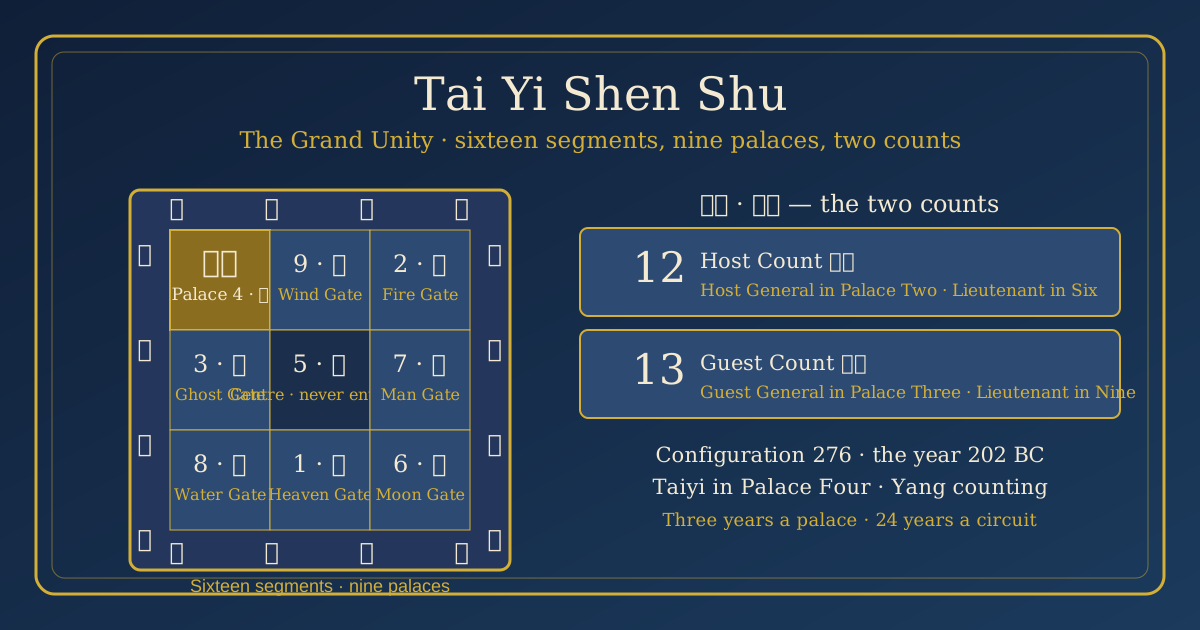
The system sits on this site's fortune-telling shelf as the missing third leg. The Qi Men Dun Jia guide covers the board system pointed at timing and direction. The Da Liu Ren guide covers the board system pointed at a single question. Tai Yi is the third board, the one that answered for emperors, and the one modern scholarship knows best through a single historian of science, Ho Peng Yoke, who reconstructed it from the texts and called it, in 1996, gone and almost completely forgotten. That last phrase is a scholar's judgement about the living practice, not about the books, and this guide treats it as such. The books survive in full, and the method inside them can still be followed step by step.
The name: the Supreme Unity and its numbers
Taiyi (太乙) means Supreme Unity. In the old cosmology it is the name of a deity, the god of the Heavenly Emperor in the words of the Tang manual Taiyi Jinjing Shijing (太乙金镜式经), and in later writing the pole star itself, the still point the heavens turn around. Shen shu (神数) means divine numbers, or numbers worked by the gods. Put together, the name says what the system claims to do: read the movement of a supreme unity through numbers, and from those numbers read the direction of events.
The name also marks the system's scale. BaZi counts a life in ten-year luck cycles. Da Liu Ren counts a question in double-hours. Tai Yi counts history in epochs: a small cycle of 72 years, five of them making a Superior Epoch of 360 years, and a count of accumulated years, the Taiyi ji nian (太乙积年), running from a distant starting epoch that the texts place at the time of a legendary emperor. One Ming table counts 10,155,541 years from its starting epoch to the year 1624. The numbers are large because the questions were large.
One of the Three Styles
The Three Styles (三式, san shi) are the three board systems. Each answers a different scale of question, and the comparison is the fastest way to place Tai Yi.
| System | Characters | Its question | Its instrument | Its scale |
|---|---|---|---|---|
| Qi Men Dun Jia | 奇门遁甲 | When and where should I act? | Nine-palace Lo Shu board with doors, stars, and spirits | Situations and timing |
| Da Liu Ren | 大六壬 | What is happening right now, and what will come of it? | Two-plate cosmic board with generals, lessons, transmissions | Specific questions |
| Tai Yi Shen Shu | 太乙神数 | Where is the arc of history heading? | Sixteen-segment board with nine palaces and eight generals | Nations and eras |
All three use the Heavenly Stems and Earthly Branches, and all three trace their theory to the I Ching. For most of Chinese history they were restricted knowledge, transmitted in lineages and studied by military strategists and court advisors, because the authorities believed the systems gave their users a real strategic advantage. In the eleventh century and for hundreds of years after, candidates were examined on the three systems behind the closed doors of the Chinese Astronomical Bureau. That restriction is history, not a claim about efficacy: the systems were classified because courts thought they mattered, which says something about courts and something about the systems' reputation, and nothing measurable about their answers.
The three were designed to be complementary. A court advisor who mastered all three could answer at every scale: Tai Yi for the era, Qi Men for the campaign, Liu Ren for the diplomatic overture about to be made. In practice very few people mastered all three. Each system alone takes years. Qi Men has the largest community of active practitioners today. Liu Ren has a smaller but fiercely dedicated following. Tai Yi is the province of scholars and a handful of specialists, and Ho's judgement that the living method is nearly forgotten is the clearest statement of where it stands now.
History: a fifth-century history, an eighth-century manual, and the Song examinations
The method can be traced further back than its books. The earliest fixed point is a history, not a manual. Xiao Zixian (蕭子顯), historiographer of the Southern Qi dynasty, wrote "Remarks" in the chronicle of Emperor Gao in the Nan Qi shu (南齊書, History of the Southern Qi) in which he uses the Tai Yi method to explain political events across 679 years, from the founding of the Han dynasty to his own time. Ho reconstructed the method Xiao used from the text of those Remarks and found it essentially the same as the method in the Tang manual and in a Ming work three centuries later. On that evidence the method reaches back at least to the Six Dynasties period, and Xiao's use of it is the oldest dated application on record.
The book the system is learned from is the Taiyi Jinjing Shijing (太乙金镜式经, Taiyi Golden Mirror Manual), written by Wang Ximing (王希明) in the Tang period. It survives in the Qinding Siku Quanshu, the Qing imperial library, though the edition there carries later additions, which leaves some uncertainty about dating. The tradition itself tells a grander origin story: that the system was devised when the Yellow Emperor fought Chiyou, and that its method follows the "Taiyi moving through the nine palaces" passage in the Yijing apocrypha Qian Zao Du (乾凿度). That is the tradition's account of its own beginnings, and this guide records it as tradition, not as dated fact. What is dated is the chain of books: the Nan Qi shu Remarks in the fifth century, Wang Ximing's manual in the eighth, and the Ming text Taiyi Taojinge (太乙淘金歌, Mnemonic Rhymes on Retaining the Essentials of the Taiyi Method like Gold Washing), written by Liu Yangkun with a preface dated 1627, preserved in the Gujin Tushu Jicheng compendium.
Between the Tang manual and the Ming rhymes sits the system's institutional peak. In the Song period the Tai Yi method formed part of the three cosmic board examinations held inside the Astronomical Bureau, and Ho's summary of the period is plain: by the time of the Northern Song the methods of the three cosmic boards had already come to maturity. The examination questions set in the Yuan Astronomical Bureau asked candidates to calculate the palaces where the four Tai Yi figures for year, month, day, and hour would be found for a given date, which shows the method was still a tested civil skill centuries after the Song.
After that the record thins. The system survives in the books, in the configuration tables of the Taiyiju (太乙局, Taiyi Cosmic Board Configurations), and in modern reconstructions, but the living line of teachers broke. Ho's 1996 paper on the method ends on that note, and it is worth quoting the sense of it exactly: the Tai Yi method is now gone and almost completely forgotten. Modern charting software and online calculators exist, and they will cast a Tai Yi board from a date in seconds, but they are reconstructions from the printed configurations, not a surviving school. A guide that pretends otherwise would be inventing a present the sources do not support.
The board: sixteen segments, nine palaces, 144 configurations
The Tai Yi board has two layers, like the other two boards, and the same fixed-versus-moving logic. The fixed layer is a ring of sixteen segments around the rim. Twelve of them are the Earthly Branches. The other four are the corner trigrams: Gen (艮), Xun (巽), Kun (坤), and Qian (乾). In order around the board they run: Zi, Chou, Gen, Yin, Mao, Chen, Xun, Si, Wu, Wei, Kun, Shen, You, Xu, Qian, Hai. Eight of the sixteen are called the upright palaces (八正宫): Zi, Wu, Mao, You, Qian, Kun, Gen, and Xun. The other eight, Yin, Shen, Si, Hai, Chen, Xu, Chou, and Wei, are the intercalary gods (间神), and the counting rules treat them differently.
Inside the ring sit the nine palaces, numbered in the Tai Yi order, which is the Lo Shu square turned 45 degrees from the order Qi Men uses:
| Palace | Name | Gate | Province in the old nine-province map |
|---|---|---|---|
| One | Qian (乾) | Heaven Gate | Ji province |
| Two | Li (离) | Fire Gate | Jing province |
| Three | Gen (艮) | Ghost Gate | Qing province |
| Four | Zhen (震) | Sun Gate | Xu province |
| Five | Centre | - | - |
| Six | Dui (兑) | Moon Gate | Yong province |
| Seven | Kun (坤) | Man Gate | Yi province |
| Eight | Kan (坎) | Water Gate | Yan province |
| Nine | Xun (巽) | Wind Gate | Yang province |
Palace Five, the centre, is the pivot of the board, and Taiyi never enters it. The deity moves through the other eight palaces in order, three years in each, taking 24 years to complete one circuit. That slow pace is the point of the system: where Qi Men turns its board every double-hour and Liu Ren casts a fresh chart for every question, Tai Yi moves at the speed of reigns and campaigns.
The board also carries the eight gates, Open, Rest, Life, Harm, Block, View, Death, and Fear, the same eight names Qi Men uses, set to different palaces.
The configurations are the board's lookup tables. The Taiyiju lists 72 configurations for Yang Dun counting and another 72 for Yin Dun counting, one set for each half of the year, and the full series across the five epochs runs to 360 configurations, numbered 1 to 360. The five epochs (五元) are:
| Epoch | Name | Configurations | Years |
|---|---|---|---|
| First | Jiazi (甲子) | 1 to 72 | Years 1 to 72 of the Superior Epoch |
| Second | Bingzi (丙子) | 73 to 144 | Years 73 to 144 |
| Third | Wuzi (戊子) | 145 to 216 | Years 145 to 216 |
| Fourth | Gengzi (庚子) | 217 to 288 | Years 217 to 288 |
| Fifth | Renzi (壬子) | 289 to 360 | Years 289 to 360 |
Configurations in the five epochs repeat identically: Configuration 1, 73, 145, 217, and 289 are the same board, and so on through the set. After five epochs the series starts again at Configuration 1 on a jiazi year. Finding a year's configuration is arithmetic on the year count: if n is the configuration number from 1 to 360, then n = 60j + p, where j counts the sexagenary cycle (0 to 5) and p is the year's position in that cycle (1 to 60); or n = 72y + q, where y counts the epoch (0 to 4) and q is the year's position in that epoch (1 to 72). The worked example below runs both formulas on a real year.
The year also fixes the Superior Epoch, and here the sources disagree with each other, which matters for any modern use. Xiao Zixian in the fifth century and Wang Ximing in the eighth regarded the years 237 BC and AD 364 as Superior Epochs, which puts later ones at 724, 1084, 1444, and 1804, and the next at 2164. The Ming text Taiyi Taojinge gives 1264 as a Superior Epoch instead, with a 60-year difference for the Ming period. On the pre-Ming value the Superior Epoch immediately before the present is 1984; on the Ming value it is 1924. A guide that picks one without saying so would be hiding a real disagreement in the sources. The 2026 box below shows both.
Advertisement
The cast: Taiyi and the eight generals
Taiyi sits at the head of the board as the sovereign. Around him stand eight figures, and the Tang manual groups five of them as the Five Generals (五将), each tied to a planet, an element, a direction, and a season:
| General | Characters | Planet essence | Element | Direction | Season | Side |
|---|---|---|---|---|---|---|
| Supervisor General | 監將 | Jupiter | Wood | East | Spring | Taiyi's own |
| Attack Initiator | 始擊將 | Mars | Fire | South | Summer | Guest |
| Wenchang | 文昌將 | Saturn | Earth | Centre | All four seasons | Host |
| Guest Greater General | 客大將 | Mercury | Water | North | Winter | Guest |
| Host Greater General | 主大將 | Venus | Metal | West | Autumn | Host |
The names carry their jobs. The Supervisor General (監將) is Taiyi's own general, the Jupiter essence, wood, east, spring. The Attack Initiator (始擊將), also called the Upper Eye, is the Mars essence, fire, south, summer, and belongs to the guest. Wenchang (文昌將), also called the Lower Eye, is the Saturn essence, earth, the centre, and belongs to the host, flourishing in all four seasons. The Guest Greater General (客大將) is the Mercury essence, water, north, winter. The Host Greater General (主大將) is the Venus essence, metal, west, autumn. The manual's rule for them is short: when host and guest arrays face each other, the side riding living qi wins, and the side riding dead qi loses.
The rest of the cast is placed by rule. The Planner (計神, Jishen), the envoy spirit of Jupiter, is found from the year branch by a fixed table:
| Year branch | Planner sits in | Year branch | Planner sits in |
|---|---|---|---|
| Zi (子) | Yin (寅) | Wu (午) | Shen (申) |
| Chou (丑) | Chen (辰) | Wei (未) | Wei (未) |
| Yin (寅) | Zi (子) | Shen (申) | Wu (午) |
| Mao (卯) | Hai (亥) | You (酉) | Si (巳) |
| Chen (辰) | Xu (戌) | Xu (戌) | Shen (申) |
| Si (巳) | You (酉) | Hai (亥) | Mao (卯) |
The two lieutenants, the Host Lieutenant (主参将) and the Guest Lieutenant (客参将), are not placed by a table at all: they come out of the two counts in the next section. A finished board also carries supporting figures Ho notes in the configuration diagrams: the Year Star Taisui (太岁), the invisible counter-rotating correlate of Jupiter, and Taiyin (太阴) sitting two places behind it, plus the Combination Deity Heshen (合神) and the Plan Determinator Dingji (定計), which the reader turns to when the board leaves the host-or-guest choice unclear. For weather work the board adds a separate set, the Ten Spirits of Taiyi (太乙十精): Tianmu, which is Wenchang under another name, Tianhuang, Difu, Tianshi, Taizun, Feiniao, Wuxing, Sanfeng, Wufeng, and Bafeng.
Each figure has a stated role in the old statecraft reading. Taiyi stands for the head of state. Wenchang, the Scholar, stands for the leader of the civil officials. Jishen, the Planner, is the envoy spirit of Jupiter, making plans in battle and watching whether victory or defeat belongs to host or guest. The Attack Initiator is the planner for the guest warriors. The four warriors, the two generals and the two lieutenants, are the armies themselves. The first question in any reading is the one the whole system is built around: which side is host, and which is guest? The side that takes the initiative to launch a campaign is the host, and the other side is the guest; but in later battles the side making the first attacking move is the guest, and the defender is the host. Getting that assignment right is the reading, and the counts are how it is tested.
The counts: host, guest, and fixed
Every Tai Yi board carries counts, and two of them matter more than everything else on the board. The Host Count (主算, zhusuan) is found by counting the Nine Palace numbers in the segments from the Scholar to the segment just before Taiyi, taking only the segments that carry a Nine Palace number and counting the Scholar's own segment as 1 if it has none. The Guest Count (客算, kesuan) is found the same way, counting from the Attack Initiator to the segment just before Taiyi. The board also carries a third number, the Fixed Count, but the sources give the host and guest counts the weight, and this guide follows them.
The last digit of each count places a general: the last digit of the Host Count is the palace of the Host General, and three times that digit is the palace of the Host Lieutenant. The last digit of the Guest Count is the palace of the Guest General, and three times that digit is the palace of the Guest Lieutenant. The worked example below does this with real numbers.
The counts also carry their own lore, a table of good and bad numbers that the old manuals print and Ho repeats:
| Count | Traditional reading |
|---|---|
| 14, 18 | Excellent |
| 11, 13, 37 | Inauspicious |
| Guest Count 24 | Equally bad |
| 5, 15, 25, 35 | Bad: the warriors land in Palace Five, the centre, with no place on the outside board to take part |
| Odd 1 to 9 | Bad, unless Taiyi and the relevant warriors sit in even-numbered palaces |
| Even 2 to 10 | Bad on the same terms, unless the palaces are even |
The palace Taiyi sits in tilts the board before the counts are even read: Palaces One, Three, Four, and Eight generally favour the host, while Palaces Two, Six, Seven, and Nine generally favour the guest. But the counts outrank the palace. A host-favouring palace with a bad Host Count is a bad board for the host, and the manuals say so plainly.
A worked example: Configuration 276, the year 202 BC
The example below is Ho's reconstruction of the first case in Xiao Zixian's Remarks, the fifth year of Emperor Han Gaozu, 202 BC, the cyclical year jihai. Every number in it comes from Ho's chapter, and the steps are his. The point is the order of operations, which is what a first-time reader actually needs.
Step 1: find the configuration number. The year 202 BC is the 36th year of its sexagenary cycle and falls in the fifth ji period, so j = 4 and p = 36, and n = 60 x 4 + 36 = 276. Configuration 276 on the Tai Yi board.
Step 2: find Taiyi. Divide 276 by 72, leaving a remainder q = 60. Divide 60 by 24, leaving 12. By Ho's table of remainders, 12 puts Taiyi in Palace Four by Yang order counting, which is the counting Xiao Zixian used throughout his Remarks.
Step 3: find the Scholar. The Scholar takes 18 years to make one circuit of the 16 segments, starting from the shen segment and pausing one year at each of qian and kun. Divide 276 by 18, leaving a remainder of 6. Counting six steps clockwise from shen, with one extra step on meeting qian or kun, puts the Scholar in the hai segment, with the Dayi deity.
Step 4: find the Attack Initiator. Count the segments separating the Scholar from the Planner. In this case the number is 4. Starting from the gen segment, count the same number of segments toward the Scholar, which puts the Attack Initiator in the hai segment, with the Yinzhu deity.
Step 5: find the Planner. The year branch is hai, and Ho's table puts the Planner in mao for a hai year.
Step 6: find the Host Count. Count the Nine Palace numbers from the Scholar to the segment just before Taiyi: 1 in the hai segment, 8 in the zi segment, and 3 in the gen segment, giving 12. The last digit, 2, puts the Host General in Palace Two. Three times 2 is 6, putting the Host Lieutenant in Palace Six.
Step 7: find the Guest Count. Count the same way from the Attack Initiator to the segment just before Taiyi: 1 in the xu segment, 1 in the qian segment, 8 in the zi segment, and 3 in the gen segment, giving 13. The last digit, 3, puts the Guest General in Palace Three. Three times 3 is 9, putting the Guest Lieutenant in Palace Nine.
Step 8: read the board. The Host Count is 12 and the Guest Count is 13. By the count lore, 13 is inauspicious, so the count runs against the guest, and Palace Four, where Taiyi sits, generally favours the host. Xiao Zixian's own sentence for this case says both host and guest received auspicious signs, which Ho calls ambiguous, and notes the historiographer could have simplified matters by leaving the clause out. That disagreement inside the sources is worth keeping: the arithmetic is checkable, the sentence is not, and a reader who confuses the two has stopped reading and started believing.
Advertisement
2026 on the Tai Yi board: two reckonings, two configurations
The same arithmetic answers a question a modern reader will ask first: what configuration is the current year in? The answer depends on which Superior Epoch the reader adopts, and the sources disagree, so this guide shows both and picks neither.
2026 is a bingwu year, the Fire Horse, the 43rd year of the sexagenary cycle. On the pre-Ming reckoning, the Superior Epoch immediately before the present is 1984, a jiazi year, which makes 2026 the 43rd year of the epoch: n = 43, Configuration 43, and Taiyi in Palace Eight by Yang counting (43 divided by 24 leaves 19). On the Ming reckoning, the Superior Epoch is 1924, which makes 2026 the 103rd year: n = 103, Configuration 103, and Taiyi in Palace Three (103 gives q = 31, and 31 divided by 24 leaves 7). Both palaces, Eight and Three, are among the four that generally favour the host. That agreement is a curiosity of the arithmetic, not a verdict on the year: two reckonings that cannot both be right still land Taiyi on the host's side of the board, and a tradition that disagrees with itself about the epoch cannot be quoted as speaking with one voice about the year.
The danger signs: pressing, blockage, confinement
A Tai Yi reading spends as much time on the bad patterns as on the good ones. The vocabulary is precise, and each term names a geometric fact about the board.
| Term | Characters | What it means on the board | Traditional reading |
|---|---|---|---|
| Po, pressing | 迫 | A deity sits in a segment next to Taiyi | Pressure on the sovereign: the Scholar next to Taiyi reads as the prime minister pressing the emperor; the Host General next to Taiyi reads as the military chief holding the emperor under his control |
| Yan, concealment | 掩 | The Attack Initiator sits in front of Taiyi | Warning of rebellion among feudal lords, senior ministers, or foreign peoples; behind Taiyi, warning that members of the imperial household or the emperor's in-laws will revolt or usurp power |
| Ge, blockage | 格 | A figure sits diagonally opposite Taiyi | The sense of the modern word geming, revolution: the Host General or the Scholar opposite Taiyi reads as rebellion by the military chief or the prime minister |
| Qiu, confinement | 囚 | A figure shares Taiyi's palace | Taiyi sharing a palace with the Planner reads as assassination of the emperor or defeat in battle; sharing with another warrior reads as execution among civil and military officials |
| Guan | 关 | Warriors share a segment without Taiyi, when the last digits of the Host and Guest Counts are identical | Officers who cannot take part effectively in the action |
Taiyi hemmed in on both sides is worse than pressed on one: the Host General on one side and the Guest General on the other reads as the emperor threatened by his own army and by the enemy at once. The pattern to watch first in any board is therefore not a single figure but the neighbourhood of Taiyi: who sits beside him, who sits opposite him, and who shares his palace.
What it was asked: war, weather, and the four scales
Tai Yi was built for the state, and its uses follow from that. Before a campaign, the emperor would offer sacrifices at his ancestral temple and order his expert to work the board and find the Host Count and the Guest Count. The Wubeizhi (武备志, Compendium on Armaments) preserves a section called Taiyi Miaosuan (太乙妙算, Taiyi Wonderful Calculations) that turns the count into orders: if the count is 16, take the last digit 6, which corresponds to the dui trigram and the west, and engage the enemy by facing the opposite direction, east; use the square Metal formation (方阵) with white banners; send the troops in from the west; keep reserves and equipment in the northwest; station the surprise-attack troops in the east-northwest; and lay the ambush between the chen and si double-hours, 07:00 to 11:00. With a count of 6, the Wubeizhi says, vehicles and horses go in front, foot soldiers at the rear, the commanding officer in the middle, drums loud, movements brisk, and offerings made to Taiyi and his deities.
The most quoted case of a board stopping a war comes from the Yuan dynasty. The Biography of Zhang Kang in the Xin Yuanshi (New Official History of the Yuan Dynasty) records that Khubilai Khan, in the year 1282, a guiwei year, consulted Zhang about invading Japan and called the campaign off when told there was no count on the Tai Yi board for the Host General and the Host Lieutenant. The year gives Configuration 32, and calculated before the summer solstice by Yang counting, the Host Count comes out at 25, one of the numbers that puts the warriors in the central Palace Five with no place on the board, a strong warning against opening a campaign. The history records the decision, not the proof: the board advised against it, and the emperor listened.
Weather was the second use, and the most general. When the year fixed the board and Taiyi entered a palace for the first year, a single-digit Host Count from 1 to 9 was read as omens in the sky: comets, meteors, irregularities in planetary movement, eclipses, thunder, lightning, hail, and unseasonable clouds. In the second year of Taiyi's stay in a palace, Host Counts of 11 to 14, 22 to 24, and 31 to 34 were read as omens on the earth: earthquake, floods, drought, locusts, and famine. In the third year, Host Counts of 10, 20, 30, or 40 were read as human disaster: war, robberies, migration of people, and epidemics. The Ten Spirits of Taiyi refined these readings: Taiyi in Palace Two in Configuration 6, both extreme yin, was read as abundant rain, especially in the summer months when Palace Two is in its phase of prosperity; Wufeng meeting Taiyi meant strong gales and changes in the sun or the moon; Feiniao and Taizun coming together predicted rain. Ho's judgement on this whole branch is that the predictions could only be given in very general terms, and that Qi Men and Liu Ren played the larger part in weather forecasting. Tai Yi's weight fell on the emperor and on state affairs.
The system also scales down, and the four scales have names: Nianji Taiyi (年计太乙), calculated by the year; Yueji Taiyi (月计太乙), by the month; Riji Taiyi (日计太乙), by the day; and Shiji Taiyi (时计太乙), by the double-hour. Together they are the Siji Taiyi, the Four Tai Yi. The year figure served the emperor and the state. The month figure applied to senior officials, the day figure to low-ranking officials and people of high social position, and the hour figure to the common people. The hour figure is the one a battlefield commander used: the double-hour fixed the configuration, and the count fixed the formation, the banners, and the direction of attack.
Advertisement
Tai Yi beside its neighbours
Placed beside the other systems on this site, Tai Yi shows a clear profile.
| Method | What it reads | What the asker supplies | Speed | Answer stock |
|---|---|---|---|---|
| Tai Yi Shen Shu | The arc of an era | A year, and a question about the state | Years: three years per palace | Sixteen segments, nine palaces, host and guest counts |
| Qi Men Dun Jia | Timing and direction for an action | A date and hour, and a direction | A nine-palace chart | Doors, stars, spirits, stems |
| Da Liu Ren | The moment a question is asked | A day, an hour, and a question | A full chart, built by hand or software | Four lessons, three transmissions, twelve generals |
| BaZi | A birth chart across decades | Birth year, month, day, and hour | Four pillars, ten-year luck cycles | Ten stems, twelve branches, ten gods |
| Zi Wei Dou Shu | A birth chart across twelve palaces | Birth date and hour, plus sex | Twelve palaces with stars | Stars, palaces, four transformations |
| I Ching, coin method | A hexagram for a question | A question, and six casts of three coins | Minutes, line by line | 64 hexagrams with line texts |
| Kau chim | A temple stick draw | One settled question | Minutes, at a temple | Usually 100 poem slips, set by temple |
Two contrasts do the most work. Against Qi Men and Liu Ren, Tai Yi is the slow one: its smallest step is a year, and its full circuit is 24 years, which is why it was the system of the Astronomical Bureau and not of the marketplace. Against BaZi and Zi Wei, it needs no birth data at all: the chart belongs to the year, so the same board answers for everyone living through it, and the question is never about one person. The methods compared guide lines all of these up side by side; the Cheng Gu bone-weighing guide shows the opposite end of the same shelf, a system that reads a birth time and never asks a question at all.
Record worksheet: write a reading down properly
Copy this table when you sit with a reading. It keeps the construction, the interpretation, and your decision in separate rows, which is the whole discipline in one page.
| What to record | Example of the right level of detail | Why it matters |
|---|---|---|
| The question, verbatim | The exact sentence settled on before the board was cast | A reading can only be judged against the question that produced it |
| Year and configuration | The cyclical year, the configuration number, and which Superior Epoch reckoning was used | Two reckonings give two configurations for the same year; the choice has to be visible |
| Taiyi's palace | Palace number, by Yang or Yin counting, and how many years Taiyi has been there | The palace tilts the board toward host or guest before the counts are read |
| The cast | Scholar, Planner, Attack Initiator, and the four warriors with their palaces | Shows the board was built, not guessed |
| The counts | Host Count and Guest Count, with the last digits and the lieutenants they place | The two numbers the old manuals gave the weight to |
| Danger signs | Any pressing, blockage, confinement, or shared segment, named in the board's own terms | A board's warnings are part of the reading, not an afterthought |
| The interpretation | Who read it, and their words, kept separate from the board | Readings vary by reader; a labelled record lets you compare fairly |
| Your decision | What you actually did, and on what grounds | Keeps the board in its place: an input, never the reason of record |
Where a board stops being useful
Tai Yi is a traditional reflection practice with a checkable construction and a long paper trail. Used that way, and paired with the site's fortune-telling hub, it can slow a decision down, force a vague worry into one written sentence, and hand the asker a structured picture of the moving parts. There are jobs it cannot do, and naming them plainly protects both the visitor and the tradition.
It cannot verify facts. A favourable Host Count says nothing checkable about a government's finances, an army's strength, a harvest, or a company's accounts. Questions with documents attached are answered by reading the documents or paying the professional who can.
It cannot be re-cast until it agrees with you. The board belongs to the year and to the configuration the year gives. Picking the other Superior Epoch reckoning because its configuration looks better breaks the practice's own discipline: the disagreement between the reckonings is a fact about the sources, not a menu.
It cannot carry health decisions. The classical lists include disease and epidemics among the things a third-year count was read to foretell, which shows how seriously the tradition once took the traffic between board and body. The modern boundary is not complicated: a board is not a diagnosis, symptoms deserve a clinician, and no count is evidence about a body.
And it cannot promise outcomes. No count, from the most favourable to the poorest, guarantees victory, peace, recovery, or success, and a bad one takes none of those away. The system was built to read the pattern of an era. Treating a pattern as a promise is the one reading error every layer of this guide has been built to prevent: state the question, find the configuration, place the cast, take the counts by rule, record what was constructed and what was said, and then decide with the evidence that actually bears on the decision.
Sources and further reading
The history, the board, the epochs, the counts, the worked example of Configuration 276, the danger signs, the Khubilai Khan case, the battle formations, and the weather readings follow Ho Peng Yoke, Chinese Mathematical Astrology: Reaching Out to the Stars (Routledge, 2003), chapter 3, "The Taiyi System in the Three Cosmic Boards: Method of the Taiyi Deity", read for this guide in the full text held by the Internet Archive, and his paper "The Tai-i Method of Divination and the Historiographer's Remarks in the Chronicle of Emperor Kao-ti in Nan-Ch'i-shu", Bulletin of the Institute of History and Philology, Academia Sinica 67.2 (1996): 383-413, which traces the method to the Six Dynasties through Xiao Zixian's Remarks and states that the method is now gone and almost completely forgotten.
The system's place as one of the Three Styles, the sixteen palaces, the 72 Yang Dun and 72 Yin Dun arrays, and the Host, Guest, and Fixed Counts follow the Taiyi shenshu entry on English Wikipedia, read for this guide, which rests on the same Ho chapter.
The Five Generals, their planets, elements, directions, and seasons, the sixteen gods, the eight gates, the nine palaces with their gates and provinces, and the rule that the side riding living qi wins follow the text of Taiyi Jinjing Shijing (太乙金镜式经), juan 2, as printed in modern editions of the classical text, and the modern summary of the system that draws on it. The statement that the method follows the Taiyi-moving-through-the-nine-palaces passage in the Qian Zao Du, and the Yellow Emperor origin story, come from the same summary and are recorded here as the tradition's own account.
Where the sources disagree, the guide says so: the Superior Epoch is 1984 on the pre-Ming reckoning and 1924 on the Ming reckoning, and the two give different configurations for 2026. The 2026 figures in this guide are the author's own arithmetic from Ho's formulas, and any reader with the same inputs should get the same numbers.