Of all the systems in Chinese fortune telling methods compared, name analysis is the one a family is most likely to pay for, because it arrives at the one moment a metaphysical decision is unavoidable: a baby needs a name, and the name, once registered, is for life. The method they will meet is almost always the same one, sancai wu ge, the Three Talents and Five Grids. It asks nothing about birth dates or stars. It asks how many strokes are in the characters of the name, and it builds everything from that single, checkable fact.
This guide teaches the method completely enough to run it by hand: the counting rules, the five formulas with their adjustments, the element mapping, the sancai chain, the 81-number list, and one worked example where every sum is shown. It also does the thing the apps do not, which is explain why the same name can score 80 in one place and 52 in another. The sums in this guide are arithmetic and can be verified by anyone. The meanings hung on the sums are the tradition's, and they are reported as the tradition states them.
The method in seven steps
- Write the name in full characters, surname first, exactly as registered. If the registered characters are traditional, count traditional; if simplified, note that the choice itself is one of the disputes covered below.
- Count each character's strokes by the Kangxi standard, applying the radical conventions in the next section.
- Compute the five grids with the formulas in the table below, including the plus-one adjustments for single-character surnames and single-character given names.
- Reduce any grid above 81 by subtracting 80 (repeatedly if needed) before looking it up.
- Map each grid to its element by its last digit: 1 and 2 Wood, 3 and 4 Fire, 5 and 6 Earth, 7 and 8 Metal, 9 and 0 Water.
- Read the sancai: the Heaven, Personality, and Earth elements in sequence, generating (supporting) or controlling (pressuring) one another.
- Look up each number in the 81 list, weigh the Personality Grid first and the sancai second, and only then read the rest. A name is judged as a structure, not as five separate scores.
Step zero: counting strokes the Kangxi way
Everything in the system stands or falls on the stroke counts, and the counts are not the ones you learned in handwriting class. The standard is the Kangxi Dictionary, the great character dictionary completed in 1716, whose counts name analysis inherited wholesale. Most characters count the same either way. The differences are systematic and live in the radicals, which Kangxi counts in their full, unabbreviated form:
| Radical as written | Counted as | Kangxi strokes | Written strokes |
|---|---|---|---|
| Water radical (three drops) | The full character shui (water) | 4 | 3 |
| Hand radical | The full character shou (hand) | 4 | 3 |
| Grass radical | The full form cao (grass) | 6 | 3 or 4 |
| Walk radical | The full form chuo | 7 | 3 or 4 |
| Jade radical (also the character for king) | Yu (jade) | 5 | 4 |
| Moon radical, when it stands for flesh | Rou (flesh) | 6 | 4 |
Two consequences follow. First, a character containing the water radical (a very large share of the characters parents choose, since water names feel gentle and flowing) counts one stroke more than a modern count suggests. Second, simplified and traditional forms of the same character can carry different counts, so the same spoken name is a different numerical object in the two scripts. Neither point is a defect in the method; both are facts about it that any honest calculation has to state up front. The worked example below uses characters whose counts are the same under both standards, deliberately, so the arithmetic can be checked without a dictionary.
The five grids and their formulas
Notation: a name has a surname part and a given part. Most names are one surname character plus two given characters, or one plus one. Compound surnames (Ouyang, Situ, Zhuge and their kin) take the adjustment shown.
| Grid | Formula (standard name: 1 surname + 2 given) | Stands for, in the tradition |
|---|---|---|
| Heaven (tian ge) | Surname strokes + 1 | Inherited fortune, family ground, the early environment |
| Personality (ren ge) | Surname strokes + first given character strokes | The core self and main life line; the master grid |
| Earth (di ge) | Both given characters' strokes | The earlier half of life, domestic ground, foundations |
| Outer (wai ge) | Total strokes − Personality + 1 | The social self, relations with the outside world |
| Total (zong ge) | All strokes in the full name | The whole life read together, weight on the later years |
The adjustments, which are where calculators quietly diverge:
- Compound surname: Heaven is the sum of both surname characters, with no plus one. Personality uses the surname's second character plus the given name's first.
- Single-character given name: Earth is that character's strokes + 1, and Outer is 2 in the standard scheme (equivalently, total minus personality plus one still holds).
- Any grid above 81: subtract 80 until it falls in the 1 to 81 range, because the rating list has 81 entries and the system treats 81 as a full cycle returning to 1.
Each grid's number does two jobs. Its last digit assigns its element, by the mapping in step 5 above. And the number itself is looked up in the list of 81, where every number carries a traditional rating, from strongly auspicious through neutral to strongly inauspicious, usually with a short poetic tag. A handful of numbers do most of the work in practice, because parents steer toward them: 1, 3, 5, 6, 7, 8, 11, 13, 15, 16, 18, 21, 23, 24, 31, 32, 33, 35, 37, 39, 41, 45, 47, 48, 52, 63, 65, 67, 68, and 81 are among those the standard list rates auspicious, while numbers such as 2, 4, 9, 10, 12, 14, 19, 20, 22, 26, 28, 30, 34, 36, 40, 42, 43, 44, 46, 49, 50, 54, 56, 59, 60, 62, 64, 66, 69, 70, 72, 74, and 80 sit on its difficult side. The middle of the list is mixed, half-luck numbers whose tags read like weather forecasts: fine, with effort.
Advertisement
The sancai: the three talents
The system's real quality judgement is not any single number but a relationship. Take the elements of Heaven, Personality, and Earth in that order: this triple is the sancai, the Three Talents. Read down the chain. If each element generates the next (Wood feeds Fire, Fire makes Earth's ash, Earth bears Metal, Metal collects Water, Water grows Wood), the configuration is read as support flowing from family ground through the self into life: the classic good sancai. If an element controls the next (Wood parts Earth, Earth dams Water, Water douses Fire, Fire melts Metal, Metal chops Wood), the chain is read as pressure at that joint, and analysts look at where it sits: Heaven controlling Personality reads as a family background that constrains; Personality controlling Earth reads as a self that overrides its domestic ground, for better or worse. Same-element triples are read as steady but unrelieved. Two names with identical 81-list scores can receive opposite verdicts on their sancai alone, which is why the method's full name names both halves: the grids count, the talents relate.
A complete worked example: Li Xiaoming
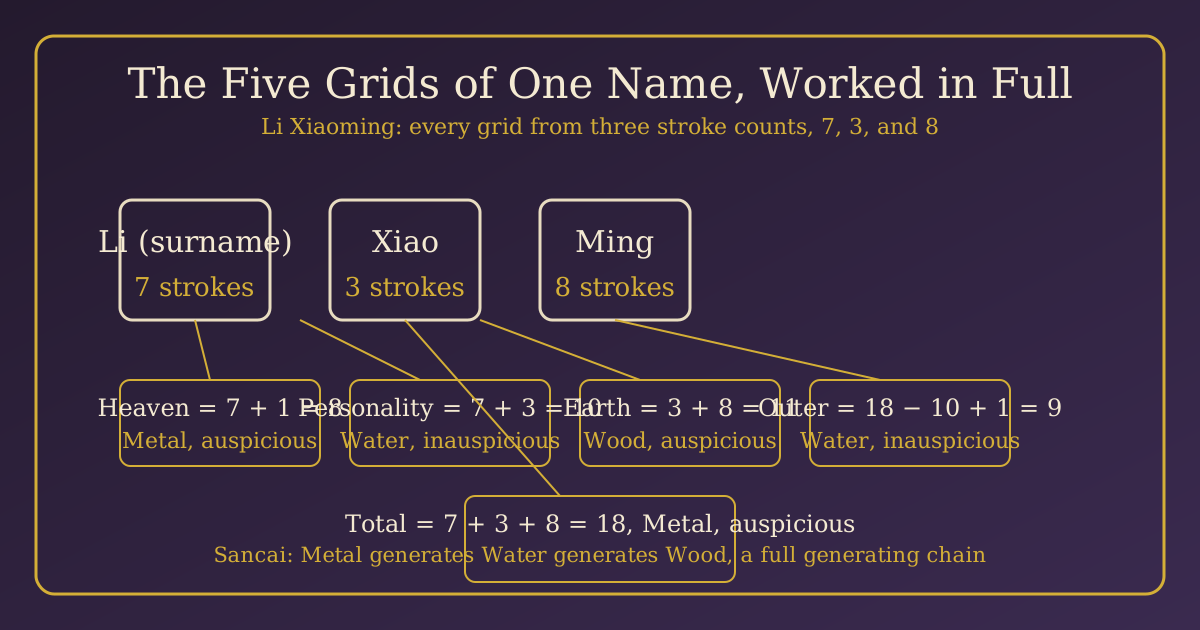
Take a common, unremarkable name and run the whole method on it. Li Xiaoming: surname Li, given name Xiaoming.
Stroke counts (identical under Kangxi and modern counting, which is why this name is a clean teaching example): Li = 7, Xiao = 3, Ming = 8.
| Grid | Calculation | Result | Element (last digit) | The 81 list's rating |
|---|---|---|---|---|
| Heaven | 7 + 1 | 8 | Metal (8) | Auspicious |
| Personality | 7 + 3 | 10 | Water (0) | Inauspicious |
| Earth | 3 + 8 | 11 | Wood (1) | Auspicious |
| Outer | 18 − 10 + 1 | 9 | Water (9) | Inauspicious |
| Total | 7 + 3 + 8 | 18 | Metal (8) | Auspicious |
Every sum can be checked in seconds: 7 + 1 = 8; 7 + 3 = 10; 3 + 8 = 11; the total is 18; and the Outer grid, 18 − 10 + 1 = 9, matches the alternative check for this name shape, 1 + the last given character (1 + 8 = 9). Two routes, one answer, as they should be.
Now the reading, in the tradition's terms and in the tradition's order. Sancai first: Heaven Metal, Personality Water, Earth Wood. Metal generates Water, and Water generates Wood: the full chain generates, support at both joints, which the system reads as the strongest structural feature a name can have, family ground feeding the self, the self feeding the life built on it. Personality Grid second: it is 10, a number the list rates poorly, read as an emptiness or a stalled start at the core. The whole picture: three auspicious grids including the Total, a fully generating sancai, and a poor master grid. A practitioner reading this name would call it a genuinely mixed chart, strong structure carrying a weak centre, and if the family were choosing this name for a baby, the standard advice would be to keep the surname and the second given character, and try first given characters with stroke counts that move the Personality Grid off 10 while keeping the Earth Grid's chain generating, which is a small search over character counts that naming books are mostly made of. That, in miniature, is the entire profession: the arithmetic is trivial, and the craft is juggling five constraints and a dictionary at once.
A second example: the adjustments at work
The formulas above change shape for compound surnames and single-character given names, and a short example shows all three adjustments at once. Take the (invented but ordinary) name Situ Liang: compound surname Situ, one given character, Liang.
Stroke counts: Si = 5, Tu = 10, Liang = 9.
| Grid | Calculation | Result | Element | Rating |
|---|---|---|---|---|
| Heaven | 5 + 10 (compound surname: both characters, no plus one) | 15 | Earth | Auspicious |
| Personality | 10 + 9 (surname's second character + given character) | 19 | Water | Inauspicious |
| Earth | 9 + 1 (single given character takes the plus one) | 10 | Water | Inauspicious |
| Outer | 24 − 19 + 1 | 6 | Earth | Auspicious |
| Total | 5 + 10 + 9 | 24 | Fire | Auspicious |
The sancai reads Earth, Water, Water: Heaven Earth controls Personality Water, pressure at the first joint, then water into water, steady and unrelieved. Set beside Li Xiaoming, the pair shows the system's range honestly: the same five formulas, one name praised for structure and faulted at the centre, the other faulted at two grids and its first sancai joint, with its strengths in the Total and Outer. Real consultations live in exactly this territory, trade-offs between grids, which is why a competent analyst talks about a name the way an engineer talks about a bridge, as a set of loads and supports, and not as a single score out of a hundred.
Choosing a baby name with the grids: the workflow that actually happens
Because the system is constraint juggling, naming work follows a recognisable order, and it is not numbers first. Families and analysts begin with the constraints that are not negotiable: the surname, any generation character the family line prescribes, the sound the full name makes in the family's dialect as well as in Mandarin (a name that is elegant in one and a joke in another fails before arithmetic starts), and the characters' meanings and written beauty. Only then does the counting begin, usually as a filter over a shortlist: compute the grids for each candidate, discard the ones with a poor Personality Grid or a controlling sancai at the first joint, and argue about the survivors on meaning and sound.
Two practical consequences follow for anyone using an app in this process. First, the app is a calculator, not the consultant: it earns its keep in the filtering step, and the judgements around it (which dialect, which generation character, which meaning) stay with the family. Second, run the same candidate through two calculators with the rules set identically, Kangxi counts, stated adjustments, before believing either: agreement between two tools using the same rules means the arithmetic is settled, and what remains is interpretation, which no tool ships.
Where the method came from, and why the apps disagree
Honesty about origins improves the guide, so: stroke-count name lore is old in China, but the Five Grids system in its current, standardised form is a twentieth-century codification, developed in Japan (where it is still used for name judgement) and carried from there to Taiwan and across the Chinese-speaking world, where it met the older bazi tradition and settled in beside it. The 81-number list it uses descends from Chinese number symbolism; the grid machinery arranged around that list is the modern part. None of this makes the system less culturally real. It does mean that appeals to its unbroken ancient lineage, which app marketing leans on, overstate the case.
The disagreements between calculators are more mechanical, and there are four. Stroke standard: Kangxi counts versus modern written counts move any name containing the radicals in the table above. Script: simplified versus traditional characters recount a name wholesale. Adjustments: the compound-surname and single-character rules are implemented inconsistently, and each one moves two grids. Reduction: totals above 81 are reduced by subtracting 80 in the standard scheme, but not every app does it the same way. Stack those four choices and the same name legitimately produces different grids in different tools, which is how one name can be scored 80 and 52 by two apps that are both, on their own stated rules, calculating correctly. The defence is the one this guide has modelled: publish the counts, publish the rules, show the sums. A score you cannot recompute is a score you are being asked to take on faith, and faith, unlike arithmetic, does not transfer between apps.
Sources and standing
The grid formulas, adjustments, and the Kangxi radical conventions follow the Five Grids method as documented in name-analysis references (Hanmystica's stroke-count guide and Chinese Metaphysical and Cultures' naming numerology survey, both read October 2026); the 81 numbers' ratings follow the standard list as reproduced in the Cantonese naming references at cantonese.sheik.co.uk (read October 2026). The account of calculator divergence follows the rule-set comparison in the widely shared analysis of sancai wuge scoring differences (Medium, read October 2026). The worked example's characters and counts were chosen so that every figure can be verified from the formulas alone. The Five Grids is reported here as what it is: a living naming tradition with exact arithmetic and interpretive meanings, used by millions of families, and not a measurement of anything outside itself.