Ask a Chinese speaker what a dream meant and, sooner or later, the Duke of Zhou gets consulted. Zhou Gong Jie Meng, usually rendered as the Duke of Zhou Dream Interpretation, is the household dream dictionary of the Chinese tradition: a long list of short verse entries, filed by subject, each one pairing a dream image with a verdict. Dream of the sun and moon entering your bosom and the entry reads children honoured. Dream of a mirror and everything depends on whether the mirror was bright.
The book carries the name of Ji Dan, the Duke of Zhou, regent of the early Zhou dynasty and the culture's great lawgiver, credited by tradition with the I Ching line texts and with establishing the Rites of Zhou. He did not write this book. It is a folk compilation, assembled over centuries and attached to his name long after his death, and the attachment is itself the interesting first fact, because the Duke became the God of Dreams through a single wistful sentence. The Analects record Confucius saying: "How I have gone downhill! It has been such a long time since I dreamt of the Duke of Zhou." Confucius meant that the Duke's governing ideals had faded from his mind. Later readers took the sentence literally, and legend settled into its present shape: if something important is about to happen to you, the Duke of Zhou will let you know through a dream. The everyday expression meng Zhou Gong, dreaming of Zhou Gong, still means falling asleep, which is why a person dozing in a meeting is teased for being off with the Duke.
This guide treats the book the way this site treats every method in the fortune-telling pillar: as a tradition with a history that can be checked, a method that can be shown working, and a boundary where the evidence stops. The history here is unusually well documented, because dream reading was more than a folk habit. For a stretch of early China it was a government job.
A ministry of dreams: the office in the Rites of Zhou
The Rites of Zhou, the great blueprint of Zhou dynasty administration, lists court officials the way a modern state lists departments, and among them sit the zhanmeng, the dream diviners. The text gives the office its duties in a few compressed lines: keep track of the seasons, watch the conjunctions of heaven and earth, distinguish the harmonies of yin and yang, and divine the fortune of the six dreams by the sun, moon, and stars.
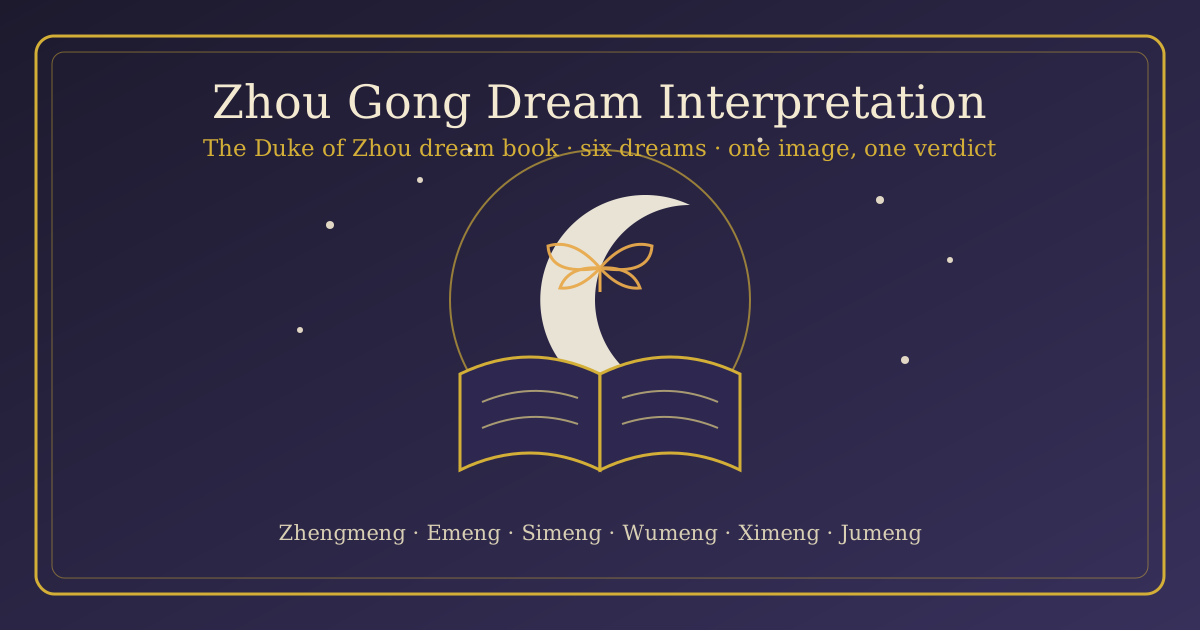
The six dreams are the office filing system, and they are worth reading slowly, because the classification is doing quiet analytical work.
| The six dreams | Name | What the category covers |
|---|---|---|
| 1 | Zhengmeng, ordinary dreams | Dreams that arrive in undisturbed sleep, with no strong charge to them |
| 2 | Emeng, startling dreams | Nightmares, dreams that shock the sleeper |
| 3 | Simeng, longing dreams | Dreams built from what you have been thinking about, wanting, or turning over by day |
| 4 | Wumeng, waking dreams | Dreams you surface from and can recount, still fresh on waking |
| 5 | Ximeng, happy dreams | Dreams of good feeling, pleasure, and ease |
| 6 | Jumeng, frightening dreams | Dreams whose content is fear itself |
Two things stand out in this table. The first is that the office sorted before it judged. A dream was assigned a kind, and the kind already carried part of the reading, which is a more careful procedure than reaching straight for a symbol dictionary. The second is the third row. Simeng is the category for dreams manufactured by your own preoccupations, and its presence on an official list, in a text compiled in the late Zhou to Han period, means the tradition never fully believed its own dictionary. It kept a labelled drawer for dreams that are just the day replaying itself. Much of what modern dream research says, two millennia later, amounts to expanding that drawer. The oracle bone divination guide covers the older Shang dynasty practice this office inherited from, and the comparison of Chinese fortune-telling methods shows where dream reading sits among the chart and casting methods.
Older than the book: a Qin daybook and the Dunhuang manuscripts
The Duke name is late, but written dream interpretation in China is genuinely ancient, and the physical evidence survives in tombs and in a sealed cave library.
The earliest layer in the record is a daybook, a hemerological almanac of lucky and unlucky days, buried in a Qin tomb at Shuihudi and dated by the tomb to 217 BCE. Robert Campany study of the early dreamscape, The Chinese Dreamscape, 300 BCE to 800 CE, describes the dream guide inside that daybook as working on four vectors at once: the day on which the dream occurred, reckoned by the heavenly stems cycle; the predominant colour of the imagery, black or green-blue; the category of phenomenon seen, clothing or the sun, for example; and the five phases. Its verdicts, Campany notes, are prognostic and uniformly auspicious. A similar dreambook genre appears on bamboo slips acquired by the Yuelu Academy, so the Shuihudi guide was not a one-off. It was a format.
The format was still being copied more than a thousand years later. Twelve manuscripts of dream books, plus fragments, dating to the ninth and tenth centuries, were recovered from the Dunhuang cave library, and a modern bilingual edition of the Duke of Zhou text prints two versions of it, one of them the Dunhuang version. That edition chapter list is a good map of what a medieval dreamer actually looked up: chapters on heaven and earth, sun, moon, and the constellations; on spouses, childbirth, pregnancies, and sex; on food and drink; on dragons and snakes. It also carries chapters the folk book tends to drop, on reading a dream by the twelve earthly branches and by the twelve watches of the night, and a chapter of talismans for treating nightmares. Timing and treatment sat inside the same covers as the dictionary. The book was a kit, not just a list.
Advertisement
How the received book is built
The Zhou Gong Jie Meng that circulates today, in print and on a thousand lookup websites, is the dictionary layer of that kit, and its construction explains both its durability and its limits.
It opens with a short poem that name-checks the tradition greatest hits, Zhuang Zhou butterfly and Lü Wang flying bear among them, and then settles into its real work: headings. The opening sections of the received text run like this.
| Section heading, as the text gives it | What gets filed there |
|---|---|
| Heaven, earth, sun, moon, and stars | Sky openings, light entering rooms, weather, rainbows, thunder, snow in the sky |
| Geography, mountains, rocks, and trees | Ground splitting, climbing, stones, trees growing, withering, and fruiting |
| The body | Hair, teeth, sweat, bathing, the body changing shape |
| Mirrors, hairpins, bracelets, and combs | Seeing your reflection, ornaments breaking, gifts of jewellery |
| Clothes and shoes | New garments, lost garments, dressing, undressing |
Under each heading the entries are single lines of verse, image first and verdict second, in a compressed classical Chinese that a reader is meant to scan. The lines quoted in this guide come from that received text: "Heaven gate opens: a person of rank will recommend you." "Sun and moon enter the bosom: your children will be honoured." "Sky clears and the rain scatters: a hundred worries dissolve." The style never varies. There is no discussion, no case history, no argument, because the book is not trying to persuade anyone. It is a reference tool, and its authority comes from the name on the cover and from the fact that your grandmother owned one too.
That construction has a consequence readers should see plainly. A dictionary entry cannot know anything about the dreamer. The same line has to serve a student, a merchant, and a grandmother, so the verdicts are written at the level of the shared furniture of life: parents, children, rank, wealth, illness, travel, food. Where a method like Mian Xiang face reading at least reads a particular face in a fixed order, the dream book reads a noun.
Reading three entries the old way
The method, such as it is, lives in the qualifiers, and the received text is more precise than its reputation. Take the three most looked-up kinds of image in the body and sky sections and read their lines with the qualifiers left in.
Snow. The sky section gives two snow lines, and they point in opposite directions. Snow falling on your body: everything succeeds. Snow falling at the home: a funeral in the family. The image is identical. The reading turns entirely on where the snow lands, on you or on your house. A lookup that stops at the word snow has not read the book. It has read a keyword.
Teeth. The body section gives: teeth falling out on their own, misfortune for the parents; and a few lines away, teeth that fall and grow again, descendants flourish. The difference is the second half of the dream. Did anything grow back? The tradition treats the regrowth as the operative fact, the way a face reader treats the difference between two otherwise similar noses as the operative fact.
Mirrors. The mirrors section opens with the qualifier stated as a rule: looking in a mirror, bright is auspicious and dim is inauspicious. Then the damage lines: a broken mirror, husband and wife part. Then the social lines: receiving someone else mirror, a child of rank. One object, three variables: clarity, breakage, and whose hands it is in.
Now run one invented dream through the whole procedure, labelled for what it is. The dreamer and the dream are made up to show the method; nothing here is a report.
A woman dreams, the night before a job interview, that snow is falling through a bright room, that one of her teeth comes loose and a new one is already pushing up behind it, and that she checks her face in a mirror and the glass is clear. The office procedure starts with classification, not lookup. By the six-dream table this is a simeng on its face: she has an interview in the morning, the dream is built from the day material, and a Zhou dynasty dream diviner had a drawer for exactly this. If she still opens the dictionary, the entries say: snow on the body rather than on the house, favourable; a tooth that regrows, the favourable of the two teeth lines; a bright mirror, favourable. The tradition would call it a good dream. The classification has already given the more useful reading, which is that she went to sleep thinking about being examined, and her mind dressed the examination in the season's weather and a clear mirror. Both readings can be written down. Only one of them claims to know tomorrow.
The two dreams the tradition could not file
The opening poem of the dream book tips its hat to two famous dreams, and it is worth seeing why neither of them fits in a dictionary.
Zhuangzi, the fourth-century BCE Daoist philosopher, dreamed he was a butterfly, flitting about and enjoying himself, with no awareness of being Zhou. He woke, and was unmistakably Zhou again, and then could not settle the question the dream had raised: was he Zhou who had dreamed of being a butterfly, or a butterfly now dreaming it was Zhou? The text calls this the transformation of things. No entry in any dream book can process it, because the dream is not an omen inside the story. It is an argument against the filing system itself, against the confidence that the waking side of the desk is the real one. The tradition kept the story anyway, in the poem at the front of the book that claims to decode dreams. That is either carelessness or good manners, and it reads like good manners: the book knows about the butterfly and proceeds anyway.
The second is the Yellow Millet dream, from the Tang dynasty tale The World Inside a Pillow by Shen Jiji. A disappointed student named Lu, travelling, pours out his frustration about his unrecognised worth to an old Daoist, who lends him a porcelain pillow with an opening at each end. Lu sleeps, and lives an entire life inside the dream: examinations passed, office, marriage, wealth, disgrace, exile, restoration, old age, death. He wakes on the same bench, and the yellow millet the innkeeper put on to cook when he lay down is not yet ready. Huangliang, yellow millet, became a standing Chinese expression for a grand dream that amounts to nothing, the kind you wake from. The dream book sells verdicts about the future. This story, filed in the same culture library, is about how a whole future can be experienced, in full, and be worth exactly one nap.
A reader who holds both stories next to the dictionary has the tradition's own internal range in view: dreams as messages, dreams as philosophy, dreams as a warning about wanting messages too much.
What a different kind of evidence says
Modern sleep research and the dream book agree on almost nothing, and the small overlap is worth locating precisely.
Sleep research associates the vivid, story-shaped dreams people remember with REM sleep, the stage identified in the 1950s by its rapid eye movements, though dreaming is now known to occur in other stages too, usually in a plainer form. Research on dream content, across many recorded dream reports, finds that dreams draw heavily on the recent concerns, people, and settings of the dreamer: the continuity between waking and dreaming life. That is the simeng drawer, restated with data. Neither line of research finds that dream images forecast external events, and no dream dictionary, Chinese or Western, has produced verdicts that hold up as predictions when they are written down in advance and checked.
The book's own text supplies a homelier version of the same caution. Its qualifiers mean that a single remembered fragment, snow, teeth, a mirror, can be matched to a favourable line or a grim one depending on details the dreamer may not remember reliably by morning. Dreams are badly recorded evidence. Most of the night dreaming is never recalled at all, and what is recalled is recalled after editing by a waking mind that prefers a story. A method that reads nouns out of an edited transcript of an unrecorded event is, at best, a mirror for the reader. The tradition's best practitioners seem to have known this: the scholarly literature on Chinese oneiromancy describes a standing tension between the professional diviners, who worked from texts, and the wise interpreters, who read a dream against the dreamer's own biography and state of mind. The second group is doing something recognisably closer to a conversation about a life. The first group is doing a lookup.
None of this makes the book worthless. It makes it a document: of what a pre-modern household worried about, ranked by heading, and of how one culture organised the strangest regular experience it had. Read that way, the teeth lines tell you how central parents and descendants were to a life, and the mirror lines tell you what a bronze mirror cost and meant, and those are real things to learn from a dream book.
Using the book without being used by it
For readers who enjoy the tradition and want to consult it the way its own classification system suggests, the procedure below keeps the book in its place. It is this guide own protocol, built from the six-dream table and the qualifier rule.
- Write the dream down before you interpret it. Time, the images in order, and how each part felt. The feeling is data the dictionary cannot file and the six-dream table can.
- Classify it before you look anything up. Ordinary, startling, frightening, happy, or a simeng, a dream visibly built from yesterday concerns. If it is a simeng, the classification is the reading. Put the book down.
- Look up the image, then read the whole entry, qualifier included. Where did the snow land? Did the tooth regrow? Was the mirror bright? A verdict quoted without its qualifier is a misquote.
- Read the verdict as the tradition line, in the tradition voice. In the dream book tradition, this image is read as favourable. That sentence is true. The dream means your parents are in danger is a different sentence, and the book cannot make it true.
- Ask the biography question last. What in the last three days does this dream rhyme with? That question, the wise interpreters question, is the one that occasionally produces something useful, and it needs no dictionary at all.
Recurring frightening dreams, dreams that wreck your sleep, and sleep that never refreshes are not dream-book problems. They are health problems, and they belong with a clinician. The tradition itself kept a chapter of talismans for nightmares, which tells you nightmares were treated as an affliction to be relieved, not a puzzle to be solved at breakfast.
Where dream interpretation stops
Dream divination is presented in this guide as a tradition: an office in a ritual text, a genre of books attested from a Qin tomb of 217 BCE to the Dunhuang cave library, and a folk dictionary still in daily use. Its checkable claims are the historical ones, and they check out. Its verdicts, the claim that snow on the body means success or that a loose tooth concerns your parents, are not checkable claims and are not made here. No entry in the book predicts a death, a diagnosis, a windfall, or a betrayal, and a dream is never a reason to change a medical, financial, or family decision.
What the book can do, used with its own filing system in view, is smaller and more durable. It can show you what you were already thinking about, sorted into six drawers by officials who understood that much of dreaming is the day replaying itself, and it can connect a private, unshareable experience to twenty-two centuries of other people trying to make sense of the same nightly strangeness. The Duke of Zhou did not write it. Confucius, who started all of this by missing him in his sleep, might have appreciated that the book bearing his old teacher's name is best read the way the Analects line was meant: as a measure of what has faded, and what has not.