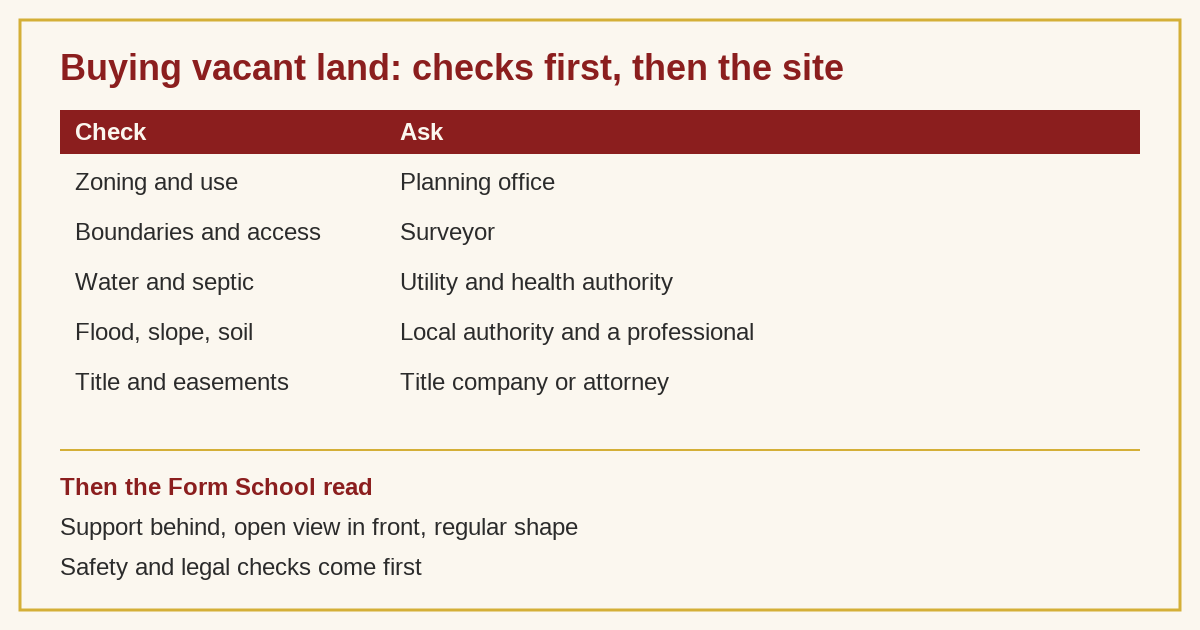
Check what the land can legally and physically support before you check its feng shui. Ask the local planning office about zoning, a surveyor about boundaries and access, utility providers about connections, and the health department about septic and water. Then read the site the Form School way: slope, water, surroundings and where the house would sit.
Reviewed on 23 November 2026.
The shape and slope of a lot have their own guides, lot shape analysis and the corner lot, cul-de-sac and slope guide. What follows is the purchase side: the checks to make and the questions to ask before you buy. More buying guides are in our real estate and home buying section.
| Before you start | What it means | Where the answer comes from |
|---|---|---|
| Rules vary | Zoning, septic, water, access and permit rules differ by county, city and province | The local authority |
| No figures here | Setbacks, fees and connection costs are set locally, so this guide gives none | The local authority |
| What to order | Survey, title search, soil and septic evaluation, utility quotes, flood check | Checklist below |
On this page
- Why land is different from buying a house
- The checks to make before you offer
- The feng shui read of a lot
- Where on the lot should the house go?
- Scoring sheet (our own template)
- How land buyers get caught out
- FAQ
- Before you make an offer
Why land is different from buying a house
A house shows you its condition. Raw land shows you only its possibilities, and many of them depend on rules you cannot see from the road. A lot that looks perfect can turn out to be unbuildable, to have no legal access, or to cost more to connect than it is worth. So the legal and physical checks come first and feng shui second.
The checks to make before you offer
Get each answer in writing, and have your agent or attorney build them into the conditions of your offer.
| Check | Who to ask | What you want to learn |
|---|---|---|
| Zoning and permitted use | City or county planning office | Whether a house is allowed, and what limits apply |
| Boundaries and access | Licensed surveyor | Exact lot lines, and a legal right of access, not just a track |
| Title and easements | Title company or attorney | Liens, easements, shared driveways, restrictions |
| Water supply | Utility, or the local authority for wells | Public connection, or well feasibility |
| Sewer or septic | Local health or environmental authority | Sewer connection, or a septic soil test, often called a percolation test |
| Power, gas, internet | Each provider | Distance to the nearest connection and the cost to extend |
| Flooding | Flood maps and the local authority | Whether the lot or the access road floods |
| Slope and soil | Geotechnical or soil professional | Stability, drainage, foundation limits |
| Taxes and fees | Local assessor | Annual tax and any impact or development fees |
| Environmental history | Local records, environmental screening | Past use, fill, tanks |
Every one of these numbers is set locally, which is why the table names who to ask rather than what to expect. Anything the seller tells you is a lead, not an answer, until someone confirms it in writing.
Advertisement
The feng shui read of a lot
Form School practitioners read land by its shape and what surrounds it, using the classic model set out in our guide to the four celestial animals. In short, they look for:
- Support behind. A higher or solid back (a hill, trees, a rise) is called the Black Tortoise.
- Open space in front. Open ground in front of the door is called the Bright Hall, with the Red Phoenix, a low feature further off, beyond it.
- Gentle sides. Lower land or features on each side are the Green Dragon (left, looking out from the door) and the White Tiger (right); many teachers like the Dragon side a little higher.
- A regular shape. Square or rectangular lots are generally preferred over sharp triangles or lots with a missing corner. See lot shape analysis.
- Slow water and a modest slope. The tradition favours gently moving water and a mild fall over fast runoff or steep drops.
Much of this is also plain site sense. A sheltered back, drainage that runs away from the house and a clear approach suit a builder as well as a practitioner. Where the tradition and the site engineer disagree, follow the engineer on safety.
Where on the lot should the house go?
Zoning and the ground itself fix the buildable area, so the feng shui choice is usually between a few positions. Practitioners suggest:
- Place the house toward the back or the solid side of the lot rather than at the front edge, if the rules allow.
- Keep the main door facing an open approach, not a wall or a pole.
- Give the house a stable platform, not the lowest corner where water collects.
- Think about the door direction early. See how to take a compass reading and our guide for planning a floor plan in a new build.
Scoring sheet (our own template)
Give each line 0, 1 or 2, with 2 the best. A 0 in any of the first six lines needs an answer before you offer.
| Line | 0 | 1 | 2 |
|---|---|---|---|
| Legal use confirmed in writing | No | Likely | Yes |
| Legal access confirmed | No | Easement unclear | Yes |
| Water and sewer or septic path | Unknown | Possible | Confirmed |
| Power and internet nearby | Unknown | Far | Near |
| Flood and slope checked | No | Partly | Yes |
| Title clear | No | Pending | Yes |
| Support behind (Form School) | None | Partial | Clear |
| Open view in front | Blocked | Partial | Open |
| Regular shape | Irregular | Mixed | Regular |
If the total is below 10, or any of the first six lines scores 0, wait, or negotiate a due diligence period.
How land buyers get caught out
- Falling for the view. A view does not make a lot legal to build on.
- Assuming utilities are at the road. Ask the provider, in writing.
- Trusting a percolation or soil result from an old listing. Order your own.
- Skipping the survey. Fences and tracks are not boundaries.
- Choosing by feng shui and ignoring flood risk. Safety comes first.
- Treating a feng shui read as a substitute for a professional report. It answers different questions.
FAQ
What should I check before buying vacant land?
Check zoning and permitted use, boundaries and legal access, title and easements, water, sewer or septic feasibility, power and internet connections, flood risk, slope and soil, taxes, and environmental history. Get each answer in writing from the local authority or a licensed professional.
What is a perc test and do I need one?
A percolation test is a common soil test used to judge how well ground drains for a septic system. Whether you need one depends on the local health or environmental authority, so ask them before you offer.
Is it good feng shui to buy land with a hill behind it?
Practitioners generally say yes: in the classic model, support behind the site is the Black Tortoise. A hill is also a safety question, so have the slope checked for stability and drainage.
What lot shape is best for feng shui?
Practitioners generally prefer regular shapes, square or rectangular, over sharp triangles or lots with a missing corner. Our lot shape guide takes each shape in turn.
Where should I place the house on the land?
Practitioners suggest placing it toward the solid back of the buildable area, facing an open approach, on a stable platform rather than in the lowest corner where water collects.
Can feng shui replace a survey or a soil report?
No. The tradition is a cultural way of reading a site. A survey, title search and soil or septic evaluation answer legal and physical questions that feng shui cannot.
Before you make an offer
Send the checks above to your agent or attorney with the lot's address or parcel number, and score the lot on the sheet. For the shape itself, compare it against our lot shape analysis.
Sources
Checked November 2026.
We cite no external source here, so the guide gives no figures, distances, setbacks or costs. Every rule above is a question for your local authority or a licensed professional.
Editorial note: Lucky Properties presents feng shui as a cultural and design tradition. This guide is educational; confirm zoning, septic, title and any building question with licensed local professionals.