A cure in feng shui is not a household oddity picked up on a shopping trip. Inside the tradition it has a specific job: an object or change placed to settle a sector read as afflicted, or to bring two elements read as clashing into a workable balance again. The salt water cure is the example most people meet first, usually through a photo of a crusted jar on red paper, with no explanation of why salt, why six coins, and why the whole thing gets thrown away rather than washed and reused.
Feng shui here is treated as tradition and design practice. Nothing in this piece promises luck, wealth, health, or relationship outcomes, and nothing replaces a real repair.
What a cure is, in traditional terms
Teachers use the words cure, remedy, and adjustment for the same idea. A room, a sector, or a whole floor plan is read against direction, element, period, and use. Where that reading finds friction, a cure is placed to change the relationship on paper. Tradition holds that the sector settles once the elements around it stop working against each other.
Three features define a cure in that sense. It is chosen, not accumulated: one object picked because its element does a specific job in a specific sector. It is placed with intention, because the same bowl of water means different things in different sectors inside the system. And it is temporary in handling: refreshed, replaced, or removed when the reading changes, when a year turns, or when the object shows wear the tradition pays attention to. A cure rarely asks for renovation. It asks for a material, a color, a shape, light, sound, movement, or a living plant set down for a particular reason. Within the logic of the practice the object is a lever on a relationship, and levers are small by design.
The element logic under every cure
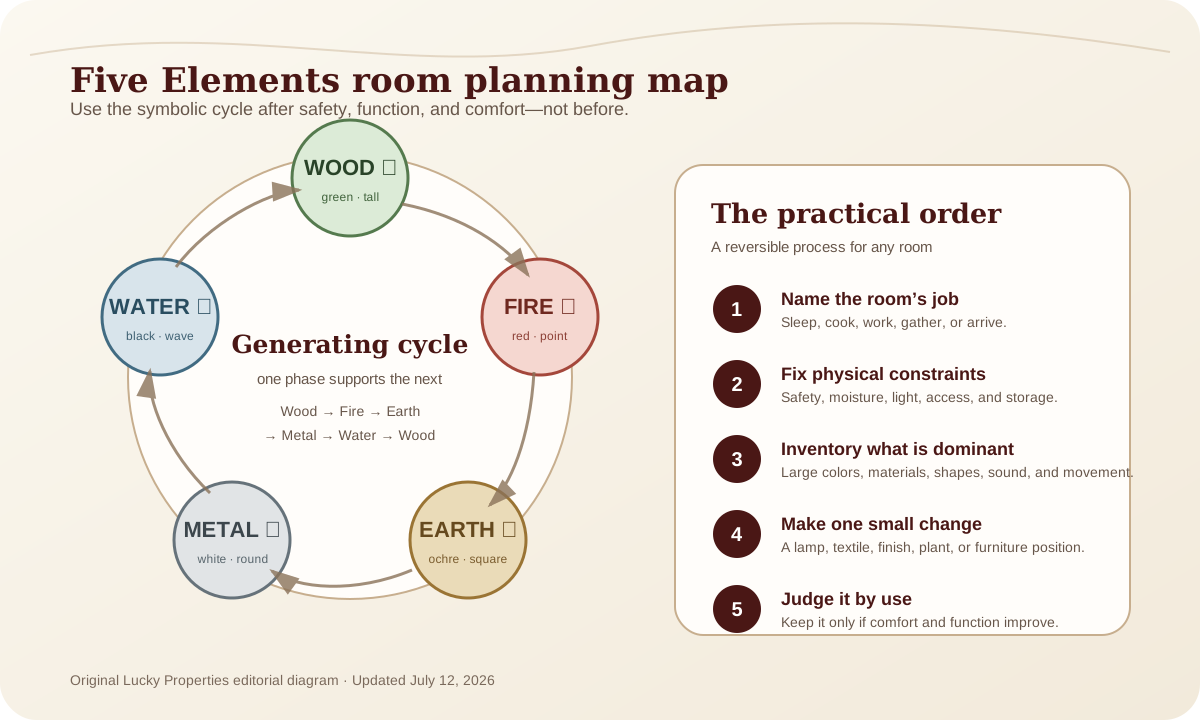
Every cure decision runs through the five elements: Wood, Fire, Earth, Metal, and Water. Practitioners use two cycles to decide what helps and what harms in a given spot. A fuller walk-through of the same cycles sits in the five elements balancing guide, and this section keeps to what a cure choice actually needs.
The generating cycle describes feeding. Water feeds Wood. Wood feeds Fire. Fire makes Earth, read as ash settling into soil. Earth bears Metal. Metal collects Water, read as condensation gathering on a metal surface. When a sector is read as weak in one element, a cure from the element that feeds it is used to support it.
The controlling cycle describes draining and restraint. Water controls Fire. Fire melts Metal. Metal cuts Wood. Wood parts Earth, the way roots break ground. Earth dams Water. When a sector is read as carrying too much of one element, a cure from the element that controls it is used to draw the excess down.
The third move, and the one that explains most well-known cures, is mediation. When two elements clash directly, practitioners often place the element that sits between them in the generating cycle, so the clash turns into a chain. A Metal door opening into a Wood sector is the textbook example used in teaching: Metal cuts Wood, so Water is placed between them, because Metal feeds Water and Water feeds Wood. The direct conflict becomes a sequence. Coins on salt under water, plants in particular sectors, and water features in particular corners all trace back to one of these three moves: feed the weak, drain the strong, or mediate the clash.
| Cycle | Pair | Reading used in cure choice |
|---|---|---|
| Generating | Water feeds Wood | Support a weak Wood sector with Water |
| Generating | Wood feeds Fire | Support a weak Fire sector with Wood |
| Generating | Fire makes Earth | Support a weak Earth sector with Fire |
| Generating | Earth bears Metal | Support a weak Metal sector with Earth |
| Generating | Metal collects Water | Support a weak Water sector with Metal |
| Controlling | Water controls Fire | Drain an excess Fire sector with Water |
| Controlling | Fire melts Metal | Drain an excess Metal sector with Fire |
| Controlling | Metal cuts Wood | Drain an excess Wood sector with Metal |
| Controlling | Wood parts Earth | Drain an excess Earth sector with Wood |
| Controlling | Earth dams Water | Drain an excess Water sector with Earth |
Reading a cure becomes easier once this table is familiar. Before asking what an object is, a practitioner asks what element it carries and which of the three moves that element performs in the sector under discussion. The object is the last question, not the first.
The cure families teachers actually use
School lists vary in wording, but working teachers tend to group cures into six families. The grouping matters because each family carries side effects a household has to live with - light changes a room, sound carries through walls, and open water near a floor is a commitment.
| Family | Typical examples | Logic a practitioner uses | Living-with-it note |
|---|---|---|---|
| Element cures | Color, material, shape: a ceramic pot, a metal bowl, a rectangular wooden frame | Directly adds the feeding or draining element | Lowest upkeep; easiest to overdo by stacking colors |
| Light | Bright lamp, uplight, mirror used carefully | Fire element and activation in the system; brightens a sector read as stagnant | Glare and heat are real; check the reflection itself before fixing the position |
| Sound | Metal wind chime, bell, singing bowl of metal | Metal element carried on movement and sound | Sound travels; agree placement with everyone in the home |
| Movement | Small water feature, fan, mobile | Keeps a sector read as still in motion; water features also carry Water | Needs cleaning, power, and a safe spot away from electrics |
| Living cures | Healthy plant, aquarium | Wood from plants; Water plus movement from an aquarium | A dying plant or dirty tank works against the intention in the tradition |
| Symbolic objects | Coins, wu lou gourd, bagua mirror | Symbolic weight inside specific schools and lineages | Schools differ sharply here; treat claims as lineage teaching |
Element cures are the quiet workhorses. A sector read as carrying excess Earth might get Metal introduced through color and material, since Earth bears Metal and the excess drains into what it produces. A sector read as weak in Wood might get a healthy plant, which is also why the feng shui plants by element guide sorts species by element and light need together - a plant that dies in a dark corner fails as a living cure in any reading.
Light cures ask for care with mirrors. In tradition a mirror is used to redirect, expand, or brighten, and teachers warn against placing one to reflect a bed, a stove, or a front door. A mirror also reflects whatever stands in front of it, including clutter and harsh light. Check the reflection at standing height, at sitting height, and at night before fixing the position.
Sound cures are almost always metal, which is why bells and chimes appear in Flying Stars practice for sectors read as heavy in Earth: Earth bears Metal, so Earth drains into it. A chime that irritates the household will be taken down within the week, so the teaching version of this choice includes everyone within earshot.
Movement and living cures overlap with plain housekeeping. A small fountain is a Water cure and also a pump and reservoir that grows film if ignored; the water feature placement guide covers positions and the sectors where teaching advises stillness. Plants need light and watering, aquariums need filtration. Tradition reads a neglected living cure as working against its own purpose, which makes upkeep part of the choice.
Symbolic objects sit apart from the other families. Coins, the wu lou gourd, and the bagua mirror carry meaning inside particular lineages, and schools differ openly. One teacher reaches for a wu lou in a sector read as carrying the illness star; another works with material and color alone. Knowing which lineage a recommendation comes from tells you how much weight that school puts on the symbol itself.
Advertisement
The salt water cure, step by step
The salt water cure belongs to Flying Stars practice. Tradition uses it in a sector read as afflicted, classically the area carrying the 5 Yellow or the 2 Black star in the annual chart. Both are Earth stars in the traditional reading, and the cure is assembled to drain Earth through its child, Metal, while salt and water do the quiet work of the setup. The feng shui wealth corner guide treats the opposite problem - a sector read as worth supporting - and reading the two side by side shows how the same element table produces opposite placements.
The setup below follows the commonly taught form of the cure. Frame each step as traditional practice. Where teachers differ on detail, the common core is what follows.
What tradition puts in the jar
- A glass or ceramic jar or bowl, open at the top. Metal containers are avoided in the common teaching because the cure works with salt water over months and the container is expected to be discarded whole.
- Rock salt or sea salt, filling roughly two thirds of the container.
- Six metal coins, stood upright on the salt in a circle. Chinese coins are the classical form; modern practice in many schools uses any real metal coins.
- Clean water, added to near the top of the container after the coins are placed.
- Red paper or a red mat under the container. Red carries Fire in the system, and Fire feeds Earth in the generating cycle while the Metal coins drain it, a pairing particular schools explain as keeping the sector engaged while it is being drained. Other schools use a plain mat and focus on the jar itself, so treat the red layer as widely taught but not universal.
Setup checklist
- Choose the sector from the annual chart first. Do not place this cure by guesswork or because a corner looks empty.
- Clean the spot before anything is set down. The cure sits in a room that has been tidied, not on top of stored clutter.
- Set the red paper or mat on a protected surface. Salt water is corrosive and will mark wood, stone, and metal finishes.
- Fill the jar about two thirds full with rock salt or sea salt. Level the top surface with the back of a spoon.
- Stand six metal coins upright in the salt in a circle, pressed in far enough to hold their position.
- Add water slowly to near the top of the jar, over the salt and around the coins.
- Place the open jar in the sector where air can reach it. Tradition keeps it out in the room rather than sealed inside a closed cupboard.
- Leave the jar undisturbed. Do not stir it, move it for cleaning underneath, or treat it as a decoration to rearrange.
- Top up the water as it evaporates, adding plain water to the same level without disturbing the salt structure more than needed.
- Replace the whole set when the salt crust is heavy, or at least once a year, whichever comes first.
- At disposal, wrap the entire container as it stands and throw it away whole. Traditional handling does not clean and reuse the jar, and does not pour the salt into garden soil or household drains.
Living with the jar over months
As weeks pass, salt crust creeps up the inside of the jar and over the rim in many setups. Tradition reads that crust as the cure doing its work, and heavier crust is read as a sign the sector needed the drain. The practical handling matters more: the crust is damp and corrosive, so the mat under the jar needs to be wide and the surface beneath protected for the whole period.
Top-ups are part of the cure. Evaporation is expected, and teachers suggest a brief weekly check rather than waiting until the waterline has dropped far and the coin circle has dried out. Place the jar where children and pets cannot reach, knock, or taste it. The water is not drinking water and the setup is not a toy.
Keep open water away from electrical outlets, power strips, and cable runs behind media units. Keep it off flooring that salt water would damage and off any surface where a slow leak would go unnoticed. If the sector has no safe, open spot, most schools accept a nearby workable position in the same sector over a textbook position that risks the floor.
Where cures go wrong
Most disappointing results trace back to three patterns, and none of them needs a bad chart to happen.
The wrong element is the first. A household reads that a sector is afflicted, reaches for the most familiar object, and places Water where the chart called for Metal, or adds Fire to a sector already read as hot. In the logic of the system this is a fresh clash rather than a treatment. The habit that prevents it is the one used earlier in this piece: name the move before naming the object. Feed, drain, or mediate. Then choose the material that performs that move, and only then choose the household form it takes.
The cluttered cure pile is the second. A corner accumulates a plant, a fountain, a crystal, three coins, and a chime because each item arrived from a different list at a different time. Each object carries an element, and stacked together they argue with each other in the reading while also reading visually as storage. A room-by-room reset, the kind worked through in the feng shui decluttering room reset, is the usual teacher response before any new object is added: clear the sector, live with the clean version briefly, then place one cure for one stated reason.
The third pattern is the cure used instead of a repair. A bright lamp is placed for a room whose real problem is a window that no longer opens. A chime goes up beside a door whose hinges scream. A water cure is set in a sector with a slow pipe leak behind the wall. Tradition itself does not ask for this trade, and careful teachers say so in plain words. Fix damp, mold, cracked glass, blocked ventilation, flickering electrics, and constant noise as building problems. Then, if the household follows the practice, read the chart again in the repaired room. The reading often changes once glare, smell, and noise stop dominating the sector.
Two smaller patterns are cheap to avoid. Cures placed from a photo rather than a chart tend to land in the wrong sector, because images rarely state the facing direction or the year they were set for. Cures left years past their replacement point - a sealed jar of grey water, a dead plant in a dry pot, a silent fountain with a filmed reservoir - read as stale inside the tradition and as neglected objects outside it. A chart, a calendar note, and a replacement habit clear both.
How long a cure stays
Time limits come from the same system that chose the cure. Annual cures follow the annual chart and are reviewed when the chart turns at Li Chun, around February 4 in the solar calendar used by Flying Stars practice. The salt water cure is the clearest case: one placement for the afflicted sector of the year, topped up through the year, wrapped and discarded when heavily crusted or when the year turns, then set fresh only if the new chart still calls for it in that sector.
Natal cures, chosen against the fixed chart of the house itself, stay longer and are reviewed when the house changes use - a bedroom becomes an office, a door stops being the main entrance, a renovation moves a kitchen. Element and living cures follow the life of the object. A plant cure lasts while the plant is healthy and the right size for the sector. A light cure lasts while the lamp is actually switched on often enough to matter in the room.
Teachers also remove cures. A sector read as afflicted in one year reads differently the next, and leaving last year's drain in place can turn a settled sector into an over-drained one in the new reading. Removal is part of the practice rather than an admission that the placement failed. Wrap and discard the salt water set as described above. Clean and store reusable objects such as bells and lamps, and let symbolic items follow the handling your school teaches for them.
Limits, disagreements, and reading responsibly
Schools disagree about cures in ways that are visible once you know where to look. Form-based teaching weighs shape, light, road pattern, and interior layout most heavily. Compass schools weigh direction measured in degrees. Flying Stars adds time: period, year, and month change the reading of the same room. A recommendation that makes sense inside one system can be pointless or backwards inside another, which is why mixing a cure list from one school with a chart from another produces confusing placements. Pick the system you are actually using, then judge the advice inside that system.
Teachers also disagree on how much weight symbolic objects carry. Material and color cures translate across schools with the least friction, because the element logic is shared. Symbolic items carry lineage meaning, and a reader outside that lineage may reasonably use the plainer material version instead. Respected teachers on both sides of that split tend to agree on the practical floor: the room must work as a room. Light you can read by, air that moves, surfaces that stay dry, and a layout people can use without squeezing past stored objects come before any symbolic layer.
A workable rule for a household deciding how far to take any of this: treat cures as the last step of a room. Read the sector, fix what is physically wrong, clear what does not belong, then - if you follow the tradition - place one cure for one reason, note the date, and review it when the chart or the room changes. The salt water cure earns its reputation inside that order: chart first, jar second, calendar third, with every part of the setup following from the element table.