Stand in a bedroom and look at the corner where two walls meet beside the bed. The edge is vertical, hard, and pointed straight at the pillow. Nothing about it moves, and nothing about it is broken. In feng shui tradition, that corner has a name. It is a poison arrow, one of the most repeated terms in the whole practice, and one of the most carelessly used.
This guide slows the term down. It covers where the idea comes from, the test the older Form School reading applies before it calls anything an arrow, the exterior and interior forms tradition actually names, the large class of corners that do not qualify, and the order in which tradition prefers its remedies. Every reading here is presented as tradition: a cultural design language with its own logic, not a set of physical claims. Where a plain, checkable fact sits beside a tradition claim, the guide says which is which.
Sha qi, and why arrows are its pointed form
Feng shui divides the movement it cares about into two broad qualities. The preferred quality is slow, curving, and settling, the movement of a path that bends, a river that meanders, a room entered at an angle. The opposed quality is sha qi. Sha is often translated as killing or attacking, qi as energy or breath, and the compound is usually softened in English to negative energy, which loses the picture. The picture is speed plus straightness plus an edge. Water forced into a jet. Wind funnelled down a straight gap between buildings. A line that arrives fast and arrives pointed.
A poison arrow is sha qi with an address. It is the specific case where a sharp form, a corner, a roofline, a pole, a straight road, is aimed at a specific target, a door, a window, a bed, a chair. Some translations call it a secret arrow, which captures a second part of the tradition reading: the arrow works on the sightline. You may not have named the corner beside the bed, but your eye has been registering it every night. Form School, the oldest branch of the practice, built its whole method on that kind of observation. It reads landforms, water, roads, and neighbouring shapes before any compass is opened, and the arrow is one of its oldest judgements. This site's form school versus compass school guide sets out how the two branches divide the work; arrows belong firmly to the form side.
Two consequences follow from that origin, and both discipline the rest of this guide. First, an arrow is a relationship, not an object. A corner by itself is geometry. A corner plus a target plus a line between them is the tradition case. Second, the reading is graded, not binary. A near, large, long-stared-at arrow reads stronger than a distant, small, glimpsed one. Tradition that forgets the grading turns into a list of bans, and a list of bans describes almost every real house ever built.
The sightline test: three conditions
Before calling anything in your home a poison arrow, run the three conditions the careful reading requires. All three must hold at once. If one fails, tradition, properly applied, has nothing to say about that corner.
1. A pointed or rushing form. The source is sharp (a corner edge, a roof apex, a pointed structure), or it channels movement in a straight rush (a road, a corridor, a driveway, the gap between two buildings). A rounded form, a curved path, a soft edge does not make an arrow in any school.
2. A direct line to a staying place. Extend the edge or the road in a straight line. The line must land on a place where a person stays for long stretches: the pillow end of a bed, a desk chair, a favourite sofa seat, the stove position in a kitchen, or, at house scale, the front door or a main window. A line that lands on a hallway, a storage wall, or a passing route is not the tradition case, because nobody dwells there.
3. Time on the line. The person on the line spends real time there, night after night or workday after workday. A guest chair used twice a year sits in a different class from the chair its owner reads in every evening. Duration is what turns a geometric curiosity into the thing tradition is describing.
There is a quick physical version of the same test. Sit or lie in the staying place, at pillow height or chair height, and look. If a hard edge lines up with your body and holds your eye, you have found the geometry tradition means. If you have to hunt for the corner, measure angles, or stand up to see it, you have not.
Exterior arrows: the house as target
At house scale, the target is the building itself, usually the front door or the windows of a main room. The catalogue below is the set of sources Form School readings name most often. Each entry pairs the tradition reading with the plain fact that often sits underneath it, because at exterior scale the two frequently point at the same feature for different reasons.
| Exterior source | Tradition reading | The checkable companion fact |
|---|---|---|
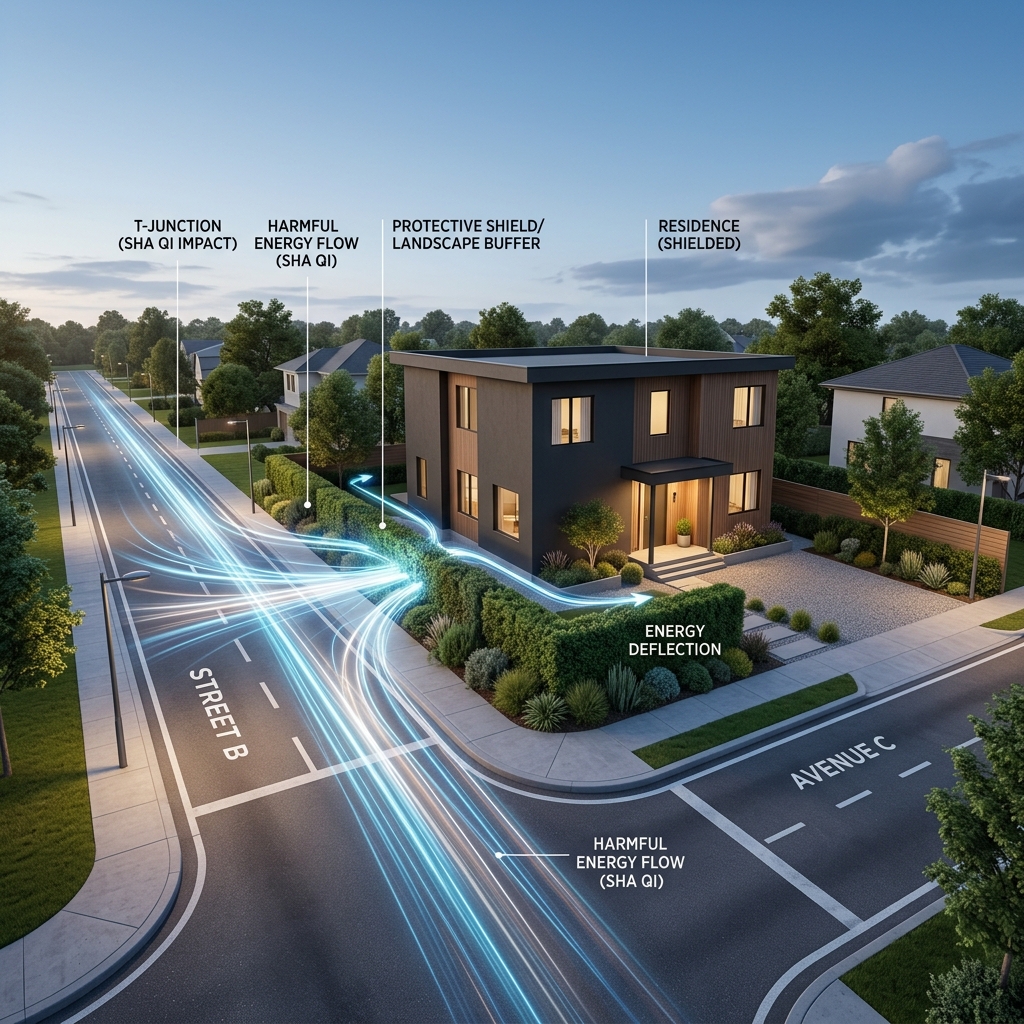
| Straight road aimed at the house (T-junction, end of a dead-straight street) | The classic road arrow; movement rushes at the door without bending | Headlights sweep the front rooms at night; traffic noise arrives head-on; a driver error has a shorter stopping story. See the T-junction field guide |
| Corner of a neighbouring building aimed at your door or window | A building-scale corner arrow | The neighbouring wall often also blocks light, dominates the view, or channels wind down the gap. Check sightlines and overshadowing directly |
| Roofline or gable point aimed at a main window | A high, sharp arrow, read as pressing on the room behind the window | Mostly a view question: the point sits in the window frame all day. Curtains and planting change the view, which is the real content of the fix |
| Utility pole, lamp post, or bare dead tree directly in front of the door | A thin vertical arrow splitting the entrance | A pole at the threshold is also a practical obstruction and, for many households, a visual one. Councils, not cures, decide whether poles move |
| Straight driveway or path from gate to door with no bend or planting | The approach rushes; the entrance has no pause | A straight, hard path is also the fastest route for rain splash, leaves, and a visitor's eye straight into the hall. A bend or a planted edge slows all three |
| Long straight corridor of a building opposite, or an elevated road on axis with the house | A raised or enclosed rush aimed at the facade | Elevated roads bring real noise and overlooking. Blinds, planting, and room reallocation answer the real parts |
Read the right-hand column as the working half of the table. Tradition noticed these features early and gave them a dramatic vocabulary. Modern households can act on the same features with ordinary tools, and the actions overlap: screen the headlight sweep and you have also, in tradition terms, broken the road arrow. Nothing in the table supports panic about a house. Most streets contain several of these features, most houses sit near one, and the tradition reading grades them by nearness, size, and whether the line actually lands on the door or merely passes the garden.
One exterior case deserves its own sentence because sales material loves it. A church spire, a pylon, or a distant tower on the horizon is not, in careful Form School reading, an arrow at your house. Distance dissolves the geometry, and the line has to land on your door or window, not merely exist in the same view. If a practitioner charges concern over a structure streets away, you are hearing the careless version of the tradition, not the careful one.
Advertisement
Interior arrows: the room as target
Inside, the scale shrinks and the corner takes over. The interior catalogue is shorter than the internet version of it, because the sightline test clears out most of the room before the reading starts.
The protruding wall corner. The strongest interior case, and the one this guide opened with. L-shaped rooms, chimney breasts, and boxed-in pipe runs all create a free-standing corner edge inside a room. If that edge lines up with a bed, a desk, or a long-used chair, it passes the test. If it lines up with a shelving wall, it does not.
Furniture edges at body height. A bookcase end, a tall cabinet corner, or the square edge of a kitchen island aimed across a short distance at a sofa or a dining chair. Furniture arrows are weaker than wall corners because they are smaller and nearer the floor of the reading, but they are also the easiest to fix, because furniture moves.
Open shelving and pointed objects over a staying place. Tradition names exposed shelf ends above a desk and sharp decorative objects (a spiky sculpture, an antler mount, a pointed light fitting) hung above a bed or chair. The plain companion fact is at its clearest here: heavy or sharp objects over a bed are a bad idea in earthquake country and a worse one above a child's bed, for reasons that need no tradition at all.
The corridor shot. A long, straight hallway aimed at a bedroom door or ending at a desk reproduces the road arrow indoors. The hallway and corridor guide on this site treats corridors as channels in their own right; the arrow case is the corridor whose run ends on a staying place rather than on a wall or a bend.
Beams are a neighbour, not an arrow. An overhead beam across a bed is a separate tradition topic, usually filed under pressure rather than arrows, because a beam has no point and sends no line. This guide leaves beams there. Lumping every feature into the arrow category is how the term loses its meaning.
What is left after the test is applied is usually a short list: one or two corners per home, not twenty. That short list is the working list. The command position guide approaches the same rooms from the opposite direction, placing beds and desks where the door is visible and the wall behind is solid; a seat in command position rarely sits on a corner line, which is one reason the two teachings are so often taught together.
What does not count
This section exists because the careless version of the tradition generates needless worry, and worry is a cost. The following are not poison arrows in the careful reading, whatever a short video may claim.
- Every corner in the house. Rooms are rectangular. If every corner were an arrow, the concept would describe architecture itself and mean nothing. The test requires a target and time.
- A corner you cannot see from the staying place. Behind the bed's headboard wall, above a curtain pelmet, inside a cupboard run. No sightline, no case.
- Distant exterior structures. Chimneys two streets away, a far tower, a mountain peak. Form School reads the near environment of a house, not the whole skyline.
- Curved and soft forms. A round table, an arched doorway, a winding path, a rounded sofa arm. Curves are the tradition's preferred movement, the opposite pole from the arrow.
- A temporary arrangement. A ladder left out during painting, a box corner during a move. Duration is a condition. The arrow case is the arrangement that stays.
If a source tells you your home contains dozens of arrows and offers to fix them at a price, the sightline test is the tool to bring to that conversation. Run the three conditions aloud and keep the items that pass.
The remedy order tradition actually prefers
Popular writing jumps straight to objects: crystals, mirrors, flapping charms. The older practice works in a different order, and the order matters because the early steps do the real geometric work while the later steps mostly decorate it. Work down the list and stop at the first step that resolves the line.
Step 1: Move the target. The cheapest and strongest answer. Shift the bed half a metre along the wall, angle the desk, swap the reading chair to the other side of the room. The corner has not changed; the relationship has, and the relationship was the arrow. The tradition grants this step first place because it follows the arrow's own definition.
Step 2: Move or reshape the source. Furniture edges can be moved outright. A wall corner cannot move, but its edge can be reshaped in effect: a corner guard in a soft material, a tall plant whose foliage breaks the vertical line, a bookcase placed flat against one face so the point no longer projects into the room. In children's rooms this step has a plain safety dividend, because a padded or planted corner is also a corner that hurts less in a fall.
Step 3: Screen the line. Place something between source and target that interrupts the sightline: a screen, a curtain, a plant on a stand, a piece of furniture at right angles. Screening is the standard exterior answer too (a hedge or fence where local rules allow, breaking the road's line to the door), and it is the step the T-junction guide builds its exterior worksheet around.
Step 4: Soften the staying place. If the line cannot be fully broken, change what the eye meets along it: a runner that slows a corridor, lighting that removes the corner's hard shadow, fabric and rounded forms in the foreground. This step concedes the geometry and works on attention, which is the level at which the milder cases operate anyway.
Step 5: Symbolic objects, last and optional. Faceted crystals, wind chimes, and mirrors belong to particular schools and to the commercial end of modern practice. The cures guide on this site sets out how cure claims are usually framed and where they overreach. Two cautions deserve space here. A bagua mirror is an exterior device in the schools that use it, and aiming one at a neighbour's home regularly starts the kind of dispute no household needs; some practitioners refuse exterior mirrors on exactly that ground. And no object on this list repairs a real hazard. A mirror does not slow a car, pad a corner, or shade a headlight. Steps 1 to 3 do those jobs, which is why they come first.
A worked audit: one schematic flat
The following flat is invented in the open to show the method, not to describe a real home. It is a one-bedroom flat. The bedroom is L-shaped because a boxed pipe run cuts into one corner, and the resulting free-standing corner edge lines up, across two metres, with the pillow end of the bed against the far wall. The living room has a bookcase whose end faces the sofa at about a metre and a half. The front door opens onto a straight internal corridor that ends at the bedroom door. Outside, the building faces a side street at a shallow angle; no road runs at the door, but a lamp post stands directly in front of the living room window.
Run the test in order. Bedroom corner: pointed form, yes; line lands on the pillow, yes; eight hours a night, yes. This is the flat's one strong interior arrow. Bookcase end: pointed, yes; line lands on the sofa's far arm rather than the seat, partly; evenings only. A weak case. Corridor: straight rush ending on a door, not on a staying place; the door is closed at night, and the run ends at a wall when it is. Not the tradition case, though the corridor still benefits from a runner for noise. Lamp post: vertical form on the window line, yes; but at kerb distance across a pavement, and the staying place (the sofa) sits to the side of the window rather than behind it. A mild exterior case at most.
Apply the remedy order. Bedroom: the bed moves 60 centimetres along its wall, which takes the pillow off the corner line entirely. Step 1, done, cost zero. A tall plant then stands against the corner itself, step 2, mostly because the resident liked the look; the geometry no longer needed it. Bookcase: rotated ninety degrees against the wall it stood beside, step 2, which cleared the weak line as a side effect of a tidier room. Corridor: no arrow work; a runner went down for sound, which tradition would file under step 4 if it were being generous. Lamp post: no action. The audit's result is one real fix, one incidental fix, and two features left alone, and that ratio, a short list with most items left alone, is what a careful audit of a real home usually produces.
Renters, small flats, and shared houses
Most of the remedy order survives renting intact, because most of it is furniture. Moving a bed, rotating a bookcase, standing a plant against a corner, hanging a curtain across a sightline: none of it touches the building. The items that need permission are the exterior screens (a fence or a hedge on a boundary you do not own) and anything fixed to a wall, and the tradition has never required them. A renter's version of step 3 is a plant on a stand or a freestanding screen, which breaks a line exactly as well as a fixed one.
Small flats concentrate the geometry. In a studio, the bed, desk, and sofa may share one room and one protruding corner can line up with two of them. Work the targets in duration order: the bed first, because the night is the longest stay, then the desk, then the sofa. In shared houses, add one courtesy rule the tradition would approve of in spirit: the remedies belong to the room's resident. Rearranging a housemate's chair to fix an arrow they do not see, in a tradition they may not share, creates a household problem larger than the corner.
Where the tradition stops
A poison arrow is a metaphor with a geometry attached. Handled carefully, it teaches a household to notice straight lines, hard edges, and long sightlines, and to place the beds and chairs of the house thoughtfully in relation to them. Those are real design goods, available to anyone, believer or sceptic, and the audit above shows how modest the actual work usually is.
The metaphor does not grade houses for purchase, and it should never be the reason a sound home is rejected or a flawed one excused. Structure, damp, light, noise measured at the wall, traffic measured at the kerb: the home buying checklist on this site keeps those checks in their proper order, with tradition readings in a separate column where they belong. Nor does an arrow diagnose anything medical or financial, and a practitioner who reads illness off a corner has left the tradition's careful version behind. Keep the term in its lane, a sharp piece of design vocabulary from the oldest branch of the practice, and it earns its place. The corner beside the bed is still worth moving the bed for. Just know which reason you are moving it for.