Every fortune-telling method on this site works from a fixed surface: a chart cast from a birth moment, lines on a palm, sticks shaken from a bamboo cylinder. Tea leaf reading works from the least fixed surface of all. You drink a cup of loose-leaf tea, turn what is left three times, drain it, and read the shapes the wet leaves leave behind. Nothing is printed, dealt, or drawn. The whole text of the reading is an accident of leaves and water, and the reader's job is to say which accidents count as pictures and what the pictures mean.
That looseness is exactly why the classic manuals matter. Left to itself, a cup of leaves can be made to say anything. The printed tradition, set down in books such as Tea-Cup Reading by a Highland Seer and Cicely Kent's Telling Fortunes by Tea Leaves of 1922, both in print through Project Gutenberg, pins the practice down: a specified cup, a specified tea, a fixed turning ritual, a map of positions inside the cup, and a dictionary of symbols. This guide follows those manuals closely, names them where their instructions differ, and frames everything as the tradition states it. A tea leaf reading is a cultural practice with a real paper trail. It is not a measurement, and nothing in it is a promise about your future.
The word, and what it covers
Tasseography is the umbrella term. Reference works define it as a divination method that interprets patterns in tea leaves, coffee grounds, or wine sediments, and the word itself is a small map of the practice's travels: the French tasse, a cup, borrowed from the Arabic tassa, joined to Greek suffixes, -graph for writing, -mancy for divination, and -logy for study. The same practice therefore appears in print as tasseography, tasseomancy, and tassology, three spellings of one idea.
Tea is the branch the English manuals teach, and it is the branch this guide teaches. Coffee reading gets its own section below, because its cup map is genuinely different and readers often mix the two. Wine sediment reading survives mostly as a mention in definitions. When a source says tasseography without qualification, it almost always means the tea cup.
Where the practice came from
The paper trail is thinner than the folklore around it, so this section separates what reference works report from what they merely repeat.
Reading meaning in the dregs of a drink is old and widespread, and tasseomancy followed the trade routes of tea and coffee. Reference summaries report that tea leaf reading originated in China, likely soon after tea itself, and that the practice was carried widely by Romani readers, whose travelling life spread it across regions; Baltic and Slavic peoples also practiced it. The Western form has a second root: medieval European fortune tellers who read splatters of wax, lead, and other molten substances poured into water. The tea cup, when it arrived, gave that older habit of reading random splashes a cheaper and safer surface.
Coffee got there first in one famous setting. Coffee fortune telling is reported to have appeared in the Ottoman palaces in the 1500s, where, the standard account says, women of the harem drank coffee and told each other's fortunes to pass the time. Tea reached Europe as an expensive import, and Kent is blunt about the consequence: for many years tea was far too costly for most people, so the tea-cup version of the practice could only spread once tea became an everyday drink. By Kent's count the cup had been in use as a divination tool for close to three centuries when she wrote in 1922.
Two later chapters of the history are firmly documented. In Scotland the practice was domestic and daily: Kent describes the Highland custom of the guid wife, the goodwife of the house, reading her breakfast cup for the events of the day, a letter, a parcel, a visitor, a wedding, and she records that Highland seers by custom took no money for a reading. And in the late 19th century the practice became an industry. English and American potteries produced specially decorated fortune-telling cup and saucer sets, many designs patented, many sold or given away with purchases of bulk tea, with printed symbols inside the cup and instructions for their use. The marked cup is the parlour-game end of the tradition. The plain white cup of the manuals is the older working tool.
The cup and the tea
Both manuals specify the equipment with unusual care, and their reasons are practical rather than mystical: the leaves have to be visible.
| Item | Highland Seer | Cicely Kent, 1922 | Shared reasoning |
|---|---|---|---|
| Tea | China tea is best; Indian tea and cheap mixtures carry too much dust and too many twig fragments to form clear pictures | Indian tea and cheaper mixtures with dust and twigs are of no use for reading | Dust settles flat and forms no shapes; whole leaves clump into readable forms |
| Cup shape | Wide opening at the top, bottom not too small; near-vertical sides and small cups are hard to read | Wide and shallow, white if possible; narrow, small, and fluted cups are all objectionable | Sloping sides display the leaves at readable angles |
| Cup surface | Plain surfaced; interior white with no printed pattern; fluting and odd shapes rejected | Plain, even surface, no pattern of any kind | A pattern printed on the cup confuses the pictures the leaves make |
A modern reader does not need period equipment. A loose-leaf tea with reasonably whole leaves, a plain white or pale cup with sloping sides and a handle, and a saucer reproduce every condition the manuals ask for. Tea bags do not work, for the simple reason the manuals identify: there are no free leaves to form the patterns. Flavoured blends with petals and pieces produce shapes too, and traditional readers would call the extra objects noise. That judgement is theirs; the working point is that the fewer non-leaf objects in the cup, the closer the result is to the one the symbol dictionaries were written for.
Advertisement
The ritual, step by step
The turning ritual is the shuffle of this system: it is what distributes the leaves, and both books describe nearly the same sequence. The Highland Seer version, with Kent's variations noted, runs as follows.
- Brew the tea in the cup or pour it unstrained, with no tea strainer, so the leaves are in the cup.
- The consultant, the person the reading is for, drinks the tea while thinking about their question, and stops with a little liquid left: about half a teaspoonful in the Seer's instruction, about a teaspoonful in Kent's.
- The consultant takes the cup by the handle in the left hand, rim upwards.
- The consultant turns the cup three times from left to right, in one fairly rapid swinging movement (Kent: turned three times from the left with a quick swing).
- The cup is inverted, slowly and carefully, over the saucer, and left there for about a minute so all moisture drains away.
- The reader lifts the cup, holds it, and turns it about as needed to view the symbols without disturbing them. Kent adds that properly drained leaves will not shift while this is done.
Two schools of thought about the mind during step 4 are recorded in the books themselves. The Seer instructs a serious consultant to concentrate on the question and will the symbols to form truly. Kent reports that some readers insist on concentration while others prefer a mind kept deliberately blank, and states her own preference for the blank mind, on the grounds that it lets the subconscious work unhindered. The manuals disagree, and the disagreement is part of the record: there is no single authorised mental state for turning a cup.
One variant method should be flagged because modern summaries often present it as the standard. The Encyclopedia of Occultism and Parapsychology, edited by J. Gordon Melton, describes pouring the tea, drinking or pouring it away, shaking the cup well, and draining the remaining liquid into the saucer. The encyclopedia summary itself notes that this shaking method is rarely seen, and that most readers ask the consultant to drink the tea and then swirl the cup. If you watch a reading today, the swirl is what you will see.
Position: the map inside the cup
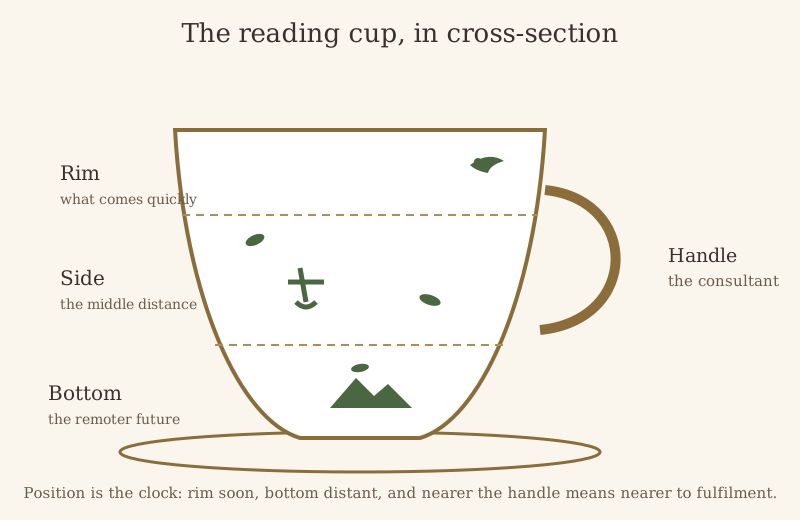
A symbol means something different depending on where it lands, and position carries two kinds of information: timing, and distance from the consultant.
The handle is the anchor of the whole map. In the Seer's account the handle represents the consultant and is akin to the house in card divination; judgements about events approaching the consultant's home, journeys away from it, and expected messages or visitors are all made against this fixed point. Kent gives the same point a slightly wider brief: the handle represents the consultant, and also the home, or the present abode if the consultant is away.
Height in the cup is the clock. Here the two manuals agree on the ends and differ in the middle, which is worth seeing in a table rather than smoothed over.
| Zone | Highland Seer | Cicely Kent |
|---|---|---|
| Near the rim | Matters that may be expected to occur quickly | Things that may be expected to occur quickly |
| Directly under the handle | (judged by nearness to the handle) | Present and immediate happenings |
| The side of the cup | Events not so far distant | More distant events |
| The bottom | The remoter future | The far distant future |
Distance from the handle is the second scale, and it is the Seer who states it as a rule: in all three zones, the nearer a symbol approaches the handle, the nearer to fulfilment the event it stands for. Read together, the two scales give each shape an address. A bird at the rim beside the handle and a bird at the bottom on the far side are the same symbol at two very different addresses, and a reader working in this tradition reads them differently: the same news, near and soon in one cup, distant in the other.
Kent adds an optional second surface. If the cup is bare of events, the drained saucer can be read too: its centre stands for the consultant, the ring around the centre for the home and events near at hand, and the outer rim for the misty future. She treats the saucer as a backup that confirms or enlarges the cup, not as a replacement for it.
The symbols, with their sources attached
Symbol lists are where tea leaf reading gets quoted most and sourced least. Meanings drift between books, and a single merged list presented without provenance hides the drift. The table below therefore keeps its two sources in separate columns. The Kent column is drawn from the Dictionary of Symbols in Telling Fortunes by Tea Leaves (1922). The second set is the short standard list quoted in Melton's encyclopedia summary. Where a symbol appears in only one source, the other cell says so.
| Symbol | Kent, 1922 | Melton encyclopedia summary |
|---|---|---|
| Acorn | Health, strength, and gain through industry; a sowing you will see reaped | Not in the short list |
| Anchor | Good and loyal friends, constancy in love, realisation of wishes; an emblem of safety to a sailor | Not in the short list |
| Arrow | Unpleasant news, or a disagreeable letter, from the direction the arrow comes from | Not in the short list |
| Axe | Mastery and power to overcome difficulties; sometimes separation | Not in the short list |
| Balloon | Much attempted but little achieved; enthusiasm that soon flags | Not in the short list |
| Basket | Domestic duties and family cares; a full basket, a present given or received | Not in the short list |
| Bird, single and flying | Speedy news, telegrams in the language of 1922; birds generally are happiness and joyful tidings | Not in the short list |
| Birds in a row | Vexatious delay in receiving wished-for news | Not in the short list |
| Book, open | A desire for information, a mind alert to new facts | Not in the short list |
| Book, closed | Expectancy | Not in the short list |
| Snake | Not in the entries sampled here | Enmity or falsehood |
| Spade | Not in the entries sampled here | Good fortune through industry |
| Mountain | Not in the entries sampled here | A journey of hindrance |
| House | Not in the entries sampled here | Change, success |
Three working rules sit underneath the table in both traditions. First, shapes are read in combination, not in isolation: a symbol's neighbours qualify it, and Kent repeatedly defines one sign by the signs around it. Second, clarity counts: a sharply formed shape is read with more weight than a smudge, which is one more reason the manuals are strict about tea quality. Third, the small change of the cup has standard readings too. Melton's summary notes that letters and rings are among the shapes readers look for, and the sceptical writer James Randi, summarising the tradition in his encyclopedia of occult claims, records the rule for stems: tea leaf stems represent persons, and fat stems are fat people. That last rule is quoted here as part of the tradition's record, from its most famous critic. The tradition contains its own scepticism about how far these rules stretch, and the limits section below takes that seriously.
Coffee reading: the sibling method
Coffee reading works on the same principle with a different drink and a different map, and the two are confused often enough that the differences deserve a short section of their own.
The drink is Arabic or Turkish coffee, brewed thick enough to leave a heavy sediment. The names alone show the spread: qira’at al-finjan in Arabic, kahve fali in Turkish, kafemanteia in Greek. The cup is commonly covered with the saucer and turned upside down, a step with no equivalent in the tea manuals.
The map differs in structure. Where the tea manuals lay a vertical clock of rim, side, and bottom, Turkish coffee readers often divide the cup into horizontal halves: symbols in the bottom half are read as messages about the past, symbols in the top half as messages about the future. Some readers divide the cup vertically instead, reading the halves as yes and no, or negative and positive. The saucer, an optional extra in Kent, is a working surface in coffee practice, and whether it sticks to the cup is itself read as a sign, positive or negative depending on the reader. One further limit appears in the coffee tradition and not in the tea books sampled here: some readers hold that a cup can show the past, but cannot predict events beyond forty days into the future.
If a reading you receive mixes the coffee map with the tea ritual, you are watching two traditions blended. That blending is common in modern practice. It is not what either set of sources describes on its own.
A worked cup, read by the rules above
The following cup is a labelled hypothetical, invented for this guide to show the method operating end to end. No real person's reading is reported here.
The consultant drinks, leaves about a teaspoonful, turns the cup three times from the left, and drains it for a minute. The reader finds four shapes.
- A single bird, clearly formed, high near the rim and close to the handle.
- An anchor on the side of the cup, roughly halfway down, on the handle side.
- A closed book low on the side, opposite the handle.
- A mountain shape in the bottom, far from the handle.
The reading, by the tables above, runs in order of the clock. The bird at the rim is, in Kent, speedy news, and its position says the news is near in time and, by the Seer's handle rule, close to fulfilment: this is the reading's headline item. The anchor on the side is read at the side's timing, which is where the manuals part company: not so far distant in the Seer, more distant in Kent. Its Kent meaning, loyal friends and constancy, makes it a statement about the consultant's base rather than an event. The closed book, low and opposite the handle, is expectancy in Kent, placed far from the consultant in both space and time: something awaited, not yet moving. The mountain at the bottom is, in Melton's list, a journey of hindrance, and the bottom is the remoter future in both manuals, so the reading ends with a difficult journey placed far off, not a warning about next week.
Notice what the method did and did not do. It produced a structured narrative with a timing order, built entirely from four printed rules and one symbol table. It did not produce a date, a name, or a fact the consultant could check. Two competent readers could weight the anchor differently, and Kent and the Seer already disagree about the side band. That is the actual shape of the practice: a fixed ritual, a semi-fixed vocabulary, and a reading that still depends on the reader.
What a reading cannot do
The leaves in a drained cup are a random pattern. Human vision is built to find pictures in random patterns, a tendency psychologists call pareidolia, the same habit that puts faces in clouds and figures in ink blots. Wikipedia's tasseography article lists pareidolia in its own See Also section, which is a fair sign of where the practice sits in reference literature: documented as a tradition, not endorsed as a method of knowing.
That framing does not make a reading worthless. It makes it a particular kind of tool. A cup reading gives a question a fixed ritual, a small set of symbols, and fifteen unhurried minutes, and many people find that a structured prompt of exactly that kind helps them say what they already think. The tradition's own history supports the modest version of the claim: this was a breakfast-table and parlour practice, done for neighbours, by custom without payment in the Highlands. Treating it as entertainment and reflection keeps faith with that history. Treating it as evidence, for a medical worry, a contract, an investment, or a relationship decision, goes past anything its manuals can support. If a reader charges heavily, predicts specific harms, or tells you a decision depends on the cup, the tradition itself is not the problem. The reader is.
Sources and further reading on this site
The method, positions, and Kent symbol meanings in this guide come from Cicely Kent, Telling Fortunes by Tea Leaves (1922), and the Highland Seer, Tea-Cup Reading and the Art of Fortune-Telling by Tea Leaves, both read in full text at Project Gutenberg for this guide. The definition, name derivation, trade-route history, Ottoman coffee account, marked-cup industry, and the Melton and Randi summaries come from the tasseography reference article and the works it cites. Meanings are reported as those sources print them, including where they disagree.
For the neighbouring methods, this site's methods compared guide sets the Chinese chart and body traditions side by side, the kau chim guide covers the shaken-stick method that shares tea reading's reliance on a random draw, and the oracle bone guide covers the oldest documented Chinese divination surface of all. The three-card spread guide is the closest Western parallel: a small fixed layout, a printed vocabulary, and a reading built from the two.