Short answer
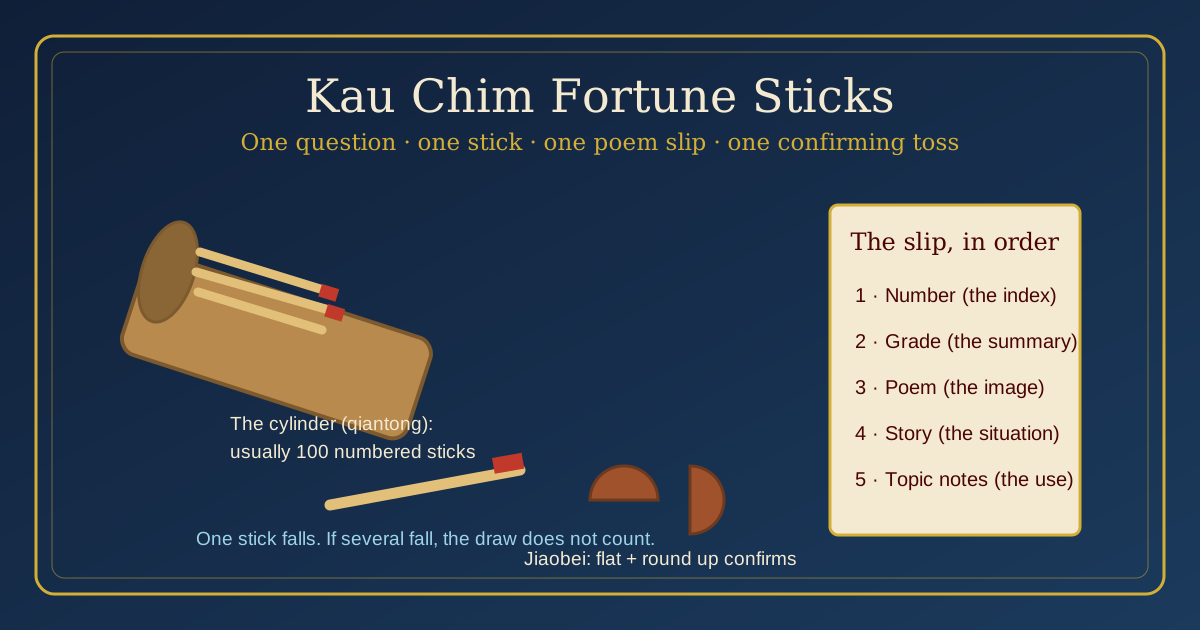
Kau chim is a way of asking a question with bamboo. You kneel in a temple with one question settled in your mind, take a cylinder holding flat numbered sticks, tilt it and shake until exactly one stick works its way out and falls. The number on that stick points to a printed slip. The slip carries a short poem, usually a grade, and in fuller sets a story and a set of notes split by topic. A pair of wooden blocks, tossed on the floor, confirms whether that stick is accepted as the answer. Everything after that is interpretation, and this guide keeps the two parts separate: the procedure, which is fixed and checkable, and the reading, which belongs to tradition and varies by temple, by set, and by interpreter.
The sticks sit in the middle of this site's fortune-telling shelf. The methods compared guide lines up chart systems such as BaZi against casting systems, and kau chim belongs firmly on the casting side: no birth data, no chart, just a random draw matched against a fixed book of answers. The I Ching coin guide works the same way with three coins and 64 hexagrams. Kau chim works with one stick and, usually, 100 slips. It is the simplest randomiser on the shelf, and the one most often done badly by visitors, because the steps around the shake matter more than the shake itself.
The names, because they get mixed up
The same practice travels under several names, and English pages use them loosely. Sorting them out first prevents most of the confusion that follows.
| Name | Language and form | What it points at |
|---|---|---|
| Kau chim / kau cim | Cantonese (kau4 cim1) | The practice as named in Hong Kong and Cantonese-speaking temples |
| Qiu qian (求籤 / 求签) | Mandarin, pinyin qiúqiān | The same practice; the characters mean, literally, to request a stick |
| Chien tung | Older English spelling | The practice, and in some writing the cylinder itself |
| Lottery poetry | Translated name | The written answers, which are poems; also the name of the slip tradition |
| Oracle of Kuan Yin | English, Buddhist temples | A stick set dedicated to Guanyin, the bodhisattva of compassion; one famous set among many |
| Siam si / seam si | Thai, from Teochew | The same practice in Thai temples, with Thai translations printed since the reign of King Chulalongkorn |
| Chi Chi sticks | United States, from 1915 | A packaged American version: 78 sticks and a booklet of 78 rhyming answers |
Two near neighbours are not kau chim. Japanese omikuji are drawn paper fortunes with their own texts and customs. Incense sticks, which look similar and sit in the same temples, are offerings burned in prayer; they carry no numbers and no answers. A visitor who mixes up the incense bundle and the stick cylinder has mixed up the offering with the oracle.
Where tradition places the practice
Written tradition traces kau chim back a long way. The Kau chim article on Wikipedia, read for this guide, reports that the practice is dated to the Jin dynasty in the Jade Box Records, a book on date selection linked to the Taoist monk Xu Xun in the 3rd century AD. That is the tradition's own account of its age, and it should be read as such: an old lineage claim recorded in a divination text, not a dated receipt. What can be said without leaning on the claim is that the practice is old, that it survived the Cultural Revolution decades in temples across Taiwan, Hong Kong, Macau, mainland China, and the Chinese diaspora in Southeast Asia, and that most Taoist temples today keep a stick set for visitors.
Its public standing in Hong Kong is easy to check. The Wong Tai Sin Temple is the best known place for the practice and draws very large crowds. Local reporting on Hong Kong fortune telling notes that a government representative draws a stick for the city on the second day of the Lunar New Year each year. When a municipal government performs a rite in public on a fixed date, the rite is a living custom, whatever a reader thinks of its answers.
The American branch of the story is dated more firmly. Kau chim reached the United States in 1915 as Chi Chi sticks, sold by the Pacific Dry Goods Company of San Francisco, in a city with a large Cantonese immigrant population. The set was smaller (78 sticks), numbered in Arabic numerals instead of Chinese characters, and packed in a yellow and red tube with a booklet of rhyming English answers. Imports stopped during the Second World War when trade routes broke, returned in the 1990s, and the early sets are now collected as fortune-telling objects. The episode matters for one practical reason: it is the clearest proof that stick count and answer text belong to a specific set. Change the market and both changed.
The kit: four objects, one job each
| Object | What it is | Its job in the reading |
|---|---|---|
| Chim bucket (籤筒, qiantong) | A long cylindrical bamboo cup or tube | Holds the set; its height is what makes one stick climb out at a time when the cup is tipped and shaken |
| Kau chim sticks (籤, qian) | Flat bamboo sticks, often painted red at one end, each marked with one number in Chinese characters and usually Arabic numerals too | The randomiser. Each number is different; no two sticks in a set are alike |
| Poem slips / the set book | Printed papers, one per number; a slip is commonly about 12 to 15 cm long and about 4 cm wide | The fixed stock of answers. The slip carries a four-line jueju poem and, depending on the set, a grade, a story, and topic notes |
| Jiaobei blocks (筊杯) | A pair of crescent blocks, wood or bamboo, flat on one side and rounded on the other | The confirmation step. Their toss accepts or rejects the stick that fell |
Notice what the stick itself holds: a number, nothing more. The answer lives in the printed set. That split, a bare index in the hand and a book of poems on the shelf, is the design of the whole system, and it explains the single most common reading error, covered below: looking up the right number in the wrong book.
Advertisement
How a draw works, step by step
Accounts of temple practice, including the Wikipedia summary and Hong Kong temple reporting read for this guide, describe the same sequence with small local variations.
- Finish your devotions first. The draw comes after prayer and offering at the altar, not instead of them. Offerings are typically incense, fruit, cakes, or a donation.
- Settle one question. You state the question to the deity, aloud or silently. The accounts stress doing this decisively: one question, held steady, not swapped or widened halfway through the shaking.
- Prepare the cylinder. In the described rite the querent passes the cylinder around the incense burner three times and mixes the sticks by hand, a purifying and shuffling step in one motion.
- Kneel and shake. Holding the cylinder between the palms, tipped slightly downward, you shake gently until a stick slides out and drops to the floor.
- Apply the one-stick rule. If several sticks leave the cylinder together, the draw does not count. The sticks go back and you shake again. Only a single fallen stick gives a number.
- Confirm with the blocks. Toss the jiaobei pair. The answer is accepted only on the confirming throw described in the next section. On a rejecting throw, you draw again.
- Take the number to its slip. The fallen stick's number is exchanged for the matching printed slip, at a counter or from the set's papers.
- Interpret, or have it interpreted. The slip's classical poem is terse and allusive. Many visitors take it to a temple priest, a volunteer, or a paid interpreter at the temple's stalls, who reads the poem and its story against the question asked.
Two of these steps do quiet work that is easy to miss. The one-question rule is a focusing device: it forces the asker to state, before any answer exists, exactly what is being asked. The one-stick rule is an anti-shopping device: it blocks the natural move of shaking until a pleasing number appears. Both rules serve the asker even if the reader grants the oracle nothing at all, because a precise question and a single unchosen answer are the raw material of a useful reflection.
The confirmation toss: three throws, three meanings
The jiaobei toss is a yes-or-no gate built into the reading. Each block lands flat side up or round side up, so a pair gives three distinct results.
| Throw | What lands up | Traditional reading |
|---|---|---|
| Confirming | One flat side, one round side | The stick stands. This is the answer to the question asked |
| Rejecting | Two round sides | The answer is not accepted. Put the stick back and draw again |
| Laughing | Two flat sides | Read, in a well-known legend, as the deity laughing; usually taken to mean the question was poorly put or its answer already known |
The gate is worth understanding because it changes the arithmetic of the draw. A stick is not an answer until the blocks accept it, so the system has a built-in rejection step that pure drawing systems lack. In Meihua Yi Shu, a cast hexagram stands as cast; there is no second device that can refuse it. Here there is, and a run of rejecting throws is itself information about the session inside the tradition: readers treat repeated rejection as a sign that the question needs restating, not as a run of bad luck to push through.
The anatomy of an answer: five layers on one slip
Open a full printed set, a Guan Yin set of 100 lots is the clearest example, and a single answer turns out to be a small structured document. Reading it well means reading the layers in order and knowing which layer does which job.
| Layer | What it is | What it does |
|---|---|---|
| 1. Number | The stick's number, 1 to 100 in a standard set | The index. It selects this answer and no other |
| 2. Grade | A short ranking printed with the lot, running in steps from the most favourable at the top to the poorest at the bottom; the exact grade words differ by set | The summary weather of the answer, before any detail |
| 3. Poem | A four-line jueju verse in classical Chinese | The image. It speaks in pictures (a fish, a boat, a locked gate) rather than in instructions |
| 4. Story | A short allusion, often a named figure from history or legend, attached to the lot | The human situation. It shows the poem's image acted out in a life or an episode |
| 5. Topic notes | Short printed rulings split by subject: household, the asker, wealth, business dealings, marriage, travel, a missing person or lost property, illness, lawsuits, moving house, and similar headings | The application. The same lot answers differently for a question about a move than for a question about a debt, and this layer is where that difference is written down |
An interpreter's work sits on top of these five layers. The interpreter holds the book of phrases and stories, reads the poem against the story, then against the topic that matches the question, and retells the result in modern language. Two consequences follow, and both are stated plainly in the sources. The reading is treated as short-range, typically covering no more than about a year counted from the Lunar New Year. And because so much depends on the interpreter, some people take the same slip to more than one interpreter to see whether the readings agree. That habit is the tradition's own quality check, and it concedes the point a careful reader makes anyway: the slip is fixed text, the reading of it is a human performance, and performances vary.
Same number, different book: why sets cannot be mixed
This is the section to keep if you keep only one. A stick number is not a fortune. It is a page number in one specific book.
Sets differ in at least four ways. The deity and temple differ: a Guan Yin set answers in Guanyin's voice and imagery, a Wong Tai Sin set in another. The poems differ: both famous sets run 1 to 100, but the verse attached to a given number is not the same verse. The stories and grades differ with the poems. And the set size itself differs once you leave the big temple sets: the American Chi Chi booklet held 78 answers, some temple sets hold other counts, and certain temples keep specialised sets, such as the medicinal oracle sticks at some Baosheng Dadi temples, whose poems are written as traditional medicine prescriptions and taken to the medicine shop nearby.
Practical rule, stated once and applied everywhere below: record the temple and the set alongside the number, every time. "Stick 47" is half a record. "Stick 47, Guan Yin set, at this temple, on this date, for this question" is a record another person, or you in three months, can actually check. The Tong Shu date-selection guide makes the same demand in its own field: a day page means nothing until you know which almanac printed it.
There is also a variant in how the stick is chosen. At the Thean Hou Temple in Kuala Lumpur, accounts describe a larger container with protrusions at its base. The asker lifts the bundle of sticks a little and lets it drop loosely; a stick that lands resting on a protrusion stands proud of the rest, and that standing stick is taken as part of the answer. The bookkeeping lesson is unchanged: a variant draw still points at numbers in that temple's own set.
A worked example: one labelled hypothetical draw
The draw in this section is invented for teaching, in full. No real temple visit is described, and no real set's poem is quoted, because quoting a verse and presenting it as a named set's text would be inventing a source. What the example shows is the order of operations, which is the part a first-time visitor actually needs.
The setup. A visitor has been offered a job in another city and wants to ask about the move. At the temple, after devotions, she writes her question down in one sentence before touching the cylinder: should she accept the offer and move this spring. One question, one topic (moving house), one time frame.
The draw. She mixes the sticks, kneels, tips the cylinder and shakes. Two sticks fall together. Under the one-stick rule that draw does not count, so both go back without being read. She shakes again. One stick falls, number side up.
The confirmation. She tosses the jiaobei pair. One block lands flat side up, the other round side up: the confirming throw. The stick stands as the answer to the question she actually wrote down, not to a broader worry about her career in general.
The slip. At the counter she exchanges the number for its slip from that temple's set. She reads the layers in order: the grade line first for the summary, then the poem slowly as an image, then the attached story, then the topic notes under the moving-house heading, ignoring the wealth and marriage notes, which belong to questions she did not ask.
The interpretation. An interpreter at the temple retells the poem against her move. She writes down what he said, in his words, next to the slip's printed layers, keeping the two separate: printed text in one column, spoken reading in another. If she consults a second interpreter later, she can compare readings against the same fixed text instead of against her memory of the first conversation.
What she does with it. The reading becomes one input among the real ones: the salary and contract terms, the lease dates, the cost of the move, what the new city does to her family arrangements. A BaZi reader asked the same question would work from her birth chart and its timing pillars, as set out in the BaZi chart guide, and the two systems would produce two different vocabularies for the same decision. Neither vocabulary signs the contract. She does.
Kau chim among the randomisers
Placed beside the other casting methods on this site, the sticks show a clear profile.
| Method | Randomiser | Answer stock | Confirmation step | What the asker supplies |
|---|---|---|---|---|
| Kau chim | One stick from a cylinder | Usually 100 poem slips, set by temple | Yes: the jiaobei toss can reject the draw | One settled question |
| I Ching, coin method | Three coins, cast six times | 64 hexagrams with line texts | No: the cast stands | A question, plus the patience to build the hexagram line by line |
| Meihua Yi Shu | Numbers from time, date, or a count | 64 hexagrams, read through a body-and-use trigram split | No: the cast stands | An observed number or moment, and the counting rules |
| Playing-card cartomancy | A shuffled deck, cards dealt into a spread | 52 card meanings, set by the reader's system | No | A question and a spread layout |
The sticks are the fastest of the four and the most dependent on a fixed local text. Coins and numbers travel anywhere, because the answer stock is a classic carried in the reader's head or book. A kau chim number travels nowhere: it is meaningless one street away, at a temple whose set was printed by someone else. That is not a defect in the design. It is a reminder that this oracle belongs to a place, a deity, and a community of interpreters, in a way the portable methods do not.
Record worksheet: write the draw down properly
Copy this table when you draw at a temple. It keeps the fixed text, the spoken reading, and your own decision in separate rows, which is the whole discipline in one page.
| What to record | Example of the right level of detail | Why it matters |
|---|---|---|
| Temple and set | The temple's name, and the set if it is named (for example, a Guan Yin set) | A number without its set cannot be looked up or checked later |
| The question, verbatim | The exact sentence you settled on before shaking | A reading can only be judged against the question that produced it |
| The draw | How many shakes, whether a multi-stick fall was discarded, the number that stood | Shows the one-stick rule was followed and the draw was not shopped |
| The blocks | The confirming, rejecting, or laughing throw, as it landed | The toss is part of the result, not a preliminary |
| The slip's layers | Grade, poem, story, and the topic notes for your topic, copied or photographed | This is the fixed text; everything else is commentary on it |
| The interpretation | Who read it, and their words, kept separate from the printed text | Readings vary by interpreter; a labelled record lets you compare fairly |
| Your decision | What you actually did, and on what grounds | Keeps the oracle in its place: an input, never the reason of record |
Where a stick reading stops being useful
Kau chim is a traditional reflection practice with a clean procedure and a long temple history. Used that way, and paired with the site's fortune-telling hub, it can slow a decision down, force a vague worry into one written sentence, and hand the asker an image to think with. There are jobs it cannot do, and naming them plainly protects both the visitor and the tradition.
It cannot verify facts. A favourable grade says nothing checkable about an employer's finances, a partner's intentions, a diagnosis, or a property's title, and the Chinese zodiac birth-year chart cannot do those jobs either, for the same reason: symbol systems organise reflection, they do not inspect the world. Questions with documents attached (a contract, a scan result, a survey, a bank statement) are answered by reading the documents or paying the professional who can.
It cannot be re-drawn until it agrees with you. Shaking again and again until a good grade appears breaks the practice's own rules, the one-stick and confirmation discipline, and converts the oracle into a mirror that only flatters. A reader inside the tradition would call that a failed session. A reader outside it can call it the same thing in plainer words.
It cannot carry health decisions. Some sets keep a whole specialised branch, the medicinal sticks, which shows how seriously temples once took the traffic between prayer and treatment. The modern boundary is not complicated: a poem is not a prescription, symptoms deserve a clinician, and no grade on a slip is evidence about a body.
And it cannot promise outcomes. No grade, from the top of the scale down, guarantees wealth, marriage, recovery, or success, and a poor grade takes none of those away. The slips were written as poems, and poems answer in images. Treating an image as a promise is the one reading error every layer of this guide has been built to prevent: state the question, follow the procedure, read the layers in order, record what was printed and what was said, and then decide with the evidence that actually bears on the decision.