Every later system on this site starts with something a person can hold in two hands: three coins, a bundle of yarrow stalks, a cup of numbered sticks. The oldest Chinese system with a large surviving record starts with something heavier. A turtle shell, cleaned and polished. The shoulder blade of an ox. A drilled pit, a point of intense heat, and a crack that splits across the surface with a sound the written language may still carry: the character for divination, bu (卜), is traditionally read as a picture of that crack, and its old pronunciation may echo the pop the bone made.
Oracle bone divination was the fortune-telling of a royal court, not of a market stall. In the late Shang period, roughly 1250 to 1050 BCE, diviners at the last Shang capital, the city now called Yinxu near modern Anyang in Henan, ran this procedure for the king, sometimes several times a day. What makes the Shang case different from every older heat-and-bone practice is the paperwork. The diviners carved the session into the bone itself, in the script scholars call jiaguwen (甲骨文), shell-and-bone script. The result is the earliest large body of Chinese writing that survives, and an archive a modern reader can still audit, session by session.
This guide teaches the method the way the record allows it to be taught: materials first, then preparation, then the session, then two real translated records read slowly. It is framed as history and tradition throughout. The Shang court believed the cracks carried answers from ancestors and powers. A modern reader can study exactly how the court asked, what it asked, and what it wrote down, without granting the cracks any power to foretell, and the last sections keep that line in plain view.
Names first, because the literature splits them
English writing about this topic uses several technical words, and they are not interchangeable. Getting them straight at the start saves confusion in every museum label and textbook that follows.
| Term | What it names | Notes |
|---|---|---|
| Jiagu (甲骨) | Shell and bone, the physical pieces | The objects themselves, inscribed or not |
| Jiaguwen (甲骨文) | Oracle bone script | The writing carved on the pieces |
| Pyromancy | Divination by fire or heat | The general family this method belongs to |
| Plastromancy | Divination on a turtle plastron | The flat underside shell of the turtle, the prestige material |
| Scapulimancy | Divination on a shoulder blade | Usually ox scapula at Anyang, sometimes sheep, deer, or other animals in earlier practice |
| Bu (卜) | To divine, and the crack itself | The character is traditionally explained as a pictogram of a crack in bone |
| Yinxu (殷墟) | The Ruins of Yin at Anyang | The last Shang capital, source of the great majority of inscribed bones |
The site fortune-telling methods comparison sets this system beside BaZi, Zi Wei Dou Shu, and the I Ching as the earliest entry in the family. That placement is a statement about records, not about invention. People heated bones to read cracks long before the Shang: evidence from Liaoning reaches back to the late fourth millennium BCE, on the scapulae of cattle, sheep, pigs, and deer, with no writing on them. The Shang contribution was standardisation plus inscription. The court prepared the pieces in a fixed way, asked in a fixed form, and filed the result on the piece itself.
The materials, and where they came from
Two materials carry almost the whole archive.
Turtle plastrons. The plastron is the flat plate on the underside of a turtle. It gives a broad, even surface that takes a drilled pit and a carved character well. Turtles are not native in number to the Anyang area, and the inscriptions themselves record shells arriving as tribute: one notation records that Que sent 250 tortoise shells. That single line does three jobs at once. It explains the supply, it maps a political relationship between the Shang court and the sender, and it shows the court logging its raw material the way it logged everything else. Some shells may have come from locally raised turtles, but the tribute traffic is the documented main line.
Ox scapulae. The shoulder blade of cattle is large, flat, and available from the court's own herds and sacrifices, so it needed no tribute network. At Anyang the two materials end up used in roughly equal numbers. Rarer pieces exist on tortoise carapace, ox rib, and the scapulae of sheep, boar, horse, and deer, and a small number of inscribed skulls and antlers appear to be record-keeping or practice pieces rather than working divination surfaces.
Provenance notations were carved or brush-written on the back of a shell, on its bridge, or on an edge of a bone, recording who sent how many pieces and when. Some of those notations were never carved, and they survive as brush writing, which is direct evidence that the writing brush was already in use in Shang times alongside the carving tool.
Preparation: the crack was engineered, not left to chance
A working piece went through a workshop sequence before any question was asked:
- Clean and flatten. Meat was removed, and the bone or shell was sawn, scraped, smoothed, and in some cases polished into a flat working surface.
- Drill the pits. Hollows were drilled or chiselled partway through the piece, on the back side, in an orderly series. A drill matching the pits in size and shape has been excavated at the earlier Shang site at Erligang, modern Zhengzhou.
- Control the crack by the pit. The shape and depth of a pit steered the crack that heat would open on the front. Pit shapes changed over the Shang sub-periods in a regular way, which is why specialists use pit shape as one of their dating tools.
- Number the cracks. In a session, cracks were made one after another and often numbered on the surface, so the written charge, the crack, and the reading could be matched to each other.
Read that sequence again and the character of the method changes. This was not a priest staring at a random break. The court thinned the bone at chosen points so that heat would crack it in a chosen direction, roughly the shape of the bu character, a main line with a branch off it. Whatever the readers believed the crack meant, the crack itself was a manufactured object, produced to a pattern, in a workshop, before the king heard the question. Holding both facts at once is the whole skill of reading this literature.
Advertisement
The session, in the order the bone records it
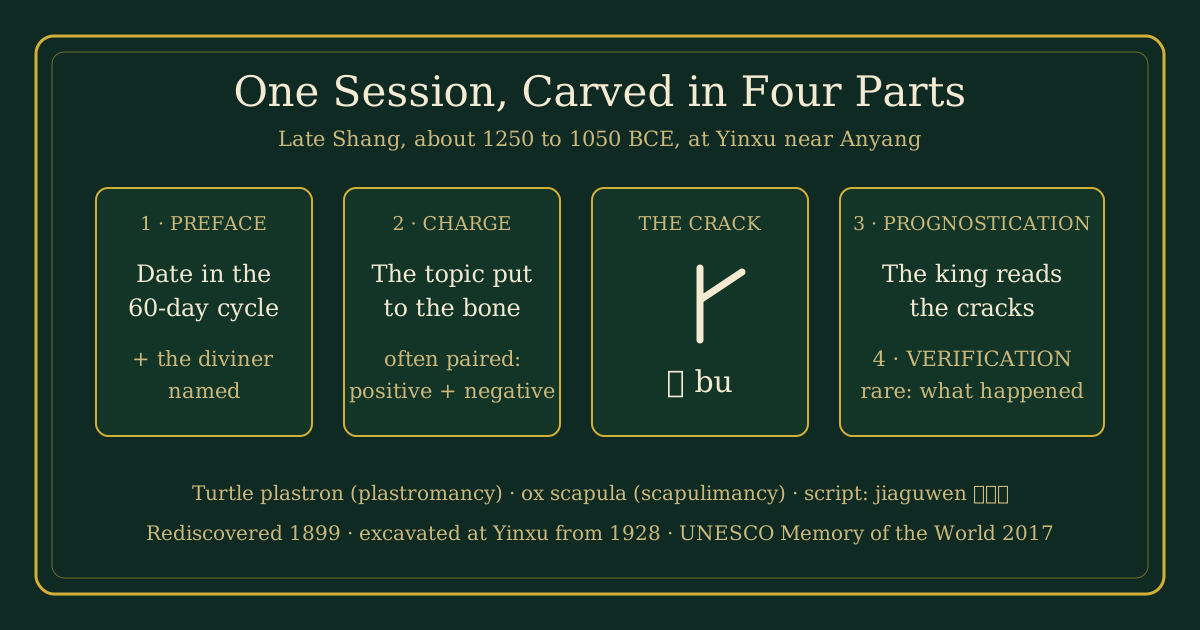
A complete inscription has four parts, and specialists name them in this order. Most bones carry only the first two. A bone with all four is the fullest surviving form of the procedure, and the table below is this guide's working map for any museum piece or published photograph you meet later.
| Part | Name in the literature | What it records | How often it appears |
|---|---|---|---|
| 1 | Preface | The date, in the sixty-day stem-and-branch cycle, and the diviner's name | On most inscribed pieces |
| 2 | Charge | The topic put to the bone, directed to an ancestor, a natural power, or Di | On most inscribed pieces, often in paired positive and negative forms |
| 3 | Prognostication | The reading of the cracks, usually spoken by the king | Sometimes |
| 4 | Verification | What actually happened afterwards, added later | Rarely |
The session ran like this. The piece was prepared and, in at least some periods, anointed with blood. The date and the diviner were recorded. The charge was stated. Charges were often put twice over, once in a positive form and once in a negative form, or with the date shifted, and a single session could spread over several bones while a single bone could serve several sessions. Heat was pressed into a pit until the front cracked. The diviner in charge read the cracks, and the king often gave the prognostication himself, sometimes marking the result simply as auspicious or inauspicious. Used pieces were then buried in pits set apart for the purpose, shells in some pits, scapulae in others. One pit opened in 1936, catalogued as YH127, held over 17,000 pieces along with a human skeleton. The archive habit, burying the spent records in sorted pits, is the reason the material survived in bulk for archaeologists to find.
By the last Shang periods the procedure had tightened into routine. Early in the sequence covered by the bones, under King Wu Ding, whose reign is the source of the largest share of inscriptions, charges range widely and ask the powers to act: rain, battles, settlements, toothaches. Later charges grow more regular, more optimistic in form, and are more often made by the king personally, on a ritual cycle, asking ancestors to witness rather than to intervene. One named scholar's reading of that shift is that the court's idea of what ancestors could be asked to do was itself changing. The bones let you watch a religion alter its paperwork over about two centuries.
What the court asked about
The charge topics are a census of royal anxiety. Grouped, they run like this:
| Topic group | Typical charge, in paraphrase | Why the court asked |
|---|---|---|
| Weather | Will it rain? Will this rain harm us? | Rain decided the harvest, and the harvest decided everything else |
| Agriculture | Praying for harvest, with cattle pledged in sacrifice | Sacrifice was the court's side of a bargain with the powers |
| Warfare | Should a named commander campaign against a named border people? | Campaigns were royal decisions with royal costs |
| Illness | Is an ancestor causing this sickness, this toothache? | Ancestors were held able to send affliction as well as protection |
| Childbearing | Will a named consort's childbearing be good? | Heirs were state business, recorded to the day |
| Ritual | Will this sacrifice, performed this way, be satisfactory? | One of the commonest charges of all |
| The ten days | In the next ten days, will there be no disaster? | A standing short-range check, repeated constantly |
Two things stand out in that table. First, almost none of it is private fortune-telling of the kind later systems sell to individuals. It is state administration conducted by ritual means. Second, the charges are concrete and checkable, with dates and names attached. That is what allows a verification to exist at all. A vague charge can never be confirmed or missed; a charge about the next ten days can.
Worked record 1: the ten-day check
This record, widely reprinted in teaching collections in the translation tradition of David Keightley's Sources of Shang History, shows all four parts on one piece. Read it against the table above.
- Preface: Crack-making on gui-si day. Que divined.
- Charge: In the next ten days there will be no disaster.
- Prognostication: The king, reading the cracks, said: there will be no harm. There will perhaps be the coming of alarming news.
- Verification: When it came to the fifth day, ding-you, there really was the coming of alarming news from the west. A reporter said a border people were besieging settlements in the east and had harmed two settlements, and another group had raided fields in the west.
Notice the shape of the king's reading. It is double: no harm, and yet alarming news. The event on the fifth day then satisfies the second half without touching the first, since news arrived and the court itself was unharmed. A modern reader is allowed to see the craft in that. A prognostication built with an escape clause is hard to falsify, and the verification, carved by the same court that made the prediction, records the hit. The bone is still valuable evidence, but it is evidence of how the court framed and scored its own readings, not evidence that the cracks carried news five days early.
Worked record 2: Lady Hao's childbearing
A second reprinted record follows a childbearing charge for Lady Hao, a consort of Wu Ding who also appears in the inscriptions as a military commander, and whose intact tomb was excavated near Anyang in 1976.
- Preface: Crack-making on jiashen day, day 21 of the cycle. Que divined.
- Charge: Lady Hao's childbearing will be good.
- Prognostication: The king read the cracks and said, in substance: if she gives birth on a ding day, there will be prolonged luck; a fuller version of the reading grades the outcome by the day of birth, with some days read as good and one day read as not lucky.
- Verification: After thirty-one days, on jiayin day, day 51, she gave birth. It was not good. It was a girl.
This one earns its place in the guide because the verification records a miss against the hope in the charge, and records it flatly, with the outcome the court counted as bad stated in the court's own terms. Whatever a modern reader makes of the grading of days, or of a daughter counted as a poor result, the archival instinct is visible: the court carved the outcome it did not want, on the record it kept. Records made only to flatter do not look like that, and the mixture of escape clauses in one record and flat misses in another is exactly the texture a real archive has.
Counting the bones: why no two totals match
Popular writing quotes a single number for the oracle bones. The sources do not support a single number, because they count different things. Laid side by side, the figures read for this guide are:
| Source tradition | Figure | Unit being counted |
|---|---|---|
| Recent collection count, summarised in the standard reference entry | About 13,000 bones, a little over 130,000 inscriptions | Catalogued bones in collections in China and some fourteen other countries |
| Reference-entry footnotes and collection histories | At least 160,000 pieces; over 100,000 pieces found in total | Pieces found, inscribed and uninscribed together |
| Cambridge University Library collection account | About 200,000 fragments excavated, some 50,000 bearing inscriptions | Fragments, which is the largest unit of all |
| Yinxu reporting by the Chinese Academy of Social Sciences team | More than 150,000 inscribed pieces from Yinxu | One site's yield, in that team's counting |
Fragments break the comparison on purpose: one plastron can survive as thirty fragments and later be rejoined into one bone, passing through three counts on its way. The same problem applies to the writing. Reference works record roughly 4,000 to 6,000 distinct characters in the script, depending on how variant forms are split, and specialists agree with certainty on a little more than a quarter of them, roughly 1,200 characters in one careful count, with several hundred more under discussion. A guide that prints one total for the bones and one for the characters, without units, is tidier than the evidence allows. This one prints the spread.
What is not in dispute is the shape of the find. The great majority of inscribed bones come from Yinxu and date to the reigns of the last nine Shang kings. Specialists assign the named diviners to five periods, and the distribution is steep: about 55 percent of extant inscriptions come from the first period, the Wu Ding era. The comprehensive catalogue effort, the Jiaguwen Heji published between 1978 and 1982 with its 1999 supplement, reproduces over 55,000 fragments, and that catalogue, not any single museum case, is the working corpus of the field, which specialists call oraculology.
Rediscovery: dragon bones, a sick scholar, and a capital found
For centuries the pieces surfaced without being understood. Farmers around Anyang dug them up and sold them as dragon bones, a standard ingredient in traditional medicine, ground for tonics and poultices. Turtle shell was prescribed for malaria; powdered bone went on knife wounds. Nobody knows how many inscribed pieces were ground up and eaten before anyone read one.
The recognition story is traditionally dated to 1899. Wang Yirong, chancellor of the Imperial Academy in Beijing and a collector of bronze inscriptions, obtained pieces from an antiques dealer and recognised the marks as ancient writing of the same family as the script on Zhou bronzes. A later legend attaches the moment to Wang's own malaria medicine and a visit from his friend Liu E; the legend is good enough that it is still retold, and uncertain enough that careful accounts flag it as legend. The documented steps that follow are firmer. Liu E published the first book of oracle bone rubbings in 1903. In 1908 Luo Zhenyu identified the source near Anyang, and with it the site of the last Shang capital. Dealers had spent years naming a false source to protect their supply, which is why the identification mattered.
Official excavation began in 1928 under the Institute of History and Philology at Academia Sinica, led by Li Ji, and ran to 1937, producing some 20,000 pieces that now form the bulk of the Academia Sinica collection. The YH127 pit in 1936 supplied the single largest deposit. Decipherment then did historical work no one had planned for: the royal names and genealogy reconstructed from the bones matched the Shang king list in much later transmitted histories, which settled, for most scholars, that the Shang had been a real dynasty and not a legend. Yinxu was inscribed on the UNESCO World Heritage List in 2006, and the oracle bone inscriptions were added to the UNESCO Memory of the World Register in 2017.
After the Shang, and where the later methods take over
Bone pyromancy did not end with the Shang. Inscribed pieces continue into the early Zhou, and a separate Zhou centre at Zhouyuan in Shaanxi produced its own inscribed bones, some three hundred of them found in 1977, written in notably smaller characters. But the practice was already changing its medium: Zhou charges and prognostications were increasingly brush-written in ink or cinnabar instead of carved, and brush writing on bone rots away, so the Zhou archive mostly perished with its ink.
The method that displaced it solved the supply and cost problems at once. Yarrow stalk divination, the milfoil method tied to the hexagrams of the I Ching, needed no tribute shells, no workshop, and no court. It could travel, and it did, becoming the prestige form from which the later casting traditions on this site descend: the three-coin I Ching method as the fast everyday substitute, Meihua Yi Shu casting from numbers and the moment, and Liu Yao building a full working chart on a cast hexagram. Temple methods such as Kau Chim fortune sticks belong to a different setting again, public and individual rather than royal. Reading the Shang material first gives those later guides their baseline: every one of them is, in part, a cheaper and more portable answer to the question the oracle bones were built to ask.
How to read a bone in a museum or a photograph
When you meet a piece in a case or a catalogue, work it in this order. It is the checklist this guide's tables were built for.
- Name the material. Plastron, flatter and often broader, or scapula, with its curved socket edge. That gives you plastromancy or scapulimancy before you read a word.
- Find the pits and cracks on the reverse. Photographs of the back show the drilled hollows. On the front, look for the bu-shaped cracks, a main line with a branch, sometimes numbered.
- Locate the preface. A date in the stem-and-branch cycle plus a diviner's name. If the piece names a known diviner, specialists can often place it in one of the five periods.
- Translate the charge as a statement, not a question. The grammar of the inscriptions states a topic rather than asking one, and charges often come in positive and negative pairs on the same piece. Pairs are a method, not indecision.
- Check for the last two parts. A prognostication, especially in the king's voice, raises the piece's interest. A verification raises it much further, because verifications are rare.
- Ask what the piece proves. A bone proves that a court asked this, on this day, with this diviner, and sometimes that it recorded this outcome. It does not prove that the crack caused, foresaw, or explained the outcome.
Where the record ends
How exactly a reader judged one crack auspicious and another not is not known. The mechanism of interpretation, the part a practitioner of the time would have called the skill, was never written down in a form that survives, and modern reconstructions disagree. That gap should be stated as plainly as the pit measurements, because it is the gap between a procedure we can fully describe and a reading we cannot reproduce.
The other limit is simpler. Nothing in the archive shows the cracks carrying information about the future. It shows a court that asked dated, concrete questions, recorded graded answers, and sometimes recorded the result, including results it did not want. That is a record-keeping achievement of the first order, and it produced, as a side effect, the earliest large body of writing in China and the confirmation that the Shang dynasty stood behind its legends. As fortune-telling, oracle bone divination belongs to the history of a belief. As an archive, it is primary evidence, and primary evidence is the rarer thing.
Editorial note: Lucky Properties presents oracle bone divination as a historical practice of the Shang court, described from published translations and museum and library accounts. It is not a service, and nothing in this guide offers a reading or a prediction. Historical dates, counts, and excavation figures are given with their sources and units in the text, because published counts differ by what they count.