Four methods, four different starting points. BaZi reads a chart calculated from the moment of birth. Zi Wei Dou Shu plots stars into twelve palaces, also from birth data. Face reading works from the face in front of the reader, no dates involved. Palm reading works from the hands. All four come out of Chinese traditions with centuries of manuals behind them, and all four are still consulted daily, which makes the practical question a fair one: what does each method actually do, what does it need from you, and how does a sitting unfold?
The differences that matter are not mystical. They are logistical. Two of these systems are fixed at birth and never change; two read a surface that changes as you do. Two work in ten-year cycles; two read the present. One needs your birth hour to the best of your knowledge; another needs nothing but your face. Sort those differences out and the choice between methods usually makes itself.
BaZi: the Four Pillars chart
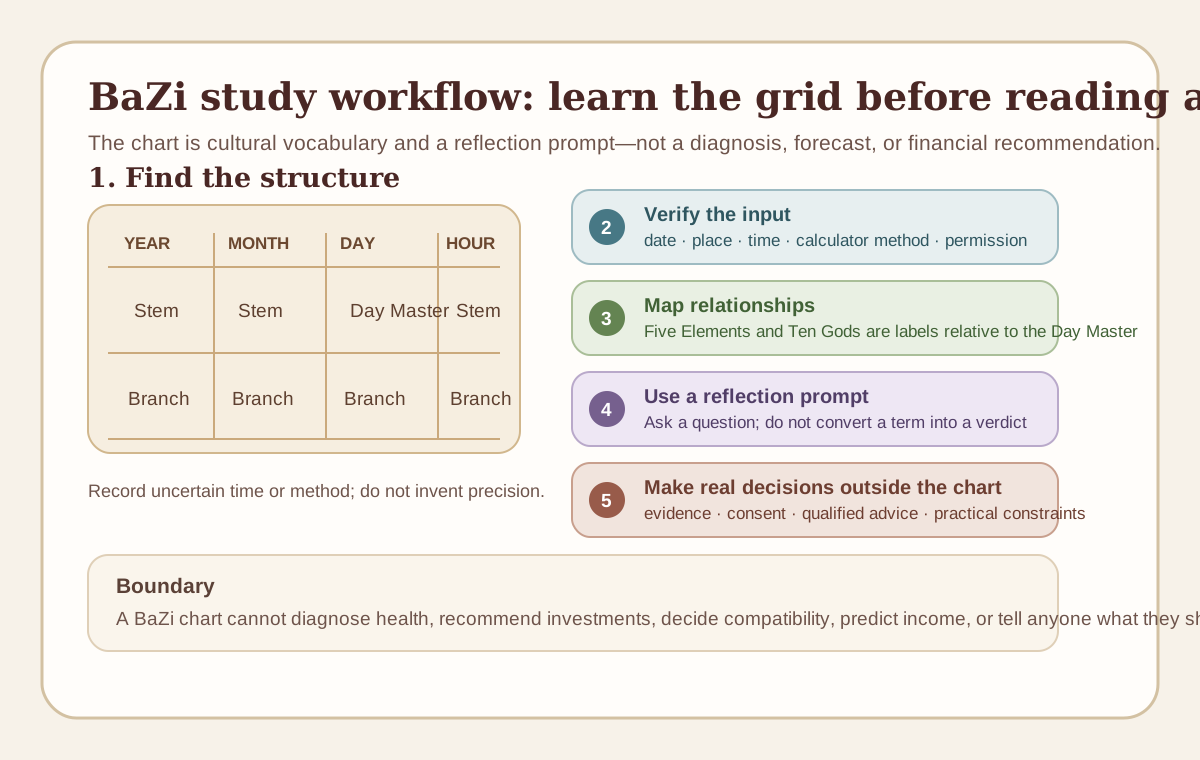
BaZi, often rendered Four Pillars of Destiny in English, builds its chart from the birth moment. The birth year, month, day, and hour each become one pillar, and each pillar is a pair: a Heavenly Stem written over an Earthly Branch. Four pillars, eight characters - the name BaZi means eight characters. The pillars are drawn from the sexagenary cycle, the rotating calendar of stem-branch pairs, so the chart is a piece of calendar mathematics before it is anything else.
The reference point of the whole chart is the stem of the Day pillar, called the Day Master. Everything else in the chart is read in relation to it. The stems and branches carry five-element associations, and the reader traces generating and controlling cycles among them: which elements feed the Day Master, which drain it, which press on it. Layered over the elements are the Ten Gods, a set of ten relationship roles that describe how each other character in the chart stands toward the Day Master - as resource, as output, as wealth, as authority, and so on. Two charts with the same Day Master can read very differently because the surrounding cast differs.
Time enters through the luck pillars. Starting from the birth chart, the reader derives a sequence of ten-year pillars that run alongside the four fixed ones. A sitting typically moves between the fixed chart and the current luck pillar: the chart as the structure, the decade as the conditions moving through it. Because the calculation is deterministic, the same birth data always yields the same base chart; two readers can weight it differently, but they start from identical characters. Readers who want to see the machinery laid out at length can work through the BaZi mastery and destiny blueprint on this site, or draw up the chart itself with the BaZi chart tool.
What a sitting looks like: mostly computation plus interpretation. The reader takes your birth date and hour, builds the chart (by software now, by almanac in earlier generations), and talks through the pillars, the element balance, and the current luck pillar. You sit and listen, ask questions, and hear the structure described.
Zi Wei Dou Shu: the twelve-palace star chart
Zi Wei Dou Shu, Purple Star astrology, is also computed from birth data - the birth date and hour read on the lunar calendar - but the chart it builds looks nothing like a BaZi chart. It is a square of twelve palaces arranged around a center, each palace named for a domain of life: Life, Siblings, Spouse, Children, Wealth, Health, Travel, Friends, Career, Property, Fortune, and Parents. One of these palaces also serves as the Body palace, marked alongside its domain role.
Into the palaces go the stars. Fourteen major stars anchor the system, in two groups. The Zi Wei group holds six: Zi Wei, Tian Ji, Tai Yang, Wu Qu, Tian Tong, and Lian Zhen. The Tian Fu group holds eight: Tian Fu, Tai Yin, Tan Lang, Ju Men, Tian Xiang, Tian Liang, Qi Sha, and Po Jun. Dozens of auxiliary stars join them. Placement is computed, not chosen: the position of the Zi Wei star follows from the birth date and the Life palace position, and the other majors fall into fixed relation to it. Two charts are rarely alike, and the same methodical flavor as BaZi applies - same inputs, same chart, reader weighting on top.
Where BaZi reads element cycles, Zi Wei reads star combinations in palaces: which stars sit in your Career palace, which stars face them across the square, which palaces stand empty and borrow light from opposite. Time moves through the chart by ten-year major limits, called Da Xian, which shift the reading's active focus from palace to palace across the life. A decade ruled in the reading by the Travel palace frames different questions than a decade centered on Property.
A sitting is again largely computation plus interpretation, denser than BaZi if anything, because the chart carries more named parts. You can generate the base layout with the Zi Wei chart tool and see the twelve-palace square before reading further. In the room, the reader walks the palaces relevant to your question, points at the stars seated there, and frames the current major limit.
Advertisement
Face reading: the face as the chart
Face reading, Mian Xiang, needs no birth data at all. The reader reads the face in front of them, and the tradition's frame has three main scaffolding pieces.
First, the San Ting, three horizontal divisions of the face. The upper division runs from the hairline to the brows and is associated with heaven and the early years. The middle division runs from the brows to the nose tip and covers the middle years. The lower division runs from the nose to the chin, associated with earth and the later years. Balance and proportion among the three divisions get read before any single feature.
Second, a set of palaces mapped across the face - positions associated with life domains, of which the Life palace, sitting between the brows, is the most cited. Third, a traditional chart of facial points mapped to ages, the so-called hundred positions, which assigns points on the face to individual years of life. A reader moving through a face in the classical sequence is checking divisions, palaces, and age points in turn, alongside the individual features: brows, eyes, nose, mouth, chin, ears, forehead, cheekbones.
Because a face changes - with age, weight, health, illness, surgery, and plain living - the tradition reads the current face, not a fixed chart. This is the sharpest practical contrast with BaZi and Zi Wei. Your Four Pillars chart at 60 is the chart you were born with; your face at 60 is a new text. Readers treat that as the method's nature rather than a flaw: the face is read as a present-tense document. The site's face reading section covers the divisions and palaces in detail for readers who want the full map.
A sitting is observational and happens in the room. There is nothing to compute in advance. The reader looks, often asks you to turn your head, and narrates what the structure suggests within the tradition's frame.
Palm reading: the hands as the chart
Palm reading, Shou Xiang, reads the hands: the lines cut into the palm, the mounts (the padded areas at the base of the fingers and thumb), and the shape of the hand and fingers themselves.
Four lines carry most readings:
- The heart line, the uppermost of the main lines, running under the fingers
- The head line, across the middle of the palm
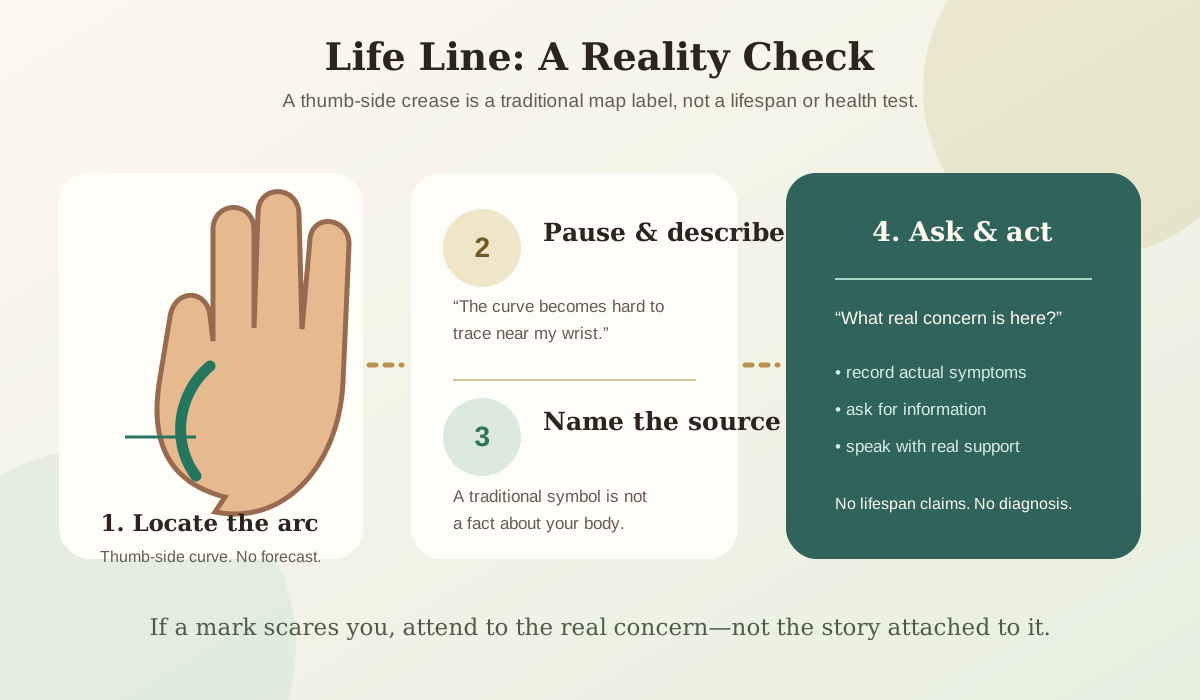
- The life line, curving around the base of the thumb
- The fate line, running vertically up the palm - not present on every hand
Depth, length, breaks, forks, and intersections among these lines form the material. Mounts add a second layer: their padding and placement are read alongside the lines. Hand shape - palm proportions, finger length - sets the general type before details. This site hosts dedicated studies of three of the main lines, the life line study guide, the heart line study, and the head line study guide, each of which takes one line through its variations.
A reader typically compares both hands. In modern popular practice, you will hear the framing that the left hand shows what you were born with and the right shows what you have made of it; that line is a popular modern framing rather than classical doctrine, and actual traditions differ on which hand leads - by school, by the sitter's dominant hand, by custom. Treat any flat rule about left versus right as the reader's house style.
Like the face, the hands change. Lines deepen, fade, and sprout branches across a life; skin and mounts change with work, health, and age. The tradition reads the hand as it is today, which puts palm reading on the changing side of the ledger with face reading.
The four methods compared
| Method | What it reads | Input needed | Fixed or changing | Time structure | What a sitting actually looks like |
|---|---|---|---|---|---|
| BaZi (Four Pillars) | Eight characters from the birth moment, read through element cycles and the Ten Gods | Birth year, month, day, and hour | Fixed at birth | Ten-year luck pillars move through the fixed chart | Computation first, then interpretation; the reader talks pillars and cycles |
| Zi Wei Dou Shu | Fourteen major stars and auxiliaries seated in twelve palaces | Birth date and hour on the lunar calendar | Fixed at birth | Ten-year major limits (Da Xian) shift focus palace to palace | Computation first, then a walk through the palaces tied to your question |
| Face reading (Mian Xiang) | The living face: San Ting divisions, facial palaces, age points, features | Nothing but your face | Changes with age, weight, and health | Reads the present surface; age points map positions to years | Observational, in the room; the reader looks and narrates |
| Palm reading (Shou Xiang) | Palm lines, mounts, and hand shape | Nothing but your hands | Changes across a life | Reads the present surface | Observational, in the room; both hands compared |
The table compresses. The paragraphs around it carry the caveats.
The differences that decide which one a person picks
Three questions settle most choices:
Do you have reliable birth data? BaZi wants the birth hour; the hour pillar is a quarter of the chart. Zi Wei wants the birth date and hour on the lunar calendar, and hour errors move palaces. People adopted in circumstances where records are thin, or born at a time and place where the hour went unrecorded, face real limits with both chart systems. Face and palm reading ask for nothing you do not carry into the room.
Do you want a fixed chart or a current reading? A BaZi or Zi Wei chart can be drawn once and consulted for decades; the document does not change, only the decade frames rotate. Face and palm readings expire, in effect, as you change. Neither property is a defect. A fixed chart suits someone who wants one stable structure to think against. A surface reading suits someone asking about their present state.
Do you think in periods or in the present? The chart systems natively speak in decades. The surface systems natively speak in tendencies and current condition. Pick the grammar that matches the question you actually have.
The same question put to four methods
Take a standard sitting question: I am 38, employed, and thinking about changing careers. Should I, and when? Here is how a reader in each tradition would approach it - at a general level, as an approach, not as a prediction with your name on it.
A BaZi reader builds your chart, locates the Day Master, and reads the Career-relevant relationships through the Ten Gods - the authority and wealth roles relative to your Day Master - then turns to the luck pillars. Which decade are you in, what does the current luck pillar feed or drain, and does the next pillar change the picture? The answer comes back framed as fit and timing across periods: this decade supports a move of a certain kind, that one argues for consolidation. The chart does not name an employer.
A Zi Wei reader computes the twelve palaces and goes to the Career palace: which major stars sit there, what faces them, what the empty or crowded palaces around them suggest inside the system. Then the major limit: which palace the current Da Xian activates, and how it touches Career, Wealth, and Travel. The answer comes back framed as which domain the decade spotlights and how the Career palace is lit within that frame.
A face reader skips the paperwork and looks at you. Within the tradition: the middle division for the years you are standing in, the palaces the system ties to work and fortune, the features it reads for drive and judgment. The answer comes back framed in present terms - what your face at 38 is read as showing about energy, patience, and appetite for risk right now. No decade arithmetic enters it.
A palm reader asks for both hands. The head line for how decisions get made, the heart line for what satisfaction requires, the fate line, if present, for the track of work so far, breaks and branches read as shifts in direction. The answer comes back framed as how you work and what has already changed in the working pattern, not when a calendar event lands.
Same question, four grammars. Readers who have sat for more than one method often report that the sittings felt different in kind, not just in content: two felt like having a chart explained, two felt like being observed closely by someone narrating. That difference in feel is the real fork in this comparison.
Readers and disagreements
No method in this comparison certifies its readers. There is no license, no board, no exam that all practitioners pass, in any of the four systems. Price and depth vary wildly: a careful hour with a senior reader and a five-minute fairground reading use the same vocabulary at very different levels of care.
Disagreement among readers is structural, not scandalous. The computations are shared - two BaZi readers given the same birth data produce the same eight characters - but weighting is judgment. Which cycle dominates this question, which palace combination matters most, how much a broken line segment counts: the manuals teach rules of thumb, and experienced readers apply them differently. Within each tradition, schools split further. The practical defense is the one used in any interpretive craft: ask the reader to show the trail. A reader who names the pillar, the star, the palace, or the line behind each claim gives you something to think with. A reader who offers only conclusions, in any of the four systems, gives you nothing to weigh.
Limits, and how to use any of them well
All four are pattern-reading traditions. None is a validated instrument for predicting events, and no sitting, in any system, supplies evidence about what will happen to you. Readers within each system disagree on weighting, and the systems themselves rest on traditional correspondences - elements, stars, facial zones, palm lines - that are articles of the tradition, not measured facts about the world.
Used inside those limits, the methods do something legitimate: they give a structured occasion to think about your own situation from an unusual angle, in a vocabulary built for the purpose. That use suggests its own ground rules:
- Treat the reading as a prompt for reflection or cultural study, not as instruction. Decisions about work, money, health, and relationships stay with the ordinary tests: numbers, documents, second opinions from qualified people.
- Ask how the reader got there. The trail is the value.
- Take notes in the sitting. Memory edits readings toward what we wanted to hear.
- Be wary of escalation. A reading that ends with paid remedies, curse removal, or a warning that only further paid sessions can help has left the tradition's frame and entered sales.
- One sitting, one method, then time. Shopping the same question across four readers in a week collects four grammars and no clarity.
A short note after the sitting does more for you than a second sitting. Write down the method used, the question as you asked it, the main structures the reader pointed to - the pillar, the palace, the division, the line - and the two or three sentences you actually took away. Date it. Months later, that note lets you judge the reader and the method by something firmer than mood: whether the framing stayed useful after the details of the session faded. It also protects you from a quiet trap in all four systems, which is remembering only the phrases that flattered the decision you had already made. The written record from the day itself is harder to edit after the fact, and it turns a single sitting into something you can learn from, whichever tradition produced it.
Four methods, two built from the birth moment and two read off the living body, all asking to be used as mirrors with structure rather than as instruments. Pick the one whose input you can actually supply and whose grammar fits your question, find a reader who shows their work, and keep the decisions where they belong: with you, after the sitting, in the light of everything else you know.