Every feng shui year, four directions of a home get flagged. The Tai Sui, or Grand Duke, takes the direction of the year animal. The Sui Po, or Year Breaker, takes the direction exactly opposite. The San Sha, the Three Killings, takes the direction opposed to the year animal family. And the Five Yellow, the heaviest of the nine Flying Stars, lands wherever the annual Lo Shu flight puts it. Three of the four come from the year Earthly Branch. The fourth comes from the star flight. Different machinery, one shared instruction in the tradition: while an affliction sits in a sector, you do not break ground there.
This guide covers the four afflictions as a set: what each one is inside the tradition, the rule that places it, the compass degrees it occupies in 2026 and in 2027, and how the two years differ on the same floor plan. One labelled hypothetical apartment gets read through both years, because the changeover is where most households get it wrong: the metal that stood in the south through 2026 has to come out before Li Chun 2027, and the north becomes the quiet sector instead. Belief content is framed as tradition throughout. These are the placement rules practitioners teach. They describe how the tradition sorts directions by year, and nothing here promises an outcome for any household or any renovation.
The site Flying Stars chart guide builds the full annual grid star by star, and the Flying Stars page turns that grid by year. This guide takes the other half of the annual picture: the branch afflictions that the star grid does not carry, and the one star, the Five Yellow, that both systems treat as the year heaviest direction.
The four afflictions at a glance
| Affliction | Chinese | What sets its direction | 2026 position | 2027 position |
|---|---|---|---|---|
| Tai Sui (Grand Duke) | 太歲 | The year Earthly Branch itself | South, Wu mountain, 172.5 to 187.5 degrees | Southwest, Wei mountain, 202.5 to 217.5 degrees |
| Sui Po (Year Breaker) | 歲破 | 180 degrees opposite Tai Sui | North, Zi mountain, 352.5 to 7.5 degrees | Northeast, Chou mountain, 22.5 to 37.5 degrees |
| San Sha (Three Killings) | 三煞 | Opposite the year animal trine | North sector, core 337.5 to 22.5 degrees | West sector, core 247.5 to 292.5 degrees |
| Five Yellow | 五黃 | The annual Lo Shu flight | South palace, 157.5 to 202.5 degrees | North palace, 337.5 to 22.5 degrees |
Read the table by columns and the pattern shows itself. Tai Sui and Sui Po always sit opposite each other, because Sui Po is defined as the opposite point. The San Sha moves by trine, not by single animal, so it jumps a full sector between animal families. The Five Yellow walks the Lo Shu flight path one step a year with the annual chart. Two of the four therefore move in small steps and two jump, which is why a household cannot simply roll last year map forward. The 2026 map and the 2027 map disagree in every row.
One overlap in the table deserves attention before the detail. In 2026 the Tai Sui and the Five Yellow occupy the south at the same time: the Five Yellow takes the whole 45 degree south palace, and the Tai Sui takes the 15 degree Wu mountain at its centre. Teachers treat doubled sectors as the year quietest ground, and 2026 puts that double in the south. In 2027 the four spread out, one to each of four different directions, and no sector carries two at once. The practical advice of the two years differs for that reason alone.
Tai Sui: the direction of the year animal
Tai Sui, the Grand Duke Jupiter, is the year direction given a personage. In the older astronomy behind the system, the year cycle was tracked against Jupiter, and Tai Sui names the counter-Jupiter point the calendar assigns to the year. On the floor plan it reduces to one rule: Tai Sui sits in the compass direction of the year Earthly Branch.
The branch directions come from the 24 mountains ring, the ring that divides the compass into 24 slices of 15 degrees each, three mountains to every 45 degree sector. Each of the twelve branches owns one mountain. The Horse branch, Wu, owns the mountain centred on 180 degrees, running 172.5 to 187.5. The Goat branch, Wei, owns the first mountain of the southwest, centred on 210 degrees, running 202.5 to 217.5. So the 2026 Horse year puts Tai Sui due south, and the 2027 Goat year puts it in the southwest. The site compass reading guide gives the full 24 mountains table and the measurement routine these degrees have to come from; a phone reading taken beside a steel door frame can sit several degrees off, and 15 degree mountains punish sloppy readings.
The traditional handling has two parts. The first is a furniture rule: do not sit facing the Grand Duke head-on. Sitting in his sector is accepted; sitting with him behind you is accepted; the arrangement the tradition avoids is the long desk or bed position that faces squarely into his mountain for hours a day. The image teachers use is court etiquette. You do not stare down the senior figure in the room.
The second part is a works rule, and it is the one with renovation money riding on it: no ground-breaking in the Tai Sui sector during his year. Drilling, digging, knocking through, and demolition noise in that 15 degree slice are what the rule names. The slice is narrow. A south sector kitchen in 2026 is not closed for the year; the drilling stays out of the Wu mountain strip at its centre, and teachers who plan work to the degree will mark that strip on the plan rather than flag the whole room.
Sui Po: the point opposite
Sui Po, the Year Breaker, is the simpler of the four to place and the easier to forget. It sits exactly 180 degrees from Tai Sui, always. The 2026 Horse year puts it in the north on the Zi mountain of the Rat, 352.5 to 7.5 degrees. The 2027 Goat year puts it in the northeast on the Chou mountain of the Ox, 22.5 to 37.5 degrees.
Inside the tradition the Year Breaker carries a lighter charge than the Grand Duke, and the handling is mostly the works rule again: no deliberate disturbance, no ground-breaking in its mountain slice. It earns its separate name because it is the direction the year faces. Tai Sui is the seat of the year authority; Sui Po is where that authority looks, and the tradition treats the faced direction as stirred up by the looking. For floor-plan purposes a household can treat the two mountains as a pair of narrow no-dig strips on opposite walls, moving together from year to year: south and north in 2026, southwest and northeast in 2027.
Advertisement
San Sha: the trine rule
The San Sha, the Three Killings, is placed by family rather than by the single year animal. The twelve animals group into four trines of three allies each, and each trine belongs to one element. The San Sha sits in the sector 180 degrees across the compass from the trine own direction. The working table is short enough to memorise:
| Year animal trine | Animals | Trine element and direction | San Sha direction |
|---|---|---|---|
| Tiger, Horse, Dog | Yin, Wu, Xu | Fire, south | North |
| Pig, Rabbit, Goat | Hai, Mao, Wei | Wood, east | West |
| Monkey, Rat, Dragon | Shen, Zi, Chen | Water, north | South |
| Snake, Rooster, Ox | Si, You, Chou | Metal, west | East |
The 2026 Horse year belongs to the Fire trine, so the San Sha sits in the north. The 2027 Goat year belongs to the Wood trine, so the San Sha sits in the west. The jump from north to west between the two years is the trine machinery working as designed; the San Sha never moves one sector at a time the way the Tai Sui does.
Width is where published charts disagree, and the disagreement is worth naming plainly. The San Sha is traditionally counted across three mountains, which on the 24 mountains ring gives a 75 degree span: for the 2027 west, 232.5 to 307.5 degrees. Many published annual charts simplify to the 45 degree compass sector at the centre of that span: west at 247.5 to 292.5 degrees, or north at 337.5 to 22.5 degrees in 2026. The centre is identical in both counts. A household planning work can hold the 45 degree sector as the agreed core and treat the flanking mountains as the caution margin, which satisfies both schools without papering over the difference.
The furniture rule for the San Sha runs opposite to the Tai Sui rule: face it rather than sit with your back to it. A desk that puts the San Sha sector behind the chair is the arrangement the tradition avoids. The works rule is the same as the others, no ground-breaking in the sector, and the San Sha wider span makes it the affliction that most often swallows a whole room. In 2027 a west bathroom sits inside the San Sha span whichever count a household uses; in 2026 the same bathroom sits clear of all four afflictions. That contrast drives the worked plan below.
The Five Yellow: the one that comes from the star flight
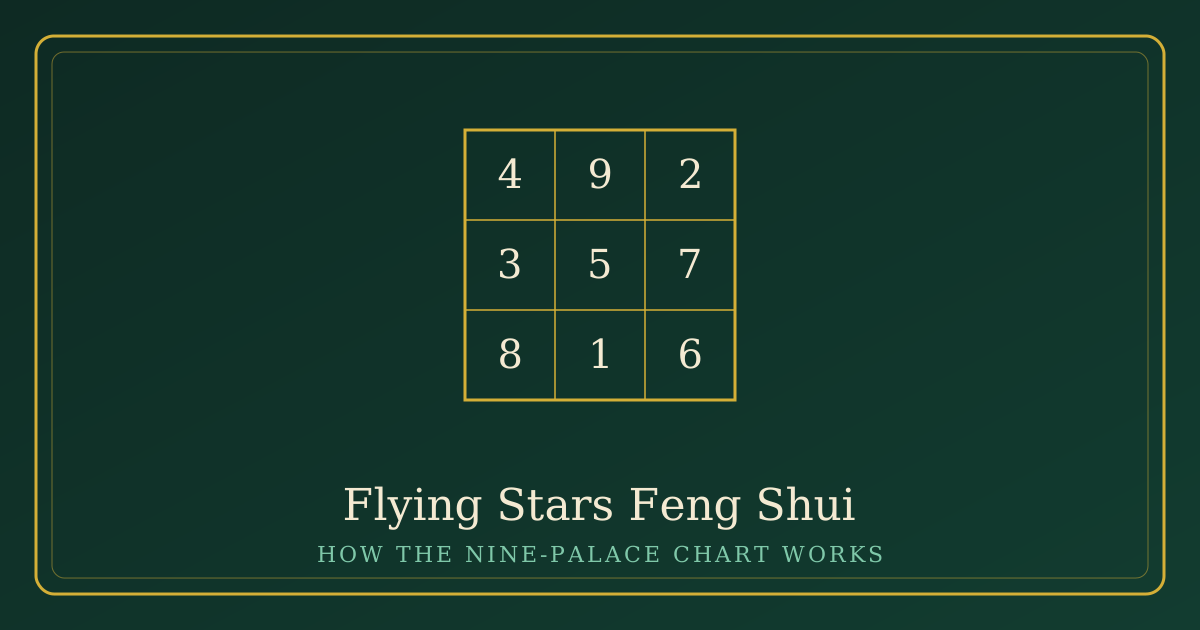
The Five Yellow, Wu Huang, is star 5 of the nine Flying Stars, the Earth star with no trigram of its own. In the natal Lo Shu square it belongs to the centre. In an annual chart it flies to a palace like the other eight stars, and the annual flight is governed by the centre star of the year. The centre star counts down one per year: 3 in 2024, 2 in 2025, 1 in 2026, then 9 in 2027, wrapping from 1 back up to 9. Walking the Lo Shu flight path from a centre of 1 puts star 5 in the south palace; walking it from a centre of 9 puts star 5 in the north palace. That single step of the centre star is the whole reason the Five Yellow moves from south in 2026 to north in 2027.
The tradition handles the Five Yellow with the quiet rule and the metal rule. Quiet: the palace holding star 5 for the year gets no renovation, no drilling, and as little sustained noise as the household can arrange. Metal: because star 5 is Earth, and the five-element cycle has Metal draining Earth, the traditional counter placed in that palace is metal, a heavy metal object, metal rods, or a metal wind chime. The site cures guide covers the salt water cure and the metal placements in full, including the upkeep each one needs. What the annual-affliction layer adds is timing: the metal belongs in the palace for that year only. Metal standing in the south is a 2026 placement. Left there through 2027 it is simply furniture in the wrong room, because the Five Yellow has moved north.
Star 5 also explains why the affliction sits at palace width, 45 degrees, while Tai Sui and Sui Po sit at mountain width, 15 degrees. The star occupies its whole palace. The branch directions occupy their mountains. The San Sha sits between, 45 degrees in the narrow count, 75 in the wide count. Marking a floor plan therefore needs three pencils, not one: a narrow strip for the Grand Duke and the Year Breaker, a full sector for the Five Yellow, and a sector with a caution margin for the Three Killings.
The year turns at Li Chun, not at Lunar New Year
All four positions change on the same day, and the day is a solar term, not the festival. The feng shui year opens at Li Chun, the Start of Spring term, which falls on February 4 in both 2026 and 2027. The 2026 positions in the table govern from February 4, 2026 to February 4, 2027. Lunar New Year, February 6, 2027 for the Goat year, runs on the lunar calendar and lands two days after the feng shui year has already turned. The site 2027 Fire Goat guide lays out both calendars for the year and the February 4 to 5 boundary cases for births; households use the same split for rooms. Work scheduled in the first week of February 2027 belongs to the 2027 map from February 4 onward, whichever calendar the family celebrates.
Households that keep annual placements usually make the changeover a small fixed routine in the last days of January: take the old year metal and cure objects out, clean the sectors, put the new year placements in, and check the plan against the new table before Li Chun. Leaving the changeover until after the festival is the common slip, because the festival is the date on the kitchen calendar. The feng shui map does not wait for it.
One apartment, two years: a worked plan
The apartment below is a labelled hypothetical, drawn to show the working method. It is not a real household, and its layout is a teaching example; the method transfers to any plan once the compass sectors are drawn the same way.
The plan: a condo with its main door in the south sector of the unit, a kitchen along the west wall, a bathroom in the west sector beside the kitchen, the main bedroom in the north sector, and a living room across the southeast and south. A bathroom renovation has been budgeted, and the owners want to know which year to do it in.
2026 through the affliction layer. The south holds the year double affliction: the Five Yellow across the whole south palace and the Tai Sui on the Wu mountain at its centre. The main door and half the living room sit in that palace, so the 2026 handling is behavioural rather than structural: the south stays as it is, no drilling for new shelving in the door wall, gatherings kept ordinary rather than loud and late, and the traditional metal placement stands inside the south sector near the door. The north holds the other two: the San Sha across the north sector and the Sui Po on the Zi mountain inside it. The main bedroom is therefore a room to keep quiet in 2026, which costs nothing, since a bedroom is quiet by design. The west holds none of the four. The bathroom renovation goes into 2026, the year its sector is clear, with the noisy work scheduled well inside the year rather than near the February edges.
2027 through the same layer. Li Chun 2027 turns the map. The Five Yellow moves to the north palace, into the main bedroom, and the San Sha moves to the west sector, into the kitchen and the renovated bathroom. The Tai Sui moves to the Wei mountain in the southwest, which in this plan is living room wall and storage; the Sui Po moves opposite to the Chou mountain in the northeast. The south is now clear of all four. The 2027 handling follows from the rooms: the north bedroom gets the metal placement and a quiet year with no drilling into its walls; the west keeps its new bathroom but takes no further works, and nobody sets up a desk with their back to the west wall for long hours if the San Sha furniture rule is being followed; any wall work the owners had vaguely planned for the south, picture hanging with drilled anchors aside, is now free to schedule. Had the renovation been left to 2027 instead, the same bathroom would have sat inside the San Sha for its entire works period. Nothing about the apartment changed. The year changed where the care goes, and scheduling the one big job into the clear year was the entire gain.
Two method points from the example carry to any plan. First, the afflictions are read against rooms, not against the compass in the abstract: the same north sector is a cheap year of care when it holds a bedroom and an expensive one when it holds a kitchen due for rebuilding. Second, the affliction layer is a scheduling tool before it is anything else. Of the four traditional responses, keeping a sector quiet, delaying optional works, facing one way rather than another at a desk, and placing metal, all four are cheapest when they are decided before the contractor is booked.
What the works rule covers, and what it does not
The shared instruction behind all four afflictions is usually translated as do not disturb the earth, dong tu. In a modern apartment it cashes out as a specific list: breaking ground or digging outside the building line, demolition, drilling and hammering into walls, knocking through partitions, and heavy vibration work such as floor grinding. Painting, papering, quiet decorating, moving furniture, and replacing appliances without wall work sit outside it in mainstream teaching. Teachers differ at the edges, on work like picture-hook drilling, and a household can watch the difference without anxiety: the tradition is arguing about degrees of disturbance, not handing down a building code.
Where work cannot move, a burst main or a failed bathroom seal, the tradition own answer is unglamorous: fix it. Practitioners advise keeping unavoidable work in an afflicted sector short, starting noisy jobs in a clear sector where a project spans several rooms, and not expanding a necessary repair into an optional renovation while the sector is flagged. The affliction map ranks and sequences work. It was never a reason to live with water running through a ceiling.
Renters get a narrower but real version of the same practice. Nothing in the quiet rule, the facing rules, or the metal placement requires owning the walls. The renter version is: know which sector of the unit holds which affliction this year, keep the Five Yellow sector the quietest room corner available, skip the optional shelf-drilling in flagged strips, and let the landlord schedule the loud repairs with the map on the table if they are open to it.
How this layer sits with the rest of the annual map
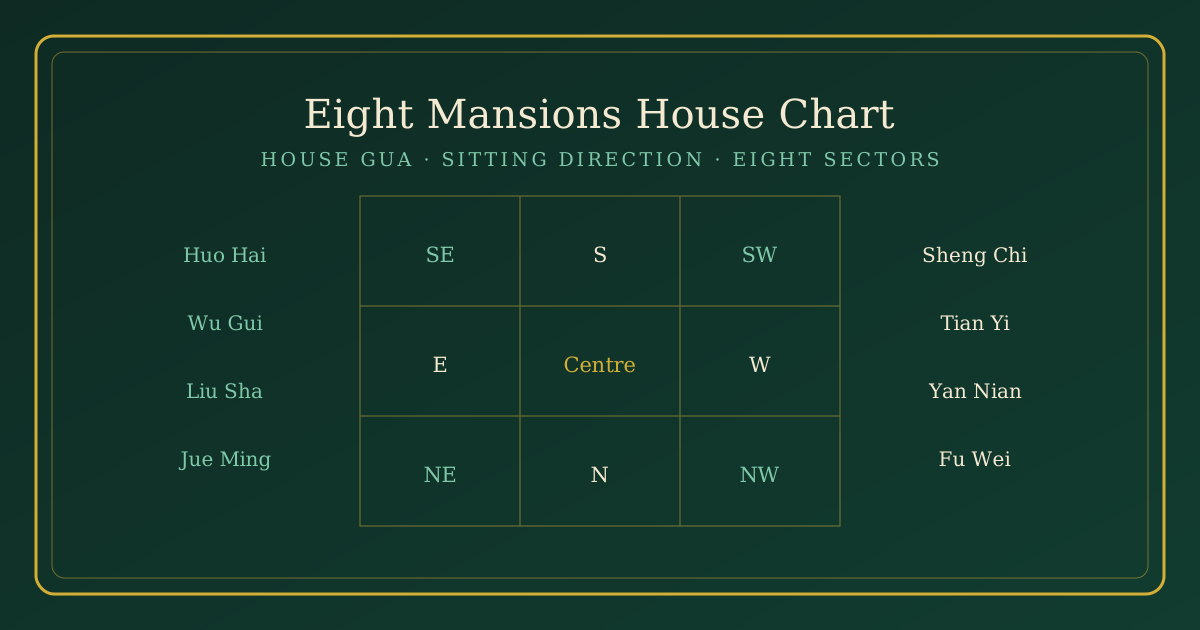
The annual afflictions are one overlay among several, and stacking order keeps readings sane. The house natal Flying Star chart and the Eight Mansions house chart are fixed by the building and outrank the year layer for room choice. The annual Flying Star grid, including the Five Yellow, runs one year and colours how each sector is used that year. The branch afflictions, Tai Sui, Sui Po, and the San Sha, run the same year on the same sectors through different machinery. Where an annual star and a branch affliction land together, as the Tai Sui and the Five Yellow do in the 2026 south, teachers treat the sector with the sum of the care. Where they argue, a favourable annual star in a San Sha sector, the usual teaching is to use the room and skip the works: the star speaks to use, the affliction speaks to disturbance, and the two claims can both be honoured at once.
The personal layer sits outside this guide. Which animals carry the year clash labels, and the ben ming nian customs that go with them, are covered in the site 2027 Fire Goat guide and the ben ming nian guide. Those are readings of the person. This guide is a reading of the floor plan. Households commonly hold both, and keeping the two apart prevents most of the confusion in published annual advice, where a direction flagged for the house and a year flagged for a person get merged into one alarming paragraph.
Limits, stated plainly
Tai Sui, Sui Po, San Sha, and the Five Yellow are traditional categories. The checkable parts of this guide are the calendar and compass parts, and they check out as arithmetic: the branch mountains and their degrees, the trine groupings, the centre star sequence 3, 2, 1, 9, the Lo Shu flight that lands star 5 south then north, and the Li Chun dates. A reader can verify every one of those from the tables above with a compass and a calendar. The interpretive part, that a flagged sector should be kept quiet or that metal belongs with the Five Yellow, is the tradition internal practice. It is not a measurement of a building, and it does not predict accidents, illness, or repair bills.
Used inside those limits, the system does a practical job that does not depend on belief in it. It forces one planning pass a year over the whole floor plan, sector by sector, before any works are booked. It gives a household a shared, neutral vocabulary for sequencing renovations: the bathroom goes this year while its sector is clear, the north wall waits until February. Families who would never describe themselves as feng shui practitioners end up doing the same exercise with contractor availability and weather. The tradition just fixes the date for it, once a year, at Li Chun.
The changeover checklist
- In the last week of January, pull the outgoing year table and mark every placement that was made for it: metal in the old Five Yellow palace, anything hung for the old year.
- Take those placements out and clean the sectors. Do not roll an annual placement into a second year by leaving it standing.
- Draw the new year four afflictions on the floor plan: two 15 degree mountains, Tai Sui and Sui Po opposite each other, the Five Yellow palace, and the San Sha sector with its margin.
- Check every planned work for the coming year against the drawing. Move optional drilling, demolition, and digging out of flagged sectors, or into the part of the year and the part of the plan where the sector is clear.
- Set the new Five Yellow metal placement, and note which desk and bed facings, if any, now face the Tai Sui mountain or turn a back to the San Sha.
- Put the drawing somewhere the household will see it in February, when the festival calendar and the feng shui calendar briefly disagree about which year it is.