Flying Stars is the time-based branch of feng shui, and its chart looks forbidding until the machinery underneath it is visible. Nine numbers sit in a 3x3 grid. Each number is called a star. The grid turns once a year, sits on top of a fixed chart belonging to the house itself, and gets read room by room. Everything in that sentence follows rules a reader can check with a pencil: a magic square from an old legend, a fixed walking path through nine palaces, a 180-year cycle of 20-year periods, and a facing direction measured in degrees.
This piece builds the chart in the order a practitioner builds it, ending with a worked annual grid for 2026 that you can verify cell by cell against the flight path. Feng shui here is treated as tradition and interpretive practice. Star labels and associations are presented as the tradition states them, not as promises about wealth, health, or any other outcome. For a live grid you can turn by year, the site keeps a Flying Stars page that lays the same palaces out interactively.
The Lo Shu square and its legend
Every Flying Stars chart is a rearrangement of one small grid, the Lo Shu square. Read in the usual chart orientation, with South at the top as Chinese charts are drawn, its rows run 4-9-2 across the top, 3-5-7 through the middle, and 8-1-6 along the bottom. Every row adds to 15. Every column adds to 15. Both diagonals add to 15. That property is why teachers call it a magic square, and it is the reason the number 5 anchors the center in the base arrangement.
Tradition ties the square to a legend about Yu the Great, the culture hero credited with taming the floods. In the legend, a turtle rose from the Luo River with a pattern of dots on its shell, and the counts of those dots, read in order, gave the arrangement above. Frame that story the way practitioners themselves tell it: as the origin legend of the system, passed down with the square rather than as a dated historical event. What matters for using the chart is not the turtle but the arithmetic. The Lo Shu order fixes which numbers sit next to each other, and the flight path below walks through the palaces in an order derived from it.
| Palace | Star in base Lo Shu | Direction |
|---|---|---|
| Southeast | 4 | Southeast |
| South | 9 | South |
| Southwest | 2 | Southwest |
| East | 3 | East |
| Center | 5 | Center |
| West | 7 | West |
| Northeast | 8 | Northeast |
| North | 1 | North |
| Northwest | 6 | Northwest |
Drawn as a chart with South at the top, the base grid looks like this:
| Southeast 4 | South 9 | Southwest 2 |
|---|---|---|
| East 3 | Center 5 | West 7 |
| Northeast 8 | North 1 | Northwest 6 |
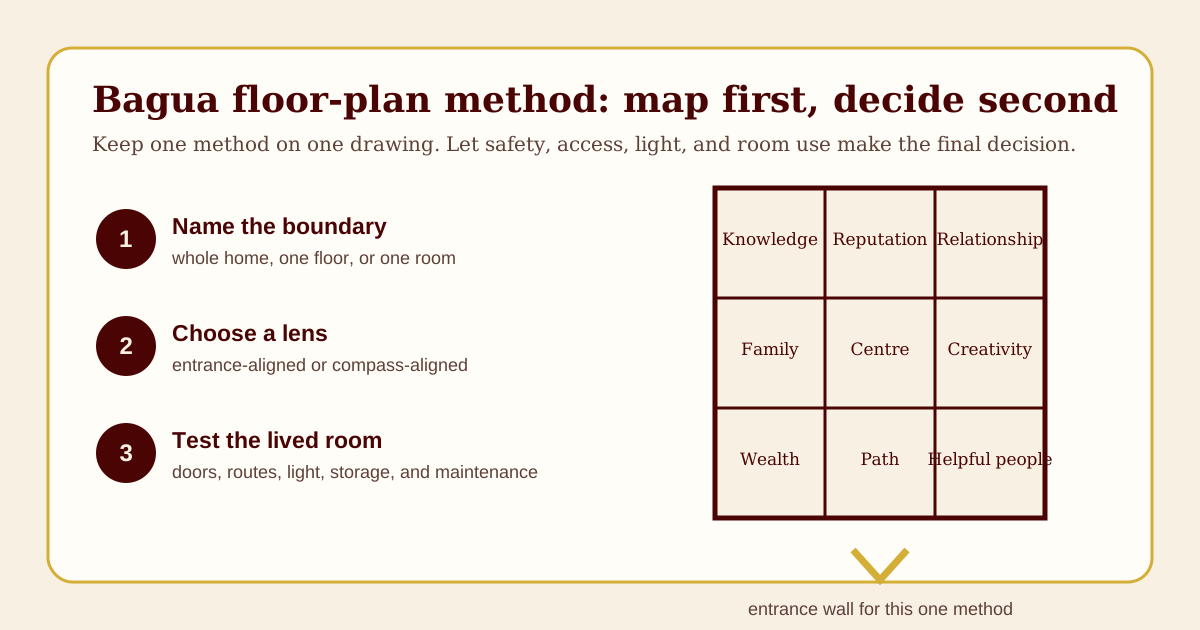
Two habits help when reading any later chart here. Keep South at the top: flipping the chart to a Western north-up layout is the most common beginner error in this system. Read directions from the center of the home outward. The grid divides the floor plan into nine palaces by direction from the middle of the plan, which is also how the bagua map room by room guide divides a home. The two systems share the nine-palace floor; they differ in what they place inside it.
The nine stars
Each number from 1 to 9 is a star with a traditional color name, an element, and a set of associations teachers use when reading a palace. The labels below are the traditional ones. Different periods change which stars practitioners read as strong or weak, so the association column states the long-standing label rather than a current verdict.
| Number | Traditional name | Element | Traditional association |
|---|---|---|---|
| 1 | 1 White | Water | Movement, study, travel, communication in older texts |
| 2 | 2 Black | Earth | The illness star in traditional reading; heaviness, delay |
| 3 | 3 Jade | Wood | Disputes, argument, legal friction |
| 4 | 4 Green | Wood | Study, scholarship, romance |
| 5 | 5 Yellow | Earth | The misfortune star; the most heavily treated label in the set |
| 6 | 6 White | Metal | Authority, structure, the head of household in older texts |
| 7 | 7 Red | Metal | Sharp loss in older readings; speech and metal cutting |
| 8 | 8 White | Earth | Prosperity in recent periods; steady accumulation |
| 9 | 9 Purple | Fire | Growing prosperity; celebration, visibility |
Stars 2 and 5 carry the labels practitioners watch most closely, and both are Earth stars, which is why traditional treatments for afflicted sectors work through Metal, the child of Earth in the generating cycle covered by the five elements balancing guide. Star 8 earned its prosperity label largely through Period 8. Star 9 carries the growing-prosperity label into its own ruling period now. Star 7 shows how labels age: useful for speech in its own period long past, read as sharp-edged in modern books. The number did not change; the period around it did.
Combinations matter more than single stars in advanced reading. When an annual star enters a palace, it meets the fixed natal stars there, and teachers read the pair together through the same element logic. A beginner does not need the combination lists to follow a chart, but knowing they exist explains why two books can read the same annual grid and write different paragraphs about the same room. They are reading different layers of it.
Advertisement
Periods and timeliness
Time in this system runs in nine Periods of 20 years each, making a 180-year grand cycle that repeats. A period is ruled by the star matching its number, and practitioners read that star as the most timely of the nine - the one whose traditional associations carry the most weight in those two decades. The star of the next period is read as rising. A star two periods past its reign is read as faded, its labels noted but discounted.
| Period | Years | Ruling star | Element of the period |
|---|---|---|---|
| Period 7 | 1984-2003 | 7 Red | Metal |
| Period 8 | 2004-2023 | 8 White | Earth |
| Period 9 | 2024-2043 | 9 Purple | Fire |
Practitioners reading a chart in Period 9 put it this way: 9 is timely, 1 is the rising future star, and 8 is the fading one. That single sentence changes how the roster table above gets used. Star 9 in a palace is read at full weight. Star 1 is read as promising and increasingly active. Star 8 is read with its prosperity label softened, a star whose best decades in this reading have just passed. Stars 2 and 5 keep their watch labels in every period, but even they are weighed against timeliness and against what else sits in the palace.
Period also explains a common puzzle. Advice written during Period 8 treats star 8 as the headline and star 9 as the rising guest; advice written now reverses the emphasis. Checking the publication period of any Flying Stars advice is a reading skill in itself.
A house carries its construction period in its fixed chart. A home finished in 2010 holds a Period 8 natal chart for its whole life, read now through Period 9 timeliness. A home finished in 2025 starts from a Period 9 base.
How a yearly chart is built
An annual chart is made by one decision and one walk. The decision is which star sits in the center palace for the year. The walk is the flight path, a fixed order through the nine palaces that every star follows: center, Northwest, West, Northeast, South, North, Southwest, East, Southeast, and back to center. Place the center star, then count upward one star at a time along that path, wrapping from 9 back to 1, and the nine palaces fill in.
The center star steps down by one each year. The sequence around the current years runs: 2024 center star 3, 2025 center star 2, 2026 center star 1, then 2027 center star 9. The step down wraps at the bottom of the count, which is why 2027 jumps to 9 rather than 0. The annual chart turns at Li Chun, around February 4, because Flying Stars follows the solar terms. A chart labeled 2026 governs from Li Chun 2026 to Li Chun 2027. January readings, and readings before Li Chun in early February, still belong to the outgoing year. This is a solar-calendar system, and keeping that straight prevents the most common dating error in the whole method.
Worked example: the 2026 annual chart
Take center star 1 for 2026 and walk the flight path upward. Center takes 1. Northwest takes 2. West takes 3. Northeast takes 4. South takes 5. North takes 6. Southwest takes 7. East takes 8. Southeast takes 9. Each direction can be checked against the path in one pass: the count rises by one at every step, and Southeast, the last stop before the path returns to center, closes the set at 9.
| Direction | Annual star 2026 |
|---|---|
| Center | 1 |
| Northwest | 2 |
| West | 3 |
| Northeast | 4 |
| South | 5 |
| North | 6 |
| Southwest | 7 |
| East | 8 |
| Southeast | 9 |
Drawn as a chart with South at the top, the 2026 annual grid is:
| Southeast 9 | South 5 | Southwest 7 |
|---|---|---|
| East 8 | Center 1 | West 3 |
| Northeast 4 | North 6 | Northwest 2 |
Read a few palaces from that grid the way a practitioner would, keeping timeliness in view. The South palace holds annual star 5 in 2026, the Earth star with the heaviest traditional label, sitting in the Fire sector where Fire feeds Earth. Teachers reading that combination tend to advise a quiet year for that sector: less renovation noise and gatherings staged elsewhere. The Southeast holds 9, the timely ruling star, read as the most supported palace of the year in this grid. The East holds 8, read as fading in Period 9, so its older prosperity label is discounted. The Center holds 1, the rising star.
That reading required no object to be bought or moved. It produced judgments about which rooms to keep quiet and which to use fully. Chart first, judgment second, objects last if at all is the working order the rest of this piece keeps.
Natal, annual, and monthly layers
The annual grid floats. Underneath it sits the natal chart, the fixed grid belonging to the house itself. A natal chart is set by two facts: the construction period of the building and its exact facing direction. Facing is measured in degrees on the 24 Mountains ring, a compass division that splits each of the eight directions into three mountains of 15 degrees each. Small differences in measured degrees can move a house from one mountain to the next and change the natal chart, which is why the compass reading guide treats metal interference, door frames, and repeated readings as seriously as it does.
Inside each palace teachers work with more than one fixed star - a mountain star and a water star in the fuller form of the method, read against the base star of the palace. Mountain stars are read against where people rest and where solid ground rises; water stars against movement, doors, and open space. A full natal reading is a consultation skill of its own. The load-bearing point for following charts is simple: the natal layer does not change when the calendar does. It is the climate of the house in this system. Annual and monthly stars are the weather moving over it.
Monthly stars follow the same flight path on a faster clock, turning roughly with the solar months, so changes land in the first week of each Gregorian month. Practitioners use this layer for short-term sensitivity: a renovation in a particular room, a desk moved for a season. Readers new to the system usually work with natal plus annual only.
Weighing order matters when the layers disagree. The order taught most often is natal first for the long character of the room, annual second for the year, monthly third for short windows. A good annual star reads as a year of relief in a hard palace, not a rewrite of it. The wealth corner practical guide shows this weighing at the sector readers ask about most.
How a reader weighs a chart in a real home
Start with the floor plan divided into nine palaces by direction from the center of the home. Note which room falls in each palace, and how that room is actually used. Then read each occupied palace in three passes.
First pass, the fixed reading. Note the natal stars of the palace and their element relationships. This pass changes only when the use of the room changes, so it rewards the most care. A palace read as settled in the natal layer becomes the anchor of the plan; rooms placed there take the high-use roles where the plan allows choice.
Second pass, the annual visitor. Note the annual star, weigh its timeliness in Period 9, and read it against the natal stars beneath it. Timely and rising stars are read as support for the normal use of the room. Faded stars are noted with their labels discounted. The watched Earth stars, 2 and 5, get the traditional response of quiet use and, in households that follow the cure tradition, metal-based treatments for the year.
Third pass, use itself. A difficult reading in a storeroom, a little-used guest room, or a garage corner weighs less in practice than the same reading at the front door, the main bedroom, or the desk where someone sits eight hours a day. Activity feeds a palace in this system. Practitioners therefore grade their response by traffic: ignore lightly in dead corners, watch in ordinary rooms, act first - if at all - where the household actually lives.
If every chart shows at least one watched star, is something always wrong somewhere? Inside the tradition, yes, and by design. Each year brings a sector that asks for quiet and a sector that carries the timely star. The practical skill is proportion: matching the response to the room, the layer, and the year rather than treating each palace as an alarm of equal volume.
Common misunderstandings
The dating error leads this list because it silently corrupts every other step. The chart turns at Li Chun, around February 4, on the solar calendar. It does not turn on January 1, and it does not turn on Lunar New Year. A household that rearranges placements in late January is working a month early, under the outgoing chart, and a reader checking their work against a published annual grid in that window will find mismatches that are really calendar mismatches.
The second misunderstanding is that an afflicted sector needs an object. The chart asks for a judgment first. Quiet use, fewer renovations, less noise and clutter in that sector for the year - these are responses inside the tradition, and for lightly used rooms they are usually the whole response. Objects from the cure tradition enter where the household follows that layer of practice and where the room is active enough to warrant it. Skipping the judgment and going straight to shopping reverses the method.
The third is the identical-house puzzle. Two homes with the same floor plan, even two units in the same building, can carry different natal charts. Construction period sets the base, exact facing direction in degrees sets the mountain, and either fact changing changes the chart. Advice copied from a neighbor's reading, or from a listing photo of a similar unit, therefore has a structural problem before it has any other kind. The plan is the last thing to copy. The chart is built from period and facing first.
A fourth, quieter misunderstanding is reading the annual grid as the whole chart. Published annual grids are real and useful - the worked 2026 grid above is complete as an annual layer - but they are one layer of three. A room that looks flagged on the annual grid may sit on settled natal stars, and a room that looks favored this year may carry a natal reading that argues for steady care across all years. Naming which layer a claim comes from keeps annual advice in its proper weight class.
Limits of the chart
Flying Stars is a closed traditional system: internally consistent, rich in rules, and not a measurement of anything a sensor would record. Its numbers come from period, direction, and calendar arithmetic. Its labels come from centuries of teaching. Readers get the most from it by holding both facts at once - using the chart as a disciplined way of paying attention to direction, light, use, and time in a home, while keeping building problems, health, safety, and money decisions on their own evidence.
Schools differ inside the system as well. Lineages weigh mountain and water stars differently and split on how literally symbolic objects should be read. Those disagreements are a reason to ask any teacher or book which lineage it follows, and for a household to adopt one coherent reading for a full annual cycle. The chart earns its place in a modest, practical way: as a calendar and a compass for attention, turned once a year at Li Chun, and read in proportion to the life lived in the rooms.