Eight Mansions, Ba Zhai, runs on two charts. The first chart belongs to the person: the Kua number from your birth year, with its four favourable and four unfavourable directions for facing a desk or pointing a bed. The site Kua number guide covers that chart in full. This guide covers the second chart, the one that belongs to the building. Every house gets a house gua from the direction it sits in, and every house gua carries a fixed map of the eight sectors of the home, four sectors tradition rates as favourable and four it rates as unfavourable. You read the person chart to choose a facing. You read the house chart to choose a room.
The system was set down in the Qing-dynasty manual Bazhai Mingjing, the Eight Mansions Bright Mirror, and it has stayed in daily use because the chart is simple to cast and never changes. A house keeps its chart for as long as it keeps its sitting direction. Belief content here is framed the way teachers inside the tradition frame it. An Eight Mansions chart describes how practitioners sort rooms and facings. It is not a measurement of a building, and nothing in this guide promises an outcome for any household.
Sitting direction first
Eight Mansions names a house by its back. The sitting direction is the compass direction the back of the house faces. The facing direction is the opposite side, the front, where the house looks out. Tradition reads the front as the active side: the main door, the bigger windows, the street or the view. The back is the settled side the house leans on. A house with its front door and living room windows facing south and its blank back wall facing north sits in the north. It is a Kan house, whatever the estate agent called the listing.
To find the sitting direction of a house you own or rent:
- Stand outside the front of the house with a compass or a compass app, far enough from cars, steel doors, and railings to keep the needle steady.
- Read the direction the front of the house faces. Take the reading two or three times from slightly different spots and use the middle value.
- Reverse it by 180 degrees. That reversed direction is the sitting direction, and its trigram is the house gua.
The compass reading guide walks through the measurement itself, including magnetic declination and the metal objects that pull a phone compass off line. Each direction covers a 45-degree sector centred on its point, so a reading a few degrees off centre changes nothing. Readings near a sector boundary deserve a second measurement, taken from the centre of the front wall.
| Facing reading | Sitting direction | House gua | Trigram | Group |
|---|---|---|---|---|
| 157.5 to 202.5 degrees (south) | North | Kan 1 | Water | East Four |
| 337.5 to 22.5 degrees (north) | South | Li 9 | Fire | East Four |
| 247.5 to 292.5 degrees (west) | East | Zhen 3 | Thunder | East Four |
| 292.5 to 337.5 degrees (northwest) | Southeast | Xun 4 | Wind | East Four |
| 112.5 to 157.5 degrees (southeast) | Northwest | Qian 6 | Heaven | West Four |
| 67.5 to 112.5 degrees (east) | West | Dui 7 | Lake | West Four |
| 202.5 to 247.5 degrees (southwest) | Northeast | Gen 8 | Mountain | West Four |
| 22.5 to 67.5 degrees (northeast) | Southwest | Kun 2 | Earth | West Four |
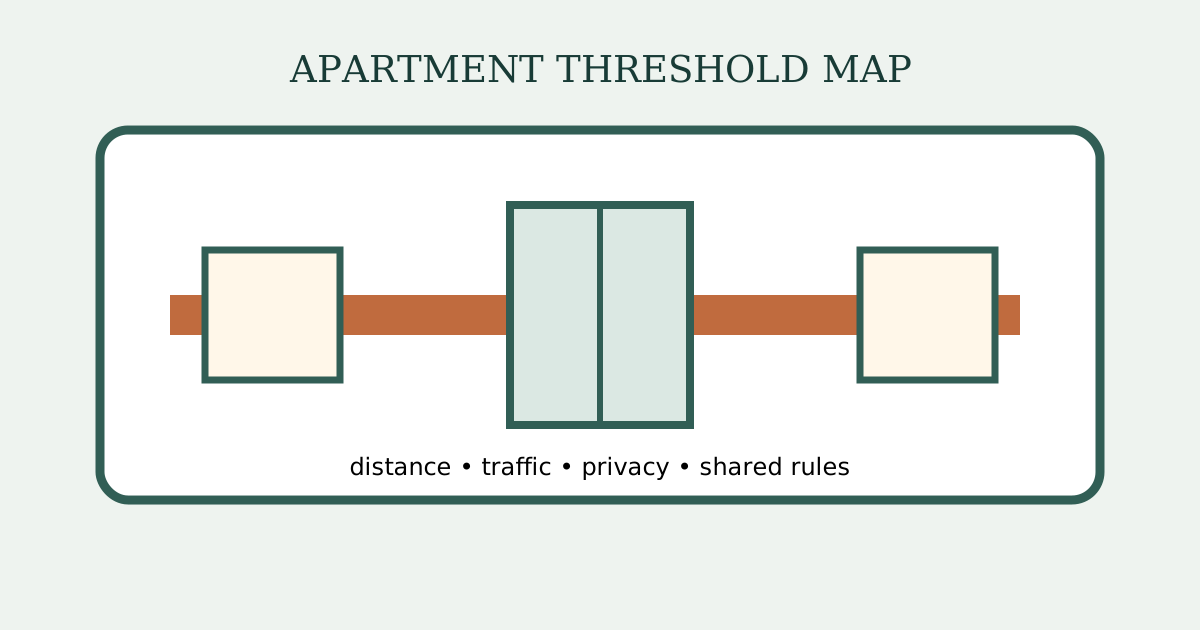
Apartments need one decision before the compass comes out. One convention treats the whole block as a single house: the block has one facade, usually the side with the balconies and the main entrance, and every unit shares the block sitting direction. The other convention reads the unit alone, with the unit front set by its door or its main windows, and the sitting direction opposite that. Teachers inside the tradition use both. Pick the convention your teacher or your own reading follows, write it on the floor plan, and stay with it. A chart cast from the block and a chart cast from the unit door can name two different house types for the same flat, and mixing the two mid-audit produces nonsense.
The eight stars, placed in sectors
The house chart uses the same eight wandering stars as the Kua chart. What changes is what the star labels. On the person chart, a star names a direction to face. On the house chart, a star names a sector of the building, a slice of the floor plan running from the centre of the home to one compass point. The favourable four:
- Sheng Chi, the life-generating star. Tradition links it with work and outward activity. First choice for a study, a home office, or the main door sector.
- Tian Yi, the heavenly doctor. Tradition links it with rest and recovery. First choice for the main bedroom.
- Yan Nian, longevity and relationships. Used for shared rooms, the living room and dining room, where people sit together for long stretches.
- Fu Wei, stability. The sitting sector of the house always carries Fu Wei. Used for a second bedroom, a reading room, or any quiet room.
The unfavourable four, in the order common listings give them, mildest first:
- Huo Hai, mishaps. Small friction in the traditional reading. Nobody replans a house over Huo Hai.
- Wu Gui, five ghosts. Read as restlessness and quarrels. Teachers avoid it for desks and bedrooms where a swap costs nothing.
- Liu Sha, six killings. Read as conflict. A poor sector for a main entrance or a long-stay room where a better option is free.
- Jue Ming, total loss. The strongest caution in the system. Tradition keeps the front door, the stove fire, and the main bedroom out of this sector where the plan gives any choice at all.
Two fixed points help you check any chart you cast. The sitting sector always carries Fu Wei, the stability star: the back of the house rests on its own trigram. And the four favourable sectors of a house always match its group. An East Four house puts all four favourable sectors in the east half of the compass (north, south, east, southeast) and all four unfavourable sectors in the west half. A West Four house reverses that. If your chart breaks either rule, the sitting direction or the arithmetic went wrong somewhere.
Advertisement
The full sector chart for all eight house types
Read across your row. Each cell names the sector of the home where that star sits for your house type. North in these cells means the north sector of the floor plan, the slice running from the centre of the house to its north edge, not a direction to face.
| House gua (sits) | Sheng Chi | Tian Yi | Yan Nian | Fu Wei | Huo Hai | Wu Gui | Liu Sha | Jue Ming |
|---|---|---|---|---|---|---|---|---|
| Kan 1 (north) | Southeast | East | South | North | West | Northeast | Northwest | Southwest |
| Li 9 (south) | East | Southeast | North | South | Northeast | West | Southwest | Northwest |
| Zhen 3 (east) | South | North | Southeast | East | Southwest | Northwest | Northeast | West |
| Xun 4 (southeast) | North | South | East | Southeast | Northwest | Southwest | West | Northeast |
| Qian 6 (northwest) | West | Northeast | Southwest | Northwest | Southeast | East | North | South |
| Dui 7 (west) | Northwest | Southwest | Northeast | West | North | South | Southeast | East |
| Gen 8 (northeast) | Southwest | Northwest | West | Northeast | South | North | East | Southeast |
| Kun 2 (southwest) | Northeast | West | Northwest | Southwest | East | Southeast | South | North |
The chart comes from the same trigram arithmetic as the Kua table: start from the trigram of the sitting direction and let the eight stars settle into the eight sectors in their fixed wandering order. You never need to run that arithmetic by hand. Cast the chart from the table, then run the two checks from the previous section. Fu Wei must sit on your sitting direction, and your four favourable sectors must sit inside your group half of the compass. Both checks pass for every row above.
Notice what the chart does not contain. There is no centre star. The middle of the house, the ninth palace in the nine-palace grid, carries no star in Eight Mansions and takes no placement rule in this system. Teachers leave the centre as circulation space and move on. Stairs, halls, and landings that land near the centre are judged by form school rules, light, air, and traffic flow, not by the sector chart.
Laying the chart on a real floor plan
Print the floor plan at a size you can write on. Mark north with an arrow, using the compass reading you took outside rather than the orientation of the paper. Find the centre of the home. On a rectangle, the centre sits where the two diagonals cross. On an L-shaped or stepped plan, teachers lay the chart over the main rectangle of the building and treat deep notches as missing sector area, a wrinkle the bagua room-by-room guide works through for irregular plans. Draw two lines through the centre, north-south and east-west, then the two diagonals. The eight slices between those lines are your eight sectors.
Write the star names into the slices from your row of the chart. A room that straddles a boundary takes the star of the sector holding the larger share of the room, and teachers read the bed or desk position itself when a room holds two sectors and the furniture sits clearly in one of them. Note which rooms land where before moving anything. The audit order matters: chart first, furniture second.
Three placements get read straight off the finished chart:
The main door. Tradition rates the sector the door sits in and, separately, the direction the door faces. A door located in a Sheng Chi, Tian Yi, Yan Nian, or Fu Wei sector is the textbook case. A door in the Jue Ming sector draws the strongest traditional caution. Most households inherit the door they have. The door reading decides nothing on its own; it tells you where the chart is working with you and where the movable furniture needs to do the work instead.
The stove. The classical rule puts the stove in an unfavourable sector and turns its fire mouth toward a favourable direction. Fire mouth in older texts means the direction the flames or the gas feed point; in a modern kitchen teachers read it as the direction the cook faces at the hob. A stove in a Wu Gui or Liu Sha sector with the cook facing Sheng Chi or Tian Yi is the arrangement the texts describe. Ventilation, the work triangle, and clearance from curtains decide whether that arrangement is safe in a real kitchen, and safety outranks the chart every time.
The toilet and bathroom. Tradition places drainage in unfavourable sectors, where the reading says the water presses the bad star down. A toilet in the Jue Ming or Liu Sha sector is treated as well placed in this system, the one case where a bad sector is the preferred address for a room. A toilet in the Sheng Chi sector is the placement teachers flag, and the standard response is modest: keep the door and the lid closed, keep the room dry and aired, and spend the renovation money elsewhere.
Bedrooms and desks take the favourable sectors the plan offers. The main bedroom looks for Tian Yi first, then Yan Nian or Fu Wei. A study or home office looks for Sheng Chi. The living room suits Yan Nian. Children's rooms usually land on Fu Wei or Yan Nian, with the desk then faced by the child's own Kua directions. Sector first, facing second. That two-step order, house chart for the room and Kua chart for the furniture, is how teachers combine the two Eight Mansions charts without letting them fight.
A worked example: a Qian house, read room by room
A labelled hypothetical makes the reading concrete. Take a two-storey semi-detached house. The front door and the living room bay face southeast, onto the street. The back wall, mostly blank except for a kitchen window, faces northwest. The sitting direction is northwest, so this is a Qian 6 house, West Four. Its chart reads: Sheng Chi west, Tian Yi northeast, Yan Nian southwest, Fu Wei northwest, Huo Hai southeast, Wu Gui east, Liu Sha north, Jue Ming south.
Now lay the rooms over the chart. The front door sits in the southeast sector, Huo Hai. Tradition notes it and moves on: Huo Hai is the mildest of the unfavourable four, and the door faces northwest into the Fu Wei sector in any case. The kitchen occupies the south of the plan, the Jue Ming sector, with the hob on the south wall and the cook facing north. That matches the classical stove arrangement without anyone trying: drainage and fire in the worst sector, the cook facing toward Tian Yi and Sheng Chi across the room. Nobody planned it that way. Kitchens land where the pipes and the garden door put them, and the chart sometimes agrees.
Upstairs, the main bedroom sits over the northeast of the plan, the Tian Yi sector. The bed head goes on the northeast wall if both partners' Kua directions allow a favourable head direction from that wall; if not, the head moves to the east or north wall of the same room and the sector choice still stands. The second bedroom, in the north sector, carries Liu Sha. As a guest room used a few weekends a year, teachers leave it alone. The room a household member sleeps in every night is the room that gets first claim on a favourable sector; a spare room can carry a worse star because nobody lives in it. The study takes the small west room, Sheng Chi sector, with the desk faced by its user's Kua chart.
The toilet, in the east sector under the stairs, carries Wu Gui, well placed by the drainage rule. The bathroom, upstairs in the southwest, sits in Yan Nian, which tradition would rather give to a bedroom. It stays a bathroom. Moving a bathroom costs real money and the pipes decide, and a Yan Nian bathroom harms nothing measurable: the room is used in minutes, not hours. The reading ranks rooms by hours lived in them. Bedrooms and desks first, shared seating next, short-stay rooms last. A chart that gets the bedroom and the study right and the bathroom wrong is a chart in good shape.
Matching the people to the house
A house chart never reads on its own for long, because people with their own Kua charts live in it. The first check is group against group. An East Four house (Kan, Li, Zhen, Xun) carries its favourable sectors in the same half of the compass as an East Group person's favourable directions, so an East Group occupant can usually find rooms and facings that agree. A West Four house suits West Group occupants the same way. Teachers call a group match the clean case.
The mixed case, an East Group person in a West Four house or the reverse, covers a large share of real households, and the tradition has a settled working order for it:
- Sleep outranks everything. Pick the bedroom by the house chart first, a favourable sector where the plan offers one, then set the bed head by the sleeper's Kua chart. Where the two charts disagree inside the room, protect the partner who sleeps worse, exactly as the couples guidance in the Kua guide sets out.
- Desks come second. A study in a favourable house sector, the chair faced by the user's own favourable directions. The two charts agree often enough here because a desk can face any wall in the room.
- Shared seating splits the difference. Living rooms run on Yan Nian logic from both charts where possible, with chairs angled so nobody spends the evening facing their Jue Ming direction.
- Short-stay rooms absorb the leftovers. Bathrooms, halls, storage, and guest rooms take the sectors and directions nobody could use. Hours lived in a room decide how much its chart position matters.
What the mixed case never calls for is moving house over a chart. Teachers treat a group mismatch as a furniture problem with a furniture budget. The chart tells you which two or three placements to spend effort on. Everything else in the home runs on light, noise, layout, and the command position rules that govern any room in any system.
Eight Mansions next to Flying Stars
Readers meeting both systems ask why the charts disagree. A Flying Stars chart can rate a sector well in one period and poorly in the next, while the Eight Mansions chart rates the same sector the same way forever. The systems answer different questions. Eight Mansions sorts the house once, by sitting direction, into rooms that suit long occupation and rooms that suit drainage and storage. Flying Stars tracks time: a chart cast from the construction period, then annual and monthly charts layered over it.
Schools combine them differently. Some teachers lay rooms out by Eight Mansions and time renovations and door use by Flying Stars. Some work in one system only and say so. The charts are not two verdicts on the same question, and a sector that Eight Mansions rates as Jue Ming can carry a good Flying Star combination in the current period without either chart being wrong. Where the two systems agree, practitioners pay attention. Where they disagree, the household's real constraints, the pipes, the light, the lease, decide.
Limits of the house chart
The chart divides a house into eight equal slices, and real houses resist that neatness. Open-plan floors blur sector boundaries. A missing corner, where the plan steps in and a sector barely exists inside the walls, gets read as a weak sector rather than a bad one. Readings taken from inside a steel-framed building can swing several degrees between rooms, which is why the measurement belongs outside, at the front wall, away from metal.
Treat the chart as tradition, applied with judgement. The placement rules rank real options when a renovation, a move, or a furniture shuffle gives you real options. They describe how practitioners inside this system sort rooms. They do not measure air, light, damp, or structure, and they never outrank a builder, a building inspector, or a gas fitter. A bedroom that is quiet, dark, and dry in a Liu Sha sector will serve its sleeper better than a noisy Tian Yi bedroom over the street, and any teacher worth the fee will tell you to keep the quiet room.
A one-hour audit you can run this weekend
- Take the facing reading outside the front wall, twice, and write down the degrees.
- Reverse it for the sitting direction and name your house gua from the first table.
- Print the floor plan, mark north, find the centre, and draw the eight sectors.
- Fill in the stars from your row of the sector chart. Run the two checks: Fu Wei on the sitting sector, favourable four inside your group half.
- List the rooms against the stars. Mark the bedroom, the desk, the stove, and the toilet first.
- Fix the cheapest mismatch: a desk turned to a better facing, a bed head moved to another wall of the same room, a reading chair shifted into a favourable sector.
- Note the mismatches that need money or plumbing, and leave them ranked for the next renovation instead of forcing them now.