A snake plant can suit feng shui if it sits to the side, away from the line of a seat or pillow, and in a spot where it will actually stay healthy. Practitioners split on it: some call its upright leaves protective, others read the sword points as cutting. Dim corners, entries and offices are the usual fits.
Last checked: 13 November 2026
| Key fact | Figure or rule | Source |
|---|---|---|
| Accepted botanical name | Dracaena trifasciata, formerly Sansevieria trifasciata | NC State Extension Plant Toolbox |
| Light | Direct sun only part of the day, 2 to 6 hours; tolerates very low light | NC State Extension Plant Toolbox |
| Water | Let the soil dry between waterings; in winter, only every one to two months | NC State Extension Plant Toolbox |
| Cold limit | USDA zones 10a to 12b; tolerates cool temperatures around 50 degrees F | NC State Extension Plant Toolbox |
| Pets | Toxic to dogs and cats (saponins): nausea, vomiting, diarrhea | ASPCA |
| Air cleaning | Plants removed pollutants orders of magnitude more slowly than normal building air exchange | Drexel University, 2019 review |
The snake plant is the houseplant feng shui writers argue about most. Money trees and jade plants (see our lucky plants guide) have round, coin-like leaves that nobody reads as a threat. The snake plant has leaves that stand up like blades, and that one visual fact splits the tradition into two camps. This guide lays out both readings, then goes room by room, and for each room it checks the plant's real needs against what tradition asks. A plant that is dying in the corner it was assigned does nothing for anyone, in any school.
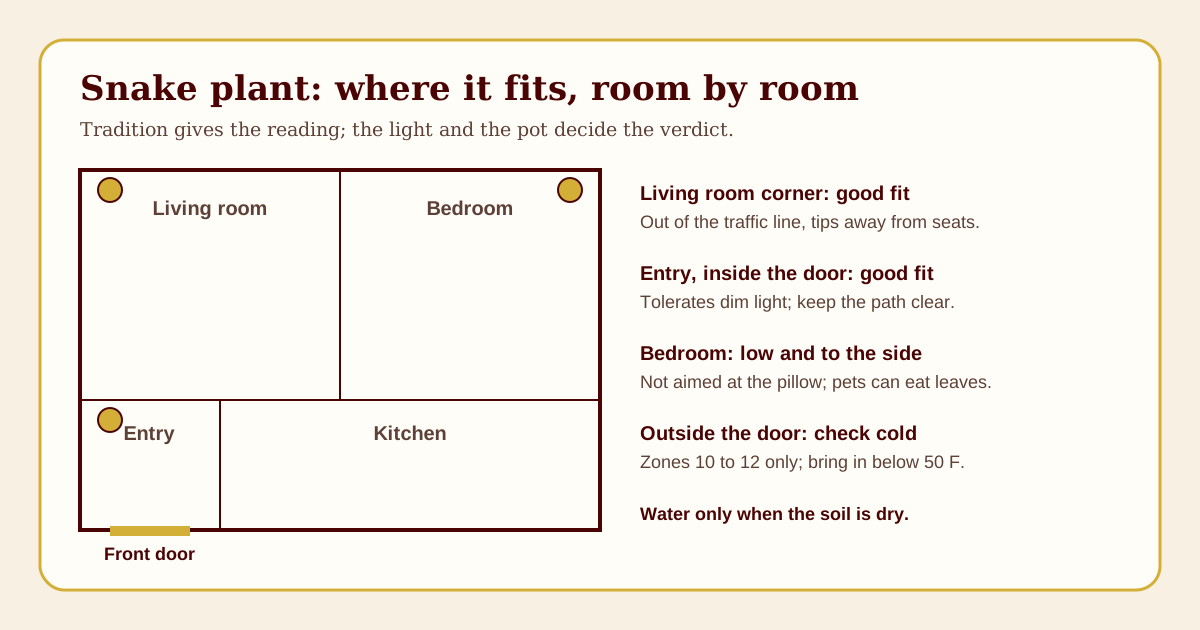
The two readings of the snake plant
Feng shui is not one rulebook. The snake plant shows this clearly, because writers reach opposite conclusions from the same leaf.
The protective reading. Practitioners who favor this view point to the plant's upright growth. Plants are commonly treated as Wood-element objects in the tradition, and a strong vertical form is read as steady, rising and guarding. Some writers compare the blades to a row of spears at a gate, which is why you will often see the plant recommended beside an entry. This is a symbolic reading, not a documented classical rule, and you will find it stated in popular books and blogs more than in older texts.
The cutting reading. Practitioners who favor this view start from form-school thinking about "sha", the harmful or sharp quality that straight lines, sharp corners and pointed objects are said to carry. Under that thinking, a cluster of pointed leaves aimed at the place where someone sits, works or sleeps is treated like a small poison arrow. Our guide to poison arrows and sha qi explains the idea and how far the tradition itself takes it.
Where the two meet. Neither camp says the plant is forbidden. Both agree on three practical points: avoid pointing the tips straight at a seat or a bed, keep the plant healthy and tidy, and remove yellowing or collapsed leaves. The existing advice on this site matches that: our plants by element guide states that no plant is automatically bad and that placement and the plant's real needs matter more than a species label.
A fair way to decide. If the cutting reading bothers you, choose a low bird's nest form or turn the plant to face a wall. If the protective reading appeals, place it beside a doorway. If neither means anything to you, use the table below and the care card.
What the plant actually is
Readers often arrive confused about the name, so it helps to be exact.
The name changed
NC State Extension's Plant Toolbox lists the accepted name as Dracaena trifasciata and lists Sansevieria trifasciata as the name it was previously known by. The change traces to a 2018 paper in Phytotaxa by Takawira-Nyenya and colleagues, titled "Sansevieria (Asparagaceae, Nolinoideae) is a herbaceous clade within Dracaena". Using DNA sequence data, the authors found that Sansevieria sits inside Dracaena and supported a broader Dracaena that includes it. They also say more work is needed, because many of the relationships in their results had weak support.
For a shopper this means plant tags may say either name, and both mean the same plant. The common names include snake plant, mother-in-law's tongue and, in the ASPCA and NC State listings, good luck plant and golden bird's nest. The ASPCA page still uses the older Sansevieria name, so search both when you are checking pet safety.
Leaf shape and size
NC State describes leaves "up to 4 feet long and 2 to 4 inches wide" on the species. That is the tall, sword-leaf form most people picture. The same page names two cultivars you will meet in shops. 'Laurentii' is the variegated, striped form with yellow edges, a dark green leaf with lighter zigzags. 'Hahnii' is a dwarf, with 6 to 12 leaves forming a short, funnel-shaped rosette, which is the "bird's nest" shape.
This split matters for feng shui because the two shapes look very different. A tall upright cultivar reads as the blade-like form the cutting reading worries about. A bird's nest form is low, open and rounded at the top, so under that same reading it is much less of an issue. We could not open a source giving mature heights for each named cultivar today, so we do not quote a height for them. Check the grower's label or the nursery staff for the height at maturity, and measure your space against it before buying. The next section shows how.
Buying the right size
Buy for the spot, not for the shop shelf. Measure three things before paying:
- Height from floor to the first obstruction. A pot on the floor beside a window needs headroom to the sill and curtains; a plant on a shelf needs clearance to the shelf above.
- Width at the base. Upright types grow clumps that widen over years. Leave a hand's width on each side.
- Weight when watered. A tall plant in a light plastic nursery pot tips easily. Plan to move it into a heavier pot with a drainage hole, with a saucer you can empty.
The common mistake is buying the tallest plant for a small entry and finding it brushes the coats. Tall types suit a corner, a landing or a spot beside a sofa. Bird's nest types suit a desk, a shelf or a bedside table.
Placement by room, with the traditional reasoning
This table is the working asset of the article. It matches each spot with the traditional reading, the light the spot usually offers, a plain verdict and the type of plant to buy. "Verdict" combines the tradition with the plant's needs, and it is our editorial judgment, not a rule from any school.
| Spot | Traditional reading | Light usually available | Verdict | Cultivar size to buy |
|---|---|---|---|---|
| Inside the front door, to one side | Entry is where energy arrives; a plant here is read as welcoming or guarding | Often dim; fine, the plant tolerates very low light | Good fit if clear of the door swing and the path | Tall type if there is floor space; otherwise bird's nest on a stand |
| Outside the front door | Threshold is read as the public face of the home | Varies; weather exposure | Only in zones 10a to 12b; otherwise bring it in below about 50 degrees F | Heavy pot, tall type |
| Entry hall, facing the door | Pointed leaves aimed at the entrance are read by some as cutting | Dim | Turn it or move it; avoid a direct line from the door | Bird's nest |
| Living room corner | Corners are said to hold still energy; a plant is read as activating or anchoring them | Often moderate, some direct sun | Good fit; best use for a tall type | Tall type |
| Beside the sofa or an armchair | Tips pointing at where people sit are the cutting reading | Moderate | Fine if the tips do not aim at a head or chest | Mid-height type, or bird's nest at arm level |
| Home office, corner or window side | Wood element suits growth; keep points away from the desk chair | Often good with a window | Good fit if not aimed at the chair | Bird's nest on a shelf, or tall at a corner |
| Bedroom, far corner or low beside the bed | Tradition split: some say plants in bedrooms stir up energy, others accept them | Often low; tolerated | Possible; check pets, and never aim at the pillow | Bird's nest, or a small tall type low |
| Bathroom with a window | Plants are used to soften hard fittings | Low unless there is a window; humidity can stay high | Works only if the soil can dry out | Bird's nest |
| Kitchen, away from the stove | Wood near Fire is read as feeding it; a plant by the stove is discouraged by some | Variable | Away from heat and cooking spray; the soil should dry between waterings | Bird's nest on a shelf |
The front door in more detail
The front door is the most-asked-about spot, and it needs separate treatment inside and outside.
Inside the entry. Practitioners often treat the entrance as the place where energy arrives and where first impressions form, so a living plant there is common. The snake plant is a good practical match for a dim hall because NC State notes it will tolerate very low light. The trade-off is physical, not symbolic: a tall plant in a narrow entry can catch a coat sleeve or block the door. Keep the plant to the side of the door swing, and leave a clear path of at least the width you would want for a stroller or a suitcase. Our entryway guide for small condos covers how to handle a tight entry.
Outside the door. Here the plant's limits decide the answer before tradition does. NC State lists hardiness zones 10a through 12b and says the plant tolerates cool temperatures "around 50 degrees". That is a mild-climate rule. In a place with real winters, an outdoor snake plant by the front door is a seasonal pot that must come in. If you do put it out in a mild climate, give it a heavy pot and shelter from midday sun, and keep it out of the walkway.
For front door colors and what practitioners say about them, see front door colors by direction.
The bedroom in more detail
This is where the cutting reading carries most weight, because the bed is where a person is still and unguarded for hours. The reasoning: a pointed shape aimed at the bed is treated as sha pointed at a sleeper. The sibling guide on bedroom plants in general covers the wider question of whether plants belong in a bedroom at all.
On a practical basis, you can keep a snake plant in a bedroom with a few rules:
- Put it at the far side of the room, or low beside the bed, never aimed at the head of the bed.
- Choose a bird's nest or a small tall type, not a plant that rises above the headboard.
- Keep it where a pet cannot chew it. Snake plants are toxic to cats and dogs per the ASPCA.
- Do not count on it for sleep or air quality. The claims around that are covered below.
The command position, the seat from which you can see the door without being in line with it, matters in tradition too. Our command position guide explains it, and it is a helpful check when deciding where tips should not point.
Bathroom and kitchen
A bathroom with a window can suit a snake plant because the plant tolerates low light, but it is easy to overwater a plant in a humid room. The soil may stay damp, and NC State warns "do not overwater, as the roots will rot." If the bathroom has no window, it is a poor home for any plant, and a snake plant included.
In the kitchen, some practitioners warn against placing Wood next to the stove, since in the five elements Wood feeds Fire. That is a symbolic concern; the practical one is heat and grease. Keep the plant on a shelf or windowsill away from the burners.
Office and desk
Many practitioners suggest a plant near the desk for Wood's growth symbolism, and a snake plant copes with low light and irregular watering. Keep the tips off the chair and put a bird's nest cultivar on a side shelf. The home office desk placement guide shows the wider layout.
Advertisement
Pot color and material by element
Tradition treats a living plant as Wood. The pot adds a second symbolic layer, and writers usually pair it with the element they want to support. This site's plants by element guide lists several pairings, and the same ones apply here:
| Pot | Element it is said to carry | Practical notes |
|---|---|---|
| Terracotta, stone, low and broad | Earth | Terracotta lets soil dry faster, which suits a plant that dislikes wet roots; heavy, so good for tall types |
| White, grey, or metal-look | Metal | Check the pot has a drainage hole; a decorative metal pot without one traps water |
| Dark blue or black | Water | Dark pots absorb heat in sun; avoid placing on a hot windowsill |
| Green, or wood-look planters | Wood | Natural fiber or wood can rot when wet; use a liner |
| Red or orange | Fire | Some practitioners use these; a snake plant does not need it, and glaze color does not change care |
Two practical rules sit above the symbolism. First, every pot needs a drainage hole or an inner pot you can lift out to drain. NC State lists the soil as a loam and sand mix with good drainage. Second, a pot that looks right but holds water works against the plant's one real weakness. A white decorative cachepot is fine as an outer sleeve around a plastic nursery pot, as long as you empty it after watering.
How many plants
Tradition offers no single agreed number. Practitioners give groups by taste: one plant for a quiet corner, three for a larger one, and some avoid sets of four because, in Chinese, the word for four sounds like the word for death. That is a folk custom about the number, not a plant rule, and you can ignore it if it means nothing to you. A practical rule is easier: one tall plant per corner, one or two small ones on a shelf, and stop when you cannot reach each pot to water it.
The botany readers get wrong
Light and watering
NC State says the snake plant takes direct sunlight "only part of the day, 2 to 6 hours" and tolerates very low light. That is why it fits the dark corners tradition often gives it. Tolerating is not the same as thriving: in very low light growth slows and the plant needs less water, which is where most people go wrong.
On watering, NC State says to allow the soil to dry between waterings from spring to autumn, and to water only every one to two months in winter. The point is the same in every house: the plant stores water in its leaves and rots from the roots up when kept wet. An overwatered snake plant collapses at the base. A thirsty one wrinkles. When in doubt, wait.
Temperature
The listing gives zones 10a to 12b and tolerance of around 50 degrees F. Keep it off cold windowsills in winter, and bring an outdoor pot in before nights near that limit.
Pets and children
The ASPCA lists the snake plant as toxic to dogs and cats. Its toxic principle is saponins, and signs include nausea, vomiting and diarrhea. NC State rates the severity as low and notes that the sap can irritate skin. If your pet may chew it, choose another plant or place it where the pet cannot reach. Our guide to pets and home layout covers how to arrange rooms around animals. For children, treat it the same way: out of reach, and wash hands after handling the sap.
The NASA air-cleaning claim
The claim that snake plants clean indoor air is among the most repeated houseplant facts. The records we opened today show the following.
- The 1989 NASA study, "A Study of Interior Landscape Plants for Indoor Air Pollution Abatement" by Wolverton, Douglas and Bounds, looked at removal of three chemicals: benzene, trichloroethylene and formaldehyde. Its abstract concludes that plants can play a major role in removal of organic chemicals from indoor air. A second NASA record from the same year, by Wolverton, Johnson and Bounds, describes a design that pairs plants with an activated carbon filter. Those summary pages do not list which plants were tested, so we do not repeat the popular lists of "NASA plants" here. The bigger question is how the tests were run, which the next point covers.
- A 2019 review by Cummings and Waring at Drexel University, in the Journal of Exposure Science and Environmental Epidemiology, looked at about a dozen studies over some 30 years. It found most were done in small sealed chambers, often a cubic meter or less, that do not resemble real rooms. When the authors converted the results into clean air delivery rates, plants removed volatile organic compounds orders of magnitude more slowly than normal air exchange in a building.
- The authors estimated that matching a building's air handling, or even a couple of open windows in a house, would take roughly 100 to 1,000 plants per square meter of floor space.
What this means for you: a snake plant is not a purifier you can rely on, and an open window does far more. Enjoy it as a plant. If you are worried about indoor air, ventilation and removing the source of pollutants are the dependable steps. Do not buy more plants to chase the claim.
"It releases oxygen at night"
This claim is repeated on many pages and used to justify putting the plant in a bedroom. Here is what we can say with care. Plants like the snake plant are often described as using a water-saving photosynthesis pathway called CAM, in which the leaf pores open mostly at night. That is a real feature of many succulents. But we did not open a primary source today that gives a figure for how much oxygen a snake plant releases at night, so we state none. What can be said without one is a comparison of scale: the Drexel review above found plants too slow to change the air of a room in the face of normal ventilation, and a person sleeping in a normal bedroom is not short of oxygen because a plant is absent. Treat the claim as a pleasant story, not a reason to place the plant by the bed.
Three worked homes
These examples give stated inputs and show the reasoning. They are illustrations, not case studies of real households.
Home 1: a one-bedroom apartment with a dark entry
Inputs. Narrow entry hall, no window. Living room with a west window. One adult, a cat. Bedroom has a small window. The renter wants one plant for the entry and nothing that harms the cat.
Reasoning. The entry is dim, which suits a snake plant's tolerance of very low light, but the cat can reach it, and the ASPCA lists the plant as toxic to cats. The tall type would also crowd the narrow hall. The decision:
- No snake plant at floor level in the entry. If the owner wants one, a bird's nest cultivar goes on a high shelf the cat cannot reach, tips angled away from the door.
- Otherwise choose a pet-safe plant for the entry and keep the snake plant, if at all, out of the cat's reach in the living room.
- Skip the bedroom because the cat sleeps there.
Verdict. Pets, a narrow hall and the door swing decided it, not the symbolism.
Home 2: a family house with a bright living room and a home office
Inputs. Living room with a south window that puts about 4 hours of direct sun on a corner next to the sofa. Home office in a spare bedroom with an east window. Two adults and two children over 8, no pets. The owners follow the protective reading and want a tall plant in the living room.
Reasoning. About 4 hours of direct sun sits inside the 2 to 6 hours NC State gives. The tall type fits there. The corner sits behind the end of the sofa, so tips would point at the back of a seated person's head. Moving the plant 1 m (about 3 ft) sideways, into the corner where the two walls meet, points the leaves at the wall instead.
- Living room: tall type in a heavy terracotta pot, in the corner, tips pointing up and not toward the sofa.
- Office: a bird's nest cultivar on the side shelf, not on the desk.
- Children: the plant sits out of reach, and the children are told not to chew the leaves.
Verdict. Good fit, with a small move. Light and size sit well in both rooms.
Home 3: a studio flat in a cold climate with a balcony
Inputs. One room, one window facing north, a small balcony. Winters fall well below freezing. The owner wants a plant for good luck at the door and has read that snake plants guard entries.
Reasoning. The balcony is the wrong place: outside, NC State's listing means zones 10a to 12b, and a freezing winter is far from that. Inside, a north window gives dim light, which the plant tolerates.
- Inside the door, to one side: a bird's nest cultivar on a small stand, water about once a month in winter.
- Not on the balcony from autumn until the nights are warm.
- Bed in the far corner, plant not pointed at it.
Verdict. The plant works indoors only. The cold limit was the deciding fact.
Advertisement
Edge cases and common mistakes
- Rentals. A plant is removable and carries no lease issue, but a heavy pot can mark a floor. Use a saucer and a felt pad.
- Small rooms and shared homes. One bird's nest cultivar on a shelf is enough. In common space, ask housemates first, especially if someone has pets or small children.
- Overwatering for luck. The most common way to lose one is giving it care it does not want. Water less than you think.
- Hiding a problem. A plant does not fix a blocked path or a bed facing a door. Fix the layout first.
- Treating it as a guarantee. Tradition describes symbolism and atmosphere. It does not promise wealth, health or any outcome from a plant.
What to look for when you buy
- The name on the tag. Dracaena trifasciata and Sansevieria trifasciata are the same species. Cultivar names tell you the shape.
- Firm, upright leaves. Soft, yellow or mushy leaf bases mean overwatering.
- A drainage hole in the pot, or a plan to repot into one.
- Mature height on the label, compared with the space you measured.
- No pests. Check leaf bases and the undersides for small insects.
- Pet access. If an animal shares the home, decide where the plant will sit before you buy.
Care card
| Item | Rule | Source |
|---|---|---|
| Light | Part-day direct sun, 2 to 6 hours, or very low light | NC State Extension |
| Watering | Let the soil dry; in winter every one to two months | NC State Extension |
| Soil | Loam and sand, well drained | NC State Extension |
| Temperature | Zones 10a to 12b; about 50 degrees F is the cool limit | NC State Extension |
| Pets | Toxic to dogs and cats; keep out of reach | ASPCA |
| Propagation | Division or stem cutting | NC State Extension |
Sources
- NC State Extension Gardener Plant Toolbox: Dracaena trifasciata: accepted name, synonym, light, water, hardiness zones, cultivars, soil. Checked November 2026.
- ASPCA toxic and non-toxic plants: snake plant: toxicity to dogs and cats, saponins, signs. Checked November 2026.
- Takawira-Nyenya and others, Phytotaxa 376(6), 2018: Sansevieria placed within Dracaena. Checked November 2026.
- NASA Technical Reports Server: A Study of Interior Landscape Plants for Indoor Air Pollution Abatement, 1989: chemicals studied and the authors' conclusion. Checked November 2026.
- NASA Technical Reports Server: Interior Landscape Plants for Indoor Air Pollution Abatement, 1989: plants plus activated carbon filter design. Checked November 2026.
- Drexel University: Potted plants do not improve air quality, 2019: the Cummings and Waring review, sealed chambers, clean air delivery rates, plants per square meter. Checked November 2026.
Sources we wanted but could not open today: the Missouri Botanical Garden Plant Finder entry (blocked to automated readers) and Kew Plants of the World Online (page error). For that reason we state no mature height for named cultivars and no oxygen figure.
Next step: if the plant is going near the bed, read the guide to bedroom plants to compare it with other choices and to check pets, light and sleep before you buy.
Editorial note: This article presents feng shui as a cultural and design tradition. Schools disagree about the snake plant, and nothing here predicts wealth, health, relationships or any other outcome. Plant care and pet safety information is educational and does not replace advice from your veterinarian, your landlord or lease terms, or a qualified horticulturist.