Every palmistry guide on this site so far has read the lines: the life line, the heart line, the head line, the fate line. The lines are only half of the classical reading. The other half is the mounts: the raised pads of flesh that sit at the base of each finger, at the base of the thumb, and along the palm's outer edge. Where a line is read for its course and its marks, a mount is read like terrain, for how high it stands, how firm it is, and how it compares with the ground around it.
This guide works the mounts the way the classical books do. It maps all seven first, gives the assessment procedure as a numbered method, then reads each mount three ways (developed, flat, and overdeveloped), covers the small marks that appear on mounts, and finishes with one complete example reading and the limits of the whole exercise. Tradition is framed as tradition throughout. The pads under your fingers are real; what they are said to mean is the tradition's, and the guide keeps those two layers separate.
The reading in six steps
For readers who want the method before the theory, the whole assessment is this:
- Rest the hand. Five minutes without gripping, typing, or carrying. Read a warm, rested hand, palm up, fingers relaxed and slightly apart, under even light.
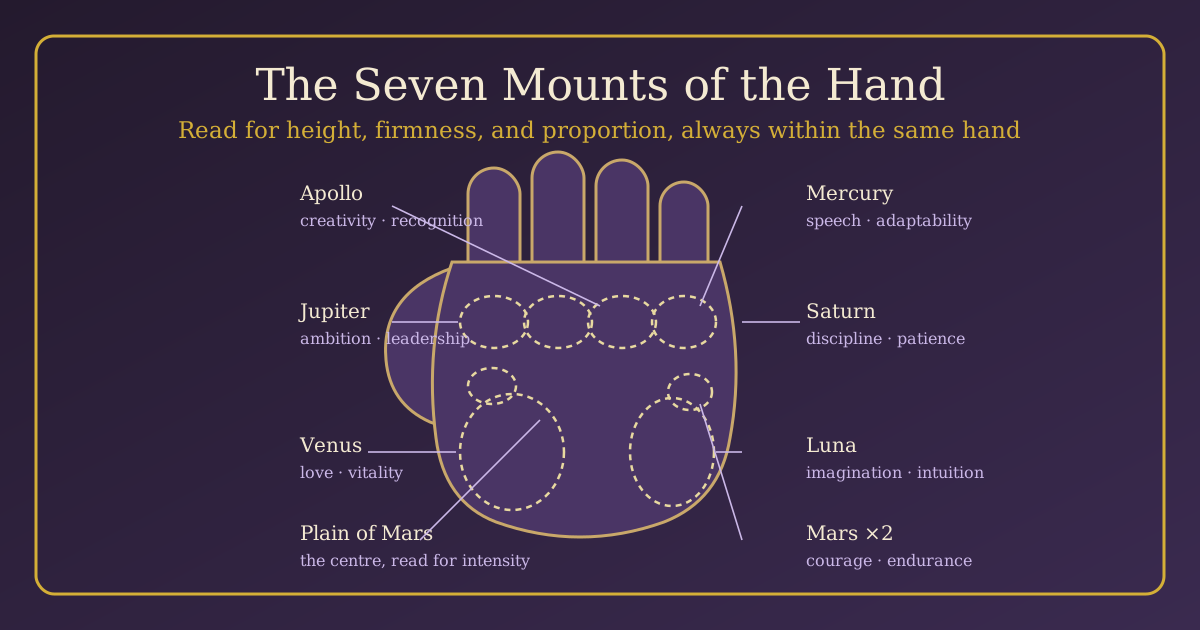
- Find the seven mounts using the map above: four under the fingers, Venus at the thumb's base, Luna on the outer lower edge, and the two Mars areas.
- Press each mount lightly with a fingertip of the other hand. Note which feel full and springy, which feel flat and thin, and which feel hard.
- Rank them against each other, not against a standard. Every reading in this system is relative to the same hand.
- Repeat on the other hand and note where the two hands disagree; the dominant hand is read as the developed self, the non-dominant as the starting material.
- Read the strongest two and the weakest one. A mount reading is a profile of emphasis, and three mounts carry most of it. Then check any marks on the mounts you just ranked.
What a mount is, anatomically and traditionally
A mount is a pad: skin, fat, and in the two big cases, muscle, over the palm's bones. The largest, at the thumb's base, is the thenar eminence, the muscle group that opposes the thumb, and it is large in every human hand because thumbs work. The pad along the outer edge below the little finger is the hypothenar eminence, built around the little finger's muscles. The four pads under the fingers are smaller cushions over the finger joints. All of this is ordinary anatomy, and none of it is in dispute.
The names are the tradition's contribution. European palmistry, systematised in the nineteenth century by writers such as Cheiro and Casimir d'Arpentigny and drawing on much older Indian and Greek material, mapped the pads to the planets of classical astrology: Venus, Jupiter, Saturn, Apollo, Mercury, the Moon, and Mars. The mapping is symbolic. Jupiter, king of the Roman gods, lends the mount under the index finger his portfolio of ambition, authority, and pride. Saturn lends the middle finger's mount his: discipline, patience, and gloom. A reader who knows what each planet stands for in the older astrology already knows what each mount is read for, which is why the system is easy to learn and was built to be.
One structural point matters for honest reading. Mounts are judged within the hand, because hands differ more than mounts do. A large hand with thick pads will show bigger mounts everywhere than a small fine-boned hand, and that says something about build and nothing, in this system, about character. Every judgement below (developed, flat, overdeveloped) means developed for that hand.
The seven mounts at a glance
| Mount | Position | Read for, in the tradition |
|---|---|---|
| Jupiter | Base of the index finger | Ambition, leadership, confidence, pride |
| Saturn | Base of the middle finger | Discipline, responsibility, patience, sobriety |
| Apollo (Sun) | Base of the ring finger | Creativity, joy, recognition, love of beauty |
| Mercury | Base of the little finger | Communication, wit, adaptability, business sense |
| Venus | Base of the thumb | Love, affection, vitality, appetite for life |
| Luna (Moon) | Outer lower edge of the palm | Imagination, intuition, dreams, restlessness |
| Mars, upper and lower | Inner edge below Jupiter; outer edge above Luna | Courage and temper; endurance and self-control |
The four finger mounts
Jupiter, under the index finger. The mount of ambition and command. Developed and firm, it is read as self-confidence, organisational drive, and a person comfortable being in charge. Flat, it is read as a low appetite for status: the person does not organise their life around rank or recognition, which the classical books treat as a neutral finding unless the reading is about a career question. Overdeveloped, high and hard and crowding the finger, it is read as the trait turned: pride, dominance, and a temper when crossed. Jupiter is also the mount most often displaced, sliding toward Saturn, which tradition reads as ambition coloured by caution.
Saturn, under the middle finger. The mount of discipline and consequence. Developed, it is read as patience, structure, and a person who finishes things and thinks in years. Saturn is the mount classical readers least want to see overdeveloped: high and hard is read as severity, pessimism, and a love of solitude taken past comfort. Flat is common and is read as a lighter relationship with rules and routine. Uniquely, a moderate Saturn is the ideal in the texts; it is the one mount where the middle reading is the flattering one.
Apollo, under the ring finger. Also called the mount of the Sun. Developed, it is read as creativity, warmth, an eye for beauty, and ease with recognition, the performer's and the artist's mount. Flat, it is read as a private temperament: the gifts may be there, but the wish to display them is not, and classical readers are careful to say so. Overdeveloped, it is read as vanity and a hunger for applause that outruns the work. A clear vertical line rising on Apollo is the much-discussed sun line, treated in the fate and Apollo material elsewhere in palmistry; on a mount reading it counts as emphasis, the mount underlining itself.
Mercury, under the little finger. The mount of messages and deals. Developed, it is read as quick speech, humour, adaptability, and commercial instinct; Mercury was the god of travellers, merchants, and thieves, and the mount keeps all three flavours. Flat, it is read as a literal, unshowy communicator. Overdeveloped or unusually broad, classical texts read sharpness: the fast talker, the negotiator who enjoys the game a little too much. A Mercury mount that leans toward Apollo is read as expression turned artistic; leaning outward, off the hand's edge, as restlessness.
Advertisement
Venus and Luna: the two large territories
Venus, at the base of the thumb. The largest mount, and the one beginners notice first because it is mostly muscle. Developed, full, and springy, it is read as warmth, affection, sensuality, and a strong general vitality, the appetite for food, music, company, and touch. The life line curves around this mount, and the two are read together: a wide curve gives Venus room, and tradition reads a generous mount and a generous curve as the same finding twice. Flat and thin, Venus is read as a cooler, more reserved temperament, lower social appetite, and a person who recharges alone. Overdeveloped, very high and firm, the classical reading is indulgence: appetites that run the schedule. Venus is also where the girdle of Venus and family influence lines are sometimes marked, but as a mount its reading is about fullness and firmness, not lines.
Luna, on the outer lower edge. The mount of the Moon, imagination's territory. Developed, it is read as a vivid inner life: intuition, dreams that are remembered, imagination used in work, and often a pull toward travel and water. Flat, it is read as a concrete, literal mind, comfortable with what can be touched and counted. Overdeveloped, especially when it bulges outward past the hand's edge, classical texts read restlessness and fantasy that displaces action, the dreamer who plans journeys instead of taking them. Luna sits opposite Venus across the lower palm, and the balance between the two is one of the standard summary judgements of a mount reading: Venus-weighted hands are read as appetite-led, Luna-weighted hands as imagination-led, and most hands sit somewhere readable between the two.
Mars, twice, and the plain between
Mars is the exception to one mount per name. Upper Mars sits on the thumb side of the palm, just below Jupiter, in the web of the hand's inner edge, and is read for active courage: temper, resistance, the willingness to fight in the moment. Lower Mars sits on the outer edge above Luna, and is read for the passive half: endurance, self-control, and staying power under pressure. Between the finger mounts and the two great lower territories lies the plain of Mars, the palm's central hollow, which is not a mount but is assessed with them: a plain that is firm and slightly hollow is read as a balanced centre, while a plain that is high and hard, rising level with the mounts, is read as an intense, driven temperament. In practice, most readers give Mars a paragraph, not a chapter: check upper Mars for temper, lower Mars for endurance, the plain for general intensity, and move on.
The apex: where a mount peaks
Developed or flat is only the first judgement. Classical readers also ask where on the mount its highest point sits, because the peak's position modifies the reading, and this is one of the few parts of mount reading with a visible anchor anyone can check. The skin on a mount is patterned, and under each finger the fine ridges of the skin form a small triangular meeting point, a triradius, whose position can be found with a magnifier and patience. Dermatoglyphics, the scientific study of skin ridge patterns, maps the same points for its own purposes. Palmistry calls the point under each mount's peak the apex, and reads its placement like this.
A centred apex is the plain reading: the mount means what it means, unmodified, and most apexes on most hands sit near the middle of their mounts.
An apex displaced toward a neighbouring mount borrows from the neighbour. A Jupiter apex leaning toward Saturn reads ambition with Saturn's caution in it: the climber who checks the rope twice. An Apollo apex leaning toward Mercury reads creativity with a commercial channel, the artist who sells; leaning the other way, toward Saturn, it reads as craft and patience, the artist who finishes. A Mercury apex sliding off the hand's outer edge is read as the restless edge of Mercury, talk and travel and change for their own sake.
An apex displaced toward the finger or toward the palm changes the register rather than the flavour. High, close under the finger, the mount is read as expressing itself in ideas and presentation. Low, toward the palm's centre, it is read as expressing itself in instinct and appetite. The same Mercury mount is a wit when its apex rides high and a gut-feeling trader when it rides low.
Apex reading is the finishing layer of a mount assessment, done after ranking, and it is also where the tradition is most candid about its own difficulty: the differences are small, hands are read under imperfect light by imperfect eyes, and the classical books advise treating an apex judgement as a shading on the main reading, never as a finding that overrules it. That ordering, bulk first, firmness second, apex last, is the correct sequence, and it is the sequence the example reading at the end of this guide follows.
Secondary signs: firmness, colour, and displaced mounts
Three further judgements refine the ranking, and experienced readers make them almost without noticing. Firmness is the first: two mounts can stand at the same height and read differently because one springs back under a fingertip and the other feels slack. The tradition reads springy as energy available and slack as energy diffuse, and it treats a hard, unyielding mount, one that feels like gristle rather than muscle, as the overdeveloped case whatever its height. Colour is the second: a mount that is pinker than the rest of the palm is read as currently active, a pale one as currently quiet, which is why mount readings are dated like weather reports rather than issued like verdicts. Displacement is the third, and it belongs with the apex discussion above: a whole mount can sit off its textbook position, most often Jupiter sliding toward Saturn or Mercury drifting off the hand's edge, and it is read the way a displaced apex is read, as the mount borrowing its neighbour's flavour. None of the three overrules the ranking. A reader who has ranked the mounts, checked firmness, and noted one displacement has done a complete mount assessment; anything beyond that is marks, which come next.
Marks on mounts
Small marks appear on mounts as they do on lines, and the classical readings are short enough to tabulate. These are the readings as the tradition states them; they are the least testable part of an untestable system, and this guide prints them because a study guide should be complete, not because they outrank anything.
| Mark | Where it matters most | Traditional reading |
|---|---|---|
| A single clear cross | Jupiter | A happy union or a deep, defining attachment |
| A star | Apollo or Jupiter | Sudden recognition; on Apollo, fame in creative work |
| A square | Any mount | Protection in that mount's area; a difficulty contained |
| A grille or crosshatch | Venus or Luna | Energy scattered in that area; on Venus, affections divided |
| A deep single vertical line | Apollo, Mercury | Emphasis: the mount's gift with a channel; the sun line on Apollo |
| An island or chain | Saturn | A period of strain or lowered spirits in the Saturn areas of life |
Position modifies every one of these. A mark is read on its mount, in the mount's territory, and a mark on a flat mount is read more quietly than the same mark on a developed one. Readers who collect marks before ranking the mounts are doing the reading backwards.
A labelled hypothetical: one hand, read in order
The example below is invented to show the sequence. The hand and the person are illustrative.
A right-handed reader examines their own hands after resting them. On the dominant right hand, Venus is full and springy, clearly the largest territory. Luna is moderate. Of the finger mounts, Mercury stands highest and firmest; Jupiter is fair; Apollo is low; Saturn is nearly flat. The left hand is similar except that Apollo is noticeably fuller there and Saturn slightly higher.
Read in the order of this guide, that profile says, in the tradition's terms: an appetite-led hand (Venus first, Luna second) with expression as its working tool (Mercury the strongest finger mount): someone who talks, explains, persuades, and enjoys company and comfort while doing it. Ambition is present but not driving (fair Jupiter), discipline is a known weak suit rather than a strength (flat Saturn, read neutrally: routine is not where this person lives), and the most interesting finding is the disagreement between the hands on Apollo: fuller on the inherited hand, flatter on the developed one, which the convention reads as a native creative streak the person has not much used in adult life. Nothing in that reading diagnoses, predicts, or grades the person. It is a structured way of talking about temperament, in a vocabulary several centuries old, and on those terms it is a complete and correctly ordered reading.
Common mistakes in mount reading
Reading a worked hand. A mount assessed after carrying shopping, training, or an hour of typing is a mount under load. Rest is not a ritual nicety; it is the control condition, and skipping it is the most common source of readings that change every time they are taken.
Judging mounts across people. Comparing your Saturn to a friend's Saturn compares hands, builds, and jobs before it compares anything symbolic. The system's unit is the single hand. Cross-person comparison is the error the classical books warn about most, because it is the one that feels most natural.
Treating flat as failed. Most mounts on most hands are unremarkable, and the tradition reads a profile, not a scorecard. A hand with one or two clear emphases and the rest quiet is the normal, readable case.
Reading mounts without the lines, or lines without the mounts. The classical method uses the mounts for temperament and the lines for course and timing, and a reading built on only one half is half a reading. The four line guides on this site are the other half of this one.
Letting a reading make decisions. A mount profile is not evidence about health, employability, compatibility, or character in any testable sense. The moment a reading is used to hire, diagnose, or judge, it has left the territory where it is harmless. Face reading, covered in the mian xiang guide, carries the same limit, and the limit is the price of enjoying either tradition honestly.
Limits of this guide
Palmistry is presented here as what it is: an interpretive tradition with a long history, real anatomy underneath its map, and no scientific standing for its interpretations. The mount names, positions, and readings are given as the tradition states them, drawn from the classical European system and its standard modern summaries. Nothing in a hand's padding measures a personality, and no part of this guide should be used as a basis for decisions about people. What the mounts genuinely offer a reader is the thing the example above demonstrates: a fixed, shared vocabulary for talking about temperament and emphasis, and ten quiet minutes looking carefully at a hand, which is a rarer activity than it should be.