Short answer
The life line is the palmistry label generally used for the curved crease around the base of the thumb. It is one of the best-known features in hand-reading traditions, partly because its name has invited a damaging myth: it cannot tell you how long you will live, when you will die, whether you are healthy, or what medical event will happen. You can still study it as a historical symbol by locating the crease, describing it without alarm, naming a traditional association, and choosing a real-world action based on evidence.
If you searched because a life line looks short, faint, split, crossed, or different from a diagram, take this in first: a mark on your palm is not a countdown. You do not need to inspect it harder, draw more lines, upload a photo, or pay for a second opinion about your lifespan. A line cannot carry that information.
Palmistry has a long cultural history. The U.S. National Library of Medicine’s historical collection includes chiromancy material, and the Wellcome Collection preserves a manuscript where palmistry appears alongside physiognomy and other fortune-telling practices. Those collections document the history of reading signs on the body. They do not turn a hand feature into a medical, psychological, or predictive measurement.
This guide is for readers who want the interesting part of the tradition without the fear. It shows where the label sits, why online meanings conflict, what common marks can prompt you to ask, and when to put the chart away. If your concern is a symptom, injury, exhaustion, intense stress, a frightening thought, or someone’s safety, start with appropriate care or support. The palm can wait.
Find the arc, not a forecast
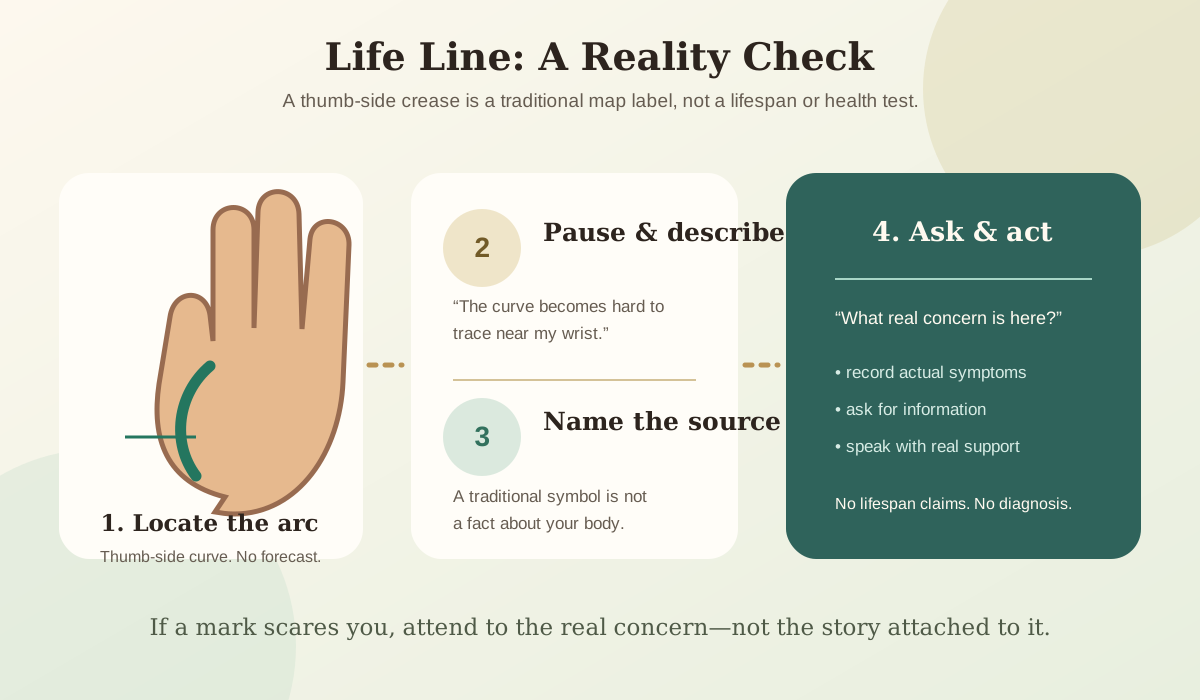
Hold one palm upward in even light. Relax the fingers and thumb. In most introductory palmistry maps, the life line begins in the area between the thumb and index finger, then curves around the fleshy thumb-side pad toward the wrist. It is usually more of an arc than the head-line label, which tends to cross the middle of the palm, or the heart-line label, which is usually closer to the finger bases.
Diagrams make hands look tidier than they are. Ordinary creases overlap. A line may be difficult to trace at the start, fade in one place, be crossed by smaller folds, or merge visually with nearby marks depending on light and hand position. Skin texture, movement, work, age, scars, and the way you stretch the thumb all change what is visible. None of that is a hidden message about survival.
Start with this five-minute locator note:
| What to observe | A neutral way to record it | What not to conclude |
|---|---|---|
| Start | “A curved crease seems to begin near the thumb-and-index-finger web.” | “This proves I began life cautiously or had a difficult childhood.” |
| Route | “It follows an arc around the thumb-side pad and becomes faint near the wrist.” | “This measures vitality, immunity, or the length of my life.” |
| Visibility | “It looks clearer with the palm relaxed than when I spread my thumb.” | “A weak-looking mark means I am physically weak.” |
| Nearby creases | “A short crease crosses it around the middle.” | “This predicts an accident, move, illness, or relationship event.” |
| Uncertainty | “I cannot tell whether this is one line or two close lines.” | “I must find a reader who can tell me the answer.” |
Write the uncertainty down. That is not a failure. It is an honest observation, and it prevents the most common reading mistake: turning a vague feature into a dramatic story.
Why the life-line myth feels so convincing
The phrase “life line” does a lot of work before anyone looks at a hand. It sounds as if the line should contain a lifespan. Movies, party readings, social posts, and click-driven pages reinforce the idea with a simple visual: a long arc equals a long life; a short arc equals danger. The simplicity is the problem.
Different palmistry systems also give the life line different symbolic roles. Some English-language Western manuals connect it with vitality or life direction. Some Indian and Chinese palm-reading material uses its own terms, associated features, and timing conventions. Contemporary websites may borrow a little from each and present a blended meaning as ancient fact. That is why one page can call a branch travel, another call it reinvention, and a third call it a health warning.
A disagreement between sources is not a puzzle you can solve by searching longer. It tells you that the meaning is interpretive. Traditional language can be studied as history, spiritual practice, art, or reflection. It cannot be used to estimate your lifespan or diagnose your body.
Even writers who reject the lifespan myth often replace it with a softer version: a deep line means strong constitution, a faint line means low reserves, a break means a health setback, or a chain means stress. Those claims can still make a reader anxious and can delay care. A visible crease is not a health metric. If your energy, sleep, mood, pain, concentration, appetite, or physical function concerns you, use symptoms and qualified assessment—not a palm map.
The life-line reality-check method
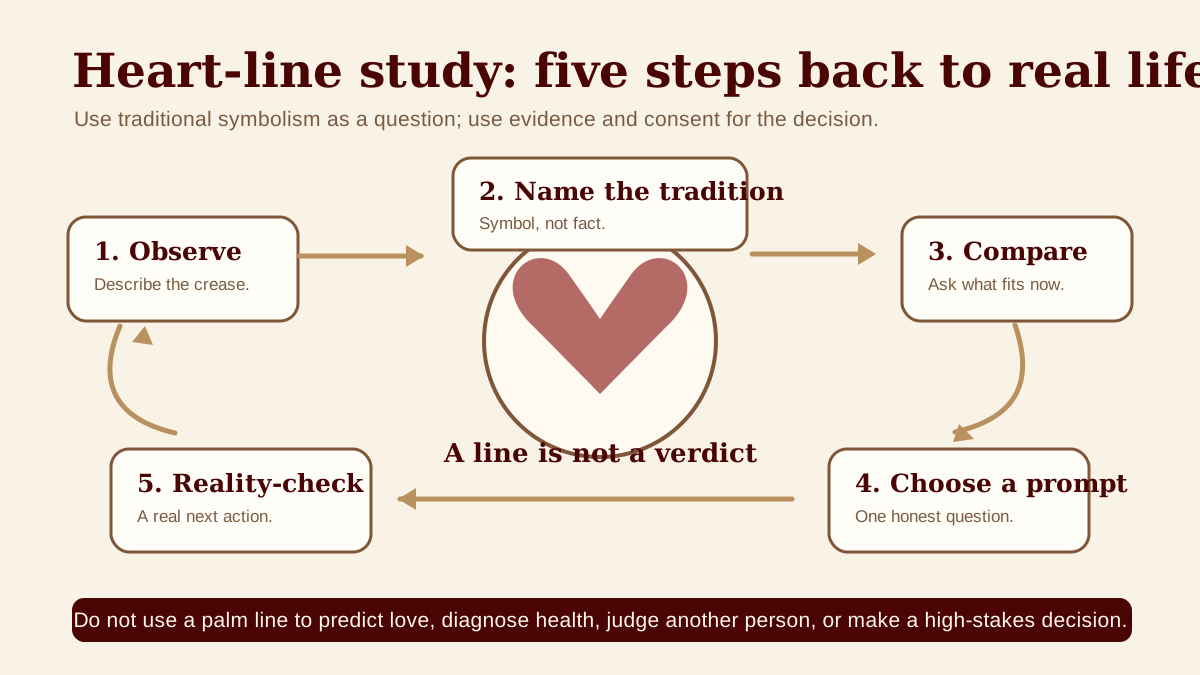
This original Lucky Properties method is for the moment when a traditional claim feels personal. It has five parts. Its purpose is to make a symbolic reading smaller than the real decision in front of you.
1. Pause before looking up a meaning
Notice the feeling that brought you to the chart. Are you curious, bored, grieving, worried about health, afraid of death, or trying to decide something hard? A search result often looks convincing because it speaks directly to the feeling. Name the feeling first. “I am scared because I think this line is short” is much clearer than “my hand says something bad.”
2. Describe the feature like a sketcher
Use ordinary, visible words: curved, close to the thumb, wide arc, faint at one point, crossed by a smaller crease, difficult to follow. Do not write “broken,” “weak,” “damaged,” “bad,” or “doomed” unless you are quoting a source and clearly label it as a traditional claim. Your description should not already contain a diagnosis.
3. Put the association back in its tradition
If you read that a branch represents travel, a break represents upheaval, or a wide arc represents energy, write where that claim came from. “One modern Western-style reading page uses a branch as a travel symbol” is accurate. “My branch means I will move” is not. Sources differ, and a source’s symbolism is not a fact about your body or future.
4. Ask a question you can answer outside the palm
Turn the feeling into a present-focused question. If a wide arc makes you think about freedom, ask, “What part of my schedule needs more room?” If a crossing crease makes you think about change, ask, “What change am I already considering, and what information would help?” If the question is health-related, ask, “What symptom or concern should I record before I contact a clinician?”
5. Choose one proportionate action
The final action should be safe and visible: make a calendar note, speak to a person involved, take a walk, prepare questions for an appointment, look up a reliable source, review a budget, or ask for help with a task. Do not redraw, seek a prediction, spend money on a frightening reading, delay care, or make a major choice from a symbol.
| Step | Example | Grounded action |
|---|---|---|
| Pause | “I saw a short arc and felt afraid of dying young.” | Name the fear; stop scrolling prediction pages. |
| Describe | “The thumb-side crease becomes hard to see lower down.” | Check once in even light, then put the hand down. |
| Name | “A popular guide treats this as a life-path change.” | Keep it as a tradition’s symbol, not proof. |
| Ask | “What real concern about my future is making this feel urgent?” | Write the concern in one sentence. |
| Act | “I am worried about persistent tiredness.” | Contact qualified care rather than reading the line again. |
The method is not meant to strip the practice of meaning. It asks you to decide where meaning ends and evidence begins.
Advertisement
Common marks, without the scary story
Traditional descriptions often focus on line length, depth, width of the arc, breaks, islands, chains, branches, and a second parallel line. You can learn those labels without treating any one feature as a signal about health or fate.
| What someone may notice | A claim often found online | A useful question instead | Never use it to decide |
|---|---|---|---|
| A short-looking arc | Independence, a shorter life, or a changed direction | What future worry did this image bring up, and what real information would calm it? | Lifespan, death, health, or whether to seek care |
| A long arc | Adventure, energy, or longevity | Where would a little more room in my routine help? | That you are protected from illness or guaranteed a long life |
| A wide curve around the thumb | Warmth, enthusiasm, or vitality | What activity helps me feel connected without overcommitting? | Personality, fertility, physical stamina, or relationship destiny |
| A narrow curve close to the thumb | Reserve, caution, or lower energy | What boundary would make this week more manageable? | Anxiety, weakness, illness, or a character flaw |
| A faint or shallow-looking section | Depleted vitality or stress | Does the appearance change with posture, light, or pressure? What is my actual energy like? | Burnout, immunity, a diagnosis, or a future setback |
| A gap, crossing, or apparent break | A disruption, accident, move, or illness | What change is already on my mind, and what support do I have? | A coming crisis or a past event you claim to know |
| A branch toward the wrist or palm edge | Travel, two paths, or a major choice | What small experiment could help me compare two options? | A move, divorce, career shift, or another fixed event |
| A parallel crease | A “guardian” or sister line | What support is already available to me? | Guaranteed protection, survival, or special destiny |
The useful questions in the table work even if you never look at a palm. That is a good test. A symbol should add a way of noticing, not replace a decision process.
Worked example: the short-line panic spiral
Imagine a person sees a short-looking life line in a social video. The comments say it means they will die early. They compare their hand with images, use the camera flash, and find a different crease in every photo. Their anxiety rises, so they search for more readings. One reader says the mark is harmless; another says it signals illness; a third sells a private consultation.
The problem here is not a palm line. It is a fear loop.
Start with the reality-check method. The person writes: “I am afraid because the line seems to end halfway down the thumb.” They then write the neutral observation: “A crease near the thumb is visible in the upper part of my palm and becomes less clear lower down.” That is all the hand has shown.
Next, they name the story: “Some online palmistry posts claim line length predicts lifespan.” The claim is not evidence. It does not become safer because it is repeated by several accounts.
Now comes the question that matters: “What am I actually worried about?” The answer may be a recent illness in the family, a symptom they have ignored, a birthday, grief, uncertainty about a medical test, or simply fear after a late-night video. Each answer has a different real-world response. They may need a doctor, a trusted conversation, accurate health information, rest from scrolling, or help with persistent anxiety.
The final action might be: “I will write down my actual symptoms and arrange an appointment,” or “I will stop searching palm predictions tonight and text my friend.” Either action is more useful than finding a fourth image of a thumb crease. The reading has become a prompt to care for the real concern, not a threat.
Why date charts and health charts need a hard boundary
Some palmistry systems divide the life line into ages and place events along the arc. Others connect islands, chains, colours, or crossing marks with specific diseases. Those systems can feel more precise than a broad statement about vitality. Precision is not proof.
No online chart can use a crease to date a move, loss, diagnosis, accident, pregnancy, recovery, or death. A reader who promises dates may make a person scan their memory for a match or wait for an event to occur. That is especially risky when the claim concerns health. A palm reading is not a reason to postpone an appointment, stop a treatment, ignore a symptom, or give advice about someone else’s body.
Use this decision boundary:
| If the question is about… | A life-line reading can be | What you actually need |
|---|---|---|
| A low-stakes personal routine | A prompt to ask what needs more room, rest, or attention | Your own experiment and review |
| A creative or spiritual practice | A cultural symbol, journal image, or conversation starter | Clear attribution and consent |
| A persistent symptom or health fear | Not a reliable tool | Qualified medical advice or urgent care when appropriate |
| Mood, distress, panic, or intrusive thoughts | Not a reliable tool | Mental-health support, a trusted person, or crisis support when needed |
| A contract, property choice, job, or money decision | Not evidence | Facts, documents, comparisons, and qualified advice |
| Another person’s future, body, or private life | Not ethical evidence | Consent, direct conversation, and respect for privacy |
The boundary is not a dismissal of tradition. It keeps a traditional activity from being asked to do something it cannot do.
Study two hands without calling one your destiny
You will often see instructions to read one hand for an inherited self and the other for a developed self. Some traditional systems use dominant-hand rules; older sources may use gendered rules. There is no single universal convention, and a difference between two palms does not reveal your childhood, future, inherited health, or moral character.
If comparing hands interests you, make it a visual exercise. Use the same lighting and relaxed posture. Note only what is visible. You might write, “The right thumb-side arc looks clearer near the wrist,” or “I can’t tell whether the difference comes from the angle.” Then choose a question that would remain useful if both hands looked exactly the same.
For example, instead of “Which hand tells me whether I will be healthy?” try “What would help me follow through on the sleep or movement routine I already want?” The sleep-supportive bedroom guide can help with light, noise, temperature, and setup—concrete factors that are worth examining.
A calm ten-minute practice
This short practice is for learning the traditional map without feeding anxiety.
Minute 1: Choose a safe question. Pick a low-stakes topic within your control: “What would make my morning less rushed?” “Where do I need a better boundary?” “What small routine could I test?” Do not use a life-line exercise for a health, safety, legal, financial, housing, or relationship decision.
Minutes 2–3: Locate the arc. Find the possible thumb-side curve. Do not force it to match an image. If you cannot identify it, write that down and move on.
Minutes 4–5: Describe three details. Route, visibility, and one uncertainty are enough. A hand does not need to supply a hidden message for the exercise to work.
Minutes 6–7: Read one traditional association. Choose one named source or a historical text, not a pile of anonymous claims. Write the association as a source’s language rather than a fact about yourself.
Minutes 8–9: Make a better question. Translate the association into a concrete prompt. “Where do I need more room?” “What fact am I avoiding?” “What support would make this transition less stressful?”
Minute 10: Put the reading into action. Set up the desk, fill a water bottle, write questions for an appointment, plan a conversation, or stop and rest. Then revisit the action later. The result you can learn from is what you did, not whether a line seemed to come true.
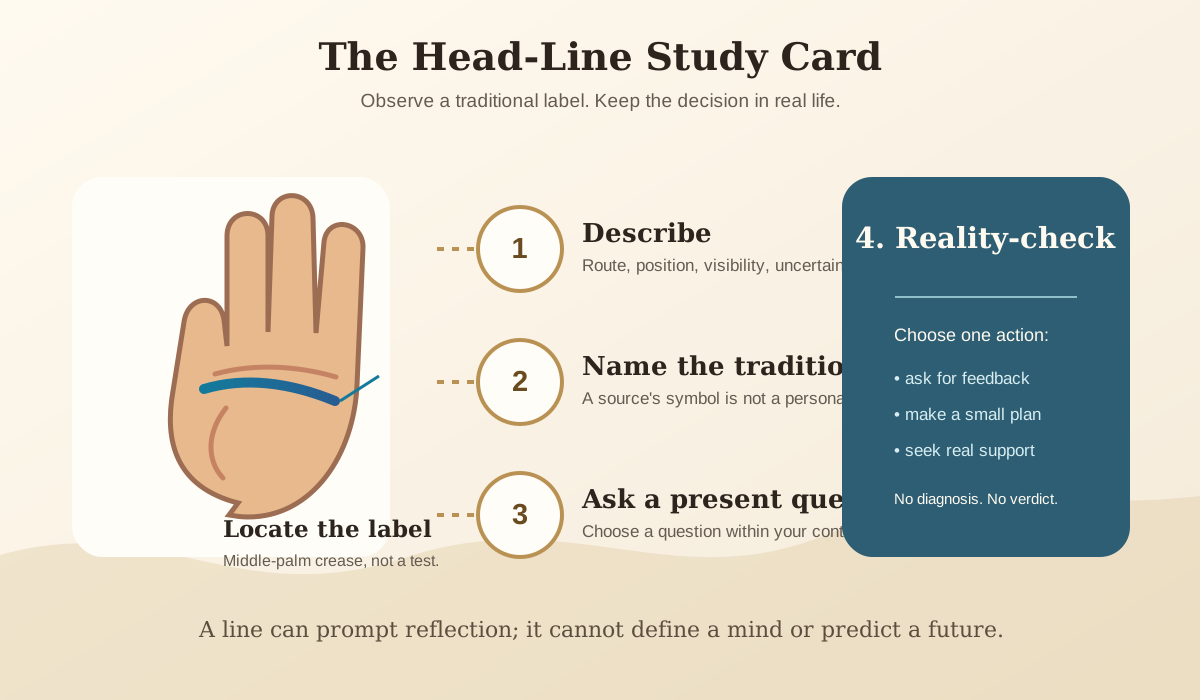
For another observation-first exercise, see the head-line study guide. It uses the same method for a crease often burdened with claims about intelligence and mental health.
Reading another person’s palm: consent and care
No one should hear a prediction about their lifespan, health, fertility, pregnancy, mental state, relationship, money, or death because someone looked at their hand. It is not playful if the other person did not ask for it, and it is not evidence if they did.
Ask before touching, pointing to, photographing, or discussing a person’s palm. Explain your approach in ordinary terms: “I treat this as a traditional reflection exercise, not a health or future reading.” Let them choose the question. A good question stays within their control: “What support would help during this change?” A bad one claims access to facts they have not shared: “Your line says you will get sick,” “You will move,” or “You cannot handle stress.”
If a person seems afraid, stop. Say clearly that a line does not predict a lifespan or diagnose a body. If they mention symptoms, abuse, self-harm, a financial emergency, or immediate danger, leave palmistry behind and focus on appropriate real-world help.
What to read next
The palm head-line guide is a useful companion if you want to learn why another familiar crease cannot measure intelligence, personality, or mental health. For a reflection practice that uses illustrated symbols rather than someone’s body, the playing-card cartomancy guide ends each draw with a question and a testable next step.
If your real question is about a tired, distracting, or uncomfortable routine, use the study-desk guide for students. It focuses on the reach, light, storage, and interruption patterns that can be changed in an afternoon.
Frequently asked questions
What does it mean if my life line is faint?
A faint-looking line is a visible feature that can change with lighting, hand position, skin texture, and nearby creases. Palmistry sources attach many symbolic meanings to it, but it cannot measure your health, energy, immune system, stress level, or future. If you feel unwell or persistently exhausted, use qualified care rather than a hand chart.
What does a double life line mean?
Some palmistry sources call a nearby parallel crease a sister line, Mars line, or guardian line and assign protective symbolism to it. Terms and meanings vary. It cannot guarantee safety, recovery, long life, or special protection. You can treat it as a traditional image and ask a practical question about the support you already have.
Can a life line change over time?
The visibility of any crease can look different with age, movement, skin condition, lighting, pressure, photographs, and attention. Do not treat a perceived change as proof that your destiny, health, or lifespan has changed. If a visible change to your skin concerns you medically, ask a qualified clinician.
Does the life line show a move or relocation?
No mark can tell you that a move will happen or where you should live. A traditional branch symbol may be a prompt to ask what you need from a home, but a housing decision needs affordability, safety, access, lease or purchase documents, inspections, and your own priorities.
What should I do if someone told me my line means I will die young?
Treat the claim as false and step away from that reading. A palm line cannot predict your death. If the comment has left you distressed, talk with someone you trust or seek qualified mental-health support. If you are worried about a real symptom or health risk, contact the appropriate health service rather than seeking another palm prediction.
Sources and limits
For historical context, see the National Library of Medicine’s chiromancy collection and the Wellcome Collection manuscript on palmistry and physiognomy. This guide’s observation and reality-check methods are Lucky Properties editorial tools. They do not turn palmistry into a scientific health, personality, longevity, or prediction method. Use real evidence and qualified support for consequential choices.