Short answer
The fate line is the palmistry label for a vertical crease that runs up the middle of the palm toward the middle finger. Tradition reads it as the line of direction: the course of a working life, duties taken on, and the degree to which a path feels chosen or imposed. It is also the line with the widest spread of real variation. It can start in at least six different places, stop at three different heights, run double, break and restart, or be absent altogether, and every one of those forms is common in ordinary hands. This guide maps the forms, gives each one the reading the tradition gives it, labelled as tradition, and keeps a firm line under the whole topic: a crease cannot choose your job, date your promotion, or tell you to quit.
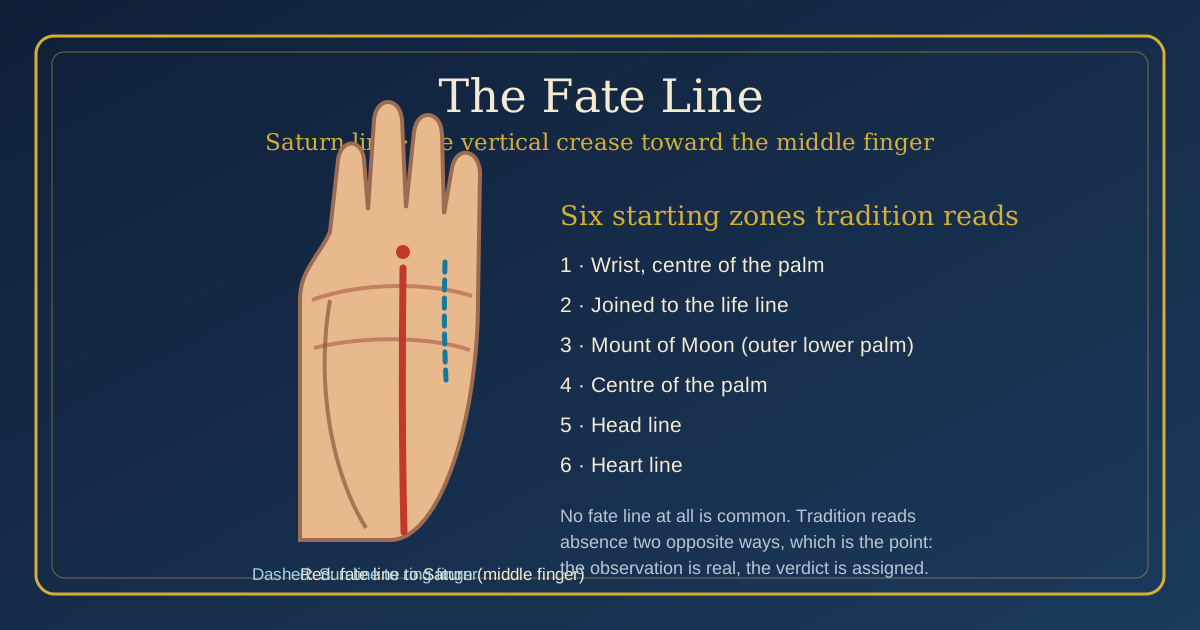
The fate line completes the set this site has been building. The life line guide covers the arc around the thumb and the lifespan myth attached to it. The head line guide and the heart line guide cover the two crosswise creases the fate line crosses on its way up. The fate line is the vertical that ties the map together, and it is the one most often searched by people in the middle of a decision about work. That is exactly when a symbol should be handled with the most care.
Palmistry itself is an old, documented practice. Britannica's palmistry entry traces chiromancy from a probable origin in ancient India through China, Tibet, Persia, Mesopotamia, Egypt, and Greece, and notes its 19th-century revival under writers such as Casimir d'Arpentigny, Louis Hamon, known as Cheiro, and William Benham. The same entry states plainly that there is no scientific support for palmistry's predictive claims. Both halves of that summary belong in a serious guide: the tradition is real as a tradition, and its readings are interpretations, not measurements.
Find the vertical line first
Hold your palm up in even light, fingers together but relaxed. Find the middle finger. The padded area at its base is the Mount of Saturn in the standard map, and the fate line is the crease, when it is present, that travels up the centre of the palm toward that mount. Its other names all point at the same crease: Saturn line, destiny line, career line, and in some Indian palmistry writing, Bhagya Rekha.
Three location checks separate it from its neighbours before any meaning is attached.
It runs vertically, not across. The head and heart lines cross the palm from side to side. The fate line runs from wrist toward fingers. A vertical crease on a palm diagram is a short list: fate, Sun, and Mercury are the named ones, and the next section separates them.
It aims at the middle finger. Trace the crease upward and ask which finger it would meet if it kept going. Middle finger means the fate line in the standard map. Ring finger means the Sun line. Little finger side means the Mercury line. This single check prevents the most common misreading in the whole topic, which is reading a Sun line as a fate line and importing the wrong set of meanings.
It may start anywhere along its route. Unlike the life line, which has a fairly fixed start near the thumb and index finger, the fate line has no single agreed starting point. Many hands show it beginning near the wrist. Many show it beginning halfway up the palm, at the head line, or not at all below the heart line. A fate line that starts late on the palm is not a damaged fate line. Starting point is the first thing the tradition itself reads, so record it before anything else.
One classification dispute is worth knowing because it explains why sources contradict each other. Some manuals count the fate line among the major lines, alongside life, head, and heart. Others file it as the most important of the secondary lines, on the ground that it is not present in every hand. Both filings appear in reputable palmistry writing. When two pages disagree about whether your crease even counts as a main line, that is not a problem with your hand. It is two filing systems describing the same hand.
Fate line, Sun line, Mercury line: the three verticals
| Line | Aims at | Traditional territory | Present in every hand? |
|---|---|---|---|
| Fate line (Saturn line) | Middle finger | Direction, duty, the course of work, circumstances met along the way | No. Absent or faint in many hands |
| Sun line (Apollo line) | Ring finger | Recognition, satisfaction with work, creative reputation | No. Often short or partial when present |
| Mercury line (health line in some schools) | Little finger | Communication and business habits; older schools tied it to health | No. Absence is read as neutral in most modern writing |
The fate and Sun lines are called sister lines in some manuals because they run roughly parallel and both get attached to working life. The division of labour between them, inside the tradition, is this: the fate line is about the path, the Sun line is about how the path is received. A person can, in traditional language, carry a strong fate line and no Sun line, read as steady work without public notice, or a faint fate line and a clear Sun line, read as recognition arriving through talent rather than through a planned career. These are the tradition's sentences, useful for understanding what a reader means. They are not findings about any actual worker.
The six starting points, and what tradition reads in each
Where the fate line begins is the most developed part of its lore. Manuals differ in wording but return to the same six starting zones, and the readings follow a simple logic: the starting point is read as where direction came from early in life.
| Starting point | How to recognise it | The reading tradition gives it |
|---|---|---|
| Wrist, centre of the palm | The crease begins low, near the wrist creases, separate from the life line | An early, self-set direction; responsibilities taken on young; a path chosen by the person rather than assigned |
| Joined to or inside the life line | The crease leaves the life line arc or starts inside it, toward the thumb | Early direction shaped by family; duty to home first, an independent course coming later as the lines separate |
| Mount of Moon (Luna) | The crease begins on the lower outer palm, the fleshy edge below the little finger side | A path that depends on the public, clients, audiences, or employers; work with people rather than inside one institution |
| Centre of the palm (plain of Mars) | No crease is visible below the middle of the palm; the line starts in open ground | A later start after an unsettled or searching early period; direction found rather than given |
| Head line | The first visible fate line sits at or just above the crosswise head line | Direction set by a deliberate decision in adult life; a career chosen by reasoning, often a second career |
| Heart line | Nothing shows below the heart line; a short crease runs from there to the Saturn mount | Direction consolidated late; work identity settled in the second half of working life |
Read the table the way it is meant to be read. Each row is a claim about how palmistry talks, not a claim about you. The family row is a good test case. A fate line joined to the life line is extremely common, because both creases occupy the lower centre of the palm and often touch. If the traditional reading were a fact, a large share of all workers would have had their careers assigned by their parents. What the row actually tells you is how the symbol system is built: contact between two lines is read as influence between the two territories. That is a rule of the map, not a finding about families.
Starting points also combine with the hand you are looking at. A line can start at the wrist on one hand and at the head line on the other. Manuals that read both hands treat that difference as past versus present, or private versus public, depending on the school. Section by section, the pattern in this topic is the same: the observation is checkable, the meaning is assigned, and schools assign differently.
Advertisement
Endings, forks, and where the line stops
The top end of the line carries its own smaller set of traditional readings.
A fate line that ends at the Mount of Saturn, stopping just below the middle finger, is the textbook full form, and manuals read it as direction carried through a whole working life. A line that stops at the heart line is read as work giving way to other priorities in later life. A line that stops at the head line is read, in the same manuals, as a course ended by a decision, a judgement call that closed one path. A line that runs on into the finger itself is treated as unusual and, in stricter manuals, as direction carried past balance, a warning symbol rather than a prize. A fork at the top, with one branch leaning toward the index finger side, is read as direction bending toward ambition or public role late in the course.
Hold these at arm's length as well. Endings are where creases are faintest and hardest to trace, where a line often fades because the skin near the finger bases folds differently. Two careful observers can disagree about whether a given fate line stops at the heart line or fades just above it. Any reading built on the ending inherits that uncertainty, and a careful description says so: "the crease becomes untraceable somewhere between the heart line and the finger base" is a complete and respectable observation.
Breaks, overlaps, doubles, and islands
Interruptions are the part of the fate line people search at 1 a.m., usually after a job loss or during a contract dispute, so this section goes slowly and keeps the two layers, observation and tradition, separate.
A clean break. The crease stops, and after a gap a crease starts again on the same track. Traditional manuals read this as a change imposed from outside: a role ended, an employer closed, a circumstance intervened. The reading is a symbol. Breaks also appear where the palm's skin is crossed by other folds, and a break in the visible crease is not, by itself, evidence that anything happened in a working life.
An overlap. The crease stops and a new segment begins beside it, running parallel for a short distance before the single track resumes. Manuals read the overlap differently from the clean break: as a change the person made themselves, a planned move from one track to a parallel one. Notice what the tradition is doing. It has two symbols for change, imposed and chosen, and it assigns them to two shapes of interruption. As a piece of symbolic design that is tidy. As evidence about a stranger's career it is worth nothing, and a reader who presents an overlap as proof you chose your redundancy is selling you a story.
A double fate line. Two vertical creases run side by side for part of the route. Tradition reads this as two tracks carried at once: a job and a vocation, employment and a business, work and a serious study. Of all the fate line readings, this one at least points at something you can check in the real world, namely whether you actually are carrying two tracks. If you are not, the second crease is a second crease.
Islands and chains. A small loop that splits and rejoins, an island, is read in manuals as a period where direction was under strain or divided. A chained stretch, where the line is made of small linked segments, is read as an unsettled period. Both readings stay inside the tradition. Neither can identify the period, name its cause, or confirm that a hard year at work left a mark. Hands under physical strain, dry skin, and ordinary ageing all produce broken-looking stretches in creases that have nothing to do with a career.
The grounded habit for every interruption is the one this site teaches for the life line: describe the shape in plain words, name the tradition that reads it and how, then ask what real question is underneath. "There is a gap in the crease at about the head line" is description. "My career will be interrupted" is a prediction wearing the description's clothes.
The timing question: age scales that disagree
Fate line timing is the most technical looking part of the tradition and the part that falls apart fastest under comparison. Some manuals lay an age scale along the line using its two crossings as fixed points. In one common version, the point where the fate line crosses the head line is read as about age 35, and the point where it crosses the heart line is read as somewhere in the fifties, with the arrival at the Saturn mount placed in the mid seventies. Other manuals set the heart line crossing in the late forties. The starting point at the wrist is set at childhood in all of them, which compresses the lower half of the palm into the first thirty-five years and stretches the short upper segment across the remaining forty.
Compare two manuals side by side and the same break in the same hand lands years apart. There is no agreed scale to be wrong against, no study that ties a crossing point to an age at a job change, and no mechanism proposed that survives contact with how skin creases actually form and shift as a hand grows. The scales are best understood as a reading convention, a way for a reader to organise a conversation about early, middle, and late working life. Early, middle, and late are real stages. The ages pinned to them on a palm are the convention's, not yours.
Practical rule: if a reader gives you a year from your fate line, ask which manual the scale comes from. A reader who can answer that question is showing their work. A reader who cannot is presenting a guess as a system.
No fate line, faint fate line, and the two opposite readings
Plenty of hands have no traceable fate line at all. Manuals and modern practice sites put no number on how many, and neither will this guide, because no proper survey of the question exists in the sources used here. What the sources agree on is that absence is common and unremarkable as a physical fact.
The tradition then splits in two, and the split is instructive. One line of reading treats the missing fate line as freedom: no fixed track, a path made by the person as they go, work chosen fresh at each stage. Another treats it as drift: direction not yet taken hold, a course still unsettled. The same blank centre of the palm receives opposite verdicts, which settles the matter for a careful reader. The absence is real. The verdict is whichever the reader brought with them.
There are also plain physical reasons a fate line can be hard to see. Secondary creases are shallower than the three main flexion creases and show less on some skin than others. Manual work, weight change, age, and dry skin all change how creases photograph and read. A fate line that a reader calls faint at a market stall in bright sun may trace perfectly well in flat indoor light with the hand relaxed. Before a missing line gets a meaning, it deserves a second look under better conditions, recorded the same way as any other observation.
Which hand, and why schools give different answers
Ask three readers which hand carries the fate line and you may get three answers. Much modern Western practice reads the dominant hand, the one you write with, as the active and present hand, and the other as the background hand of inheritance and temperament. A fate line strong on the dominant hand and weak on the other gets read, in that system, as direction built by effort rather than given. Some Chinese palm-reading practice has historically assigned the hands by gender, left for men and right for women in one well-known convention, while other lineages read both hands for everyone and compare. The site's face reading guide meets the same pattern in Mian Xiang: shared maps, school-level differences in how they are applied.
The comparison habit is the part worth keeping from all of this. Look at both hands. Note where the line starts, how far it runs, and whether it breaks, for each hand separately. Where the hands differ, you have a difference to describe. Which story, if any, to lay over that difference belongs to a stated school, stated out loud, not to the hand itself.
A worked example: one labelled hypothetical hand
The hand in this section is invented for teaching, in full. No real person's hand is described. Working through it shows the order a careful reader uses: locate, describe, name the tradition, stop before prediction.
The hand as described. Right hand, dominant. A vertical crease begins just above the wrist, slightly toward the thumb side, joined at its base to the life line arc. It runs clear to the head line, where there is a short overlap: the first segment ends and a second segment begins a few millimetres toward the little finger side, then continues as one clear crease. It crosses the heart line without a break and fades somewhere between the heart line and the base of the middle finger. The left hand shows a shorter version that begins at the head line.
Step one, locate. The crease aims at the middle finger, so in the standard map it is the fate line, not the Sun line. The Sun line position, under the ring finger, shows only fragmentary short creases. Recorded.
Step two, describe without verdict words. Start: joined to the life line at the base. Course: clear to the head line. Feature: overlap at the head line crossing. Course above: clear across the heart line, ending untraceable below the Saturn mount. Left hand: starts at the head line. Every word in that list could be checked by a second observer with the hand in front of them.
Step three, name the tradition readings as tradition. In the manuals' language: a family-shaped start, a self-made change at the head line crossing, direction carried past the heart line. In a both-hands school, the shorter left line would be read against the longer right one. These sentences describe what the symbol system says. They are the reading, clearly labelled.
Step four, the questions that are actually answerable. Does the person feel their early work was assigned by family circumstances? Are they carrying one track or two? Is a change of role currently on the table, and what do the contract, the money, and the people involved say about it? Those questions have answers in the world. The methods compared guide puts the same point across four systems: chart and palm methods hand you a structure for thinking, and the thinking still has to be done with real information. A BaZi reader working the same person's birth chart would talk about decade pillars, in the manner set out in the BaZi chart guide. Two systems, two vocabularies, one real life underneath, which neither vocabulary replaces.
The record worksheet
Copy this table when you study a hand, your own or, with clear permission, someone else's. It keeps description and interpretation in separate columns, which is the whole discipline in one page.
| What to record | Neutral wording to use | What it does not establish |
|---|---|---|
| Presence | "A vertical crease toward the middle finger is traceable from the wrist to the heart line." | That the person has a settled destiny, or lacks one |
| Starting point | "It begins joined to the life line arc." | That family assigned their career |
| Interruptions | "There is a gap of a few millimetres at the head line, then the crease resumes on the same track." | That a job loss happened, or will |
| Doubling | "A second, shorter vertical crease runs beside it through the middle of the palm." | That the person holds two jobs or should start a business |
| Ending | "It fades between the heart line and the finger base and cannot be traced further." | An age for retirement or a final role |
| Difference between hands | "The left hand line starts higher, at the head line." | Which hand is telling the truth |
Where the fate line stops being useful
A fate line reading is a traditional reflection tool. Used that way, in the spirit of the fortune-telling hub and the palm reading hub, it can organise a conversation about direction: where you started, what changed, what you are carrying. The moment it is asked to do any of the following jobs, it is out of its depth, and the answer has to come from somewhere else.
It cannot tell you whether to accept a job, resign, retrain, or start a business. Those decisions turn on pay, contract terms, savings, health, dependants, and the actual state of the work, none of which is written on a palm. It cannot be used to judge another person: a candidate's hand is not a screening instrument, an employee's crease is not a performance record, and reading a colleague's or a partner's hand without clear consent, then treating the reading as knowledge about them, is a misuse of the tradition as well as a discourtesy. It cannot date events, past or future. It cannot speak to health at all; the Mercury line carries the old health associations in this system, and even there, as the life line guide sets out for its own line, a crease is not a diagnosis and symptoms deserve a clinician, not a chart.
And it cannot promise outcomes. No form of the fate line, deep, long, unbroken, doubled, guarantees success, income, promotion, or security, and a missing line takes none of those away. Tradition framed carefully says the same thing in its own way: the manuals describe patterns and tendencies inside a symbol system. Writers who turn those patterns into promises have left the tradition's careful core behind, usually at the point where a payment is introduced. Keep the map, enjoy the map, and make the decision with the evidence that actually bears on it.

