Short answer
The head line is the palmistry name usually given to a major crease across the middle of the palm, below the heart-line label. Historical and modern palmistry traditions have connected it with thought, learning, and decision-making. A crease cannot measure intelligence, personality, mental health, education, talent, or a future event. The useful way to study it is to locate it carefully, record visible features without labels, compare one traditional association as cultural context, and choose a real-world action based on evidence.
People often search for a head-line reading after seeing a faint spot, a fork, a slope, or a line that seems different from an online diagram. Search results tend to offer a quick personality verdict: straight means logical, sloping means creative, short means practical, broken means mental strain. Those shortcuts are memorable because they sound personal. They are not a sound way to judge a person.
Palmistry is a real historical and cultural practice, not a clinical or psychological test. The National Library of Medicine’s historical collection includes early chiromancy material, while the Wellcome Collection holds a manuscript combining palmistry and physiognomy with other forms of fortune telling. Those records help explain why hand reading has persisted as a symbolic language. They do not establish that a palm crease reveals a person’s abilities or future.
This guide keeps the interesting part—the map, the history, the act of looking closely—while setting aside the claims that can frighten, flatter, or label someone. You can use it on your own hand, or as a consent-based observation exercise with a friend. If the question is about health, mental distress, learning support, safety, money, housing, or another high-stakes decision, skip the reading and use the appropriate real-world support.
Find the line before you interpret it
Use even light, a relaxed hand, and a few unhurried minutes. Place the palm upward rather than stretching the fingers hard; force can change how creases appear. In popular maps, the head line runs roughly across the centre of the palm. It often begins near the thumb-and-index-finger area, close to the place where the life-line label begins, and travels toward the outer edge of the hand. The heart line is typically higher, below the bases of the fingers.
This is an orientation, not an anatomical rule. Hands differ in skin texture, movement, manual work, scars, age, lighting, and how a palm is held. A line may be faint, interrupted by smaller creases, or appear to meet another line. Some hands do not match the clean three-line diagram at all. That is ordinary variation, not a sign that something is wrong or hidden.
Use this locator check before opening a meaning chart:
| Look for | Neutral note | Do not turn it into |
|---|---|---|
| Position | Is the crease below the highest major cross-palm crease? Where does it begin and become difficult to see? | A score for intelligence or maturity |
| Route | Does it look mostly horizontal, gently curved, or harder to follow at one point? | Proof of a thinking style or personality |
| Relationship to nearby creases | Does it appear close to, joined with, or separate from another crease near the thumb? | Evidence of courage, caution, trauma, or a family trait |
| Visibility | Does its appearance change with daylight, posture, or a relaxed hand? | A health, energy, or stress diagnosis |
| Comparison | What is visibly similar or different between two hands? | A verdict about “potential” versus “reality” |
The word neutral matters. “A line starts close to another crease and curves slightly down in the last third” is an observation. “This person is anxious but creative” is a story placed on top of an observation. Start with the first sentence. You may decide whether the second is useful after you understand where it came from.
Why the usual meanings disagree
There is no single palmistry authority that assigns one fixed meaning to every mark. English-language Victorian and twentieth-century books, contemporary commercial readings, Indian traditions, Chinese palm-reading material, and individual readers use different terminology and different conventions. Even the question of which hand to read has competing answers.
The popular Western “dominant hand = present, non-dominant hand = inherited potential” rule is a convention, not a verified model of personality. Older manuals can use gendered rules that are not appropriate as a default today. A respectful modern practice is simpler: look at both hands only if you want to compare visible features, write down what you see, and do not infer a childhood, inherited trait, or future outcome from the difference.
This is also why a search snippet can feel authoritative while offering little help. It may say that a long line indicates focus, a curved line indicates imagination, or a fork indicates writing talent. Another site can give the same features a different meaning. The disagreement does not mean you need to find the “right” reader. It means the meaning is interpretive rather than a measurable fact about the hand.
Historical source material is still worth studying as history. The Wellcome manuscript places chiromancy beside other systems of reading bodies and signs. A reader can learn how those systems were framed, circulated, and adapted without accepting their bodily claims. Treating an old claim as old is more respectful than pretending it has become a modern assessment tool.
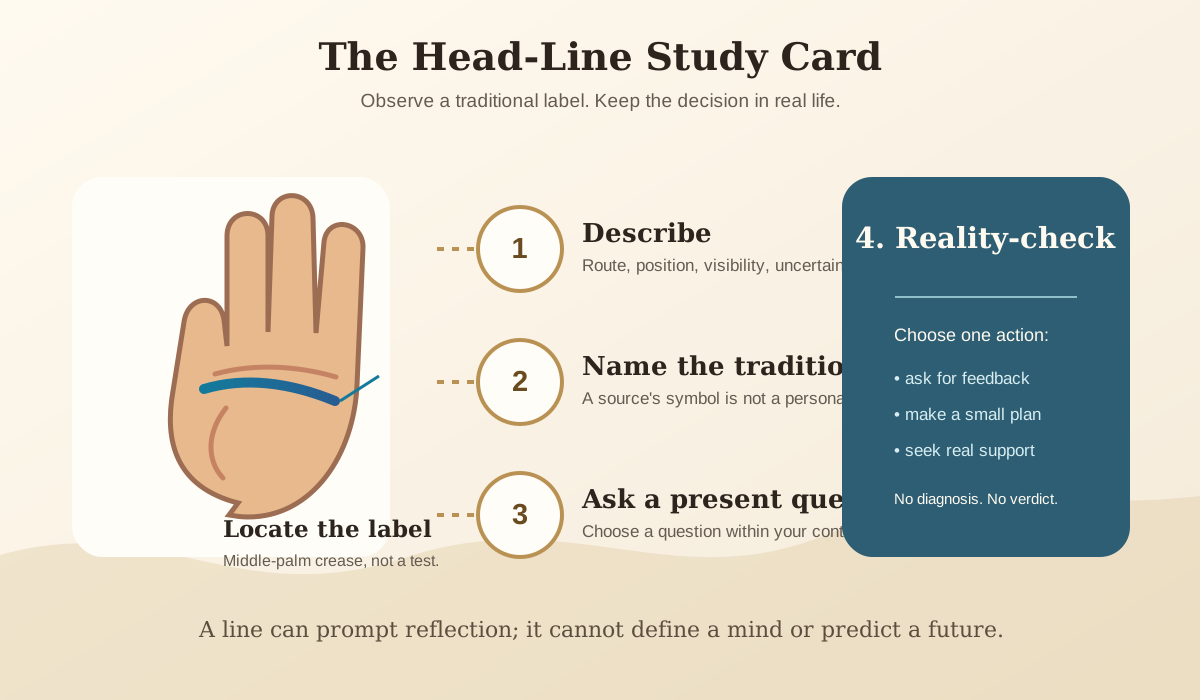
The five-part head-line study card
This original Lucky Properties method turns a vague reading into a short, repeatable practice. It is deliberately designed to stop before prediction.
1. Locate
Sketch the palm loosely or take a private photo of your own hand. If you are studying another person’s hand, ask before touching, photographing, or saving anything. Mark only the crease you think a diagram calls the head line. If you are unsure, write “uncertain” rather than choosing the line that makes the story work.
2. Describe
Use visible language: starts near, appears separate, crosses the middle, slopes gently, fades, branches, is difficult to trace. Avoid loaded words such as strong, weak, damaged, gifted, unstable, lucky, or blocked. A good description could be read by someone who knows nothing about palmistry.
3. Name the tradition
If you choose to look up a meaning, record where it comes from. For example: “A modern Western palmistry site connects an outward fork with balancing practical and imaginative concerns.” Do not rewrite that as “my hand proves I am a writer.” Naming the source keeps the association in its proper category: a tradition’s symbol.
4. Turn it into a present question
The question must be answerable by your choices, evidence, or a conversation. A line that seems to slope might prompt, “Where could I make room for a more imaginative approach to this project?” A line that looks straight might prompt, “What concrete information would make this decision easier?” Neither line answers the question; it merely gives you a way to ask it.
5. Reality-check one action
Choose something outside the hand: make a list, ask for feedback, take a break, book study time, check a source, speak with a trusted person, or seek qualified support. For serious worries—symptoms, intense distress, unsafe situations, a failing course, a job decision, or a major financial choice—use the relevant real-world help first. The palm can wait.
| Stage | Example note | Useful next move |
|---|---|---|
| Locate | “Middle crease, below upper line; hard to see near the outer edge.” | Check in even light; do not force a label. |
| Describe | “Mostly horizontal, with a small fork-like split at the end.” | Draw it once, then stop inspecting. |
| Name | “One modern guide calls such a split a ‘writer’s fork.’” | Treat this as a cited tradition, not a trait. |
| Prompt | “Where am I trying to choose between a practical and an imaginative approach?” | Write two options for a current, low-stakes project. |
| Reality-check | “I will ask a classmate which option is clearer.” | Review the answer before drawing another conclusion. |
The point is not to drain all poetry from the practice. A palm image can be evocative. The point is to keep the evocative thought from becoming a diagnosis or a command.
Advertisement
Common features, translated into safer questions
Many head-line pages list length, curve, depth, breaks, islands, branches, and the point where the line appears to meet the life line. You can study those labels without treating them as facts about a person. The table below translates common claims into questions that preserve agency.
| Feature people notice | A traditional association you may encounter | A better question | What it cannot establish |
|---|---|---|---|
| A line that extends far across the palm | Broad interests, concentration, or a wide-ranging mind | What topic or task has held my attention lately, and what evidence supports that? | Intelligence, exam outcomes, career success, or a future achievement |
| A shorter-looking line | Practicality or quick decisions | Which current decision needs a short experiment rather than more rumination? | Low ability, poor education, impulsiveness, or limited potential |
| A mostly straight route | Logic, practicality, or realism | What facts would make this situation less vague? | A person’s profession, emotional range, or worth |
| A gentle downward curve | Imagination, intuition, or creativity | Where might a sketch, story, prototype, or alternative viewpoint help? | A talent diagnosis, artistic destiny, or mental state |
| A faint or uneven appearance | Mental energy or focus | Does my note change under different light or hand position? | Stress level, fatigue, illness, ADHD, depression, or burnout |
| A visible change, gap, or crossing crease | A major life interruption | What change am I actually navigating, if any, and what support would help? | Trauma, a crisis, an accident, or a future event |
| A fork at the outer end | A ‘writer’s fork’ or divided interests | Which two approaches could be tested side by side in a small project? | Writing talent, fame, or a calling |
| A close start near another crease | Caution, family influence, or careful judgment | What information would help me feel ready to begin? | Fearfulness, childhood experience, inherited temperament, or a moral trait |
The phrase “traditional association” is not a soft way of saying “true.” It tells you where the idea belongs. You are free to enjoy it as a prompt, reject it, compare it with another tradition, or decide it is not useful today.
A worked example: from a ‘writer’s fork’ to a real study plan
Imagine that you are preparing a presentation and notice a small split near the outer end of the crease you have labelled the head line. A video calls it a writer’s fork and says it proves verbal ability. That claim feels flattering, but it is not evidence.
Use the study card instead.
Locate. You write: “A middle-palm crease appears to divide slightly near the outer edge.” You take no second photo and do not zoom in until it becomes more dramatic.
Describe. You write: “The split is clearer when my fingers are slightly bent. I cannot tell whether it is one branch or two crossing creases.” That uncertainty is useful information; it is better than a false certainty.
Name. You write: “Some modern Western palmistry sources call an end fork a writer’s fork.” The label belongs to a particular body of interpretation. It does not belong to your transcript, résumé, or identity.
Prompt. You ask: “For this presentation, where do I need both a clear structure and a more memorable example?” That is a specific question about a real task.
Reality-check. You make a ten-minute outline, then ask one classmate or colleague whether the central point is understandable. You might add one concrete example, practise out loud, and revise based on actual feedback.
The result is not a fortune. It is a better preparation routine. If the symbolic label gave you a useful question, it did its job. If it did not, nothing was lost by setting it aside.
Compare hands without inventing a life story
Comparing two hands is common in palmistry, and it can be a satisfying visual exercise. The risk starts when a difference becomes a biography: “this hand shows your true self,” “the other proves you have changed,” or “your inherited nature is fixed.” None of those claims can be read from a crease.
Try a limited comparison instead:
- Look at each hand under the same light and with the same relaxed posture.
- Note only two or three visible similarities or differences: route, clarity, approximate start, or whether a branch is easy to see.
- Write one uncertainty. For example: “The left side seems more curved, but the angle of the photo may explain it.”
- Choose a question about your present life that would still make sense if the hands looked identical.
- Do not use the comparison to rank yourself or another person.
This approach is especially important when reading for someone else. A different-looking hand does not authorize a claim about their childhood, intelligence, mental health, gender, relationships, trauma, or private choices. If the other person seems worried by a feature, tell them plainly that the line is not evidence of an outcome. You do not need to keep a reading going because a tradition makes a dramatic claim.
A ten-minute practice for learners
Use this when you want to learn the map without making palmistry feel like a test.
Minute 1: Set the question. Choose a low-stakes question within your control, such as “What would make my study session easier to start?” Do not use a palm line to decide medical, legal, financial, relationship, housing, or safety questions.
Minutes 2–3: Locate. Identify the possible head line. If you cannot find one confidently, stop there. The exercise can still be useful: note that diagrams do not fit every hand.
Minutes 4–5: Describe. Write three visible details and one uncertainty. Do not search meanings yet.
Minutes 6–7: Compare a source. Read one clearly attributed traditional association. Write it in quotation marks or explicitly call it a traditional association. Do not mix multiple websites until they produce an answer you like.
Minutes 8–9: Make the question practical. Convert the association into a question about your choices. For a study concern, you might ask, “What is the first small task I can complete before I ask whether I am capable?”
Minute 10: Take one action. Set a 15-minute timer, make a checklist, locate a source, prepare a question for a teacher, or text a friend to arrange a conversation. Record what happened later. The action—not the line—is what can teach you something.
For a visual refresher of the major labels, the Palm Study page offers a map and keeps the same boundaries. If you enjoy symbolic prompts, the Reading Lab uses a three-position reflection exercise without claiming to know your future.
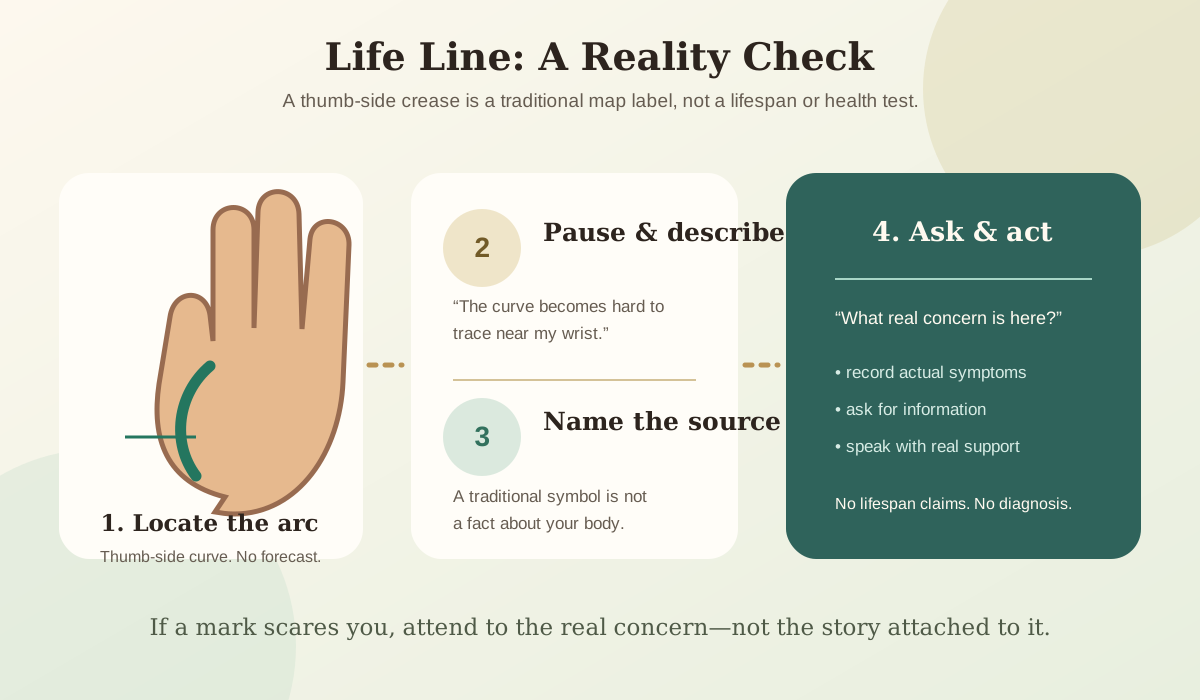
The life-line study guide applies this observation-first approach to the thumb-side arc, including the persistent myth that a crease can predict lifespan or diagnose health.
Myths worth leaving behind
“A short head line means low intelligence.”
No. This is one of palmistry’s most damaging shortcuts. Intelligence is not a single thing, and a visible crease is not a measure of reasoning, learning, language, attention, education, creativity, or human value. Do not use this claim on yourself, a child, a student, a partner, or a stranger.
“A broken line means a mental-health crisis.”
No. A mark, crossing crease, or change in visibility cannot diagnose trauma, anxiety, depression, psychosis, dementia, brain injury, or any other condition. If you or someone else has symptoms or is in distress, seek qualified care or urgent support as appropriate. Do not wait for a reading to become reassuring.
“A straight line proves someone is logical and a curved line proves they are creative.”
No. Those are broad symbolic stories. A person can be imaginative while writing a spreadsheet, practical while painting, methodical while composing music, or uncertain while doing anything. Let the symbol suggest a question, never a category.
“A fork proves a calling.”
No. A fork-like mark may be clear, faint, or simply an intersection. It cannot choose a career, name a talent, or guarantee recognition. If you are curious about writing, design, research, coding, music, or another practice, make a small project and seek feedback. Real work produces more useful evidence than a hand chart.
Read another person’s palm only with consent
Palm reading often happens in social settings, where a remark intended as fun can land heavily. Ask before you touch a hand, point at a line, take a photo, or begin a reading. Say what kind of practice you use: “I treat this as a traditional reflection exercise, not a prediction or personality assessment.” A person should be free to say no, stop, or change the question without explanation.
Keep the conversation within their agency. “What kind of support would make this decision easier?” is respectful. “Your line says you will fail, leave someone, lose money, have a condition, or should choose a career” is not. Avoid interpreting someone’s sexuality, fertility, health, mental state, trauma, honesty, competence, or future from their body.
If the person brings up abuse, coercion, self-harm, medical symptoms, financial emergency, legal trouble, or immediate danger, end the practice and focus on appropriate help. A symbolic reading cannot safely carry those situations.
What to read next
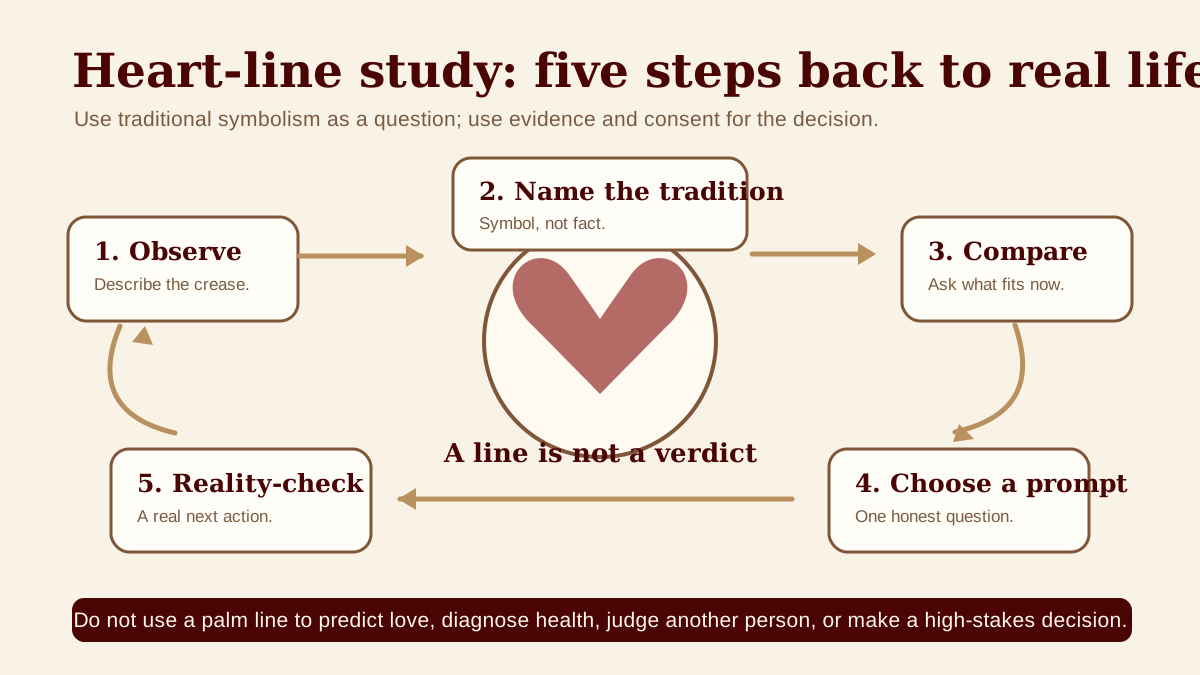
For another example of the observation-first method, read the palm heart-line guide. It shows how a traditional relationship symbol can lead to a grounded conversation rather than a verdict about love.
If you want to practise interpretation with images rather than bodies, try the playing-card cartomancy study guide. Its suit-and-rank framework ends every reading with an action you can test. For a practical study concern, the Feng Shui study-desk guide focuses on light, reach, distractions, and routines—things you can actually change.
Frequently asked questions
Is the head line the same as the life line?
No. In common palmistry diagrams, the life-line label curves around the thumb base, while the head-line label crosses the middle of the palm. They may appear close together near their start, and individual hands vary. The labels are traditional map terms; neither line measures health, lifespan, intelligence, or destiny.
What does it mean if I cannot find a clear head line?
It means the diagram may not map neatly onto your hand, the lighting or posture may obscure a crease, or the line is difficult to distinguish from nearby creases. It does not mean you lack intelligence, focus, direction, or a future. You can stop the exercise rather than forcing a conclusion.
Can I use a palm photo or AI tool to read a head line?
Use caution. A photo can distort lines through light, angle, filters, resolution, and skin detail. Do not upload another person’s hand without meaningful consent, and do not treat an automated interpretation as evidence about their health, personality, competence, or future. A private sketch is often enough for a reflection exercise.
Is palmistry scientific?
Palmistry has cultural and historical significance, but a palm reading is not a validated method for assessing intelligence, personality, health, relationships, finances, or future events. Study it as symbolism, history, or personal reflection, and use appropriate evidence for real decisions.
What if a palm reading makes me anxious?
Pause. Put the chart away, name the actual worry, and choose a grounded next step. Talk to a trusted person, seek professional support for a serious concern, or focus on information and choices you can verify. A practice meant for reflection should not make you feel trapped by a mark on your hand.
Sources and limits
Historical context: the U.S. National Library of Medicine’s chiromancy collection and the Wellcome Collection manuscript on chiromancy and physiognomy. This guide offers an editorial study method, not a scientific interpretation of palm creases. Do not use it to diagnose a condition, judge intelligence or character, predict an event, or make a medical, legal, financial, housing, education, employment, or relationship decision.