The short version
Short answer: Lucky numbers are a language game before they are anything else. In much of East Asia, a digit earns its reputation from what it sounds like when spoken, so 8 (close to "prosper") is treasured and 4 (close to "death") is quietly skipped on elevator panels. In the West, numbers collect luck from religion, folklore, and mathematics instead, which is how 7 became the favourite and 13 the villain. None of this changes what a number does. All of it changes what people pay for the number, and the prices are documented and occasionally astonishing: the world's most expensive license plate, a plain "P 7" in Dubai, sold for AED 55 million in 2023. This guide maps the major traditions, then points you to the records, the phone-number markets, and the number-by-number detail.
If you are here for one specific digit, the fastest routes are our guides to the number 8 in Chinese culture, the number 4 and tetraphobia, and 7 and 13 in Western culture. If a house or unit number brought you here, the lucky house numbers guide covers address numerology on its own terms.
Why a digit can carry luck at all
Three engines drive number luck around the world, and every tradition in this guide runs on at least one of them.
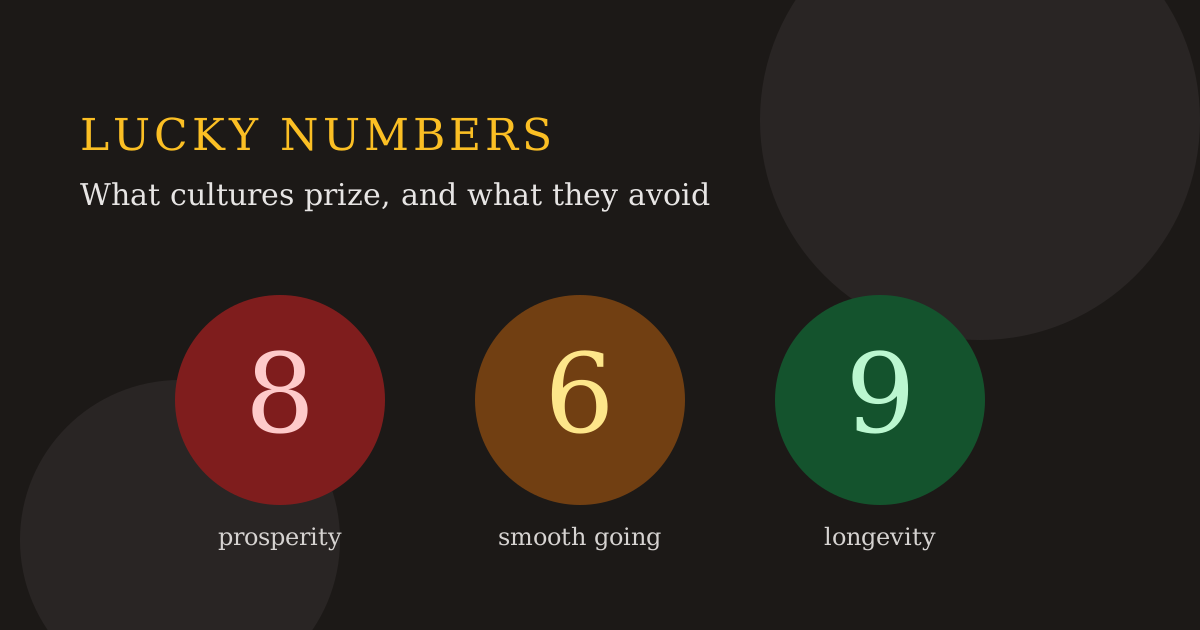
The first engine is sound. In tonal languages, homophones are everywhere, and a number whose name sounds like a good word inherits the word's glow. Eight prospering and four dying is the famous pair, but the family is bigger: 6 sounds like smooth or flowing in Mandarin, 9 sounds like long-lasting, and combined plates like 168 are read as "prosperity all the way." Cantonese adds its own readings, which is why Hong Kong plates mix lucky letters and digits in ways that puzzle outsiders.
The second engine is story. Numbers pick up reputations from scripture, myth, and habit: seven days of creation and seven heavens, three as a complete cycle, twelve signs and twelve months. A number repeated in the stories a culture tells itself starts to feel significant all on its own.
The third engine is scarcity and status. Once a digit is believed lucky, everyone wants it on their plate, their phone, and their door, and there is only one 8888-8888 to go around. Scarcity turns belief into auction prices, which is why the documented record sales get their own guides here: lucky license plates and world records and the market for lucky telephone numbers.
The map: prized and avoided numbers by culture
| Number | Where | Association in tradition | Everyday sign of it |
|---|---|---|---|
| 8 | China, Hong Kong, Taiwan, Singapore, diaspora communities | Prosperity and wealth, from the ba/fa sound | Premium prices for 8-heavy plates, phone numbers, addresses |
| 9 | China and Japan (with a Japanese caveat below) | Longevity and endurance in Chinese tradition | 99 and 999 in prices, wedding dates, hotel floors |
| 6 | Chinese-speaking cultures | Smooth progress, things flowing well | 66 and 666 in prices, gifts, and internet slang |
| 4 | China, Japan, Korea, Vietnam | Avoided: its name echoes "death" (and "suffering" in Japanese) | Missing 4th floors, no room 4, plates avoiding 4 |
| 7 | Western cultures, and much of the world | The favourite number: luck, completeness, the divine | Lottery picks, jerseys, "lucky seven" branding |
| 13 | Much of the West | The unlucky one: triskaidekaphobia | Buildings skipping a labelled 13th floor (the floor exists; the label does not) |
| 17 | Italy | The traditional unlucky number | Rearranged Roman numeral VIXI read as "I have lived," i.e., I am dead |
| 39 | Afghanistan | Strongly avoided historically (association with pimping slang) | Owners paying to change plates carrying 39 |
Two caveats about this table. First, these are tendencies, not laws: plenty of people in Beijing happily live on the fourth floor, and plenty of Italians would never think twice about the 17th. Second, traditions travel and merge. A Toronto condo tower may skip both 13 and the 4s because its buyers come from everywhere.
Advertisement
The Chinese system: a sound-based hierarchy
Chinese number luck is the most systematic in the world because it is built on pronunciation, and pronunciation can be ranked.
8 sits at the top. Ba echoes fa (to prosper), so 8 became the digit of business success. It doubles happily: 88 reads as double prosperity, 888 as triple, and sequences like 518 ("I will prosper") and 168 ("prosperity all the way") are read like short sentences. The Beijing Olympics opened on 8 August 2008 at 8:08 in the evening, a choice planners openly tied to the number's reputation.
9 follows, sounding like jiu, long-lasting. It is the number of endurance and, thanks to being the highest single digit, of the emperor in older symbolism. 6 is the comfortable one, sounding like smooth or flowing, the digit of things going well rather than striking it rich; internet slang later adopted 666 as a cheer meaning "brilliant." 2 is seen as doubling and pairing, good for couples. 3 sounds like birth or life in Cantonese reading and turns up in phrases about growth.
4 is the one left off the guest list, sounding like si, death, in Mandarin, Cantonese, Japanese (shi), and Korean (sa). Combinations sharpen it: 14 can be read as "certain death," 24 as "easy death" in some readings, while 48 and 84 are sometimes rescued by reading the 8 last, "prosper in death's face" is not a thing; the polite version is that context and tone decide, and most people simply avoid the plain 4 and move on. Our full guide to the number 4 covers missing floors, phone numbers ending in 4 trading at a discount in some markets, and the plenty of places where 4 means music or the four seasons and nobody minds.
Japan and Korea: shared characters, local dialects of luck
Japan inherited the same characters and readings, so 4 (shi, also "death") and 9 (ku, also "suffering") both get avoided in Japanese hospitals and hotels, which is why Japanese number luck skips two digits where Chinese tradition skips one and prizes the other. Seven, shichi, is lucky in Japan too, anchored by the Seven Lucky Gods (Shichifukujin) of folklore. Korea shares the 4 avoidance (sa), and Korean buildings routinely label the fourth floor F or skip it. This is a good place to learn the general rule of this whole topic: the luck lives in the local pronunciation and the local stories, never in the digit itself.
The Western system: story-driven luck
Western number luck leans less on sound and more on narrative. 7 won the West through accumulation: seven days in the creation story, seven classical planets, seven colours in the rainbow, and a habit of landing on seven when people worldwide are asked to name a favourite number (a preference noted so often in surveys and classroom experiments that it has become a small cultural fact of its own). 3 is the charm of completeness (beginning, middle, end; "third time lucky"). 12 feels complete through months and signs. 13 drew the short straw somewhere between Norse myth, the Last Supper count, and centuries of retelling; the fear's name, triskaidekaphobia, is more famous than the fear. 777 cashed all of it in at the slot machine, where three sevens became the jackpot icon. Our 7 and 13 guide separates the documented building behaviour from the folklore.
Where belief becomes a bill
Number luck stops being trivia at the point of sale, and this is where our pillar gets its most-read pages.
- License plates. Single digits and lucky sequences are auctioned by governments in the UAE, Hong Kong, and elsewhere, with charity auctions setting the records. The verified top of the market: Dubai's "P 7" at AED 55 million (about US$15 million) in April 2023, a Guinness-recognised record; before it, Abu Dhabi's "1" at AED 52.2 million in 2008. Hong Kong's record is the single letter "W" at HK$26 million in 2021. Full table and sourcing in the license plate records guide.
- Phone numbers. Chinese courts have auctioned debtors' mobile numbers ending in five 8s for RMB 2.25 million, and a UAE diamond number of seven 7s sold for AED 7,877,777 in 2014, with the price itself written in the lucky digit. Detail in the telephone number guide.
- Addresses. House numbers ride along with the same beliefs, and the number on your door has its own numerology tradition (digit reduction to 1-9), covered in the house numbers guide. Note the split: address numerology is a modern numerological practice, separate from classical Feng Shui, and we treat it that way.
Choosing your own numbers, sensibly
Most readers meet this topic at a checkout: a plate transfer, a new phone plan, a unit in a condo building. Practical guidance, in tradition's own terms:
- Decide whose luck you are buying. If resale or rental to buyers from a particular culture matters to you, their hierarchy (8 over 4, say) matters more than yours. If the number is purely for you, pick the one whose meaning you enjoy saying out loud.
- Check what is actually priced in. In Hong Kong, Dubai, and parts of China, lucky digits carry real premiums and unlucky ones real discounts. In most Western markets, the effect concentrates in specific communities and building types; do not pay a global premium for a local belief.
- Do not let the digit outrank the asset. A great apartment on the fourth floor is a great apartment. Traditions themselves say this: the house numbers guide makes the same point about layout and light coming first.
- Expect variation inside every culture. Generational, regional, and personal differences are wide. The respectful move is to ask, not assume, when a number matters to someone else.
A balanced word before you go shopping
Number luck is a real cultural force with unreal causal claims, and both halves deserve keeping. The cultural force is measurable: governments run the auctions, courts sell the phone numbers, and developers renumber the floors. The causal claim, that a digit bends events, has never survived controlled scrutiny, and you will not find this site pretending otherwise. Enjoy the 8 on your plate as a small daily pleasure and a signal you chose on purpose. That is what it can deliver, and it is not nothing.
Sources for this guide
- Guinness World Records, "Dubai driver drops nearly $15 million on most expensive license plate ever" (May 2023): http://www.guinnessworldrecords.com/news/commercial/2023/5/dubai-driver-drops-nearly-15million-on-most-expensive-license-plate-ever-746334
- Carscoops, "Most Expensive License Plate Ever Sells For $15 Million In UAE" (April 2023), including the prior 2008 Abu Dhabi "1" record: https://www.carscoops.com/2023/04/most-expensive-license-plate-ever-sells-for-15-million-at-auction/
- Hong Kong Transport Department auction results as reported by Hong Kong news outlets (2021 "W", 2023 "R", 2024 "D" sales), summarised in The HK HUB's record table.
Deeper sourcing lives on the two market pages linked above, where every figure carries its citation.