Stand in a room and look at what presses on it: the road running at the front door, the corner of the next building aimed at the window, the desk chair with its back to everyone who walks in. Then take a compass bearing, note a birth year, open a chart for the year. Feng shui has always worked in those two registers, what the eye reads and what the compass calculates, and it gave them names. Form School reads the first. Compass School reads the second. Most of the advice sold under the word feng shui comes from one or the other, and sorting which is which tells you what a tip can actually claim and what it needs to work.
The two branches are not competing products. They grew in sequence, the compass methods layered over an older practice of reading land, and working practitioners use them in that order: forms first, then directions inside sound forms. A building struck by a road has a form problem before it has a direction problem, and a perfect bearing in a badly shaped room is still a badly shaped room. Getting the order right is most of what combining the schools means.
Where the two branches came from
Form School is the older of the two. Guo Pu, who lived from 276 to 324 CE, is traditionally credited with the Book of Burial, the Zang Shu, the earliest surviving text to use the term feng shui. Its subject was yin zhai, the siting of graves, and its method was reading land: where hills gather, where water slows and turns, where a burial plot sits sheltered from wind with open ground before it. House feng shui, yang zhai, developed from the same form-reading roots and applied the same eye to dwellings. The attribution to Guo Pu is traditional, and the text reached its surviving form through later hands, but the lineage teachers describe starts there, with graves among hills and a reader judging ground by looking at it.
The branch carries two names for that method. Xing Shi points at form and shape. Luan Tou, often given as mountain-head reading, points at the landforms themselves. Both names describe one act: reading what is physically there. The classic image of a well-sited place is the armchair formation. Higher ground behind gives support, read as the Black Tortoise in the north. A lower ridge on the left, the east, is the Green Dragon. A lower ridge on the right, the west, is the White Tiger, set a little below the Dragon in the traditional picture. Open, level ground in front, the south, is the Red Phoenix, with the bright hall, the ming tang, as the clear space where the site gathers. The four animals name positions around a seat. Behind, left, right, front: support, a rising flank, a lower flank, and room to breathe. Read any traditional site description and those four positions do most of the work.
Compass School grew as practitioners put direction and time on top of that reading. Its Chinese name, Li Qi, points at principle and the regulation of qi. Where Form School asks what shape the land takes, Compass School asks which direction a building faces, which sector of it a person uses, and what the calendar does to both. The instrument of the branch is the luopan, the ringed feng shui compass, a needle at the centre of concentric rings carrying directions, trigrams, and cycles. Its methods include Eight Mansions, which assigns personal directions from a birth year and house directions from the sitting direction, Flying Stars, which builds time-based charts on the Lo Shu grid and moves them by year and month, and the 24 Mountains, which split each of the eight directions into three for finer bearings. Trigram and bagua correspondences run through all of it. The branch answers questions form reading cannot phrase: which sector, which facing, which year.
Form School in practice
Form reading starts before the front door. The practitioner walks the ground and reads the land at every scale the site offers. Hills, ridges, and the fall of the ground come first where they exist. Water comes next, rivers, streams, ponds, and the paths water takes through a street grid, since roads carry movement the way water does in the classical reading. Then the built forms: the shape of the plot, the height and mass of neighbouring buildings, the angle of streets, and what points at the home. It ends indoors, with the shapes rooms make, where doors drive sightlines, and what hangs over beds and desks.
The tools are the eyes, the feet, and a survey habit. No instrument sits at the centre of the method. A practitioner notes which side of the building takes weather, where light enters in the morning, how a street delivers noise to a bedroom wall, whether a plot widens or narrows toward its back. Two judgements recur. The first is support: a seat, a bed, a desk, or a whole house reads as settled when something solid stands behind it and exposed when nothing does. The armchair formation is that judgement drawn at the scale of a valley. The second is the reading of sharp forms. A corner, a road, or a roofline aimed straight at a building or a window is read in this branch as sha qi, often given in English as poison arrows. The phrase is dramatic and the underlying observation is plain: a straight road delivers headlights, noise, and weather down its line, and a hard corner close to a window dominates the view from it. Form School names that pressure and then prescribes by moving, screening, or planting between the source and the seat.
Inside the home, form reading becomes furniture reading. The clearest example is the command position, seating that lets a person see the door without sitting in its direct path, with a solid backing behind. It is pure form: sightline, approach, support. The whole-home treatment sits in the command position whole-home guide. The plot itself is a form question, and the lot shape analysis works through widening, narrowing, and cut-corner plots the way this branch reads them. A building where a road runs straight at the door is the street-scale version, covered in the T-junction house guide. None of these need a compass to state. You can check each one by standing where the practitioner stood.
What Form School cannot do is rank directions for a person or a year. It has no use for a birth date and nothing to say about one sector being active this year and quiet the next. Ask it which of two identical bedrooms suits which partner and it can judge light, noise, size, and distance from the door, then it stops. That stop is the gap Compass School filled.
The same reading applies outdoors at the scale of a purchase. Two houses on one street can share a builder, a floor plan, and a price and still read very differently to a form eye. One sits with a taller building close behind it and a road that bends away from the door. The other sits low, with a straight road segment running at its entry and a neighbour corner aimed at its front window. Form School ranks the first ahead of the second before any chart is drawn, on support and pressure alone. That kind of judgement, made standing on the pavement, is what the branch has offered since its grave-siting roots.
Advertisement
Compass School in practice
Compass work starts with a bearing. The practitioner takes a reading, usually at the front of the building and again at its centre, converts it through the rings of the luopan, and builds the charts the question needs. How to take a feng shui compass reading covers the measurement itself, including why readings taken beside steel come back wrong. From the bearing come three kinds of answer.
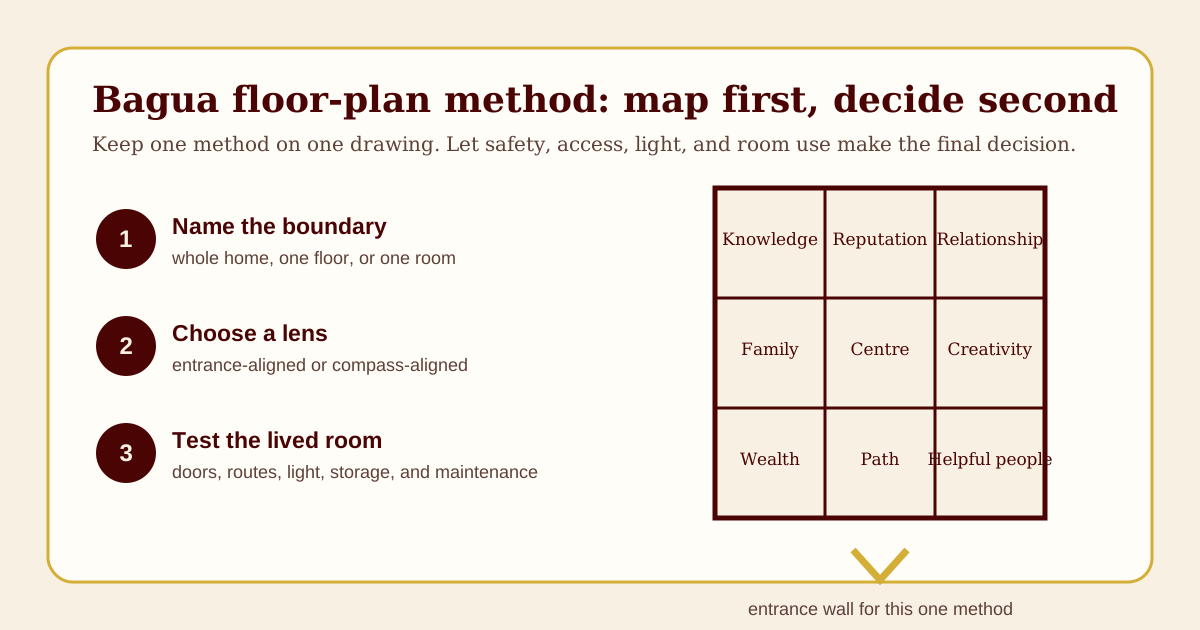
The first is personal. Eight Mansions reduces a birth year to a Kua number and assigns four favourable and four unfavourable directions, used for desk facing and bed head direction. The second is spatial. The bagua laid over a floor plan divides the home into sectors tied to trigrams and areas of life, and the room-by-room application is worked through in the Bagua map room-by-room guide. The 24 Mountains refine the reading when a bearing falls near a boundary and the chart changes across it. The third is temporal. Flying Stars charts a building from its construction period and facing, then runs annual and monthly stars over the Lo Shu grid, so a sector can read as active one year and troublesome the next. Time is the element Form School never carries. Compass School carries little else without it.
The tools tell the same story. Where form reading trusts a walked survey, compass work trusts an instrument and a set of tables. The luopan rings hold the 24 Mountains, the trigrams, and the cycles so the practitioner reads bearing and meaning together. The blind spot mirrors the form blind spot exactly. A compass chart has nothing to say about a low beam over a bed, a door that strikes a desk chair with its swing, or a road aimed at the house, except by sector. It can rank the sector the road enters. It cannot see the road. Practitioners who work only by chart produce rooms that read well on paper and sit badly, which is why the combined order puts the walked survey first.
One modern branch sits off to the side of this history. Black Sect, often shortened to BTB and linked with Lin Yun in the 20th century, maps the bagua from the front door instead of the compass. Turn the door and the sectors turn with it. Traditional teachers in both older branches dispute that move, since it removes the compass from the mapping step while keeping the bagua vocabulary. You meet BTB often in Western books. A tip that places a wealth corner by counting walls from the entry is working from the door-based map, whatever label the book gives it.
The two branches side by side
| Aspect | Form School | Compass School |
|---|---|---|
| Reads | Landforms, watercourses, building and room shapes, streets, sightlines | Compass bearings, birth years, construction periods, calendar cycles |
| Tools | Eyes, site survey, walking the ground | Luopan, compass readings, charts and tables |
| Answers | Is this place sheltered, supported, pressed on, well arranged? | Which sector, which facing, for whom, in which year? |
| Time element | Largely none; reads what stands now | Central; charts run by period, year, and month |
| Typical advice | Move the desk to see the door, screen the corner, choose the supported bed wall | Face the desk to Sheng Chi, use this sector this year, pick a date |
| Blind spots | Cannot rank directions by person or year | Cannot see shape, approach, light, or pressure in a room |
The row that settles arguments is the blind spot row. Each branch is silent exactly where the other speaks. That is why combined practice is the norm among teachers who work in houses rather than in books, and why single-school advice tends to read as thin: it answers its own questions well and the other set not at all.
Everyday tips, sorted by school
Most advice a homeowner meets arrives without a label. Sorted, it shows its evidence.
| Tip | School | Why |
|---|---|---|
| Command position for desks and beds | Form, with compass refinements | Sightline, door path, and backing are read by eye; a compass step may then pick the facing within the position |
| Wealth corner in the far left or southeast of a room | Compass and bagua | Placed by the sector map, either door-based or compass-based, not by anything the eye reads in the room |
| Cures for a corner or road aimed at the home | Form | The problem is a shape and a line; the response screens, plants, or moves the seat |
| Kua direction for a desk | Compass (Eight Mansions) | Needs a birth year and a bearing; the room shape does not enter the calculation |
| Annual star remedies and sectors to keep quiet | Compass (Flying Stars) | Runs off the calendar and the building chart; changes by year |
| Bagua mirror over a door | Mix of both | The mirror is a form object placed on a line of approach, often justified by a sector reading |
| Decluttering and clearing blocked paths | Modern practice drawing on both | Older texts in neither branch set out a tidying system; current teachers apply form logic about flow and compass logic about sectors to it |
| Bagua mapped from the front door, counting walls | Black Sect adaptation | A 20th-century door-based mapping; traditional teachers in both branches dispute it |
The test behind the table takes one line. If the advice works by looking, at a shape, a height, a road, a corner, it is form. If it needs a compass degree, a birth year, or a calendar, it is compass. Run any tip through it and you know what you would check to test the tip: stand in the room, or take a reading and open the chart.
Both together: one apartment
Take a one-bedroom apartment. The front door opens off a corridor. The bedroom window faces the corner of a taller building across a narrow street. The only wall long enough for a desk sits so the chair back meets the door. A couple rents it; she works at home, he does not.
Form reading goes first. The chair with its back to the entry is the sharpest problem in the flat, and it costs nothing to fix: turn the desk to the side wall so the seat sees the door at an angle with a wall behind it, accepting a shorter wall run. The building corner aimed at the bedroom window is read next. It cannot move, so the response is screening, curtains that break the line and a plant on the sill, the standard form answer to a form problem. The bed takes the wall away from the window wall, both for the corner reading and because that wall is the quiet one. The door swing, the light, and the radiator settle what is left.
Compass work runs second, inside those positions. A reading at the entry sets the sitting direction of the unit and the sector map, which the room-by-room guide applies to the plan. Her birth year gives a Kua whose Sheng Chi facing turns out to be east. The moved desk, on the side wall, faces east already: the compass choice and the form fix land on the same chair, which is how the two branches look when they agree. His Kua is the other group, so his reading chair angles to his Fu Wei rather than sharing her facing. The year chart marks one sector of the flat as the active one for the year and another as the one to keep quiet; the couple puts the working storage in the first and leaves the second unrenovated until the year turns. Nothing in the compass step asked them to move the desk back into the door path or the bed under the window corner. Where a chart preference met a form rule, the form rule held and the chart choice moved to the next workable spot.
That sequence, survey, placement, then bearing and chart, is the whole combined method. It also tells you how to read advice that skips a step. A report that opens with sector remedies for a flat nobody walked through has started at step three.
Where both branches stop
Traditions vary by lineage. Teachers set the turn of the year at different points, split on the door-based bagua, and rank some remedies differently, and a practitioner trained in one line may set out the same room differently from another. That variation is part of the record, not a defect to hide. What the schools share is their standing. Form and Compass are traditional frameworks for reading places and arranging rooms inside a coherent set of rules. They describe how practitioners judge a site and choose a layout. Their claims stay cultural and interpretive, and nothing in either branch measures an outcome in the home. Used with that standing clear, the two give a homeowner a complete way to look at a dwelling: form for what the place is doing, compass for which way things face and when, and a settled order for the days they point in different directions.