Most feng shui advice is written as if the year had one season. Place the bed, clear the entry, balance the elements, and the job is done until you move. The older system underneath that advice does not work that way. In five-element theory, the system feng shui shares with traditional Chinese medicine, every season carries its own element, and a home that is balanced in July is not automatically balanced in January.
Winter belongs to water. That single correspondence drives everything in this guide: the direction (north), the colours (blue and black), the climate (cold), and the behaviour the tradition recommends (stillness, storage, retreat). A winter home in this tradition is not a summer home with the heating on. It is a home rebalanced for the dark half of the year, with fire and earth added in measured amounts where people live, and the water side of the house kept calm instead of fought.
This guide works in that order. First the table, as tradition states it. Then the rooms, one at a time. Then the layer that is not symbolism at all: drafts, condensation, and the safe use of the candles and heaters that winter advice tends to reach for. Tradition is framed as tradition throughout, and nothing here promises an outcome for health, wealth, or anything else.
The correspondence table: where winter sits
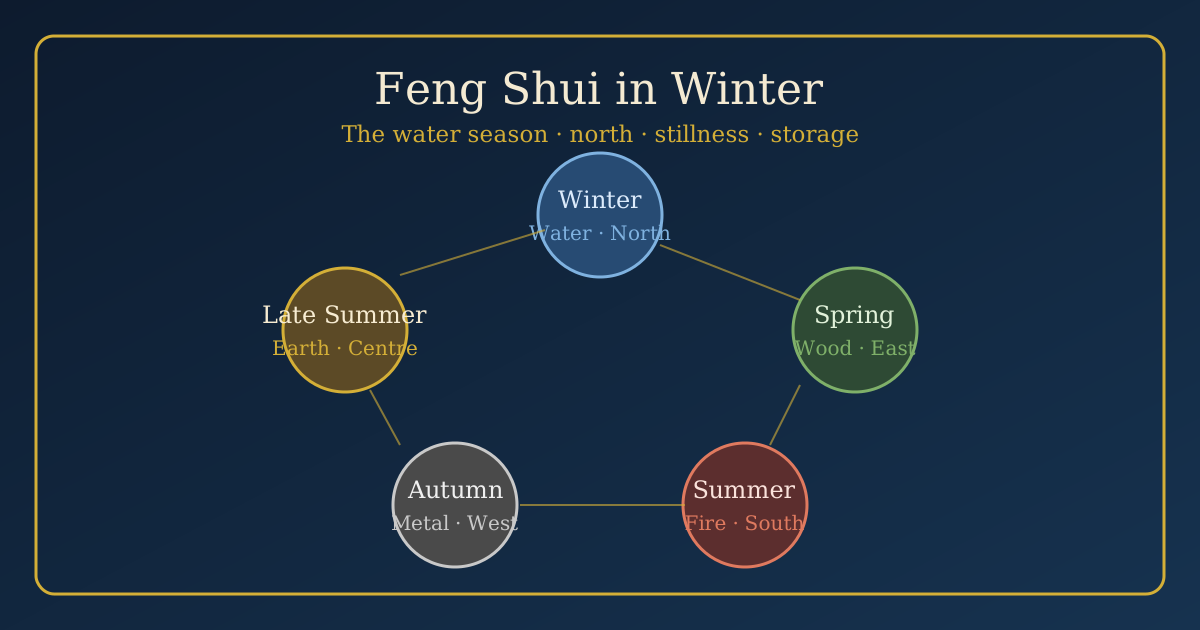
Five-element theory matches each phase to a season, a direction, a colour family, and a climate. The table below is the version printed in standard references on the theory, including the five-element summary published by Acupuncture Today, a professional publication for practitioners of Chinese medicine. Feng shui uses the same table when it talks about sectors and seasons.
| Element | Season | Direction | Colours | Climate | Character in the traditional description |
|---|---|---|---|---|---|
| Wood | Spring | East | Green | Wind | Growth, sprouting, new activity |
| Fire | Summer | South | Red | Heat | Expansion, flowering, display |
| Earth | Late summer | Centre | Yellow | Damp | Levelling, fruition, the turn of the year |
| Metal | Autumn | West | White | Dryness | Harvest, collecting, letting go |
| Water | Winter | North | Blue, black | Cold | Retreat, stillness, storage |
Read the last row as the season's brief. Water in winter is not the water of fountains and features. It is water held still: frozen, stored, underground. The tradition's own image for the season is dormancy with a purpose, the part of the cycle where things are kept rather than grown. In the generating cycle, water nourishes wood, which is the cycle's way of saying that a winter of storage is what a spring of growth draws on. In the controlling cycle, water extinguishes fire and earth dams water, and both of those pairings show up in winter home advice below: too much fire fights the season, and earth is the element used to steady a home that feels like it has too much cold water energy in it.
The calendar marks the season before the weather does. In the traditional Chinese calendar, winter is counted from the solar term Lidong (Start of Winter, around 7 November) to Lichun (Start of Spring, around 4 February), with Dongzhi, the winter solstice (around 21 December), near its middle. The five elements balancing guide sets out the two cycles and the full correspondence system for readers who want the theory before the practice. This guide stays with the practice, and with one caution: follow your own weather. A home in a mild coastal winter and a home under two metres of snow are both in the water season on paper. Only one of them needs a boot tray the size of a small boat.
The balancing move: add fire and earth, in that order, in small amounts
Winter advice in this tradition is a balancing act with two added elements, and the order matters to practitioners.
Fire first, through light before colour. The fire element in a modern home is mostly light and warmth, not flame. Winter is when a home's lighting plan is tested, because the lamps carry the rooms for sixteen or more hours a day at northern latitudes. Warm bulbs in the rooms where people sit in the evening, a lit corner in a room that otherwise goes dark at four in the afternoon, and candles used as attended decoration rather than as a light source are the standard moves. The lighting guide grades light by the jobs it has to do in each room. In winter the grade that matters is simple: no lived-in room should depend on a single ceiling light after dark.
Earth second, through weight and textile. Earth is the element the controlling cycle uses against excess water, and in a home it arrives as the heavy, soft, square, and warm-toned layer: rugs over cold floors, throws and cushions in yellows, tans, and terracotta, ceramic and stone objects with some weight to them. This is also the layer that does checkable work. A rug on a cold floor and a throw on a sofa change how a room feels at ankle level, which is where winter discomfort actually lives.
Water itself: keep it calm, do not add to it. Practitioners generally advise against installing a new water feature in midwinter, and against turning a home blue from end to end to match the season. The season supplies water on its own. What the home supplies is containment: calm surfaces, ordered north rooms, and water in the house (bathroom, kitchen, any feature you already own) kept clean and in good repair. The water feature placement guide covers placement for readers planning one for spring.
What this balance is not: a ban on a season. A home that refuses winter entirely, sealed, overheated, and lit like a showroom at midnight, reads in this tradition as a home fighting its own calendar, and the fight shows up as restlessness the texts associate with fire unopposed. You do not have to accept that reading. The proportion rule underneath it (warm light and textiles in the sitting rooms, calm and dark kept for the sleeping rooms) is ordinary interior practice in cold countries, with or without the element names.
Advertisement
The entry in winter: the hardest-working square metre in the home
Every season makes its own entry problem, and winter's is water in the wrong place: melting snow, road salt, wet boots, dripping coats, and grit carried in on soles, all arriving at the one doorway that tradition says sets the tone for the home. The garage, entry, mudroom, and laundry guide covers these rooms as a group. The winter version is a short, physical list.
- A tray or mat that can hold meltwater. Boots stand on it, not beside it. Empty and wipe it before the water reaches the floor finish underneath, because standing meltwater under a mat is how a winter entry quietly damages a floor.
- Salt and grit swept, not spread. A small broom and a closed bin by the door keep the daily sweep to under a minute. Grit walked through a home is a floor problem and, in the tradition's language, a dirty mouth of the home all winter long.
- A place for wet outer layers that is not a chair. Hooks or a rail within reach of the door, with air around what hangs there. Wet coats draped over furniture spread damp through the rooms the season is trying to keep dry and warm.
- Light that survives the season. The entry bulb does more work in winter than in any other season, including the work of making a dark four o'clock arrival feel safe. If it fails in December, it is replaced in December, not at the spring clean.
None of this needs the word feng shui to justify it, and the tradition would not disagree. Its winter texts praise an entry that is clean, lit, and unblocked in every month. Winter just raises the cost of skipping it.
Windows and the north rooms: darkness, drafts, and glass that sweats
The windows guide calls windows the eyes of the home and works through placement and curtains in full. Winter adds three conditions that guide mentions only in passing.
Darkness is the season's given, so curtains become a schedule. In summer, curtains tune light. In winter, they divide the day: opened fully in the short bright hours to take what sun there is, closed at dusk, because glass after dark is a mirror and a cold surface at once. Heavy or lined curtains closed at dusk are also insulation you can measure, in the plain sense that a room with its glass covered loses less heat through it than a room with bare glass. Tradition says a home should close itself in for the night in the water season. A thermometer on the windowsill will agree with the practice if not the reason.
Drafts are the winter form of the straight line. Feng shui writing worries about air moving too fast and too straight through a home, and calls the sharp version of it sha qi. In a winter home the checkable version is the draft: the gap under a door, the window that no longer seals, the cold line across a bed or a desk chair. Sealing a gap, moving a chair out of a cold line, and hanging a curtain over a door that leaks air are building fixes that every school of the tradition would also count as corrections. Start with the seat you use most. A desk chair in a draft is a winter problem no arrangement of objects will outvote.
Condensation is the season's water appearing indoors. Warm indoor air meeting cold glass lays water on the pane, and water left standing on reveals and sills feeds mould. Wipe panes in the morning, keep air moving in kitchens and bathrooms after cooking and showers, and do not push furniture tight against a cold external wall where damp air sits still behind it. This is the practical ground under the tradition's insistence that water in a winter home be contained and calm: uncontained water, in January, is a maintenance bill.
North rooms collect all three conditions at once in northern homes, since they take the least sun. Tradition gives the north to water and advises calm, quiet uses there. Building practice gives the same answer for a different reason: the north room is the worst place in the house for a damp-sensitive store, a sun-hungry plant, or a desk that needs daylight, and a good place for a bedroom, a bathroom, or storage that likes the cold and the dark. When a tradition and a thermometer agree this closely, follow them both and save your arguments for the rooms where they part.
Bedroom and kitchen: rest and the larder
Two rooms carry the season's character in the traditional description, storage and stillness, and both are rooms where winter practice is mostly rhythm rather than objects.
The bedroom is where the stillness advice lands. Longer nights make the sleep-supportive bedroom the winter room that matters most: blackout that actually closes, a cool room with warm bedding rather than a hot room with thin covers, and screens and work out of the bed's sightline in the hours when the season is asking for retreat. Tradition adds one colour note: the bedroom is the room where the water colours belong in winter, deep blues and dark neutrals in bedding and curtains, with the fire element kept to a low warm lamp rather than bright overhead light. A reader who finds a dark bedroom restful in December is experiencing the practical layer of the same advice.
The kitchen is where the storage advice lands. The traditional winter kitchen is a stocked one: dried goods, preserved foods, root vegetables, and the slow, covered cooking that suits a season of staying in. No object placement is required to honour that. The feng shui layer is the usual kitchen order (clear worktops, a clean and working cooker, bins closed and emptied) kept up in the months when a household cooks most. The kitchen layout guide covers the room itself. One winter caution belongs here rather than in a safety section, because cooks forget it: a kitchen in full winter use produces more steam than any other room, and steam is the home's main condensation source. Lids on pans and the extractor on are water management, in every sense the tradition uses the word.
A labelled hypothetical: one house, November to February
The example below is invented to show the sequence. The house, the weather, and the results are illustrative, not a report of a real home.
A household in a cold-climate city lives in a house with a north-facing back bedroom, a living room with a fireplace they rarely light, and an entry with no tray, where boots stand on the floor. In early November they work through this guide in an afternoon. A boot tray and a small broom arrive at the entry, with hooks for coats. The living room gets two warm lamps in its dark corners, a rug over the coldest part of the floor, and cushions and a throw in terracotta and mustard over the existing grey sofa. The fireplace is cleaned and used on weekend evenings, attended, with the guard in place. Curtains in both front rooms are closed at dusk from the solstice onward. The north bedroom, already the quietest room, gets the deep blue bedding and the blackout curtains, and the desk that stood in it moves to a south room with daylight, out of a cold line from its window. The kitchen larder is filled once, properly, instead of by weekly improvisation.
By February, in this example, the household can name the checkable changes: the entry floor is dry, the living room is used after dark instead of abandoned to the television's light, and no mould has appeared on the front windows' reveals, which had shown it the previous winter before the morning wipe became a habit. The tradition would describe the same February house as a home that stored well. Both descriptions fit on the same facts, and the household is free to prefer either.
Month by month: a winter checklist
| When | In the tradition's calendar | Do this |
|---|---|---|
| Early November | Lidong, Start of Winter, around 7 November | Entry tray, broom, and hooks in place. Rugs and throws out of storage. Entry and living room bulbs checked. Larder filled. |
| Late November | First hard cold in most northern homes | Draft check at doors and windows, seated height, with a hand or a candle flame watched carefully and kept clear of fabric. Furniture off cold external walls by a hand's width. |
| Around 21 December | Dongzhi, the winter solstice | The darkest point of the year. Curtains closed at dusk as a fixed habit from here to February. Fire element at its most deliberate: lit fireplace or candles, attended, in the main sitting room. In many Chinese households Dongzhi is a family festival with a shared meal, marked with tangyuan (glutinous rice balls) in the south and dumplings in the north, and a home that marks it is following the calendar this guide is built on. |
| January | The storage month at full depth | Condensation wipe as a morning habit. North rooms checked for damp and kept ordered. No new large projects or purchases for the home unless a failure forces one. |
| Early February | Lichun, Start of Spring, around 4 February | Season turns on the calendar before it turns outside. Review what winter stored and what it damaged, plan spring changes, and retire the boot tray when the melt actually ends, not before. |
The checklist is deliberately short. Winter practice in this tradition is a small set of habits kept for three months, not a renovation with a theme.
The safety layer, stated plainly
Winter is the season when feng shui content online reaches for flame and heat, so the rules belong in the guide, not in a footnote. Candles are lit only in a room someone is in, set on a stable surface away from curtains, paper, and the textiles this guide just added to your sofa, and put out before sleep. A fireplace is used with its guard, a swept flue, and a working carbon monoxide alarm in the home. Portable heaters keep the clearance their makers specify from bedding, rugs, and furniture, and are never the thing a curtain falls against. None of these rules come from feng shui. They outrank it. A placement that a safety rule forbids is not a placement a tradition gets to argue with.
The same ranking applies to the season's health framing. Traditional Chinese medicine associates winter with rest and with the kidneys, and advises keeping warm and sleeping more. Reported here, that is a cultural tradition about the season. It is not medical advice, it does not diagnose anything, and a reader with a health concern in winter needs a clinician, not a correspondence table.
Limits of this guide
Feng shui is presented here as a tradition, with its reasoning shown and its checkable layer separated out wherever the two can be told apart: drafts, condensation, light levels, and floor damage can be tested, and claims about energy, fortune, and health cannot. Follow the testable layer where they conflict, and treat the rest as a way of organising a home that many people find satisfying in the dark months, which is a sufficient reason to use it and the only one this guide claims.