Short answer
In feng shui tradition, a wind chime is a sound cure. Its job is to make a quiet place audible: practitioners hang chimes to stir a corner where nothing moves, to mark the front door each time it opens, and to break up a corridor where air, footsteps, and (in the tradition's language) qi run in one straight line. Choosing one runs in a fixed order. Material first, matched to the sector: metal for the west and northwest, bamboo or wood for the east and southeast, ceramic for the southwest, northeast, and centre. Rod count second: six hollow metal rods are the classic general chime, eight is read for growth, and five is the contested count sold for the Five Yellow. Placement third: at the door, along a hall, or under the eaves, never sounding directly over a bed, a desk, or a dining table. Sound last and above all of it: a chime whose tone you dislike, or one loud enough to annoy the people in the next flat, fails in practice no matter how correct its materials are. This guide works through each of those decisions in order, with the tradition's rules stated as tradition and the acoustics stated as physics, because a wind chime is one of the few feng shui objects where both layers can be checked.
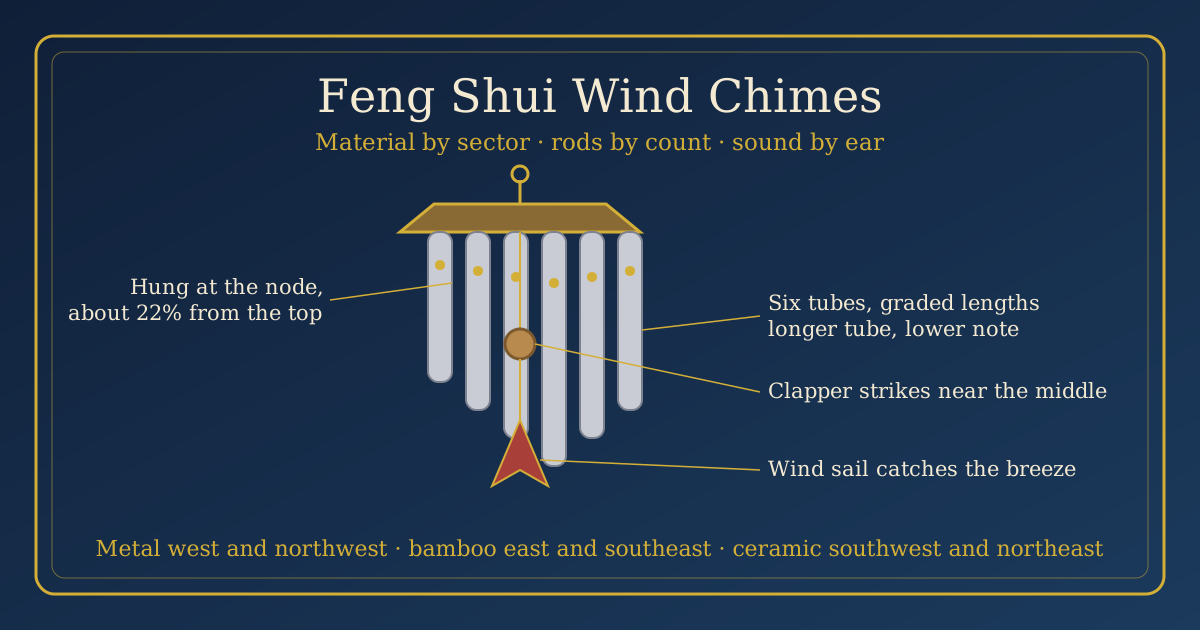
The chime sits in a family of sound and metal objects this site has covered from other angles. The feng shui cures guide explains how the tradition files cures at all, the five elements balancing guide sets out the element cycles the material table below depends on, and the annual afflictions guide covers the Five Yellow, the star the five and six rod dispute is about. Read those for the systems. This page is about one object: how to buy it, hang it, and keep it from becoming a nuisance.
An old object: pagoda bells, feng-ling, and furin
Wind bells are older than feng shui as a named practice, and their first jobs were practical and protective at once. The wind chime article on Wikipedia, read for this guide, records that in India during the second century CE, and later in China, large pagodas carried small wind bells at each corner, and that the slightest breeze set the bronze clappers tinkling. The bells were said to frighten away birds and lurking evil spirits together, which is a tidy summary of how these objects have always worked: one sound, a farm job and a temple job. Bells also hung under the corners of temple, palace, and house roofs, not only on pagodas.
The Chinese branch took its modern shape as bell casting matured. A clapperless ceremonial bell called a yong-zhong came first; after it, the Chinese developed the feng-ling (風鈴, wind bell), hung from shrines and pagodas to ward off evil spirits and attract benevolent ones, in the same account. Rome had arrived at a cousin independently: bronze tintinnabula hung in gardens, courtyards, and porticoes, bells again believed to ward off malevolent spirits. The Japanese furin (風鈴, the same two characters) descends from the Chinese bells, was hung at temples as a talisman from the Heian period, and became a household summer object in the Edo period, when glass versions appeared and the sound itself came to be felt as cooling. The furin at Mizusawa Station are listed among the 100 Soundscapes of Japan. So the object arrives in a modern feng shui shop carrying three histories at once: a temple bell, a summer soundmark, and a protective charm. The sector and rod-count rules in the next sections are a later, systematised layer laid over that history, and they deserve to be read as the tradition's filing system rather than as properties of bronze.
What tradition says a chime does
Practitioner writing gives a chime three jobs, all of them about movement.
The first is stirring. A corner where nothing happens, a spare room, a landing: in the tradition's terms, energy pools and goes stale in such places, and a chime's sound is read as movement introduced into stillness. Strip the vocabulary away and a usable observation remains: a chime makes you notice a forgotten corner every time the air moves, and noticed corners get cleaned, aired, and used.
The second is announcing. A chime at the front door sounds when the door opens and when someone arrives. The front door and back door alignment guide covers the layout this belongs to: the entrance is read as the mouth of the home, and a sound at the threshold marks the crossing between street and house. Shops have used door bells for the same announcement job on every continent, with no metaphysics attached.
The third is slowing. Where a front door faces a back door, or a corridor runs the length of a flat without a turn, tradition reads a rush: everything travels the line at speed and leaves. A chime hung on that line is the sound equivalent of the screens and plants the poison arrows guide recommends for the same geometry, a point where the straight run is interrupted and the ear, at least, pauses.
None of the three jobs requires the chime to be large, loud, or constant. Practitioners are consistent that the sound should be occasional and pleasant, and that a chime battered by strong wind into continuous noise has crossed from cure to disturbance in the tradition's own terms.
Advertisement
Choose by material: the element table
A chime's material files it under one of the five elements, and the element files it under a set of compass sectors. Take a compass reading of the room before shopping, then use the table. Sectors here are compass sectors of the home or room, the classical method; a household working from a BTB bagua overlay should place by that map instead and not mix the two, the same pick-one rule the bagua room-by-room guide applies to every object.
| Material | Element | Sectors tradition assigns | Sound character | Practical notes |
|---|---|---|---|---|
| Metal (aluminium, brass, copper, steel) | Metal | West, northwest; also used in the north | Bright, long ring; aluminium sustains the longest tone | Loudest family. Keep sizes modest in flats and near neighbours |
| Bamboo or wood | Wood | East, southeast; many lists add the south | Soft, hollow knock, short decay | Quietest family and the neighbour-friendly default; untreated bamboo weathers outdoors |
| Ceramic or clay | Earth | Southwest, northeast, centre | Mellow clink; higher-fired stoneware rings brighter than low-fired earthenware | Fragile in storms and the first to chip; bring in during hard winters and high winds |
| Glass | Read by maker as water or earth, varies | Sold for the north as water, or with ceramic as earth | Light, high tinkle | The furin material. Best under shelter; the most breakable option on the table |
Two consequences follow from the table. The first is the mismatch practitioners flag most often: a metal chime in the southwest. The southwest is an earth sector, and in the controlling cycle metal drains earth, so a metal chime there is read as weakening the sector it hangs in. The suggested fix is a material swap, ceramic in place of metal, not a bigger chime. The second is quieter: material decides how far the sound travels, which decides how much of the building hears your cure. Metal carries. Bamboo does not. In a detached house that difference is a preference; in a fourth-floor flat it is the whole decision, and the noise section below treats it that way.
Choose by rod count: 3, 4, 5, 6, 8, and one real disagreement
Rod count is where shop marketing runs ahead of the sources, so this section separates what practitioners broadly agree on from what they argue about.
| Rods | What tradition attaches to the count | Typical material and use |
|---|---|---|
| 3 | Beginnings and growth; three is a wood number in the element-number pairing | Wood or bamboo, east |
| 4 | Steady growth; four is also a wood number in the same pairing | Wood or bamboo, southeast |
| 5 | The contested count: sold widely as the Five Yellow remedy | Metal, hung in the sector the Five Yellow occupies for the year |
| 6 | The classic metal count; six is the metal number, tied to the northwest and to helpful people | Hollow metal tubes; the default recommendation across practitioner sources |
| 8 | Growth and prosperity, reinforced by the fa homophone eight carries in Chinese | Any material; the most common count in decorative sets |
The disagreement is worth stating plainly, because a buyer will meet both versions within five minutes of shopping. Many retailers describe a five-rod, all-metal chime as the traditional answer to the Five Yellow, the earth star the tradition treats as its most troublesome annual visitor: five rods for the fifth star. Flying star writers often give a different specification for the same job, six hollow metal rods, on cycle logic: in the controlling cycle metal drains earth, so a strongly metal chime (six being metal's own number, the tubes hollow) is used to weaken an earth star, and the rod count follows the element doing the work rather than the number of the star. Both specifications circulate as tradition, they cannot both be the original rule, and no source this guide read settles the question with anything older than modern practitioner writing. A reader who wants the flying star version should follow a flying star source all the way through, sector placement included, since the sector the star occupies changes every year; the flying stars guide explains that machinery. A reader buying a general chime for a door or a porch does not need the dispute at all: six hollow metal rods, or a bamboo set for a wood sector, covers the settled part of the tradition.
One construction detail does carry agreement: for metal chimes, practitioners specify hollow tubes rather than solid rods for a cure, on the reasoning that the sound and the air both pass through. The acoustics in the next section give an independent reason to prefer tubes tuned as tubes. Decorative solid-rod and bell sets are not wrong as ornaments; they are simply not the object the cure literature describes.
The sound itself: what the physics says
A tuned chime is a small percussion instrument, and its behaviour is measurable in a way most feng shui objects are not. Three facts from the acoustics, all from the Wikipedia summary read for this guide, are worth a buyer's time.
First, pitch is set by the tube. For a given material, the main note of a tube falls as its length grows, roughly with the square of the length, and rises with diameter. That is why a tuned set is a staircase of lengths: short tubes high, long tubes low, each length cut to a note rather than to a round number of centimetres.
Second, where the tube hangs decides how cleanly it rings. A vibrating tube has two still points, its nodes, at about 22.4 percent of its length from each end. Quality chimes are hung from a hole drilled at that node point, about 2/9 of the length, so the suspension does not damp the main note, and the clapper is arranged to strike near the middle of the tube, where the note rings loudest. A chime whose tubes are strung from the very top, or tied in a bunch, is built for looks; it will thud where a node-hung set sings.
Third, the scale is chosen to forgive randomness. Most chimes are tuned to pentatonic or tetratonic scales, four or five note sets with few clashing intervals, because the wind plays the tubes in no order and a five-note scale sounds acceptable in almost any sequence. A chime that sounds vaguely musical in a gust and harsh in a lull is often a scale problem, not a placement problem. Material sets the ring's length on top of all this: aluminium has the lowest internal damping of the common chime metals, so aluminium tubes ring the longest and loudest, one more reason the metal row of the material table carries a size warning. Clay runs the other way: the higher the firing temperature, the brighter the ring, and stoneware outlasts earthenware in weather.
The tradition's core listening advice survives translation into these terms intact: hear the actual chime before it hangs over your door, because you are choosing a sound your household will live with, and no table of sectors can make a disliked tone pleasant.
Where to hang one, and where not to
With material and count settled, placement is a short list of yes positions and a shorter list of no positions.
Yes, in tradition: just outside the front door under the porch or eaves, or just inside it where the swing clears the door's arc. Partway along a long straight hallway, or on the line between facing front and back doors. In the sector that matches the material, hung at a window or opening where air actually moves. Above a garden path or gate, the descendant of the temple eave bells, where the sound belongs outdoors and marks arrivals. In every case the tubes hang free with clearance on all sides, out of the wind's hardest line: a chime belongs at the edge of a breeze, not in the funnel between two buildings.
No, in tradition and in practice: directly over a bed, where an active sound object contradicts the room's job and a falling object is a hazard in plain terms. Over a desk or a dining table, the same activity-over-rest objection, plus the drip and dust logic of anything hung above food and work. Inside a cluttered store room or a messy corner, because the tradition reads a chime as activating the space it hangs in, and a junk corner is the last space that needs amplifying; clear the corner first, as the decluttering guide sets out, then decide whether it still needs a chime. In a spot where strong wind rings it for hours, which practitioners themselves file as disturbance rather than cure. And on a balcony rail where the sound lands in a neighbour's bedroom window: no school of feng shui grades a cure above the people it keeps awake, and many leases, condo bylaws, and municipal noise rules have their own view of a chime that sounds all night. Check the rule that applies to your building before the hook goes in, not after the complaint.
A worked example: one flat, two chimes, labelled hypothetical
The flat in this section is invented for teaching, and its layout is stated so the reasoning can be checked. A one-bedroom flat on the third floor: front door on the flat's north wall, opening into a straight hall that runs south to a living room; a small balcony off the living room at the south end; the bedroom in the southwest corner; a neighbour's bedroom window across a narrow light well from the balcony.
The front door is the first decision. North is a water sector, and metal feeds water in the generating cycle, so a small metal chime is the tradition's pick for the doorway. Small is doing real work in that sentence: the household chooses a six-rod aluminium set of short tubes, hung inside the door on a hook clear of the door's swing, where it sounds on arrivals and otherwise stays still, because hall air barely moves. Length and loudness stay modest because the hall is shared walls on both sides.
The balcony is the second decision, and it goes the other way. South is a fire sector and wood feeds fire, so bamboo is the sector match; bamboo is also the only defensible choice across a light well from a bedroom window, because its knock dies within a few metres. The household hangs it from the balcony's sheltered end, not the exposed rail, and takes it in on storm nights and during a winter month away. The bedroom in the southwest gets no chime at all: it sits over the bed's sector of the room in every sense that matters, and the earth-sector mismatch would argue against the metal set anyway. Two chimes, two different materials, one deliberate absence: that pattern, matched and restrained, is what correct looks like in the tradition's own terms.
Care, breakage, and the end of a chime's life
A chime is outdoor hardware and ages like it. Cords fray and rot in sun, hooks loosen in soft wood and old mortar, aluminium pits, bamboo splits, ceramic chips at the rim where it strikes. A short routine covers it: once each spring, take the chime down, wipe the tubes, check the cord along its full length, test the hook with a firm pull, and rehang or retire accordingly. A chime over a door or a path gets this check without exception, because that is the one whose fall can land on a person.
When a chime does fall or crack, folk retelling sometimes casts the breakage as the chime absorbing misfortune for the house. Treat that as a story, not a finding. The checkable account is shorter: a mount failed or a material reached its limit, the remedy is a better hook or a sturdier set, and a cracked tube or bell should be retired rather than rehung, because a cracked tube no longer sounds its note and a cracked ceramic edge only widens. Tradition and maintenance agree on the endpoint even where they disagree on the meaning: a broken chime does not stay up.
Limits: what a wind chime cannot do
A wind chime is a pleasant, old, and symbolically loaded garden instrument. Hung by the rules above, it can mark a threshold, give a still corner a voice, please the ear several times a day, and carry a family's sense that the home's sectors have been attended to, which is a real part of why people practise feng shui at all.
It cannot change a property's value, a household's income, a neighbour's behaviour, or the weather it hangs in, and no rod count converts sound into those outcomes. It cannot substitute for the unglamorous fixes its favourite spots usually need: a hall that feels rushed often needs light, a landing, and a place to put shoes; a front door that feels exposed needs a working lock, a mat, and a clear path. And it cannot outrank the people around it. A chime that costs a neighbour sleep is a failed chime by the standard the tradition itself sets, harmony in the home, extended one wall further. Choose the material by sector, the count by the settled part of the tradition, the size by the building, and the sound by your own ear, and the object will do everything it was ever able to do.