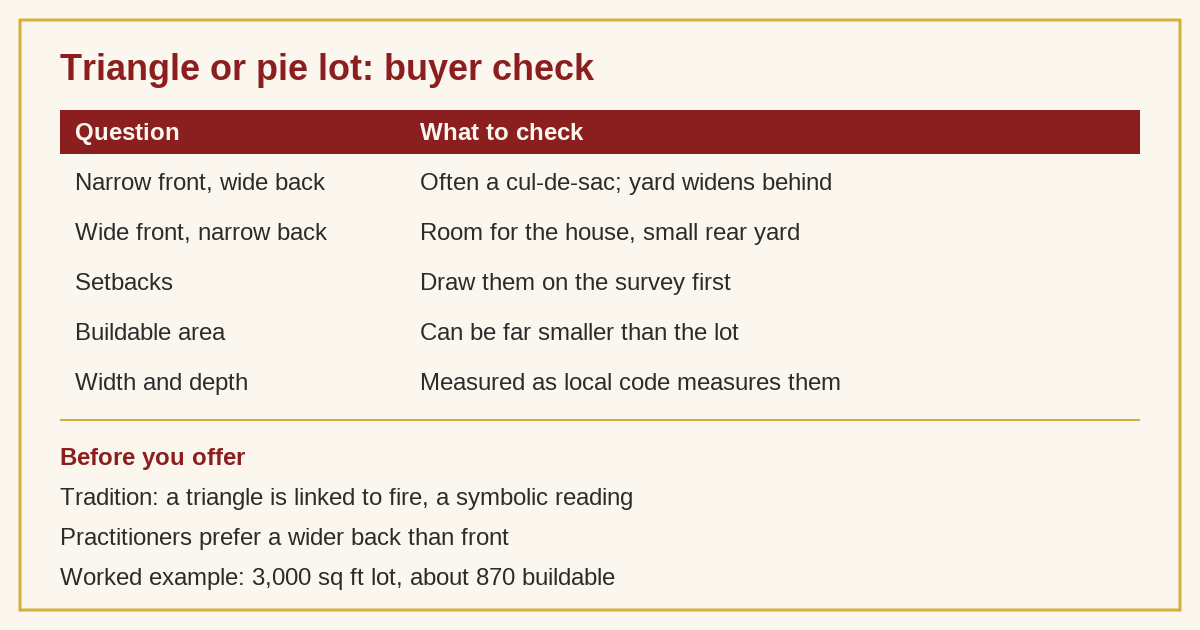
A triangle or pie-shaped lot is not a doom sign in the tradition, and it is not an automatic problem for a buyer either. What matters is which end is wide, where the setbacks fall, and how much land the house can actually use. Practitioners usually prefer a wider back than front; the survey decides the rest.
Planning rules checked: 23 November 2026
Our lot shape analysis covers every outline and how to read a boundary. Triangles and wedges get a closer look here, and the rest of the buying process is in our real estate and home buying guides.
| Point | Rule or figure | Source |
|---|---|---|
| Lot width on irregular lots (Menlo Park, CA) | The shortest distance between the side lines, between the required front and rear setback lines | City of Menlo Park |
| Lot depth on irregular lots (Menlo Park, CA) | Average of eleven evenly spaced measurements between the front and rear lines | City of Menlo Park |
| Orientation | Planners may need to confirm the front, rear and sides of an irregular lot | City of Menlo Park |
| Accurate lot area | A boundary survey gives the most accurate lot area | City of Menlo Park |
| Worked example below | A 3,000 square foot right triangle with 10 foot setbacks leaves about 870 square feet to build in (assumed inputs) | Our calculation |
On this page
- What the tradition says
- Narrow front or wide front
- How planners measure an odd lot
- Worked example: buildable area after setbacks
- Where the house can sit
- Buyer checklist
- Four ways buyers misjudge a wedge lot
- FAQ
What the tradition says
In Five Elements imagery a triangle is linked to Fire: pointed, active and emphatic. Some practitioners warn that a triangular lot or house brings sharp energy and prefer to soften the point with planting. It is a symbolic reading. Our lot shape analysis explains why it is no forecast of money, arguments or health.
More useful to a buyer is the Form School preference for a lot that is wider behind the house than in front. Practitioners describe that shape as holding or gathering, and a lot that narrows away behind the house as leaking. Teachers differ on how strictly to apply this. None of them would put it ahead of the survey.
Advertisement
Narrow front or wide front
Narrow at the street, wide at the back. This is common on cul-de-sacs, where lots fan out like slices of a pie. The street edge is short, so the house is often close to the road, and the back yard opens out. Practitioners usually favour this shape, and many buyers like the larger private yard. Check that the narrow front leaves room for a driveway, a garage and a safe sight line.
Wide at the street, narrow at the back. The house has room along the frontage, but the rear yard tapers to a point. Practitioners prefer the other shape, and buyers often find the tapering yard hard to use. Check the rear setback and what, if anything, can be built at the narrow end.
Long right triangle on a corner. The point may fall at the corner of two streets. Our corner lot, cul-de-sac and slope guide covers traffic and sight-line issues for those sites.
How planners measure an odd lot
Zoning rules usually set a minimum lot width, depth and setbacks, and they have to define how to measure them on a lot with no parallel sides. The City of Menlo Park gives one clear example. It measures width as the shortest distance between the side lot lines, between the front and rear setback lines, so the figure comes from the narrowest point once the setbacks are drawn. It measures depth as an average: divide the front and rear lines into eleven equally spaced points, connect them, measure each distance and average the results. For irregular lots it advises asking the planning division to confirm the front, rear and sides, and it notes that a boundary survey gives the most accurate lot area.
Your city will have its own method. Either way, a quoted lot size such as "3,000 square feet" does not tell you how much of it the house may occupy.
Worked example: buildable area after setbacks
The inputs are assumed for illustration and do not come from any city's code:
- A right-triangle lot with straight sides of 100 feet and 60 feet, the long side (hypotenuse) about 116.6 feet.
- Lot area: 100 x 60 / 2 = 3,000 square feet.
- A setback of 10 feet from every lot line.
Setbacks shrink a triangle toward its centre. The largest circle that fits in this triangle has a radius of about 21.7 feet (the sum of the two straight sides minus the long side, divided by two). Pulling every edge in by 10 feet leaves a smaller, similar triangle scaled by (21.7 - 10) / 21.7, about 0.54. Area scales by the square of that, about 0.29, so the buildable footprint is about 870 square feet, or 29 percent of the lot.
With a 5 foot setback the same lot leaves about 1,780 square feet, or 59 percent. Five feet of setback is the gap between a small cottage footprint and a family house. Read the setbacks before you fall for a big yard or a low price.
The calculation assumes straight sides and equal setbacks. Real codes set different distances for the front, rear and sides, so have a surveyor or planner draw your actual envelope.
Where the house can sit
Practitioners suggest placing the house toward the wide end, so the point of the triangle is yard rather than rooms, and using planting or a fence to round off a sharp corner. The practical advice agrees, since a house on the wide end tends to leave a more usable yard. Ask what the zoning allows beyond the main house, such as a garage, an addition or a shed, because the tight envelope applies to those too.
If the house itself has an irregular footprint, see bagua maps for L-shaped and irregular floor plans.
Buyer checklist
- Get a recent boundary survey and read the lot lines, not an aerial photo.
- Ask the planning office for the setbacks and how they measure width and depth.
- Draw the setbacks on the survey and note the buildable area left.
- Check where the driveway enters, and the sight line at the street.
- Find any easements or utility corridors. They cut the buildable area further.
- Ask what additions or outbuildings the rules allow before you pay for the yard.
- Compare the price per buildable square foot, not per lot square foot.
Four ways buyers misjudge a wedge lot
- Treating lot area as usable area.
- Paying for a big back yard that tapers to a point where nothing can go.
- Assuming a neighbour's fence marks the real boundary.
- Letting a Fire element warning, rather than the survey, decide the purchase.
FAQ
Is a triangle lot bad feng shui?
No rule says so. Some practitioners link triangles to Fire and advise softening the point with planting, but this is a symbolic reading. Most teachers care more about whether the lot is wider behind the house than in front and whether the land is usable. Read the survey before the symbolism.
Is a pie-shaped lot good for a house?
It can be. Pie-shaped lots on cul-de-sacs often have a narrow front and a wide back, which practitioners usually prefer and many buyers like for the private yard. The limit is the narrow front: check the driveway, the setbacks and the buildable area.
How do I know how much I can build on an irregular lot?
Ask the local planning office for the setbacks and the way it measures width and depth, then have a surveyor draw the buildable envelope. Menlo Park, California, for example, measures depth by averaging eleven measurements, so a quick estimate from lot area will not match.
Does a triangular lot lower the price?
We have no neutral study that sets a discount, so we give none. What moves the price is usually how much of the lot can be built on and how usable the tapering yard is. Compare price per buildable square foot against recent sales of similar wedge lots.
Before you make an offer
Order the survey and ask the planning office for the setbacks, then work out the buildable area the way the worked example does. Our feng shui home buying checklist covers the rest of the walk-through.
Sources
Checked November 2026.
We did not consult a neutral study of resale values on irregular lots, so we give no resale figure. The Menlo Park rules are one city's method, and the worked example uses assumed setbacks, not a real code.
Editorial note: Lucky Properties presents feng shui as a cultural and design tradition. This guide is educational. Confirm setbacks and buildable area with your local planning office and a licensed surveyor.