Practitioners say a tree should not stand in line with the front door, should not touch the house, and that tall trees at the back of the lot give the house support. Red Lotus Letter also says to remove a dead tree. None of this settles whether you may cut it, and that part is your city's call.
Last checked: 26 November 2026
| Key fact | What it says | Source |
|---|---|---|
| Tree in front of the door | "Trees must not be planted in front of the door"; a gazing ball or mirror is the stated fix when removal is not possible | Red Lotus Letter, 12 Feng Shui Tips for Trees |
| Trees at the back | Tall trees behind the house act as "mountain support"; a row of five is suggested where it is missing | Red Lotus Letter |
| Trees touching the house | Any tree touching the house is said to add negative yin; keep limbs off and leave space | Red Lotus Letter |
| The doorway test | Stand inside the main door and look out; a trunk aimed straight at the door is read as a "knife" | Cecil Lee, Geomancy.Net forum |
| Removal | Weigh the surroundings, the view, how dark the frontage gets and birds, before cutting | Cecil Lee, Geomancy.Net forum |
| Planting distance from walls | Small trees 8 to 10 ft, medium 15 ft, large 20 ft | Mississippi State University Extension, P4026 |
| Distance from power lines | Medium trees at least 20 ft, large trees at least 50 ft | Mississippi State University Extension, P4026 |
| Example city permit rule | Toronto: permit needed to remove or injure a private tree 30 cm or more in diameter at 1.4 m; not needed for a tree that is 100% dead | City of Toronto, When to Apply for a Tree or Ravine Permit |
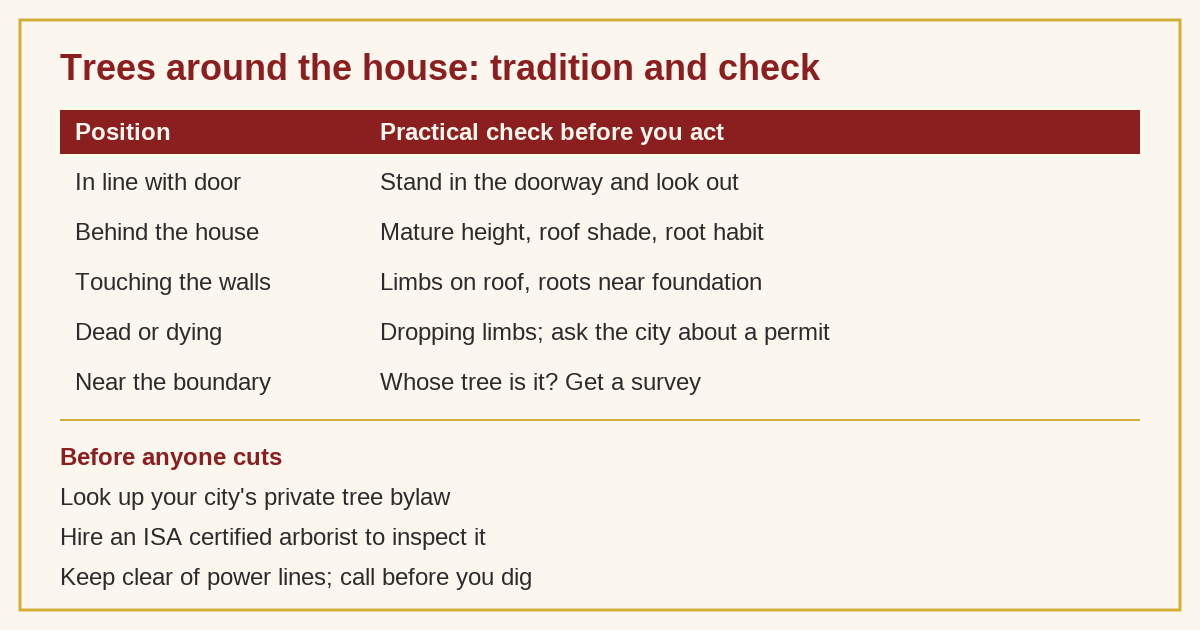
A tree also has roots, weight and sometimes legal protection, so each position below comes with the practical check. Other outdoor and building projects are in the renovate and build guides.
On this page
- The doorway test for a tree in front of the house
- Tree positions, the tradition and the practical check
- Trees behind the house
- Before you cut: what practitioners weigh
- Permits, arborists and utility lines
- Planting a new tree
- Questions about trees and the house
- Sources
The doorway test for a tree in front of the house
Cecil Lee, a moderator on the Geomancy.Net forum, gives a simple test. Stand inside the main door and look out. If a trunk points straight at the door, he reads it as a blade aimed at the "mouth of the house". If the trunk misses the door, there is little to read. He applies the same test to a window, and says a trunk pointing at a balcony window counts too.
He is careful on two points. Left and right of the line make no difference, and one such feature is rarely the only cause of a household's troubles. A trunk that is small or far away is a minor matter, but one that is still growing can become the main one. To judge it fairly, photograph it from exactly in line with the door, since a bad angle makes a harmless trunk look like it is aimed at you.
Red Lotus Letter is blunter: no tree in front of the door at all, because it is said to block opportunity. That is a stricter view, and a tree that stands beside the path rather than on its line would pass Lee's test. Which reading to follow is your choice. Neither one is a measurement.
Advertisement
Tree positions, the tradition and the practical check
| Position | What practitioners say | The practical check |
|---|---|---|
| Trunk in line with the front door | Read as a threat aimed at the entrance (Geomancy.Net); said to block opportunity (Red Lotus Letter) | Do the doorway test, then see whether the path or the drive could shift instead of the tree. See the driveway and front path guide |
| Tall trees at the back | Said to give support behind the house, like a hill (Red Lotus Letter) | Check mature height, shade on the roof and what falls on the roof in a storm |
| Tree touching the house | Said to add negative yin; keep limbs off the house (Red Lotus Letter) | Limbs on the roof and roots near the foundation are the real concerns. An arborist can say whether pruning is enough |
| Tree in the centre of the lot | Avoided by Red Lotus Letter, which links it to money trouble | Look at what sits under it: drains, septic fields, buried lines |
| Dead or dying tree | Red Lotus Letter says to remove it | Dead limbs can drop. Ask the city whether a dead tree still needs a permit |
| Trees along the side boundary | Red Lotus Letter suggests trees on both sides of the house | Check the property line first; a boundary tree can be shared or owned by a neighbour. The fence and gate guide covers surveys and lines |
Lot shape changes the picture. On an irregular lot, the sides and back may be where the planting goes, and our lot shape analysis covers which shapes practitioners read as missing a corner.
Trees behind the house
The back of the house is where practitioners want mass. Red Lotus Letter calls tall trees there "mountain support", and recommends a row of five across the rear when a lot has nothing there. It also names bamboo as a backing. It gives no species list and no spacing, so treat the number five as a tradition, not a rule.
Backing has a cost the tradition does not mention. A tall tree behind the house can shade the roof, drop branches on it, and send roots toward the foundation. Mississippi State University Extension's rule of thumb is that roots spread at least 1.5 times the width of the crown, and it puts large trees (40 feet and up) at least 20 feet from walls. Pick the species by its mature height and root habit, and ask a local nursery or certified arborist how it grows in your soil and climate.
Before you cut: what practitioners weigh
The Geomancy.Net moderator was asked about a row of pine trees blocking a view. He did not say cut or keep. He listed four things to weigh: external threats near the lot (a T-junction or road), whether the view makes the household feel better, whether the trees make the frontage too dark for the open space in front of the house that practitioners call the Ming Tang, and whether the trees draw birds and animals, which he counts as a quiet advantage. He suggested replacing a removed tree with other planting. Asked about a palm that faced a door, he said the simplest answer was to make it disappear.
Red Lotus Letter is firmer about dead trees. It says remove them, and names a corner-by-corner list of whom a dead tree harms. That list is tradition, and you should read it as such. The better reason to remove a dead tree is that it can drop limbs.
Permits, arborists and utility lines
The feng shui reading does not decide any of this part. These are the checks that do.
- The tree bylaw. Many cities protect larger trees on private land. Toronto's Tree Protection By-law is a typical example: removing or injuring a private tree 30 cm or more in diameter, measured 1.4 m (4.5 feet) above the ground, needs a permit. A tree that is 100% dead is exempt there, but one in poor condition is not. Other cities set different sizes and species lists, so search your city's name with "private tree bylaw" or "tree protection", or call its forestry or planning office before anyone cuts.
- A certified arborist. Mississippi State University Extension points readers to an International Society of Arboriculture (ISA) certified arborist. A good one will inspect the tree, say whether it is dying or just thin, and tell you whether pruning would do instead of removal.
- Utility lines. Do not cut or climb near power lines yourself; call the utility about any tree touching its lines. Before digging to plant or to remove a stump, the fence and gate guide explains the 811 call-before-you-dig step in the US.
- Roots and the foundation. If you think roots are damaging the foundation, bring in the arborist and a structural or foundation professional together. Cutting a large root can destabilize a tree.
- Your property line. A tree on the boundary may belong to you and the neighbour. Get a survey before agreeing to any work.
Our renovation do's and don'ts covers the rest of a project where a tree comes down as part of the build.
Planting a new tree
Plant for the mature tree, not the sapling in the pot. Mississippi State University Extension sorts trees by mature height (small under 25 feet, medium 25 to 40, large over 40) and gives these minimum distances:
| Mature size | From walls and other trees | From power lines |
|---|---|---|
| Small, under 25 ft | 8 to 10 ft | Not given; Illinois Extension suggests under 15 ft mature height near lines |
| Medium, 25 to 40 ft | 15 ft | 20 ft |
| Large, over 40 ft | 20 ft | 50 ft |
Illinois Extension adds that a tree that could reach 25 feet or more should never go near a power line, and that nothing should be planted over or near buried utility lines. In the US, call 811 for a locate before you dig. If you follow the doorway test, also keep the trunk off the line from the front door. A tree planted at the back for support should still be a species that will not outgrow the roof. Your local extension office can tell you which species fit those sizes in your climate.
Advertisement
Questions about trees and the house
Is a tree in front of the house bad feng shui?
Practitioners disagree on how bad. One widely read site says trees must not be planted in front of the door because they block opportunity. A Geomancy.Net moderator says a trunk pointing straight at the door is a threat only when you check it from the doorway, and that one such feature rarely explains problems alone. A tree off to the side of the path is not treated the same way.
Should I cut down a tree because of feng shui?
Not on feng shui grounds alone. Red Lotus Letter wants dead trees removed, and one Geomancy.Net moderator weighs the view, how dark the frontage becomes and the wider surroundings first. The practical questions come first: whether your city protects the tree, whether it is near power lines, and whether a certified arborist should do the work.
What can I do if I cannot remove a tree in front of the door?
Practitioners suggest deflecting rather than removing: a gazing ball or mirror (Red Lotus Letter) or a convex mirror (Geomancy.Net). Moving the path so it does not run straight at the trunk, or planting a low screen, are physical alternatives. Mirrors are a tradition, not a safety measure, and a tree that is damaging the foundation still needs an arborist.
What trees do practitioners suggest behind a house?
Red Lotus Letter treats tall trees at the back as the "mountain support" behind the house and suggests a row of five across the back where support is missing, or bamboo. It names no species list beyond that. Choose a species by its mature height and root habit for your climate, and ask a local nursery or arborist.
Do I need a permit to cut down a tree on my own property?
Often yes. Toronto, for example, needs a permit to remove or injure a private tree 30 cm or more across, measured 1.4 m above the ground, and still needs one for a tree in poor condition. Rules differ by city, trunk size and species, so check the tree bylaw of your own municipality or call its forestry office before any cutting.
Can a tree be too close to the house?
Red Lotus Letter says a tree should not touch the house. Mississippi State University Extension gives a practical spacing: small trees at least 8 to 10 feet from walls, medium trees 15 feet and large trees 20 feet. For a tree already in place, ask an ISA certified arborist to look at it.
Sources
Each page was opened on 26 November 2026.
- Red Lotus Letter, "12 Feng Shui Tips for Trees", redlotusletter.com/feng-shui-trees/, checked 26 November 2026.
- Geomancy.Net forum, "Is a tree in front of my house a problem? Can I do anything? Help!", replies by moderator Cecil Lee, geomancy.net/forums/topic/10042, checked 26 November 2026.
- City of Toronto, "When to Apply for a Tree or Ravine Permit" (updated 29 January 2026), toronto.ca, checked 26 November 2026.
- Mississippi State University Extension, "Yard Tree Placement and Risk Assessment", publication P4026 (08-24), extension.msstate.edu, checked 26 November 2026.
- University of Illinois Extension, "Tree Planting Safety", extension.illinois.edu, checked 26 November 2026.