A feng shui fence is usually kept lower than the front door and house, fairly open at the front, with the gate on the path to the entrance and no wider than the entrance it serves. Before any of that, your city's fence height, corner visibility and permit rules decide what you may build. This guide covers both. It is part of our renovate and build with feng shui guide.
Last checked: 17 November 2026
| Key fact | Figure or rule | Source |
|---|---|---|
| Front yard fence, Fremont CA | 48 inches (4 feet) maximum for fences and hedges | Fremont Municipal Code 18.171 |
| Rear and side yard fence, Fremont CA | 8 feet maximum | Fremont Municipal Code 18.171 |
| Corner sight triangle, Fremont CA | Nothing over 30 inches above the curb inside a triangle with 20-foot legs | Fremont Municipal Code 18.171 |
| Front yard fence, Toronto | 1.2 m within 2.4 m of the street lot line, 2.0 m beyond that | Toronto Municipal Code ch. 447 |
| Fence near a driveway, Toronto | Open construction for at least 2.4 m from the lot line so the view stays clear | Toronto Municipal Code ch. 447 |
| Fence permit, Seattle | None for 8 feet or lower without masonry over 6 feet, unless flood-prone | Seattle SDCI |
| Digging | Call 811 first; free; state laws require 48 to 72 hours notice | U.S. PHMSA |
On this page
- What the tradition says about fences
- Gate position and width
- Fence and gate color by direction
- What your city decides first
- Property line, 811, HOA and pools
- Decision table
- Worked example: a corner lot front fence
- Questions to ask before you hire a fence builder
- Common mistakes
- FAQ
- Where to go next
- Sources
Our garden gate, path, fence and tree guide covers the garden as a whole. This page is the build-and-buy companion: what to ask for, what the law allows, and what to check before a post hole is dug.
What the tradition says about fences
In the Form School, which reads the land and the shapes around a house, a fence is a boundary that should protect without trapping. Practitioners commonly give these guidelines. They are tradition, not tested fact, and none of them promises money, health or luck.
- Front fence lower than the door. A front fence that rises above the entrance is said to press on the house and hide it from the street. Practitioners keep it below the door and the main wall, so the front door stays visible and welcoming.
- More open at the front, more solid at the back. Open pickets or slats at the front let the entrance be seen. A taller, solid fence at the back or sides is described as support and shelter, in the spirit of the "armchair" shape many teachers recommend.
- Pointed pickets. Sharp points aimed at the door or at a neighbour are called "cutting" shapes. Many practitioners choose rounded or flat tops where points would face the entrance.
- Fence in good repair. Leaning, broken or half-finished fences are read as neglect at the edge of the property. This is also a plain maintenance point.
- Continuous, clear line. A boundary with a large gap at a corner is said to leak. Schools differ on how seriously to take this.
Schools differ on all of these. Compass-based teachers add direction rules, covered below. If the tradition and your city's rules clash, the law wins.
Gate position and width
- Gate on the path to the door. Practitioners usually want the gate to lead onto the walkway so the route from street to door reads as one clear line, not a detour around the yard.
- Gate not wider than the entrance. A gate far wider than the house entrance is described as "gathering" more than the door can hold. A gate about as wide as the walkway is a common recommendation.
- Gate facing the front door. A gate lined up straight with the front door at the end of a long straight path is called a fast channel by some practitioners, who suggest a gentle curve, a planter or a shift of the gate to one side. Others see a direct welcome as fine. See our front door replacement guide if you are moving the door itself.
- Gate that works. A gate that sticks, squeaks or will not latch is called a poor welcome in the tradition, and it is also a safety problem.
Practical limits come first: the gate must sit where your driveway, utilities, and the property line allow it.
Advertisement
Fence and gate color by direction
Teachers who use the five elements often assign colors by the side the fence faces. This is the same table this site uses elsewhere, and it is a style guide, not a rule.
| Side the fence faces | Element in tradition | Colors usually named |
|---|---|---|
| East, southeast | Wood | Green, teal, natural wood tones |
| South | Fire | Red, warm terracotta (often as a gate accent only) |
| Southwest, northeast, center | Earth | Sand, clay, warm neutrals |
| West, northwest | Metal | White, grey, metallic finishes |
| North | Water | Deep blue, black, charcoal |
Many people search for a "lucky color for a fence and gate." The tradition has no single lucky color, only this direction logic. Our front door colors by direction guide uses the same table for doors, and the gate often looks best echoing the door. Check HOA rules before choosing, as many limit fence colors or require stain.
What your city decides first
Fence height, style and permit rules are local. A few examples show how much they vary. Read your own city's code or ask its planning department.
- Fremont, California limits fences and hedges in the front yard to 48 inches and fences in rear and side yards to 8 feet. A building permit is required for fences over 7 feet, masonry or concrete walls over 4 feet and retaining walls of any height.
- Toronto, Ontario limits a residential front yard fence to 1.2 metres within 2.4 metres of the street lot line and 2.0 metres beyond that. Heights are measured from average grade, and hedges that act as fences follow the same limits. Toronto's chapter 447 text does not say a permit is needed for an ordinary fence, but a swimming pool enclosure needs one.
- Seattle, Washington allows fences up to 6 feet in neighborhood residential zones, plus up to 2 feet for features like trellises, with no construction permit for a fence of 8 feet or lower (without masonry or concrete over 6 feet) outside flood-prone areas. The Seattle page does not give a separate front yard limit or a corner rule, so check the Land Use Code or ask the city.
Corner lots add a visibility rule. Many cities, including Fremont, define a sight triangle at the corner: nothing taller than a set height may stand inside it, so drivers and pedestrians can see each other. In Fremont the limit is 30 inches above the curb inside a triangle bounded by the street lot lines and a line joining them 20 feet from the intersection. Other cities use different sizes and heights.
Toronto does not use a named triangle in this chapter. It requires open construction near driveways instead, so the view of the street stays clear. Rules differ by city and country, so confirm yours with your building department.
Property line, 811, HOA and pools
Know where your line is. Do not trust a fence line, hedge or old stakes. Fences go wrong most often at the boundary. A land survey by a licensed surveyor, or your lot's recorded plan, shows the legal line. Many cities also require fences to sit inside your line, or ask for a neighbour's agreement when a fence sits on it. For shared walls and neighbour boundaries in attached homes, see our semi-detached and townhouse neighbour boundary guide.
Call 811 before digging (United States). The U.S. Pipeline and Hazardous Materials Safety Administration says to dial 811 to reach the one-call center wherever you are digging, that the call is free, that homeowners and professionals both must call, and that every digging project needs one, even planting a tree or shrub. It also says state laws require calling 48 to 72 hours before you dig, and you wait for lines to be marked. Fence post holes are digging. In Canada, call or click before you dig through your province's one-call service. Canada's rules and numbers differ.
HOA and covenants. A homeowners association or deed covenant can restrict height, material, color and gate style beyond the city's rules. Ask for the written rules and any approval form before you order materials. A city permit does not override an HOA.
Pool fences. A fence or gate that doubles as a pool barrier has separate safety rules about height, latches and gaps, and some cities require a permit for it (Toronto does for pool enclosures). Do not use a decorative fence design for that job. Read our swimming pool and hot tub placement guide and your local pool barrier code.
Decision table
| Question | Tradition says | Practical check | Who decides |
|---|---|---|---|
| How tall at the front? | Lower than the door and house | City front yard limit (48 in Fremont, 1.2 m near the street in Toronto) | City code, HOA |
| Open or solid? | Open at the front, solid at the back | Corner sight triangle, driveway visibility | City code |
| Pointed pickets? | Avoid points aimed at the door or neighbours | Local rules on sharp or barbed tops | City code, HOA |
| Where does the gate go? | On the path to the door, about as wide as the entrance | Property line, utilities, driveway, 811 | Survey, utilities |
| What color? | By direction and element | HOA color rules | HOA |
| Is a permit needed? | Not addressed | Depends on height and material (Fremont over 7 ft; Seattle over 8 ft) | Building department |
| Pool barrier? | Not addressed | Separate pool barrier code | Building department |
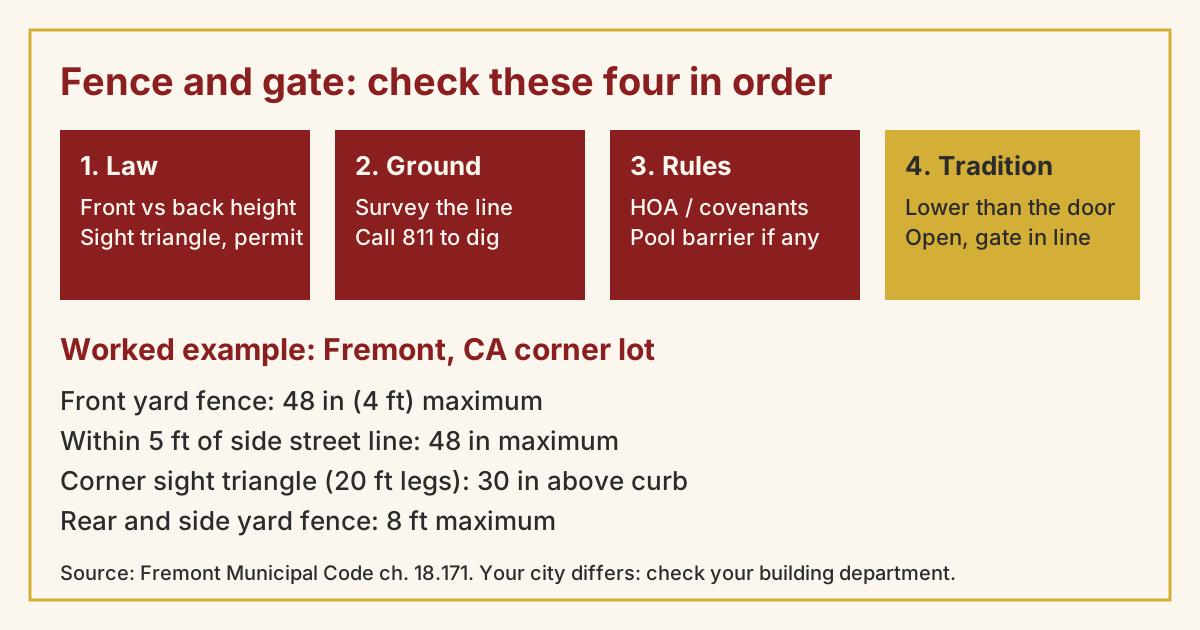
Worked example: a corner lot front fence
Inputs (illustrative, not a real lot; Fremont, California rules as the example city): a corner lot, the front door facing the main street, the side yard facing the side street. The owner wants a front fence that feels welcoming and a taller fence along the side street for privacy.
- Front yard fence along the main street. The Fremont limit is 48 inches. A tradition-minded choice is open pickets at about 36 to 42 inches, below the door and well under the limit. The 36 to 42 inches figure is our design suggestion, not a code number.
- Along the side street. On a corner lot, fences and hedges over 48 inches are not allowed within 5 feet of the side street lot line. A privacy fence at the side street must stay 5 feet or more back from that line if it is taller than 48 inches, up to the 8-foot rear and side yard limit where those rules apply.
- Corner sight triangle. Mark 20 feet along each street lot line from the intersection, and join the two points. Inside that triangle nothing, including fence, hedge or planter, may rise above 30 inches above the top of the curb. The low corner section is also a "gap" at the corner, which some practitioners dislike, so a low planter at 30 inches or under can finish the line.
- Gate. Put the gate on the walkway to the front door, away from the sight triangle.
- Before building. Confirm the legal line with a survey, call 811, check the HOA, and ask Fremont's planning division whether the plan needs approval.
If this were Toronto, the numbers change: 1.2 metres within 2.4 metres of the street, open construction near the driveway, and no named triangle in chapter 447. The method is the same: find the limit, then fit the tradition inside it.
Advertisement
Questions to ask before you hire a fence builder
- Who pulls the permit, if one is needed, and who pays any fee?
- Has the legal line been surveyed, and will the fence sit inside it?
- Who calls 811, and when, so the lines are marked before digging?
- What is the finished height, measured the way the city measures it (Toronto uses average grade)?
- Does the design respect any corner sight triangle and driveway visibility rule?
- Does the HOA need to approve the plan, color and gate in writing?
- Is the gate hardware rated for the gate's weight, and does the gate latch?
Common mistakes
- Building to the tradition before checking the law. A lovely 6-foot solid front fence may be illegal where the limit is 4 feet.
- Ignoring the corner. A sight triangle violation can be a safety issue and can force the fence's removal.
- Trusting the old fence as the property line. Survey first.
- Skipping 811 for "just a few posts." The PHMSA page says every digging project needs the call.
- Using a decorative fence as a pool barrier. Pool barriers have their own code.
- Copying a neighbour's fence height. Their fence may predate the current rules.
FAQ
How high should a feng shui front fence be?
Practitioners generally say a front fence should stay lower than the front door and the main body of the house, so it frames the entrance without closing it in. The tradition gives no single number, and your city sets the legal limit. Fremont, California, for example, caps front yard fences at 48 inches, and Toronto at 1.2 metres within 2.4 metres of the street.
Where should the gate go in a feng shui fence?
Most practitioners place the gate on the path to the front door so the route into the home reads as one clear line, and prefer a gate that is not wider than the entrance it leads to. Many schools avoid a gate that lines up exactly with the door across a long straight run. Check the property line and utilities before moving a gate.
What color should a fence or gate be in feng shui?
Schools that use the five elements often match color to the direction the fence faces: green or teal for wood in the east and southeast, red for fire in the south, earth tones in the center and corners, white or grey for metal in the west and northwest, and dark blue or black for water in the north. Treat it as a design choice, not a promise of luck, and follow any HOA color rules.
Do I need a permit to build a front fence?
It depends on the city. Fremont requires a building permit for fences over 7 feet, masonry walls over 4 feet and retaining walls of any height. Seattle needs none for a fence of 8 feet or lower without masonry over 6 feet, outside flood-prone areas. Ask your local building or planning department before you order materials.
Do I have to call 811 before putting in fence posts?
Yes in the United States. The U.S. Pipeline and Hazardous Materials Safety Administration says every digging project needs a call to 811, including planting trees and shrubs, that the call is free, and that state laws require calling 48 to 72 hours before digging. Fence post holes count as digging.
Where to go next
If your lot is on a corner, read our corner lot, cul-de-sac and slope field guide next: it covers how street position changes the layout of the whole property, which decides where a fence and gate make sense. Back to the renovation hub for the rest of the series.
Sources
Checked November 2026.
- Fremont Municipal Code, Chapter 18.171, Fences and Hedges: front yard 48 inches, rear and side 8 feet, corner rules, sight triangle (30 inches, 20-foot legs), permit thresholds.
- Toronto Municipal Code Chapter 447, Fences: height table (1.2 m and 2.0 m), driveway open-fence rule, measurement from average grade, pool enclosure permit.
- Seattle Department of Construction and Inspections, Fences: 6 feet plus 2 feet for architectural features, permit threshold of 8 feet.
- U.S. PHMSA, Call Before You Dig (811): free call, homeowners included, 48 to 72 hours.
- Sources we wanted but could not open today: Seattle's Land Use Code text on front yard and corner lot limits. No Seattle front yard or sight triangle figure is stated here.
- The tradition (front fence lower than the door, open front, gate position, pointed pickets) comes from common Form School and five-element teaching and has no single published standard. Practitioners differ.
Editorial note: Lucky Properties presents feng shui as a cultural and design tradition. This guide is educational. Fence heights, sight lines and property lines are local matters: check with your city, any HOA and a survey before you build.