Feng shui reads a south facing house as having a Fire-direction front (the Li side). In Eight Mansions, though, it is a Kan house, because that system names a house by the direction its back sits in. What it means day to day depends on your hemisphere. North of the equator the front gets the winter sun; south of it, the front is the cooler, shadier side.
Last checked: 23 November 2026
Our overview of north, south, east and west facing houses compares all four directions. Here we stay with south, which Period 9 (from 2024) has made the most talked-about of them, and we keep what the tradition says apart from what you can check. More buying guides are in real estate and home buying.
| South at a glance | Figure or rule | Source |
|---|---|---|
| South sub-directions | S1 Bing 157.5 to 172.5 degrees, S2 Wu 172.5 to 187.5, S3 Ding 187.5 to 202.5 | Feng Shui Unzip |
| Eight Mansions type | A house is named by the direction it sits; a south facing house sits north, so it is a Kan house in the East Group | Feng Shui Nexus |
| Period 9 | Associated with Fire, the Li trigram and the South; that source gives 2024 to 2043 | Wikipedia (Flying Star Feng Shui) |
| Solar windows, northern hemisphere | Should face within 30 degrees of true south and stay unshaded from 9 a.m. to 3 p.m. in the heating season | U.S. Department of Energy |
| Overhang effect | A properly sized overhang gives full shade in summer and full sun in winter (shown at 36 degrees north) | Pacific Northwest National Laboratory |
| Oversized south glass | Avoid oversizing south facing glass; shade it to prevent overheating and higher cooling loads | U.S. Department of Energy |
On this page
- What south facing means on a listing
- Light and heat by season
- The three south sub-directions
- Eight Mansions and Period 9 in plain terms
- Rooms, garden and entry
- Viewing scorecard and worked example
- Resale and price
- Where south fronts trip buyers up
- FAQ
- If your reading is off due south
- Sources
What south facing means on a listing
A south facing house has its front, the side that looks out to the street, toward the south. Take the bearing from the front step looking out. If the door is on a side wall, write its direction down separately; our guide to house facing versus front door direction explains why the two differ. The back of the house faces north.
Solar designers in the northern hemisphere want the main glass on exactly this side. South of the equator the midday sun is in the north, so a south facing front is the shaded side and the sun falls on the rear garden.
Light and heat by season
| Season | Northern hemisphere (for example the US and Canada) | Southern hemisphere (for example Australia) |
|---|---|---|
| Winter | The low sun reaches the front rooms all day, which is free heat if nothing shades the glass | Front rooms get little direct sun; the rear (north) side is the warm one |
| Summer | An overhang blocks the high sun easily, but bare, unshaded glass can overheat | The front stays cool and the rear needs shading |
| Best use | Living rooms toward the front, if the street is quiet and private enough | Living areas toward the rear |
The Department of Energy advises that solar collecting windows face within 30 degrees of true south and stay clear of shade from buildings or trees from 9 a.m. to 3 p.m. in the heating season. It also warns against oversizing south glass, since modern homes need little heating, and says roof overhangs can shade vertical south windows in summer. The Pacific Northwest National Laboratory shows the effect: at 36 degrees north an overhang gives full shade in summer and full sun in winter. So look up at the viewing. Is there an eave, an awning or a deep porch roof over the big windows, or just bare glass?
South of the equator, YourHome puts the ideal living area orientation between 15 degrees west and 20 degrees east of true north. On tropical sites, it says, south facing windows need little shading. In a cold climate with a view to the south it advises against large areas of glass, to limit winter heat loss, and recommends double glazing and thermally broken frames.
Thinking of paying for new glass on the sunny side? Read our window replacement guide first.
Advertisement
The three south sub-directions
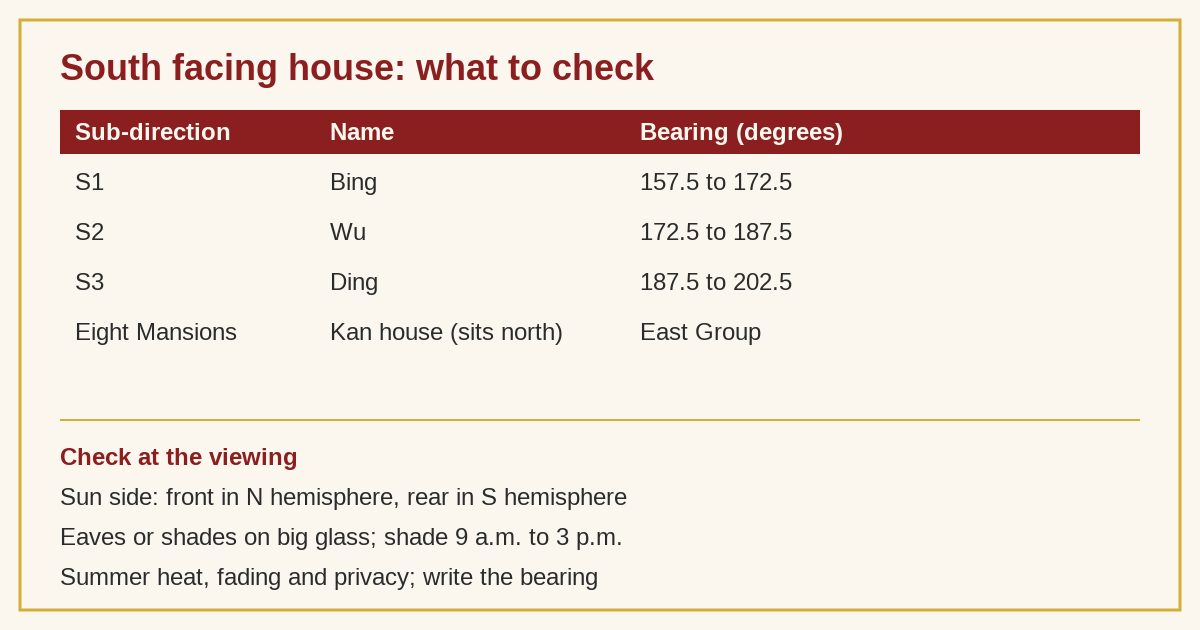
Compass School practitioners divide south into three 15-degree sub-directions, part of the 24 mountains.
| Sub-direction | Name | Degrees (compass bearing) |
|---|---|---|
| S1 | Bing | 157.5 to 172.5 |
| S2 | Wu | 172.5 to 187.5 |
| S3 | Ding | 187.5 to 202.5 |
When Period 9 articles praise south, they usually mean Wu, the mountain centred on 180 degrees. Bing and Ding are south too, and Flying Stars teachers chart each of them separately. A reading near 157.5 leans toward the southeast and one near 202.5 toward the southwest. Take those twice, standing clear of the garage door and any car, as the feng shui compass reading guide describes. For the solar checks above, convert to true south first, because magnetic and true bearings can differ by many degrees depending on where you live.
Eight Mansions and Period 9 in plain terms
Eight Mansions. The back of a south facing house points north, and Eight Mansions names a house by its back. That makes it a Kan house, not the Li house the word "south" suggests. Kan belongs to the East Group with Zhen, Xun and Li, which practitioners pair with people whose Kua number is 1, 3, 4 or 9; see the Kua number guide and the Eight Mansions house gua guide. Popular pages that name houses by their facing give the opposite type, so check which convention a source uses.
Period 9. South is the home direction of the current Flying Stars period. Period 9, the Fire and Li period, began in 2024 and runs to 2043 or 2044, depending on the source. Many teachers therefore give a south facing house, room or garden particular weight in this period. That reading comes from the tradition. We found no measured evidence linking a south facing front to better outcomes, and the chart itself depends on the exact degrees and on when the house was built or last renovated in a major way. See how the Flying Stars chart works and our Period 9 guide.
Rooms, garden and entry
The tradition links south with Fire and summer, and with red, orange and strong warm tones; see front door colors by direction. Practitioners often add that too much Fire feels harsh. In a south room they would rather use softer tones with some wood or earth elements than pile on red.
What a buyer can act on, in the northern hemisphere:
- The sun side gets the best daylight. Sit at a screen in that bedroom or home office on a summer afternoon and see what the glare does.
- Look closely at the glazing. Is it low-emissivity, is it fogged between the panes, and are blinds or shades already fitted?
- The south front garden is the warm one, good for plants that need sun. Check how much of it the neighbours can see.
- Gates, paths and trees at the front are covered in our garden gate, path and tree guide.
South of the equator, put bedrooms and quiet rooms on the south front, and expect the sun and the main garden at the rear.
Viewing scorecard and worked example
Give each line 0 (poor), 1 (acceptable) or 2 (good), and write down the time of your visit. The scores only mean something when you compare homes on your own shortlist.
| Check | What to look at | Score |
|---|---|---|
| Shading on big glass | Eaves, awnings, trees, blinds on the sun side windows | 0 to 2 |
| Winter shade from neighbours | Buildings or trees between the glass and the sun from 9 a.m. to 3 p.m. | 0 to 2 |
| Glass area | Is the sun side glass oversized for the room | 0 to 2 |
| Furnishings | Fading on floors, rugs and sofas near the glass | 0 to 2 |
| Privacy at the front | Sight lines into the south rooms from the street | 0 to 2 |
| Bearing | Written degrees from three readings, and the sub-direction | note only |
Worked example (hypothetical numbers). A buyer takes readings of 193, 195 and 197 degrees at a home listed as "south facing". The middle value, 195, falls in S3 Ding, the mountain beside southwest, not the Wu that Period 9 articles praise. The back reads 15 degrees (N3 Gui), so the house sits north and is a Kan house in the East Group. Corrected from magnetic to true south for the area, the front still sits well inside the Department of Energy's 30-degree tolerance for solar windows. If nothing shades it, the glass counts as south facing for passive solar purposes.
Resale and price
No direction is sold as a premium more often than south. A hedonic pricing study of south facing homes in Shanghai gets cited for it, but we have not verified that study, so we give no premium figure. If a seller or agent quotes one, ask where it came from, and ask for sold prices of similar north facing homes on the same street. Climate counts as well. In a hot area, buyers may see a big south front as a cooling bill rather than a gain.
Where south fronts trip buyers up
- Paying extra because a 2024 article calls south the Period 9 direction, without checking shade, glass and heat.
- Expecting a south front to be sunny in the southern hemisphere.
- Overlooking summer overheating in a south room with big, bare windows.
- Confusing facing with sitting. A south facing house is a Kan house, not a Li house.
- Calling one quick phone reading "Wu" without checking whether it is really Bing or Ding.
FAQ
Is a south facing house good in feng shui?
South is linked to Fire and, since 2024, to Period 9, so many teachers give it extra emphasis. That is tradition, not measured evidence. Practitioners still look at the exact bearing, the surroundings and the layout, and for a buyer the practical points are shade, glass and summer heat.
Is a south facing house sunny?
In the northern hemisphere, yes: the front gets the low winter sun, and the Department of Energy advises solar windows within 30 degrees of true south that are unshaded from 9 a.m. to 3 p.m. in the heating season. In the southern hemisphere the sun is to the north at midday, so a south facing front is the shaded side.
Can a south facing house be too hot?
Yes, when the glass is large and unshaded. The Department of Energy warns against oversizing south glass and says overhangs can shade vertical south windows in summer. At the viewing, check the eaves, awnings, blinds and glazing type.
What are the three sub-directions of south?
Bing (157.5 to 172.5 degrees), Wu (172.5 to 187.5) and Ding (187.5 to 202.5). Only Wu is centred on due south; Bing leans toward the southeast and Ding toward the southwest, and Flying Stars teachers chart each one separately.
Is a south facing house an East Group or West Group house?
East Group. Its back faces north, and Eight Mansions names a house by its back, so it is a Kan house, grouped with Zhen, Xun and Li.
Advertisement
If your reading is off due south
A bearing in Bing sends you to the southeast facing house guide, and one in Ding to the southwest facing house guide, because both edges change the sun and the chart. If you are weighing this home against one across the street, the north facing house guide covers the opposite case. Either way, go back on a sunny afternoon and fill in the shading and glass lines of the scorecard. Other buying checks are in the real estate and home buying guides.
Sources
Checked November 2026. Pages opened for this guide:
- 24 Mountains, Feng Shui Unzip: the Bing, Wu and Ding mountains that make up a south front, with their degree ranges.
- Eight Mansions house types, Feng Shui Nexus: why a south-facing house is the north-sitting Kan type, which the school places in the East Group.
- Flying Star Feng Shui, Wikipedia: the link between Period 9, the Fire element, the Li trigram and the south, which is why south fronts get so much attention in this period.
- Shading and Solar Control for Windows and Skylights, Pacific Northwest National Laboratory (Building America Solution Center): why south glass is the easiest orientation to shade with a fixed overhang.
- Passive Solar Homes, U.S. Department of Energy, Energy Saver (copy of the page hosted on cornwallvt.com): the passive solar test a south front meets most easily, glass within 30 degrees of true south left unshaded from 9 a.m. to 3 p.m. in winter.
- Orientation, YourHome (Australian Government): the southern hemisphere case, where a south front faces away from the sun and living areas belong on the north side (15 degrees west to 20 degrees east of true north).
Not verified for this guide: published studies of orientation and sale price, so no premium or discount for a south front is stated.
Editorial note: Feng shui is presented here as a cultural and design tradition, not a guarantee of any outcome. Confirm legal, financial and inspection questions with a licensed professional.