The short answer
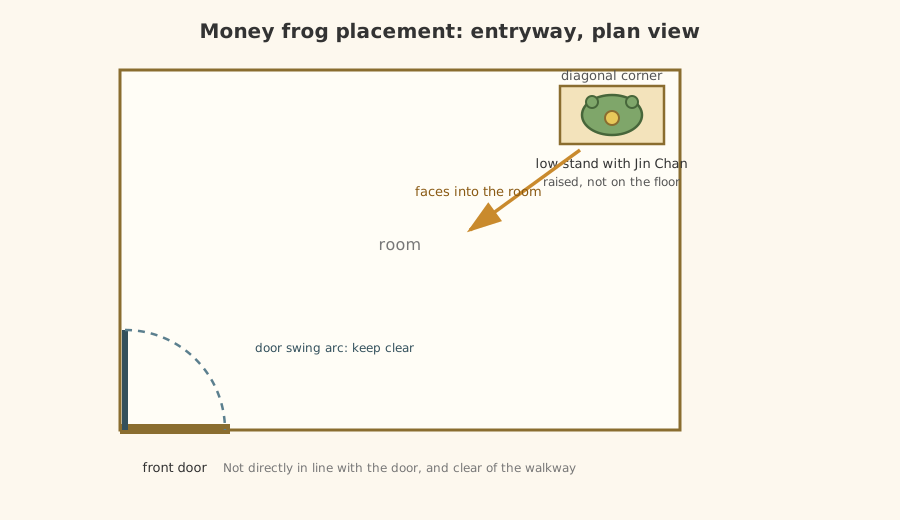
Place a Jin Chan, the three-legged money frog, just inside the entrance of a home, facing into the room, on a low stand in a corner diagonal to the door, with the spot kept clean and clear. That is the short form of most modern home guidance, and the rest of this guide is the longer form: where the figure comes from, why shops tell a different facing story from homes, which rooms tradition leaves it out of, and how to read a figure in a shop before money changes hands.
One framing note runs through everything below. The money frog is a folk symbol. Its stories are legend, its placement rules are custom, and its link to wealth is a claim of the tradition, reported here as tradition states it. A Jin Chan is a piece of cultural decoration with a long story behind it. It is not a financial tool, and no placement in this guide is a promise of income, luck, or any other result.
The first legend: Liu Hai and the toad in the well
The figure starts with a man and a well. Liu Hai, also written Liu Haichan, appears in the stories as a government minister who gave up office and became a Daoist immortal. Sources disagree on when he lived. Some place him in the Tang dynasty, others in the Five Dynasties period under Yan, and a careful telling says the stories differ rather than picking one date and hiding the disagreement.
In the legend, a golden toad lived in a deep well and would not come out. Liu Hai coaxed it up by dangling gold coins on a string or thread over the well. The toad bit the coins, and Liu Hai hauled it out of the well on the string. The scene became a fixed motif in Chinese art, usually named Liu Hai plays with the golden toad, and it is why carvings and paintings of Liu Hai show a smiling figure holding a string of cash coins, often with the toad at his feet or on his shoulder. Because the toad came to the coins, and because Liu Hai is invoked in folk practice for commercial success, the toad itself took on the role the figures now carry: a creature that arrives where money is, and brings a coin with it when it comes.
The three legs get two explanations inside the story tradition. In one telling, the toad lost a leg in the struggle at the well, and three legs is simply what it has had since. In other readings, nobody was injured, and the number is symbolic. Both versions circulate, and sellers who present either one as settled fact are going past what the stories support. The folk saying attached to the figure is shorter than either story: Jin Chan does not settle where there is no wealth (金蟾非财地不居). It is a saying, quoted here as one, and it explains why the figure is sold as a presence to invite rather than a charm against loss.
The second link: the toad and the moon
The toad is older than the money story, and its older home is the moon. In Chinese tradition the moon carries a toad alongside the better known rabbit, and Chang'e, the goddess who flew to the moon, has her home there in the Moon Palace. That palace has a second name: Chan Gong (蟾宫), the Toad Palace, chan being the same character as in Jin Chan.
The moon link left a phrase in the language. Chan Gong zhe gui (蟾宫折桂), plucking cassia in the Toad Palace, came to mean passing the imperial examinations, the old route to rank and salary. A toad figure therefore carried a second set of associations for much of its history, tied to study, examinations, and advancement, beside the commercial ones Liu Hai gave it. A related piece of folklore places the toad at the door: folk telling says the toad appears near the door of a house that is due good fortune around the full moon. That doorstep detail is one reason, inside the tradition, that the modern figure so often ends up near an entrance rather than in the middle of a room. The placement habit follows the story.
How to read a figure: the iconography
A Jin Chan figure is built from a short list of parts, and the list doubles as a buying check, because figures that drop parts are common at the cheap end of the market. Read a figure in this order.
| Feature | What it shows | What to check when buying |
|---|---|---|
| Three legs | The toad of the Liu Hai legend, in the form the stories settled on | Count them. Exactly three. A four-legged frog figure is a garden frog, not a Jin Chan |
| Coin in the mouth | The coin the toad bit at the well, carried in | Folk guidance puts the characters side up. On figures with a removable coin, check that the coin is present and fits |
| Seat of coins or ingots | The pile the toad sits on, cash coins or gold ingots (sycee) | Check the base is complete and the figure sits level, with no wobble |
| Seven star dots on the back | Read in tradition as the Big Dipper (北斗七星) | Present on many figures, absent on plainer ones. Treat it as a style point, not a quality grade |
| Red eyes | A regional tradition on some figures | Painted or inset. Check paint is finished cleanly if the style matters to you |
Two points in the table save confusion in shops. First, the seven dots are the Big Dipper in the tradition's reading, which is why they run across the back in a loose ladle pattern rather than a neat row. A figure with a random scatter of bumps is not automatically wrong, but a seller who cannot say what the dots are is guessing about the rest as well. Second, the coin. Some figures are cast with the coin fixed in the mouth. Others have a loose coin that slots in. The loose design is a manufacturing choice, and it explains the most common small complaint about these figures, which is that the coin falls out on a shelf or in transit. It means nothing in the tradition. Put it back, characters side up.
Advertisement
The facing question, answered properly
Ask a search engine which way a money frog should face and you will get two flat answers that contradict each other: face it into the room, and face it toward the door. Both answers exist because they come from different settings, and most short guides print one and hide the other. They are set out separately here.
The home rule. Most modern home guidance faces the toad into the home. The picture the tradition paints is of the toad just arrived: it has hopped in through the entrance carrying a coin, and it faces the room it has entered. Placed at the door facing outward, the same picture reads in reverse, as if the toad and its coin are on their way out. So the home figure sits near the entrance, facing in, set in a corner diagonal to the door rather than in the direct line of it.
The shop custom. Business guidance in the Black Sect tradition, the school founded by Lin Yun and often shortened to BTB, gives the shopkeeper a daily routine instead. Katherine Metz's published teaching sheet for this tradition describes turning the toad: by day it faces the door, read in the tradition as going out to gather, and at night it is turned to face into the shop, read as returning with coins. The figure by a shop counter that faces the street at noon and the till at closing time is not placed wrong. It is being worked through the day by a different custom from the home rule.
Neither rule cancels the other. They answer for different buildings, and one of them includes a daily handling routine the other never asks for. Pick by setting, using the table below, and then stop adjusting the figure. A home figure that gets turned every few days out of worry is following neither custom.
| Setting | Facing | Why, in the tradition's terms |
|---|---|---|
| Home | Into the room, from near the entrance | The toad has just hopped in bringing a coin, and stays facing the household |
| Shop (Black Sect custom) | Toward the door by day, turned into the shop at night | Out to gather by day, returning with coins at night; a daily routine, done by hand |
| Desk | Into the room, or toward the person who sits at the desk in some home-office guidance | A still figure follows the home rule. Turning routines belong to the shop custom |
The desk row needs one note. A desk figure is a home figure in a smaller space, and the steady choice is to face it into the room and leave it. Guidance for desks varies more than guidance for doors, and no version of it asks for a figure that points at a monitor, a phone, or a wallet. Keep it on the desk surface or a shelf beside it, out of the working area, where it will not be knocked into a mug.
Placement, step by step
The steps below follow the home rule. Shop readers can run the same steps for position, then apply the turning custom for facing.
- Start at the entrance. The figure belongs in the entry zone of the home, the same ground this site's entryway guide works with: the first space a person steps into, where shoes, keys, and post already collect.
- Pick the diagonal corner. Stand in the doorway looking in. The corners diagonal to the door, off to the sides rather than straight ahead, are where guidance puts the figure. The spot directly in front of the door, in line with it, is left clear.
- Raise it on a low stand. A low cabinet, a side table, or a stand roughly between knee and waist height is the usual range given in guidance. Two limits matter more than any measurement: not on the floor, where the figure reads as forgotten and gets kicked, and not up high on a tall shelf, where it reads as stored rather than placed.
- Face it into the room. Turn the figure so the coin and the face point into the living space, at a slight angle following the corner rather than square to a wall.
- Clear the door swing and the walkway. Check the door opens fully without the arc reaching the stand, and that nobody has to step around the stand in the dark. A placement that obstructs the entry fails on plain household grounds before any tradition is consulted.
- Clean the spot, then leave it. Dust the stand, clear the clutter around it, and let the figure stay put. In the tradition's terms the spot is kept clean and uncluttered. In plain terms a figure buried in unopened post stops reading as a placed object at all.
Renters and small flats can run the same steps at a smaller scale. A figure on a shoe cabinet just inside the door, facing in, follows the home rule in full. Size of home and size of figure do not change the steps.
Rooms tradition keeps it out of
Modern guidance repeats a short list of rooms the figure does not go in. Sources vary slightly at the edges, so the list below is the common rule, with the reasoning tradition gives for each room.
| Room | The reasoning given in tradition |
|---|---|
| Bedroom | A private, resting room. The toad is a public symbol tied to the entrance and to commerce, and the two roles do not match |
| Bathroom | A room of drains and waste. Tradition avoids placing a wealth symbol where water and waste leave the home |
| Kitchen | A fire room, ruled by the stove. The entry-facing, coin-carrying role does not sit with the room of cooking fire in the common reading |
The pattern under the table is the useful part. Every room on the list is either private, waste-handling, or fire-led, and the figure is none of those things: it is a greeter. If a room is not on the list and the figure would sit there as a public, visible presence, the common rule has nothing against it. A living room, a hallway, and a home office all pass that test, which is why the entrance end of those rooms is where figures usually stand.
The wealth corner option, and the two maps
Some guides place the Jin Chan in the wealth corner instead of at the door, and the option is real, with one condition: the wealth corner depends on which bagua map you use, and the maps disagree.
- In classical compass framing, the wealth area is the southeast of the home, found with a compass reading.
- In BTB framing, it is the far-left corner of the home or room, judged standing at the door looking in, with no compass involved.
The rule that keeps this workable is the one this site applies across its bagua guides, from the room by room bagua guide to the wealth corner guide: pick one school and use its map for the whole home. Do not mix the two maps. A home mapped by compass in one room and by door position in another has no consistent corners at all, and a figure moved between a compass southeast and a BTB far-left corner in alternate months is following neither school. Readers who want the door placement and the wealth corner to be the same spot will find they sometimes are, by accident of layout. Treat that as a bonus, not a requirement.
Whichever map you use, the wealth corner version follows the same physical rules as the door version: raised on a low stand, facing into the room, spot kept clear. The command position guide gives a related check for the room as a whole: a placed object, like a seated person, reads better set back from the door with a view of it than squeezed beside the door in its swing.
Two worked placements
Both cases below are labelled hypothetical. No real household or business is described, and the figures are worked examples of the rules above, not reports.
A small entryway. A flat has a front door that opens into a short hall, with a shoe cabinet against the left wall and a bathroom door on the right. The diagonal corner on the cabinet side gives a spot that is inside the entrance zone, off the direct line of the door, and raised, because the cabinet top sits at low-stand height. The figure goes there, facing down the hall into the living space. The checks run in order: the front door opens against the opposite wall, so its swing never reaches the cabinet; the walkway stays at full width, because the cabinet was already there; the bathroom door is beside the spot, but the figure is in the hall, not in the bathroom, so the rooms rule is met. A visitor sees the figure on entry, which is the public, greeting position the tradition describes.
A shop counter. A small shop has a counter running across the back, a door at the front left, and a till at the counter's right end. Following the Black Sect shop custom, the figure stands on the counter near the till, where staff pass it at opening and closing. At opening it is turned to face the door. At closing it is turned to face into the shop. The position never changes; only the facing rotates, and the rotation is part of the closing routine alongside the till count, which is how a daily custom survives in a working shop. A shop that cannot keep the routine up should use the home rule instead, figure facing in, and skip the turning, because a custom done at random two days a week is just a figure that gets moved a lot.
Buying checklist
- Count the legs. Three. This is the fastest sort between a Jin Chan and a generic frog ornament.
- Check the coin. Present, seated in the mouth, characters side up if fixed. If the coin is removable, confirm it is in the box before you leave the shop.
- Check the seat. Coins or ingots under the figure, base complete, figure sits level on a flat surface in the shop.
- Look at the back. Seven star dots on figures that carry them. Absence is a plain style, not a fault.
- Judge the material plainly. Jade, bronze, resin, and ceramic figures all carry the same symbolism in tradition. Price differences buy weight, finish, and durability, not a stronger effect. No source read for this guide ranks materials by result.
- Refuse the upsell. Activation services, blessing fees, and paired objects the figure supposedly needs are retail custom. The figure is complete as sold.
- Pass on a damaged centrepiece. A chipped or broken figure can live on a shelf as an ornament if you like it, but guidance and plain display sense agree on not making a damaged piece the centrepiece of a placement. If the face or the coin is damaged, choose another figure.
The same scepticism used on other symbolic objects applies here. This site's cures guide works through how cure objects are sold across the tradition, and the bagua mirror guide shows the same pattern at the door outside: a real object, a set of traditional claims, and a retail layer that adds rules the tradition never printed. The money frog has the same three layers. Buy the object, follow the custom if it appeals to you, and leave the retail layer in the shop.
Care
Care is short, because the figure asks for little. Dust it when you dust the stand. Wipe resin and ceramic with a damp cloth; use a dry cloth on painted surfaces and on metal, and skip soaking any figure with a glued or inset coin. If a removable coin falls out, put it back characters side up. If the figure is chipped in a fall, the practical answer is repair or replacement as a display piece, judged the way you would judge any broken ornament on a stand by a door. No re-activation is needed after cleaning, moving house, or a coin incident, because no activation was part of the tradition to begin with.
Moving a figure to a new home is ordinary handling: wrap it, carry it, place it by the same steps at the new entrance. Readers who follow the tradition closely often set the figure in place before smaller ornaments when arranging a new entryway, on the greeting logic that runs through the placement rules. That is a custom of ordering, reported as such, and skipping it breaks no rule.
Common mistakes
- Facing the home figure out of the door. The single most repeated error in short guides, usually caused by copying a shop instruction into a home. Home figures face in.
- Putting it on the floor. Guidance is consistent on raising the figure. A floor figure by a door is also a tripping and kicking risk with a coin in its mouth.
- Placing it in line with the door. Directly opposite the door is the walkway, not a placement. Use a diagonal corner.
- Mixing the two bagua maps. Compass southeast in one decision, BTB far-left in the next. Pick one school for the whole home.
- Buying the activation. Paying for a ritual no classical text requires, sold at the till after the figure itself is already complete.
- Treating a fallen coin as a sign. It is a loose part doing what loose parts do. Replace it in the mouth and carry on.
- Expecting a result. The figure is a symbol inside a tradition. Reading it as a device that produces money sets up a disappointment the tradition's own careful tellers never promised.
What the money frog can and cannot do
A Jin Chan figure can do the things a well chosen ornament does. It can mark an entrance, carry a story your guests ask about, hold a place in a room that looks deliberate, and connect a modern flat to a folk tradition that runs from a Tang or Five Dynasties legend about a minister and a well, through the Toad Palace of the moon, to a shop counter where the figure is still turned by hand at closing time. That history is documented, and it is the real substance of the object.
What it cannot do is produce wealth, luck, customers, or examination results. Those effects are claims of the tradition, presented in this guide as the tradition states them, and no study read for this guide tests a money frog against any outcome. Read the guide the way this site reads the whole subject: as cultural and interpretive material for arranging a home you like living in. Financial decisions belong to budgets, contracts, and qualified advice, not to a three-legged toad, however good its story is.
Sources and notes on this site
The legend material in this guide follows the standard tellings of the Liu Hai story, including the disagreement over his period, the string of coins at the well, and the Liu Hai plays with the golden toad motif in Chinese art. The moon material follows the standard references for Chan Gong, the Toad Palace, and the examination idiom drawn from it. The shop turning custom follows Katherine Metz's published Black Sect teaching sheet. Placement, rooms, and iconography points are the common form of modern home guidance across the feng shui literature, with disagreements between schools flagged in the text where they occur rather than smoothed over.