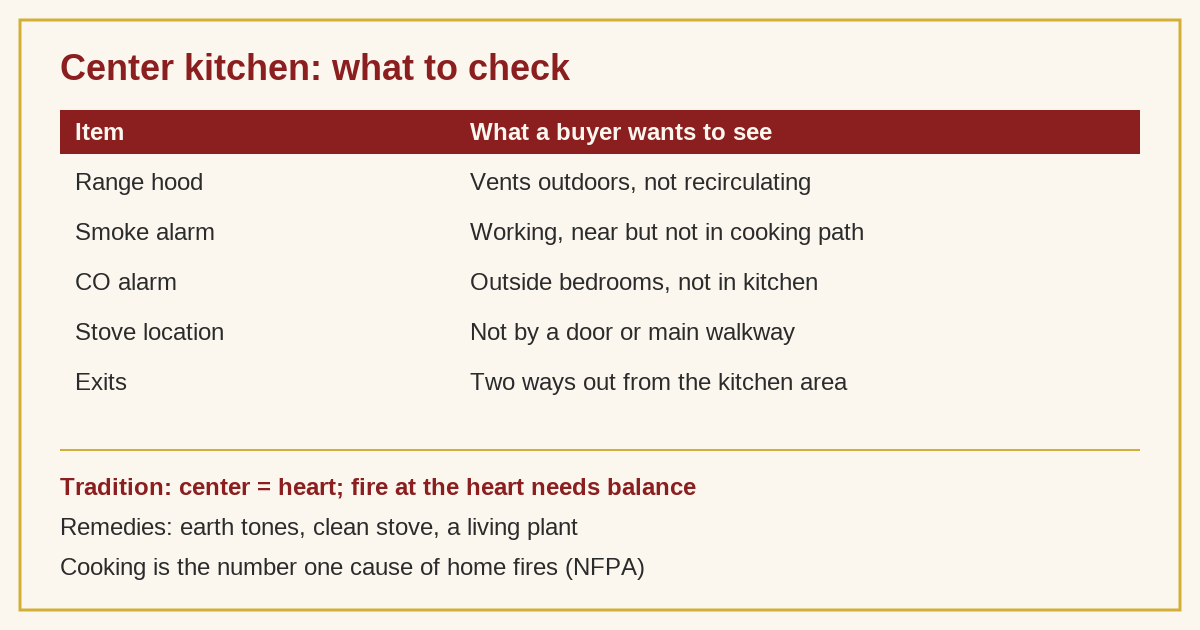
Practitioners say a kitchen at the center puts the stove's fire in the middle of the home, and they balance it with earth tones and a tidy stove that gets used. A buyer has a more practical worry. Cooking is the number one cause of home fires and injuries, so the hood, the alarms and the space around the stove deserve the closest look.
Safety sources checked: 23 November 2026
This guide is about where the kitchen sits in the house. For the layout inside the kitchen, read feng shui kitchen layout and stove and sink placement. The rest of our buying topics are in the real estate and home buying guides.
| Safety point | Figure or rule | Source |
|---|---|---|
| Cooking and home fires | Cooking fires are the number one cause of home fires and home injuries | NFPA |
| Leading cause of kitchen fires | Unattended cooking | NFPA |
| Kitchen fans that exhaust outdoors | Remove contaminants directly from the room and raise outdoor air ventilation | U.S. EPA |
| Gas stoves | Adjustment can cut emissions, and cooking is a short-term source of high pollutant levels | U.S. EPA |
| CO alarms | Not recommended in kitchens or above fuel-burning appliances. Place them outside sleeping areas and on every level | CPSC |
On this page
- What the tradition says
- The buyer facts
- Viewing checklist
- Layout comparison
- Remedies practitioners suggest
- Three things people get wrong in a central kitchen
- When to walk away
- FAQ
- On your next viewing
What the tradition says
In the Bagua, the center belongs to the earth element and the health of the household. The stove is the household's fire. Put the kitchen in the middle and the fire sits in the earth position, which practitioners say can leave a home feeling hot and restless. The usual remedy is to balance fire with earth, using warm neutrals, a solid counter surface and a plant on a window sill. Other teachers count a central kitchen as a plus. The cook has a commanding position, they say, and the family gathers around the meal. Both are readings from the tradition, not facts about outcomes.
Advertisement
The buyer facts
NFPA describes cooking fires as the number one cause of home fires and home injuries, and names unattended cooking as the leading cause of fires in the kitchen. Escape routes in a house often run through a central kitchen. So the question is a practical one. If a pan catches fire, can everyone get out without crossing the stove?
The EPA notes that cooking is among the short-term activities that can create high pollutant levels, that gas stoves can be adjusted to cut emissions, and that local kitchen fans that exhaust outdoors remove contaminants directly from the room. A center kitchen is usually the room furthest from a window, which makes the hood more important. A recirculating hood only filters grease and sends the air back into the room. Ask which type the house has.
On alarms, the CPSC says carbon monoxide alarms go on every level and outside sleeping areas, and does not recommend them in kitchens or above fuel-burning appliances. In a central kitchen, then, the CO alarm belongs in the nearby hall, not over the stove.
Viewing checklist
- Find where the range hood vents. Look for a cap on the roof or an outside wall, or ask the agent to show you the duct run.
- Turn the hood on and watch whether the steam clears.
- Stand at the stove. Can you see two clear ways out that do not pass the burners?
- Look at the smoke alarm near the kitchen. It should work and carry a date.
- Make sure the stove is not on the wall people walk along to get through the house.
- Ask whether the stove is gas or electric, and when any gas appliance was last serviced.
If you plan to change the layout, feng shui kitchen remodel layout shows what practitioners suggest and what to ask the contractor.
Layout comparison
| Layout | Tradition view | Practical view |
|---|---|---|
| Closed central kitchen with a door | Fire contained in the middle; balance it with earth | Better smoke and odor control; check the second exit |
| Open central kitchen, island | Commanding view of the home, but fire in every sightline | Odors and steam spread, so a good hood earns its cost |
| Central kitchen as the only route between zones | Energy rushes through the fire | Crowding and burn risk; consider a layout change |
Remedies practitioners suggest
- Use earth tones in the cabinets, walls or floor: sand, terracotta, ochre and warm stone.
- Keep the stove clean and use every burner over time. Teachers say a stove that gets used signals a well-fed household.
- Put a plant or a bowl of fruit on the counter, away from the cooking area.
- Place the stove so the cook can see the door without standing directly in line with it.
One more item belongs on the list for safety, not tradition: keep a fire extinguisher where you can reach it without passing the stove.
Three things people get wrong in a central kitchen
- Putting the CO alarm in the kitchen because that seems to be where the smoke is. The CPSC does not recommend it.
- Assuming a big stainless hood must vent outdoors.
- Painting the walls red to stir up the fire element. Practitioners usually advise against it in a kitchen that already has plenty of fire.
When to walk away
A central kitchen is usually something to fix, not a reason to walk away. The exceptions are a stove that sits on the only way out, a hood that is damaged or vents into the attic, and old wiring near the kitchen with visible scorch marks. If you see any of those, get an inspection before you offer.
FAQ
Is a kitchen in the center of the house bad feng shui?
Practitioners disagree. Some say fire in the middle of the home needs balancing with earth tones and a tidy stove. Others see a central kitchen as a commanding, welcoming place. Either way it is a view from the tradition, not a promised outcome.
What is the best remedy for a central kitchen?
Teachers usually suggest earth colors, a clean stove that gets used, a plant away from the cooking area, and a stove placed so the cook can see the door. The one safety step that matters most is a hood that vents outdoors.
Why does the range hood matter more in a center kitchen?
Because a center kitchen is far from the windows. The EPA notes that local kitchen fans that exhaust outdoors remove contaminants directly from the room, and a room you cannot air out by opening a window depends on that.
Where should the CO alarm go near a kitchen?
In the hall nearby, not in the kitchen. The CPSC says to place alarms on every level and outside sleeping areas, and does not recommend installing them in kitchens or above fuel-burning appliances.
Is cooking really a common cause of fires?
Yes. NFPA describes cooking fires as the number one cause of home fires and home injuries, and says the leading cause of kitchen fires is unattended cooking.
On your next viewing
Stand at the stove of each house on your shortlist, count the ways out and find where the hood vents. Then add what you found to the feng shui home buying checklist.
Sources
Checked November 2026. The NFPA statistics pages would not load in full when we checked, so we quote only the headline claims on its cooking page and no percentages.
- NFPA, Safety with cooking equipment
- U.S. EPA, Improving Indoor Air
- U.S. Consumer Product Safety Commission, Carbon Monoxide Questions and Answers
Editorial note: Feng shui is presented here as a cultural and design tradition, not as a guarantee of any outcome. Confirm legal, financial and inspection questions with a licensed professional in your area.