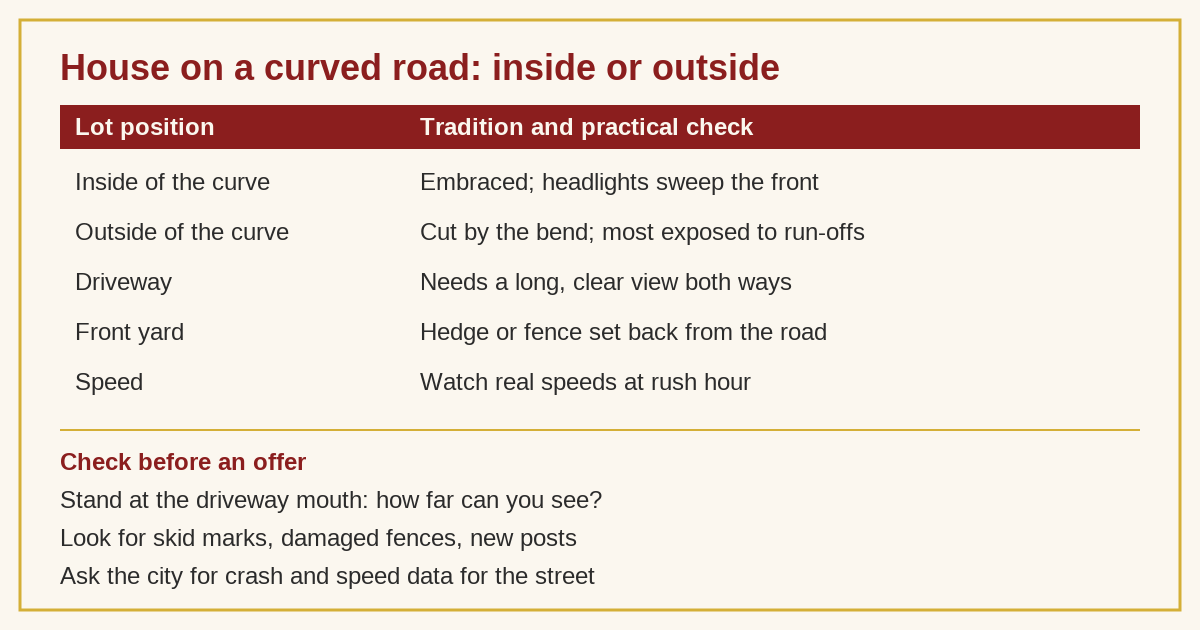
In the tradition, a road that bends around your lot embraces the house on the inside of the curve and cuts at the house on the outside. The practical picture points the same way. A car that leaves the road on a bend tends to carry straight on, toward the outside, and driveways on a curve often have short sight lines. Check both before you buy.
Figures checked: 23 November 2026
If the road points straight at the house instead of bending past it, read the T-junction house guide. More buying topics are in our real estate and home buying guides.
| Curve crash fact | Figure or rule | Source |
|---|---|---|
| Curves and fatal crashes | More than 25 percent of fatal crashes are associated with a horizontal curve | FHWA, Horizontal Curve Safety |
| Crash rate on curves | Average crash rate on curves is about three times that of other highway segments | FHWA, Horizontal Curve Safety |
| Roadway departures | Roadway departures are 87 percent of curve-related fatal crashes | FHWA, Horizontal Curve Safety |
| Scope of the figures | National highway statistics, with no rate for any single residential street | FHWA, Horizontal Curve Safety |
On this page
- Inside versus outside of the curve
- What the tradition says
- What crash data says
- Driveway and sight lines
- Scoring sheet: two lots on the same bend
- Remedies
- Where buyers misjudge a bend
- FAQ
Inside versus outside of the curve
A house in the crook of the bend is on the inside of the curve. If the road bows out toward your lot and then swings away, the house is on the outside.
Plenty of lots sit on a mild curve and nothing much follows from it. What follows matters on a tight bend, a curve on a hill, or a street where cars drive fast.
What the tradition says
Form School practitioners treat a curved road or river as a ribbon that either holds the house or turns away from it. When the road wraps around the front, it is said to embrace the house and gather qi in the yard. When it arcs away behind, or the lot sits on the outside of the bend, the house is called cut or exposed, and some teachers compare the road to a blade edge. Many also say the straight, fast stretch leading into the curve carries more force than the curve itself.
None of this is a measured outcome. The poison arrows guide explains how the tradition treats hard lines pointed at a home, and the lot shape guide covers the lot itself.
Advertisement
What crash data says
The Federal Highway Administration reports that more than 25 percent of fatal crashes are associated with a horizontal curve, that the average crash rate on curves is about three times that of other highway segments, and that roadway departures make up 87 percent of curve-related fatal crashes. About three-quarters involve a single vehicle leaving the road and hitting a fixed object or overturning, and about 10 percent are head-on crashes where a vehicle crosses the centre line.
Those are national figures, not a description of your street. They do back up a physical point that happens to match the tradition: a car that loses control on a curve usually keeps going in a straight line, toward the outside of the bend. (That is our reading of the data; FHWA says nothing about houses.) So on a tight curve the outside lot is the exposed one. The inside lot is less likely to be hit, but headlights sweep across its front windows every night.
FHWA also notes that many curve fixes, such as signs, markings and shoulder or surface changes, are low cost. If cars keep running off a bend near the house, ask the city whether it can add them.
Driveway and sight lines
On a curve, the stretch you cannot see is the one that matters. Stand where your car would stop at the end of the driveway. How far can you see each way, and how far can a driver coming round the bend see you? Hedges, fences, parked cars and the house itself all block the view. On the inside of a curve the usual culprit is your own corner planting or fence.
Your city can tell you the posted and observed speed on the street and whether it keeps crash records for it. Sight distance standards are set locally, so we give no figure here.
Scoring sheet: two lots on the same bend
Give each check 0 to 2, where 2 is better. The scores below are an example, not data.
| Check | Lot on the inside | Lot on the outside |
|---|---|---|
| Exposure to vehicle run-offs | 2 | 0 |
| Driveway sight lines | 1 (blocked by corner hedge) | 1 |
| Headlight sweep at night | 0 (across front windows) | 1 |
| Tradition reading | 2 (embraced) | 0 (cut) |
| Fence or berm possible | 2 | 1 (bylaw limits) |
| Total | 7 | 3 |
A low score does not make the outside lot a bad buy. It makes it a lot that needs a plan: a solid fence or berm within local bylaws, bedrooms on the far side from the road, and a driveway that pulls out with a clear view.
Remedies
- Move the bedrooms back. If the floor plan allows, sleep on the side away from the road.
- Add a planted or fenced edge set back from the road, within local height and sight triangle rules. Practitioners like it too, as a soft barrier that stops qi rushing in.
- Curve the front path so it does not run in a straight line from the road to the door.
- Ask about the road itself. The city may add signs, markings or speed calming on the bend.
Our home buying checklist lists the other exposure patterns to look for at a house.
Where buyers misjudge a bend
- Reading the lot by the tradition alone, without ever standing at the end of the driveway.
- Visiting at midday on a quiet day instead of at rush hour or after dark.
- Planting a tall hedge that blocks your own view out.
- Treating the inside lot as trouble-free. Headlights and traffic noise still reach it.
FAQ
Is a house on the inside of a curve good feng shui?
Practitioners generally read the inside of a bend as embraced, with the road wrapping around the front like an arm. That is a traditional reading, not a guarantee. Check the driveway sight lines too, since the view from the inside of a curve can be short.
Is a house on the outside of a curve bad feng shui?
Teachers often call it cut or exposed, as if by a blade edge. There is a physical side as well: a vehicle that leaves the road on a curve tends to keep going straight, toward the outside. FHWA data shows roadway departures are 87 percent of curve-related fatal crashes. A fence or berm helps, and so do bedrooms on the far side of the house.
How common are crashes on curves?
FHWA reports that more than 25 percent of fatal crashes are associated with a horizontal curve and that the crash rate on curves is about three times that of other highway segments. These are national highway figures, not a rate for a residential street.
Should I avoid buying a house on a curve?
Not automatically. Most bends are gentle. Look at how fast traffic runs, how far you can see from the driveway and whether the city has crash records for the bend. Walk away only if the sight line cannot be fixed and the road is fast.
What can I do if my house is on the outside of a curve?
Keep bedrooms away from the road side, add a fence, berm or planted edge that meets local rules, keep a clear driveway view, and ask the city about signs, markings or speed calming on the bend.
Before your second viewing
Go back at rush hour, stand at the mouth of the driveway and note how far you can see each way. Then ask the city for speed and crash data on that stretch. The home buying checklist covers the rest of the visit.
Sources
Checked November 2026.
We found no verified crash rate for residential streets by lot position and no sight distance standard for driveways, so neither appears here.
Editorial note: Lucky Properties presents feng shui as a cultural and design tradition. This guide is educational. Confirm legal, financial and inspection questions with a licensed professional.