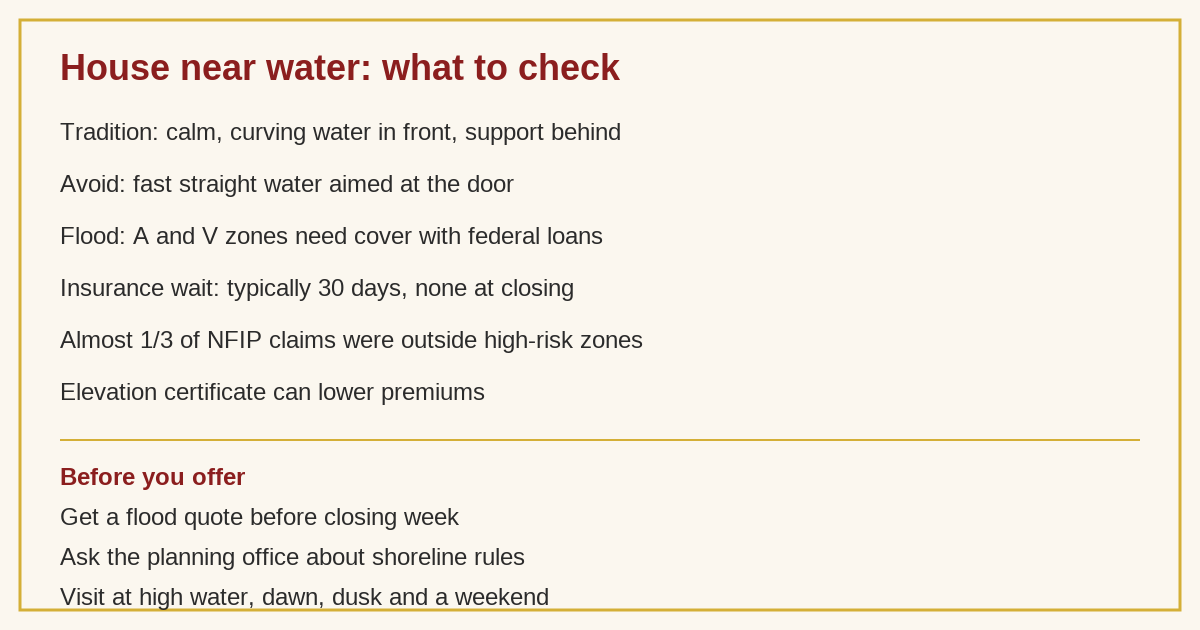
Feng shui tradition favours calm water in front of a house and dislikes fast or cutting water. Whether to buy is a different matter, and it turns on flood zones, the 30-day insurance wait, the elevation certificate and shoreline rules that change from place to place.
Last read against sources: 23 November 2026
Our subject is a house next to or near a river, lake or sea shore; the other settings buyers ask about are in our real estate and home buying guides. Water as a design feature inside the garden is a separate topic, covered in feng shui garden water features.
| Flood and permit rule | Figure or rule | Source |
|---|---|---|
| High-risk flood zones | Zones A and V are Special Flood Hazard Areas; flood insurance is required for government-backed mortgages there | FEMA, National Flood Insurance Program real estate brochure |
| Waiting period | Typically 30 days; none when the policy is tied to a mortgage | FEMA, NFIP real estate brochure |
| Claims outside mapped risk | Almost one-third of NFIP claims from 2014 to 2024 were outside high-risk areas | FEMA, NFIP real estate brochure |
| Elevation certificate | Optional in many cases; can lower premiums | FEMA, NFIP real estate brochure |
| Seller's policy | A seller's flood policy can be transferred to the buyer | FEMA, NFIP real estate brochure |
| Natural feature permits (Toronto) | A permit is needed to injure or remove a protected tree or to work in a ravine or natural feature | City of Toronto |
On this page
- What the tradition says
- River, lake or sea: reading each
- Flood zone, insurance and the elevation certificate
- Shoreline rules and what you can build
- Noise, bugs, damp and daily life
- Waterfront scoring sheet
- Remedies and when to walk away
- Four waterfront buying errors
- FAQ
What the tradition says
Form School has a long saying that water brings wealth, and many practitioners like water in front of a house, in the bright hall (the open ground the door faces), as long as it is gentle. By their reading, calm, slow, clear water that curves around the house, as if embracing it, collects qi (energy). They call the opposite harmful. That means a straight, fast channel pointed at the door (an arrow or cutting edge, in their terms), a house on the outer bank of a bend where the water curves away from it, and dirty, stagnant or noisy water.
The same tradition prefers support behind the house, so a lake in front with higher ground behind is a classic favourable pattern, while a house with water on all sides can feel unsupported. These readings describe a setting. They are no promise that a waterfront home will bring money. They do line up loosely with real concerns: fast water erodes banks, and the outside of a river bend is often where the bank wears away.
Advertisement
River, lake or sea: reading each
| Setting | Tradition's reading | What matters to a buyer |
|---|---|---|
| River | Gentle curve that embraces the house is favoured; straight, fast water aimed at the door is not | Flood zone, bank erosion, whether the house sits on the inside or outside of a bend |
| Lake | Calm water in front, higher ground behind is a favoured pattern | Water level changes, shoreline rules, shared dock or beach rights |
| Sea or large bay | Big, open water is described as powerful; practitioners often prefer some shelter and distance | Storm exposure, V zones, insurance, salt and wind wear |
| Canal or pond | Still, small water is a calm feature; stagnant water is not | Smell, mosquitoes, who maintains it |
Flood zone, insurance and the elevation certificate
For a US buyer, the questions to ask are set out in FEMA's National Flood Insurance Program real estate brochure. A and V zones are Special Flood Hazard Areas, and flood insurance is required for government-backed mortgages there. A typical policy has a 30-day wait before it starts, but no wait when it is tied to a mortgage closing, so ask for the quote early. The same brochure says almost one-third of NFIP claims from 2014 to 2024 were outside high-risk areas, so price a house near the water for flood risk even when it sits outside a mapped zone.
The elevation certificate is optional in many cases and can lower premiums. Ask the seller whether one exists, and ask the insurer how it would change your quote. A seller's flood policy can also be transferred to you, which can save time and keep the rate, so find out what the seller pays and what the policy covers.
All of this is US guidance. We did not check a Canadian flood or insurance source, so there are no Canadian figures here. In Canada, ask your agent, lender and insurer about flood maps and cover where you live.
The "water season" in the feng shui calendar is a different idea, explained in feng shui and winter water season at home.
Shoreline rules and what you can build
Waterfront land often carries rules that limit what you do near the water: setbacks from the shore, limits on removing vegetation, dock and boathouse permits, and protected natural features. Setback distances are set locally, so we give none. For an example of the kind of rule to look for, Toronto requires a permit to injure or remove a protected tree or to work in a ravine or natural feature, and its tree bylaws changed on 1 September 2026. Rules in your area will differ.
Ask four things: who owns the bed and the bank, whether the lot has riparian or beach rights, what permits any dock, deck or addition would need, and whether any part of the lot is within a protected setback. The survey and the title will show boundaries and easements, such as a public path along the shore.
Noise, bugs, damp and daily life
Practitioners tell soothing water apart from loud or smelly water, and a buyer should too. Go at dawn, at dusk and on a weekend. Check for boat traffic noise, road noise on the far bank, mosquitoes and algae in summer, fog and damp in the cooler months, and ice movement in spring. Look for rot on decks and wood near the ground, and for rust on metal. A damp basement can point to flooding or groundwater, so have a home inspector look at it.
Waterfront scoring sheet
Score 0 for a problem, 1 for unknown and 2 for confirmed. A waterfront lot under 8 out of 12 should be seen again at high water before you commit.
| Check | 0 | 1 | 2 |
|---|---|---|---|
| Flood zone and insurance | In A or V zone, no quote | Zone unknown | Zone known, quote in hand |
| Elevation certificate | None, in a mapped zone | Exists, not shared | Provided and reviewed with the insurer |
| Water's shape and speed | Fast and straight at the door, or eroding bank | Not seen at high water | Calm or curving, bank stable |
| Shoreline rules | Unknown | Seller says fine | Planning office confirmed in writing |
| Noise and nuisance | Loud or foul at peak times | Not checked | Visited at several times, fine |
| Support behind the house | Water on all sides | Open behind | Higher ground or trees behind |
Remedies and when to walk away
- Place the main living room and the bed where you see the water but do not look directly down a straight channel at the door. Practitioners say a curved path, a hedge or a few trees breaks the arrow.
- Keep the back of the house solid with trees or a rise. Practitioners say this gives the support that open water lacks.
- Keep water clean and moving where you control it: clear debris, maintain drainage and avoid stagnant pools.
- Plant to hold the bank where the rules allow, and ask a local conservation office before changing the shoreline.
Walk away when the lot is in a high-risk zone and no coverage can be bound, when the bank is visibly eroding toward the house, or when the seller cannot show permits for docks or additions.
Four waterfront buying errors
- Buying on the view and the dock, and skipping the flood quote.
- Trusting the map alone. FEMA says almost one-third of NFIP claims came from outside high-risk areas.
- Visiting at low water or in summer only.
- Changing the shoreline before reading local rules.
FAQ
Is it good feng shui to live near water?
Practitioners favour calm, slow, clear water in front of a house, especially water that curves around it, with support behind. They dislike fast, straight or stagnant water, and a house on the outside of a bend. These are traditional readings, not guarantees.
Is a house on a river bad feng shui?
Not necessarily. The tradition looks at how the water moves: gentle and curving is favoured, while a straight, fast channel aimed at the door is not. On the practical side, check the flood zone, bank erosion and which side of a bend the house sits on.
Do I need flood insurance for a waterfront home?
In the US, flood insurance is required for government-backed mortgages in A and V zones, and optional elsewhere. FEMA says almost one-third of NFIP claims from 2014 to 2024 were outside high-risk areas, so many buyers get a quote even outside the zone.
How long does flood insurance take to start?
FEMA says a policy typically has a 30-day wait before it takes effect, but there is no wait when it is tied to a mortgage closing. Ask for the quote well before closing day.
What is an elevation certificate?
It records a building's elevation against flood levels. FEMA says it is optional in many cases and can lower premiums. Ask the seller whether one exists.
Flood quote first, then the planning office
Ask your lender and an insurance agent for the flood zone and a quote this week. After that, ask the local planning office which shoreline rules cover the lot. Once the water questions are settled, the feng shui home buying checklist covers the house itself.
Sources
Checked November 2026.
- FEMA, National Flood Insurance Program: questions and answers for real estate professionals (brochure, August 2025)
- City of Toronto: permit page for trees, ravines and natural features
We did not consult shoreline or riparian setback rules or any Canadian flood guidance, so no figure from them appears above. FEMA rules are US rules, and Toronto's permit rules are one city's example.
Editorial note: Lucky Properties covers feng shui as a cultural and design tradition, and this guide offers general information, not advice. Confirm flood zone, insurance, shoreline rules and permits with your lender, an insurance agent, your local planning office and a licensed professional.