A house near a gas station is not automatically bad feng shui, but practitioners read one as concentrated fire energy, constant traffic and noise. Their advice is not to face it and to shield the bedroom. A buyer's questions are more concrete: has the site ever leaked fuel, and do petroleum vapors, noise or light reach the house?
Figures checked: 23 November 2026
For the wider buying picture, see our real estate and home buying guides.
On this page
- Key facts at a glance
- What the feng shui tradition says
- Leaking tanks and vapors: what EPA says
- Gas station buyer scoring sheet
- Remedies you can actually do
- When to walk away
- Where buyers near a station go wrong
- FAQ
- Before you make an offer
- Sources
Key facts at a glance
| EPA measure | Figure | Source |
|---|---|---|
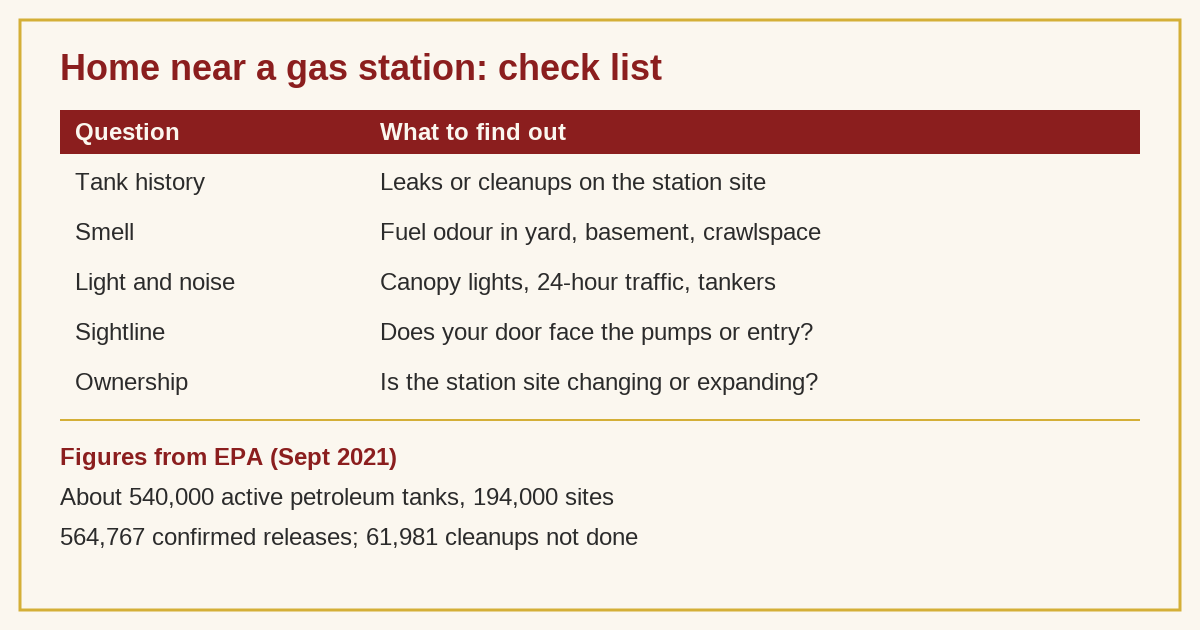
| US federally regulated underground storage tank (UST) universe, September 2021 | About 540,000 active petroleum USTs and 2,700 hazardous substance USTs at roughly 194,000 facilities | EPA UST program facts |
| Confirmed UST releases (cumulative) | 564,767 | EPA UST program facts |
| Cleanups completed | 502,786 | EPA UST program facts |
| Cleanups not yet completed | 61,981 | EPA UST program facts |
| Facilities in significant operational compliance (release prevention and leak detection) | 68.1% | EPA UST program facts |
| Petroleum vapor intrusion field study (1996) | Indoor air about six orders of magnitude lower than soil gas | EPA petroleum vapor intrusion page |
These are national totals from 2021, not a risk figure for any one station. Whether a particular leak reached a nearby home is something only the site record and an assessment can show.
What the feng shui tradition says
Practitioners describe a gas station as fire and metal energy with fast, constant movement. Their usual advice:
- Do not face the pumps or entry. A front door looking straight at a busy driveway is read as a sha qi line. See poison arrows and sha qi.
- Protect the bedroom from light and sound, and keep the quiet side of the house for sleep.
- Balance with earth and water. Practitioners suggest calmer, cooler colours and plantings on the station side.
None of this predicts luck. It describes a noisy, bright, fuel-heavy neighbour.
Advertisement
Leaking tanks and vapors: what EPA says
EPA describes petroleum vapor intrusion as vapors from petroleum hydrocarbons such as gasoline, diesel or jet fuel entering a building, with concern about explosive concentrations of vapors or methane and health risks from toxic chemicals breathed indoors. EPA's page gives a 1996 field study in which indoor air concentrations were about six orders of magnitude lower than soil gas, attributed to biodegradation, a partial physical barrier and ventilation. The page also says its database compiled data from 74 sites. It gives no distance or frequency, and we won't guess at one.
What a buyer can do:
- Ask the seller whether they know of any fuel release, cleanup or monitoring wells near the home.
- Look up the station with your state environmental agency, which tracks leaking UST sites. EPA points buyers to state guidance, and each state's database differs in what it holds and how current it is.
- Smell the basement and crawlspace. If you smell fuel, stop and call the agency.
- Ask about a professional assessment from an environmental consultant if the station site has a known release.
The other site checks are listed in our feng shui home buying checklist.
Gas station buyer scoring sheet
| Item | 0 | 1 | 2 |
|---|---|---|---|
| Fuel release on the station site | None found | Not checked | Known release |
| Fuel odour at the home | None | Faint | Noticeable |
| Door or bedroom faces the pumps or entry | No | Angled | Direct |
| Canopy light into the bedroom | None | Some | Strong |
| 24-hour traffic, tanker deliveries | None | Some | Frequent |
| Planned change or expansion of the site | None | Unknown | Yes |
Worked example with stated inputs: a house scores 1 (release status not checked), 0 (no odour), 1 (angled), 1 (some light), 1 (some traffic) and 1 (unknown plans). Total 5 out of 12. The first job is turning the 1 on the release check into a 0 or a 2.
Remedies you can actually do
- Check the record first. The state agency lookup and the seller's disclosure cost little or nothing.
- Block light and sound. Blackout curtains, better glazing and a hedge or fence on the station side. See windows, curtains and light.
- Move the bedroom to the far side.
- Ventilate the basement or crawlspace if a professional assessment advises it.
When to walk away
Walk away if there is a known release that is not closed and the agency or consultant cannot tell you the status, if you smell fuel indoors, or if night light and tanker noise reach the bedroom with no fix. An unresolved environmental question also causes trouble with financing and resale.
Where buyers near a station go wrong
- Treating a national figure as the risk at one station.
- Skipping the state agency lookup.
- Visiting only by day.
- Ignoring an expansion that could add pumps or hours.
- Forgetting the road. A station sits on a busy road by design, and near-road traffic pollution is its own question, covered in feng shui house near a highway or busy road.
FAQ
Is it bad feng shui to live near a gas station?
Practitioners see fire energy and constant traffic. They advise not facing the pumps or entry and protecting the bedroom from light and sound. It is a design reading, not a prediction.
Are petroleum vapors from gas stations a risk to nearby homes?
EPA describes vapor intrusion as a concern for explosive concentrations and health, and cites a 1996 field study where indoor air was about six orders of magnitude lower than soil gas. It gives no distance or frequency, so check the specific station record and smell the home.
How common are leaking underground storage tanks?
EPA reports 564,767 confirmed releases and 502,786 cleanups completed as of September 2021, leaving 61,981 cleanups not completed. These are national totals, not a risk for one station.
How do I find out if the station has leaked?
Ask the seller and look up the site with your state environmental agency, which tracks leaking tank sites. Systems vary by state, so ask the agency what it records.
Should I get an environmental assessment?
If the station has a known release, ask an environmental consultant whether you need one before you commit. For an unknown record, start with the agency lookup.
Before you make an offer
Start with the state environmental agency lookup. After that, walk the house with the feng shui home buying checklist. If you expect to sell one day, feng shui for selling a house is worth reading too, and the rest of the series is in our real estate and home buying guides.
Sources
Checked November 2026.
- EPA, UST program facts (September 2021 figures)
- EPA, petroleum vapor intrusion (January 2025 archive snapshot)
We could not confirm local setback rules for gas stations or find a price study for homes near them, so no figure here comes from either.
Editorial note: Feng shui appears here as a cultural and design tradition, and nothing on this page is professional advice. Confirm environmental, legal and financial questions with a licensed professional and your state agency.