A flag lot (also called a battle-axe or panhandle lot) puts a house behind another one, reached by a narrow strip of land. Practitioners are wary of the long approach and the hidden position. The decision itself turns on legal facts: the recorded driveway easement, the width of the strip, fire access, and what the survey actually shows.
Planning sources checked: 23 November 2026
Lot outlines in general are covered in feng shui lot shape analysis and our other real estate and home buying guides. Here we look only at the flag lot.
| Rule | Portland or Menlo Park example | Source |
|---|---|---|
| What a flag lot is | A lot with two parts: the flag (the only building site, behind another lot) and the pole that connects it to the street | City of Portland, Oregon zoning code summary |
| Pole width (Portland) | 12 feet for its whole length, or 10 feet only for a lot made by property line adjustment with no vehicle access on the pole | City of Portland, Oregon |
| Fire access (Portland) | The fire code standard requiring access to the house within 150 feet applies, unless sprinklers are installed | City of Portland, Oregon |
| Setbacks (Portland) | 15 feet on all lot lines in the largest-lot zones, 10 feet in mid-size zones, 5 feet for flag portions under 3,000 square feet | City of Portland, Oregon |
| Shared access (Portland) | Access easements for other lots to use the pole may be required | City of Portland, Oregon |
| Front of a panhandle lot (Menlo Park, CA) | The shorter boundary next to the private driveway or easement; planners may need to confirm it | City of Menlo Park |
On this page
- What the tradition says
- What a flag lot means legally
- Easements and the shared driveway
- Fire access and services
- Privacy and the front house
- Buyer scoring sheet
- Remedies
- Four flag lot traps
- FAQ
What the tradition says
Practitioners look at how a house meets the road. A flag lot house has no street frontage of its own: you see a long strip first, then a house tucked behind a neighbour. Teachers who stress the approach call the strip a channel that qi (energy) must travel along. A narrow, dark or winding one is said to pinch, and a wide, bright, gently curved one to welcome. Others point out that a house set back from the road is shielded from street traffic, which the Form School tradition tends to like.
There is no agreed verdict. Take all of it as design advice about how the approach feels, not as a prediction.
Practitioners also raise the question of which side is the front. The side of the house that faces the street is not always the side the door is on, so read house facing versus door direction before you give a flag lot house a direction.
Advertisement
What a flag lot means legally
Portland's zoning code defines a flag lot as a lot with two distinct parts: the flag, which is the only building site and sits behind another lot, and the pole, which connects the flag to the street. In Portland the pole must be 12 feet wide for its whole length (a 10 foot pole is allowed only when the lot is created by a property line adjustment and the pole gives no vehicle access), and setbacks are the same on every lot line. Portland also says only the flag portion counts toward lot area and building coverage, so a lot that looks large on a map may have less buildable land than the listing suggests.
That is one city's rule. Other cities set different pole widths, setbacks and limits, and some do not allow new flag lots at all. The question to ask carries across, though: what does the local code say about this lot, and was it created legally?
Menlo Park, California shows why the survey matters. Its planning page says the front of a panhandle lot is the shorter dimension of the boundary next to the private driveway or easement, and that irregular lots may need the planning division to confirm their orientation and lot lines. Setbacks run from the lot lines, so a different "front" changes where you can build or extend.
Easements and the shared driveway
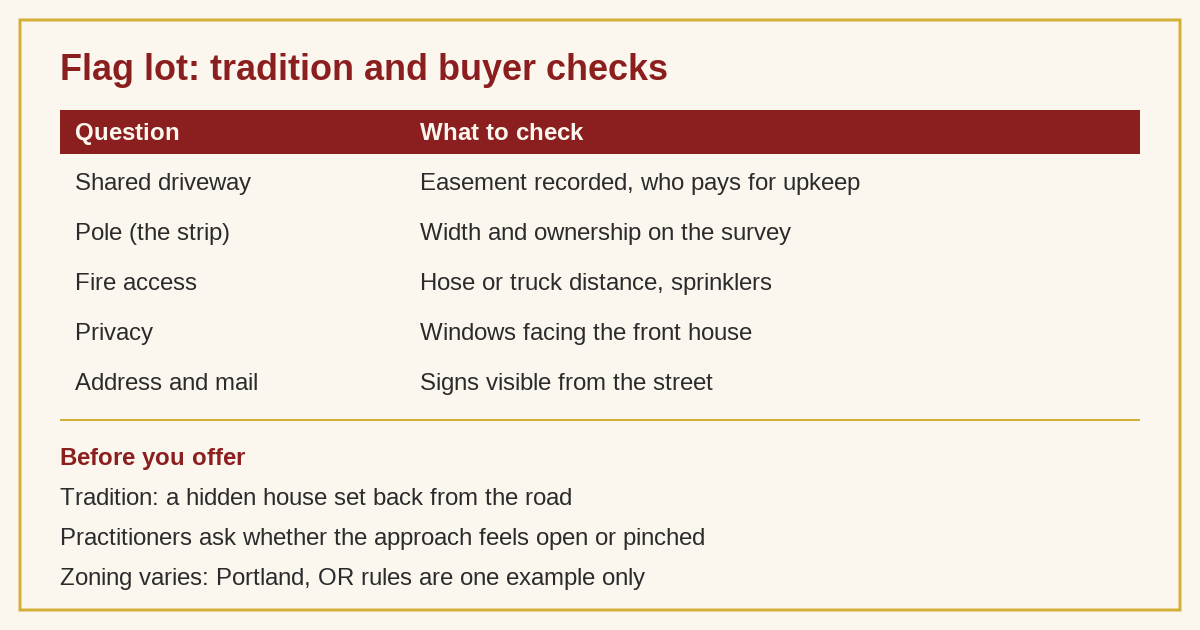
Many flag lots reach the street across a strip that belongs to the flag lot itself. Others use an easement across the front lot. Portland notes that access easements may be required so other lots can use the pole. A buyer needs answers to four questions:
- Is the strip part of the lot you are buying, or an easement across someone else's land? Ask for the recorded document and the survey.
- If the driveway is shared, who pays for repairs and snow clearing, and is the sharing agreement written and recorded?
- Can the neighbour in front park on, block or gate the strip?
- Is there room for two cars to pass, or a place to turn around?
Have your attorney or title company read the recorded easement rather than relying on how the seller or agent describes it.
Fire access and services
Portland's code says the fire code standard that requires access to a house within 150 feet must be met unless fire sprinklers are installed. Your own city's number matters less than the answer to a plain question: can trucks and hoses reach the house, and does it have sprinklers or a hydrant nearby? A long, narrow pole can also get in the way of ambulances, garbage collection, parcels and mail. Ask how each one reaches the house, and where the bins go on collection day.
Privacy and the front house
The front house shares your approach and often looks into your yard. Walk the lot and count how many of its windows face your windows and outdoor space. Practitioners prefer that a door or bedroom not look straight at a neighbour's wall or door, and that happens to be a good privacy test too. See feng shui lot shape analysis for how to read the yard once you know the outline.
If the house also sits on a corner, a slope or a cul-de-sac, read feng shui for corner lots, cul-de-sacs and slopes as well.
Buyer scoring sheet
Score each line 0 (problem), 1 (unclear) or 2 (clear and documented). Below 8 out of 12, ask more questions before you make an offer.
| Check | 0 | 1 | 2 |
|---|---|---|---|
| Access documents | None found | Seller describes them | Recorded easement or pole in your title |
| Pole width | Under local minimum or unknown | Close | Meets local rules on the survey |
| Fire access | Not reachable | Unknown | Reachable or sprinklered, confirmed |
| Maintenance agreement | Disputed | Verbal only | Written and recorded |
| Privacy from front house | Direct sight lines | Partial | Screened or offset |
| Address visible from street | No | Partly | Clear sign and lighting |
Remedies
- Put a clear address sign and a light at the street end of the strip so visitors and emergency crews can find you.
- Plant or fence for privacy only where the survey shows the land is yours, and check height limits first.
- Light the strip, clear the overgrowth and make the door visible from the turn. Practitioners would say this opens the approach. It is also safer.
- If the driveway is shared, get the maintenance agreement in writing.
Walk away when the strip is not part of your title and there is no recorded easement, when emergency access is unclear, or when the lot may have been created without approval.
Four flag lot traps
- Listing photos show the house on the flag, not the strip you will drive every day.
- Driveway rights that rest on a handshake do not bind the next owner of the front lot.
- A map is not a survey. Measure from the survey.
- A feng shui consultant cannot settle a legal question, so do not ask one to.
FAQ
Is a flag lot bad feng shui?
There is no single verdict. Some practitioners worry that a long, narrow approach pinches the flow of energy, while others like that the house is set back from street traffic. Judge the actual approach: is it bright, wide enough, and easy to find? Then settle the legal and safety questions, which matter more.
What is a battle-axe lot?
It is another name for a flag lot: the "blade" is the house portion and the "handle" is the strip to the street. The legal rules differ by place, so ask the local planning office how your lot is defined.
Does a flag lot sell for less?
We found no neutral study that puts a number on it, so we give none. The shared driveway, privacy from the front house and fire access are what buyers tend to weigh. Ask your agent for recent sales of other flag lots nearby, and ask the appraiser how the access strip was treated.
What is the minimum pole width for a flag lot?
It depends on the city. Portland, Oregon requires 12 feet for the whole length of the pole, with a 10 foot exception when the flag lot is created by a property line adjustment and the pole gives no vehicle access. Check your own city's zoning code or ask its planning office.
Who owns the driveway on a flag lot?
It depends. The strip may be part of your lot, or it may be an easement across the front lot. Ask for the recorded easement and the survey, and have your attorney or title company explain them before you commit.
Survey, easement, then the house
Order a current survey and the recorded easement, then ask the local planning office how the lot was created. After that, use the feng shui home buying checklist to walk the house itself.
Sources
Checked November 2026.
- City of Portland, Oregon: flag lot regulations (zoning code chapters 33.110, 33.610, 33.611, 33.677)
- City of Menlo Park, Lot area, orientation, width and depth
We did not consult a neutral study of flag lot resale prices, so no price figure appears above. The Portland and Menlo Park rules are examples, not national rules, and we checked no Canadian municipal rule.
Editorial note: Lucky Properties presents feng shui as a cultural and design tradition. This guide is educational. Confirm zoning, easements and fire access with your local planning office, a surveyor and a licensed attorney.