A dead end street is a road that stops with no turnaround bulb. Practitioners count the quiet and the low traffic in its favour, and a road that ends at your lot against it. The questions that matter more to a buyer are practical: who owns the road, whether fire trucks, plows and garbage trucks can turn around, and whether the road may be extended later.
Fire code reference checked: 23 November 2026
Here we deal with a road that simply ends. A street with a circular turnaround is a different case, which our corner lot, cul-de-sac and slope guide covers along with the rest of our real estate and home buying guides.
| Rule | What it says | Source |
|---|---|---|
| Long dead ends need a turnaround | Under International Fire Code 503.2.5, a dead-end fire apparatus access road longer than 150 feet needs an approved turnaround, though local codes may differ | North Carolina Office of State Fire Marshal code quick review |
| Turning radius | Set by the local fire code official for the apparatus expected to respond (IFC 503.2.4); no single national figure | North Carolina Office of State Fire Marshal code quick review |
| Where the code applies | The IFC is a model code that each state or city adopts, often with changes, so check the local version | North Carolina Office of State Fire Marshal code quick review |
On this page
- What a dead end street is
- What the tradition says
- Fire access: the turnaround rule
- Who owns and maintains the road
- Plowing, trash and deliveries
- Will the road be extended
- Scoring sheet: three streets compared
- Remedies if you buy
- Four ways buyers misjudge a dead end
- FAQ
What a dead end street is
A dead end (also called a no-through road) ends without a loop. A cul-de-sac ends in a round or hammerhead turnaround that vehicles can use. Listings often mix the two up, so look at the end of the street on a satellite map rather than trusting the description. If the street ends in a loop, read our cul-de-sac guide instead.
The road might stop at a lot, a park, a creek, a fence or open land. Each of those reads differently, in the tradition and in practice, so note what is there.
What the tradition says
Practitioners usually describe a road as a channel for qi (energy) that moves with the traffic. On a through street the qi is said to move quickly. On a dead end it slows, gathers and stops. Many teachers count that in favour of a quiet, settled home. Some warn that qi which stops at the end of the road can turn stagnant for the house that sits right there.
That last house has a second problem in the tradition, because a road pointing straight at a door is what practitioners call a poison arrow. Our T-junction house guide covers that pattern, and the poison arrows guide explains the idea. A road that stops at a side wall or a garden, not at the front door, is generally read more gently.
None of this has been measured. It is one way of looking at the street, and the practical checks below should carry more weight.
Advertisement
Fire access: the turnaround rule
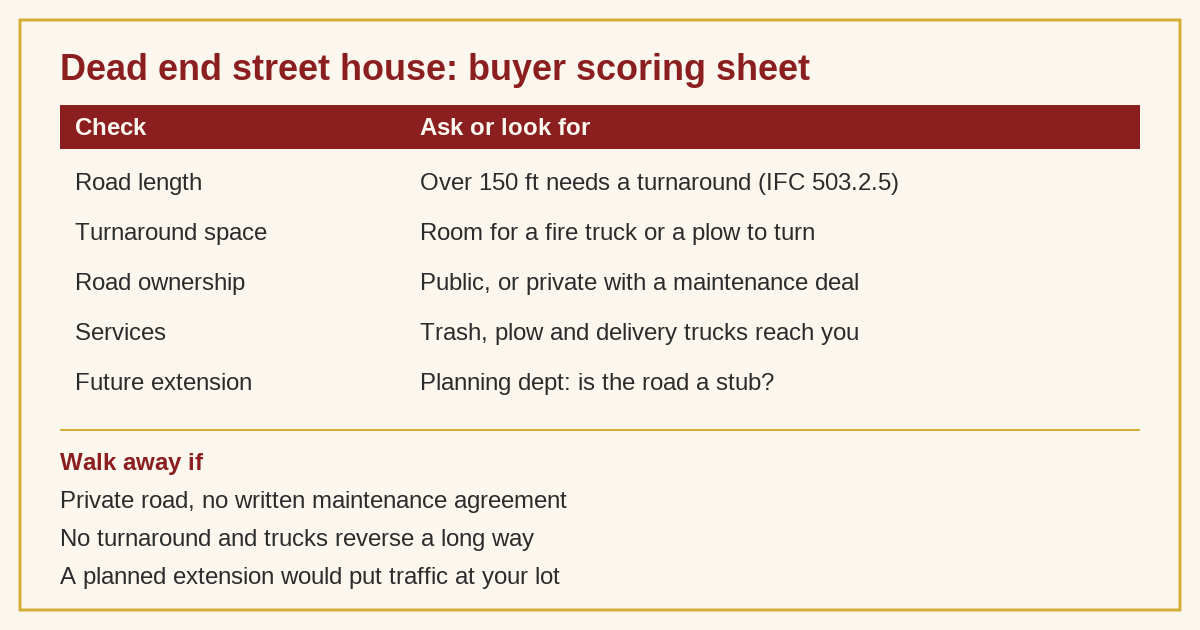
Fire codes have firmer views on dead ends than any tradition. The International Fire Code, section 503.2.5, says a dead-end fire apparatus access road longer than 150 feet must have an approved area for turning around fire apparatus. The North Carolina Office of State Fire Marshal explains the reason: a turnaround reduces the hazard of backing large apparatus down a long road. The turning radius is set by the local fire code official based on the vehicles expected to respond (section 503.2.4), so there is no single national radius.
There are two catches. The IFC is a model code, and your state, province or city adopts its own version, which may change the 150 foot figure or the exceptions. And many older streets were built before these rules existed and do not have to be brought up to date, so a road that was legal when it was built can still be awkward for a fire truck.
Ask the fire department or the planning office how a truck serves the street, and whether it meets today's access rule or was grandfathered. In Canada the rule comes from provincial building and fire codes and municipal subdivision standards; we did not verify a figure for them.
Who owns and maintains the road
Buyers skip this check more than any other. The city, county or province looks after a public road, and taxes pay for the plowing and repairs. On a private road the owners pay, sometimes under a road maintenance agreement or through a homeowners association, and a buyer takes over the seller's share.
Ask the seller and the agent for the road's status in writing, any road maintenance agreement, the last assessment or bill, and whether any owner has stopped paying. Your lawyer or title company can confirm the legal access, which will be either an easement or a dedicated road. A private road with no written agreement is a risk, and the price should reflect it.
Plowing, trash and deliveries
A large truck that cannot turn around either backs up the whole street or stops at the entrance. Ask the city or the hauler which it is: whether the trash truck comes in, whether you have to take bins to the corner, and where the plow turns. In snow country, ask where plowed snow is piled at the end of the road, because the pile may end up in front of the last lots.
How the end of a road shapes the lot itself is covered in our lot shape guide.
Will the road be extended
A dead end that stops at undeveloped land may be a stub street that the city intends to connect later. Through traffic would make it a different street. Ask the planning department whether the road is shown as continuing on the official plan or subdivision map, and what is on the land beyond it. For resale, the answer matters more than any feng shui reading.
Scoring sheet: three streets compared
Score each item 0 (bad), 1 (unclear) or 2 (good), for a total out of 10. The three streets are made-up examples, not data.
| Check | Street A | Street B | Street C |
|---|---|---|---|
| Road length and turnaround | 2 (short, hammerhead) | 1 (long, unclear) | 0 (long, none) |
| Road ownership | 2 (public) | 2 (public) | 0 (private, no agreement) |
| Trash, plow, delivery access | 2 | 1 | 0 |
| Future extension risk | 2 (park at the end) | 1 (vacant land) | 0 (stub shown on plan) |
| House position vs road end | 1 (side of road) | 1 | 0 (road points at door) |
| Total | 9 | 6 | 0 |
Under 6, ask more questions before you make an offer. Street C is the one to walk away from. A private road with no agreement, no turnaround and a planned extension fails on practical grounds alone, and the road aimed at the front door only adds to it, whatever the tradition says.
Remedies if you buy
Practitioners often suggest softening a road that points at the house with a planting bed, a low fence or a curved path so the straight line is broken. If the road ends at your lot, keep the driveway and the sight line clear first and plant second. The home buying checklist lists other things to confirm at a viewing.
Four ways buyers misjudge a dead end
- They treat a cul-de-sac and a dead end as the same thing.
- A street name makes them assume the road is public.
- A visit on a quiet Sunday shows nothing of trash day, a plowing day or the school run.
- Nobody checks what lies beyond the end of the road.
FAQ
Is a dead end street good or bad for feng shui?
The tradition is mixed. Practitioners often like the low traffic and quiet, and some warn that a road ending directly at your front door acts like a poison arrow. It depends on whether the road stops at your door or beside it. It is a cultural reading, not a measured effect, so check the fire access and road ownership first.
Does a dead end street need a turnaround?
Under International Fire Code 503.2.5, a dead-end fire apparatus access road longer than 150 feet needs an approved turnaround. The IFC is a model code that each state or city adopts, often with changes, and older streets may predate it. Ask your fire department how the street is served.
Is a dead end street the same as a cul-de-sac?
No. A cul-de-sac ends in a loop or turnaround that vehicles can use. A dead end just stops. Our cul-de-sac guide covers the loop, and this guide the road with no turnaround.
Who maintains a dead end road?
If the road is public, the city, county or province does. If it is private, the owners do, usually under a road maintenance agreement or a homeowners association. Ask for the status and any agreement in writing before you make an offer.
Do dead end streets hurt resale value?
We found no reliable figure, so we give none. What buyers weigh is quiet and low traffic against awkward turning, service access and any future extension. Compare recent sales of similar homes on and off the street with your agent.
What should I ask the seller about a dead end street?
Ask whether the road is public or private, whether there is a maintenance agreement or recent bill, how trash and plow trucks serve the street, whether fire trucks have difficulty turning, and whether the road is planned to be extended.
Get the road papers first
Get the road's status and any maintenance agreement before your second viewing. After that, use the home buying checklist for the rest of the viewing, and read the corner lot, cul-de-sac and slope guide if the street ends in a loop.
Sources
Checked November 2026.
We could not verify a national figure for the resale effect of a dead end street, or the turnaround rules in Canadian provincial fire codes, so neither is quoted.
Editorial note: Lucky Properties presents feng shui as a cultural and design tradition. This guide is educational. Confirm legal, financial and inspection questions with a licensed professional.