Practitioners treat the center of a home as its heart and say a bathroom there drains energy from the whole house. Buyers have more concrete things to check: an interior bathroom has no window to ventilate it, so whether it stays free of damp, mould and smell comes down to a working fan that vents outdoors.
Code and EPA figures checked 23 November 2026.
The layout inside the room itself is covered in feng shui bathroom layout, one of our real estate and home buying guides.
| Ventilation and leak rules | Figure or rule | Source |
|---|---|---|
| Bathroom ventilation, window route | At least 3 square feet of glazed area, with at least half openable (IRC R303.3, 2024 as summarised) | Jaspector, IRC 2024 |
| Bathroom ventilation, fan route | 50 CFM intermittent or 20 CFM continuous | Jaspector, IRC 2024 |
| Where the fan must discharge | Outdoors; not into an attic, crawlspace, garage or interior space | Jaspector, IRC 2024 |
| Bathroom fans that vent outside | Remove pollutants from the room and raise outdoor air ventilation | U.S. EPA |
| Average household leak loss | More than 9,300 gallons of water a year | U.S. EPA WaterSense |
| Homes with large leaks | Nine percent leak 50 gallons or more a day | U.S. EPA WaterSense |
On this page
- What the tradition says
- The real buyer issue: moisture with no window
- What to check at a viewing
- Should you buy it?
- Remedies practitioners suggest
- Where buyers slip up
- When to walk away
- FAQ
- At your next viewing
What the tradition says
In the Bagua and in Form School teaching, the center of the house is its core, linked to health and to the earth element. Practitioners say water and waste in that spot disturb the whole house, because every other room sits around it. Many teachers also accept that modern homes often cannot avoid it, and they draw a line between a well-kept, ventilated bathroom with a closed door and a neglected one. Read the tradition as a reason to give this room extra care.
Advertisement
The real buyer issue: moisture with no window
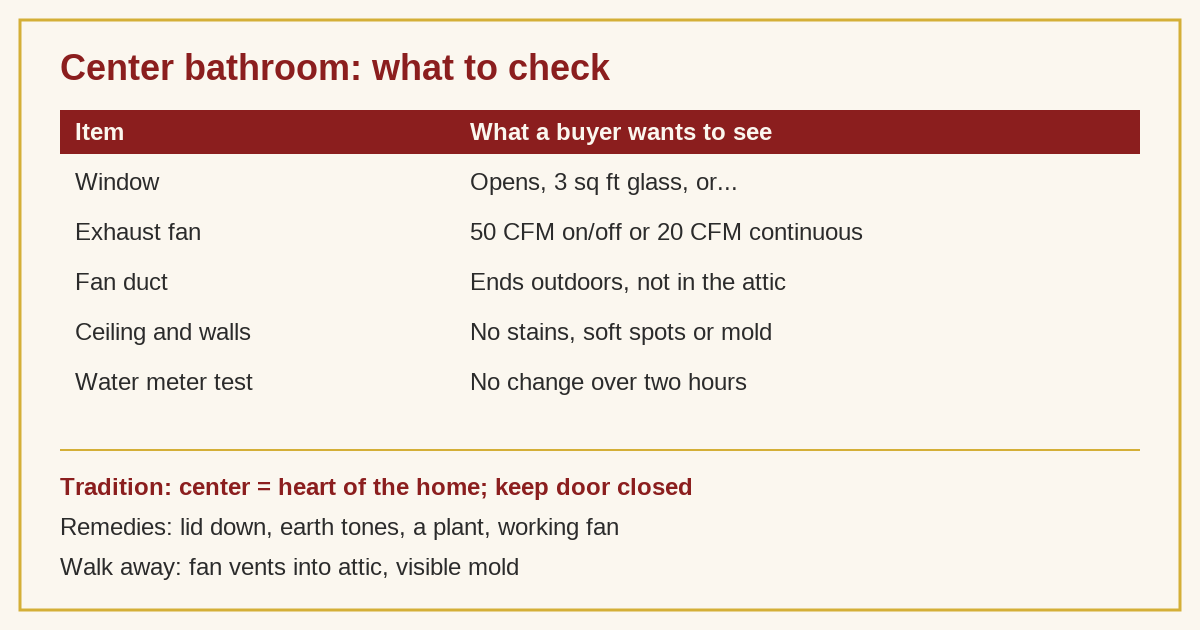
A center bathroom usually has no window. Under the 2024 International Residential Code as summarised by Jaspector, a bathroom needs either at least 3 square feet of glazed area with half of it openable, or a mechanical exhaust fan of 50 CFM when run intermittently or 20 CFM when run continuously. The fan has to discharge outdoors; a duct that ends in an attic, crawlspace, garage or other interior space is not allowed.
According to the EPA, bathroom fans that vent outside remove pollutants from the room and raise the outdoor air ventilation rate. In a center bathroom, then, the fan matters more than anything else in the room. A fan that only pushes air into the attic leaves moisture to collect above the ceiling, and the first sign is often a stain below.
Editions and local amendments vary, and an older home may predate the rule altogether. Your building department can tell you which edition applies.
What to check at a viewing
- Turn the fan on and listen. People rarely run a loud, rattling fan, and they do run a quiet one.
- Hold a tissue to the grille. The fan should pull it firmly flat.
- If the agent allows, go into the attic and check that the duct ends at a roof or wall cap, not in loose insulation.
- Look at the ceiling and the paint near the shower for stains, bubbling or black spots.
- Test water use. The EPA suggests recording the meter reading, waiting two hours without using any water, and checking again; any change suggests a leak. Ask the seller before you do this. Leaks are common enough to justify the two hours: the EPA reports that the average home loses more than 9,300 gallons a year to them, and nine percent of homes leak 50 gallons or more a day.
- Ask how old the shower waterproofing is and whether the floor around the toilet feels soft.
To find where the center of your floor plan actually falls, use the bagua method in feng shui bagua map and floor plan. Layout ideas for the room are in feng shui bathroom layout.
Should you buy it?
| Situation | Tradition view | Practical view | Action |
|---|---|---|---|
| Quiet fan, vents outdoors, no stains | Mild concern, remedies help | Fine | Keep and apply remedies |
| Fan works but duct ends in attic | Same | Moisture risk | Price the duct fix and make it a condition |
| No fan, no window | Same | Fails the model code route | Add a vented fan before or soon after closing |
| Visible mould or soft floor | Strong concern | Repair before use | Get an inspection, reprice or walk away |
| Second bathroom elsewhere in good order | Less concern | Fine | Use the center one less and keep its door closed |
Remedies practitioners suggest
- Keep the door closed and the toilet lid down. Teachers commonly say this keeps energy from draining out.
- Bring in earth tones, such as sand and terracotta, in towels and paint. Practitioners link them to the center and to balancing water.
- Add a healthy plant if there is light, or a bright bulb if there is not.
- Fix drips and leaks promptly. A dripping tap or leaking fixture is what teachers object to most.
- Run the fan during and after showers. The code sets its rate, not how long it runs, so go by what your fan and your room need.
Where buyers slip up
- Hanging a mirror on the door as a cure and never checking the fan.
- Assuming a newer house has a vented fan. Check each one.
- Moving the toilet out of the center during a remodel without a permit. Many places require one for moved plumbing, so ask first.
When to walk away
Do not buy without a repair price if the fan vents into the attic and the attic shows damp insulation or stains, or if there is active mould or a soft floor. In a sound room with a good fan, the tradition becomes a design preference, and the remedies above cost little.
FAQ
Is a bathroom in the center of the house bad feng shui?
Practitioners often count it as a drain on the home because the center is its core. They also say remedies work: keep the door closed, keep the room clean and in repair, and use earth tones and a plant. No remedy is guaranteed, and for a buyer the practical checks matter more.
Does a bathroom without a window need a fan?
The 2024 model code as summarised requires either at least 3 square feet of glazed area with half openable, or an exhaust fan of 50 CFM intermittent or 20 CFM continuous. Without a window, the fan route applies, and it must vent outdoors.
Can a bathroom fan vent into the attic?
No. The model code summary says termination into an attic, crawlspace, garage or interior space is prohibited; the duct ends at an exterior cap with a damper. Check this at the viewing.
How do I check for a hidden leak in a bathroom?
The EPA suggests recording the water meter, using no water for two hours, and checking again; any change suggests a leak. Also look for ceiling stains below, a soft floor near the toilet and loose tiles.
What is the best cure for a center bathroom?
Practitioners most often suggest a closed door, lid down, an earth-toned palette and a plant. On the practical side, a quiet fan that vents outside is the one change that protects the house itself.
At your next viewing
Run the fan, do the tissue test and look hard at the ceiling. Choosing between houses? Add what you find to the feng shui home buying checklist.
Sources
Checked November 2026. The code figures are from a paraphrase of the model code; confirm the adopted edition locally.
- Jaspector, IRC 2024 bathroom exhaust fan (R303.3), a paraphrase of the ICC model code
- U.S. EPA, Improving Indoor Air
- U.S. EPA WaterSense, Fix a Leak Week
Editorial note: Feng shui is presented here as a cultural and design tradition, not as a guarantee of any outcome. Confirm legal, financial and inspection questions with a licensed professional in your area.