Seasonal feng shui starts from a claim most year-round advice skips: a home balanced in one season is not automatically balanced in the next. In five-element theory, the system feng shui shares with traditional Chinese medicine, each season carries its own element, and autumn carries metal.
Metal in this system is not mainly a material. It is a phase description. The traditional picture of autumn is a harvest brought in and weighed, a field cut back to stubble, air losing its moisture, and light going pale and low. The traditional picture of metal is structure, refinement, and an edge that separates what is kept from what is discarded. The system matched the season to the element because the two descriptions rhyme. Everything in this guide follows from that match: the direction (west), the colour (white), the climate (dryness), and the two pieces of behaviour the season is said to ask for, gathering in and letting go.
This guide is published in the season's last fortnight, after Shuangjiang, Frost's Descent, has passed and before Lidong closes the season on November 7. It still covers the whole season, because the calendar table below is the part readers return to each year, and it marks the places where late-autumn practice differs from September practice. Tradition is framed as tradition throughout. Where a claim can be checked (sun angles, humidity, the state of your gutters), the guide says how to check it.
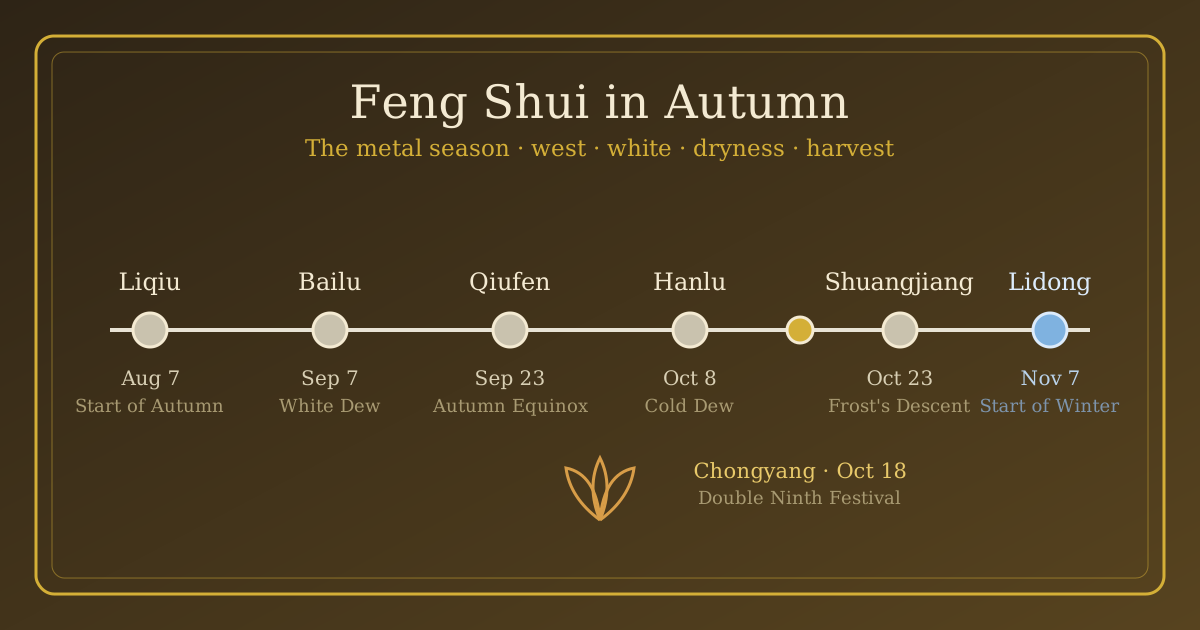
The autumn calendar: six solar terms and two festivals
The traditional Chinese calendar divides the solar year into 24 solar terms, each tied to a position of the sun, and autumn owns six of them. The 2026 dates below follow the published 2026 solar-term table (Liqiu falls on August 7 in 2026; in other years each term can move by a day). Two lunar festivals sit inside the same span and are placed on the table where they fall.
| When in 2026 | Term or festival | What shifts | The home task tradition attaches to it |
|---|---|---|---|
| August 7 | Liqiu, Start of Autumn | The season turns on the calendar while the weather is still hot in most places | None that cannot wait. Note the date, change nothing yet |
| August 23 | Chushu, End of Heat | Nights begin to cool; the first real break in summer heat | Air the house at night again; wash and store the heaviest summer bedding |
| September 7 | Bailu, White Dew | Dew forms on clear nights; the dry side of the year starts | First humidity check with a hygrometer as heating season approaches |
| September 23 | Qiufen, Autumn Equinox | Day and night are equal; the Mid-Autumn Festival (15th day of the 8th lunar month) falls in this stretch | The family festival of the season: a shared meal, mooncakes, the moon watched from a window, a balcony, or a roof |
| October 8 | Hanlu, Cold Dew | Dew turns cold; leaves colour and begin to fall | Wardrobe swap; garden harvest brought in; gutters checked once leaves are down |
| October 18 | Chongyang, the Double Ninth Festival | Ninth day of the ninth lunar month, a doubled yang date | Climb high ground, chrysanthemums on the table, time given to elders |
| October 23 | Shuangjiang, Frost's Descent | First frosts in the north of China; the last autumn term | Outdoor taps and hoses dealt with before frost; tools cleaned and stored |
| November 7 | Lidong, Start of Winter | Autumn ends on the calendar | Hand over to the water season; the winter guide takes it from here |
Two things about this table are worth stating plainly. First, the solar terms are astronomy, not weather forecasts. Liqiu can arrive in a heatwave and Shuangjiang in a mild October, and the home tasks follow your own weather, not the term name. Second, the festivals run on the lunar calendar, so their Gregorian dates move each year even though their lunar dates do not. Chongyang was October 18 in 2026 and falls on October 8 in 2027, for example. The five elements balancing guide sets out the correspondence system and the two cycles behind this table for readers who want the theory in full.
What metal means, in the system's own terms
The correspondence table gives metal a full row, and the row is the season's brief.
| Correspondence | Metal, as tradition states it |
|---|---|
| Season | Autumn |
| Direction | West |
| Colours | White, pale grey, metallic tones |
| Climate | Dryness |
| Organs in the TCM pairing | Lungs and large intestine |
| Emotion in the TCM pairing | Grief |
| Taste in the TCM pairing | Pungent |
The organ and emotion pairings come from the medical side of the tradition and are reported here as part of that tradition, not as health claims. What a home guide can use from the row is the direction, the colours, and the climate, plus the two cycles that say how metal relates to its neighbours.
In the generating cycle, earth generates metal (metal is drawn out of the ground) and metal generates water (the teaching image is water collecting on, and carried by, metal). In the controlling cycle, fire tempers metal and metal cuts wood. Practitioners translate those two sentences into proportion rules for an autumn room. Earth tones are the support layer, because earth feeds the season's element. Water colours are used sparingly and calmly, because the year is heading that way but has not arrived. Fire is the small, deliberate note: a lamp's warm bulb, a red-brown cushion, candlelight at a meal, enough to keep a pale room from feeling cold, not enough to fight the season. And wood, the green and growing layer of spring and summer, is the layer that gets edited down: plants pruned or brought in, green softened, the room's lines made clearer. The colours by room guide works the palette out room by room, and the front door colours by direction guide covers the door itself, including the west-facing case.
None of this requires a reader to believe the cycle moves anything. The proportion rules produce a recognisable room either way: pale and ordered, warmed by ochre and one or two fire notes, with the summer's green edited back. People who live in northern countries furnish that room every October without knowing its element name.
Advertisement
West rooms and the low sun
Autumn is the season when the west side of a home announces itself. The sun sets earlier and lower, and for a few weeks it comes straight through west glass at sitting height in the late afternoon, at an angle summer never produces because the summer sun is still high at that hour. A west living room that was pleasant in July can be unusable at five o'clock in October: glare on the television, a hot stripe across the sofa, and a room that then goes dark within the hour.
Tradition gives the west to metal and asks for clarity there. The building layer asks for three specific things, and the two lists overlap more than usual in this room.
Cut the glare, keep the light. A sheer curtain, a light blind, or a film on the worst pane takes the edge off the low sun without closing the room down at the brightest hour it has left. Heavy blackout belongs to bedrooms and to winter evenings. In an autumn west room it throws away the season's best light to fix a one-hour problem.
Place screens and desks across the light, not against it. A television facing a west window reflects it. A desk with its back to a west window puts the glare on the screen. Side-on placement is the fix in both cases, and it costs nothing but ten minutes with the furniture. The lighting guide grades lamps by the job each one does; in autumn the grading changes because the daylight shift moves, and the lamp that was decorative in August is the room's main light by late October.
Bring the lamp hour forward. The practical autumn habit is a timer or a routine: lamps on an hour earlier than in summer, in the rooms people actually sit in, so the home does not fall into a grey half-light between sunset and the moment someone finally gets up to switch a light on. Tradition describes this as keeping a measured amount of fire in a metal season. A light meter would describe the same rooms as adequately lit. Both descriptions point at the same switch.
East rooms have the mirror-image experience, a bright early morning that arrives later each week, and bedrooms there may want the blackout layer the living room was just told to avoid. The season does not issue one instruction for the whole home. It issues one per orientation, which is the oldest habit in the whole system.
Dry air: the season's checkable problem
Of everything the correspondence table says about autumn, dryness is the claim a reader can test with an instrument that costs less than a houseplant. As outdoor air cools and heating starts, indoor relative humidity falls. Wood shrinks and can crack, houseplants crisp at the leaf edges, static builds on synthetic fabrics, and people notice dry skin and throats. None of that needs an element theory to explain it, and the tradition's contribution is mainly that it told households to expect the season to dry out, centuries before the hygrometer.
The measured version of the advice is short. The US Environmental Protection Agency's guidance on mould and moisture advises keeping indoor relative humidity below 60 percent, and ideally between 30 and 50 percent. Autumn is the season when homes drift out of that band at the low end. A small hygrometer in the main living room and one in a bedroom will tell you where your home sits. Then:
- Below the band: a humidifier is the standard answer, used with discipline. A humidifier that is not emptied, dried, and cleaned on its maker's schedule trades dry air for a dirtier problem, so the appliance only counts as a fix if the cleaning routine comes with it. Bowls of water and extra plants move the number by very little; they are decoration, not equipment.
- Inside the band: do nothing. A home sitting between 30 and 50 percent in October is a home whose autumn air is already handled, whatever its element balance.
- Above the band: unusual in a heated autumn home, and usually local: a bathroom or kitchen with poor extraction, or a damp problem that predates the season. That is a building issue, not a seasonal one, and it belongs to the condensation and ventilation advice in the winter guide, which covers the wet side of the year in full.
Plants sit on both sides of this section. Tradition sorts them by element in the plants by element guide, and autumn is when tender plants come in from balconies and windowsills before first frost, get checked for insects while they are still outside, and lose their dead growth. That cutting back is the season's letting-go verb applied at the windowsill, and it is also ordinary plant care. The two descriptions keep meeting like this, and the guide does not apologise for it: a tradition that survived by describing real seasonal work will often describe real seasonal work.
Gather in: kitchen, garden, and tools
Autumn's first verb is gather. In a farming calendar that meant the harvest, and in a modern flat it still means a specific round of bringing in and putting by, different from the deep storage the winter guide describes. Winter storage is about holding. Autumn gathering is about processing what the growing year produced before it spoils.
The kitchen. The traditional autumn kitchen preserves: pickles and ferments started, herbs dried, fruit bottled or frozen, root vegetables and squash bought in season and stored cool and dark. The feng shui layer is the ordinary kitchen order from the kitchen layout guide, kept up while the preserving happens: clear worktops, jars labelled and dated, the oldest stock used first. A larder with dates on it is the metal element's structure applied to food, and it is also how a household avoids finding a jar of unknown age in February.
The garden and the front of the house. The front yard guide covers the approach to the house as a whole. The autumn-specific round is shorter: leaves cleared from paths and steps, where they turn slippery when wet; gutters cleared once the leaves are down, following the ladder and safety discipline in the clean gutters guide; outdoor furniture cleaned before it is covered or stored, so it does not spend four months under a cover with the dirt sealed in; and the last cut and feed the lawn gets before winter, where your climate calls for one.
The tools. Metal season is a fitting time to care for actual metal. Garden tools cleaned, dried, lightly oiled, and stored out of the damp; kitchen knives honed; scissors, hinges, and locks given the drop of oil they have been asking for since spring. Practitioners who like the correspondence will call this honouring the season's element. A toolmaker would call it the difference between a spade that lasts twenty years and one that lasts four. Both are describing the same October afternoon's work.
Let go: the autumn sort
The season's second verb is release, and it is the one that separates an autumn guide from a generic decluttering article. The room-by-room decluttering guide covers the method. The autumn version is defined by its timing: it sorts the things the turning season makes decidable.
Summer things are decidable in October because the evidence is in. The chair that was never sat in, the barbecue tool that was never used, the summer clothes that were never worn this year: in July each of them still had a possible season ahead of it, and in October each has a completed season behind it. The same logic runs through the wardrobe swap, which is the autumn sort's fixed centre. Summer clothes are washed, repaired where they need it, and stored; winter clothes come out, get tried, and lose the pieces that no longer fit or no longer get worn. Paper follows the same rule: the year's receipts, school papers, and manuals are easiest to judge in the month when the year is visibly three quarters done.
Tradition frames this as metal doing its work, the edge that separates kept from released, and links it to the season's emotion pairing, grief, in a plain way: autumn is when the year lets go of its growth, and households use the same weeks to let go of what the year showed they do not use. A reader does not need the frame to get the use of the timing. Sorting in October works because October supplies the evidence. Sorting in March relies on predictions about a summer that has not happened yet.
One boundary belongs here. Letting go is for objects with a season's evidence behind them, not for a purge. The tradition's own image is a harvest, and a harvest keeps the grain. What a thing cost, who gave it, and whether its season may simply have been an odd one are all part of the judgement, and the metal edge in the teaching image refines more than it discards.
Two festivals, translated for a flat
The season's two festivals give the autumn home its social shape, and both translate down to the scale of a small flat without losing their point.
The Mid-Autumn Festival, on the 15th day of the 8th lunar month around the equinox, is the harvest's family festival: a shared meal, mooncakes cut and divided, and the full moon watched deliberately, from a window, a balcony, a roof, or a walk taken for the purpose. The home version asks for a table cleared and set for people rather than for storage, one evening in the season when the sitting room is used at full capacity. Lanterns are part of the festival's decoration in many places; lit candles and lanterns follow the ordinary fire rules, attended, on stable surfaces, away from curtains and paper, and out before sleep.
Chongyang, the Double Ninth, on October 18 in 2026, is the season's second marker: the ninth day of the ninth lunar month, nine being a yang number in the I Ching tradition, doubled. Its customs are climbing to high ground (the festival is also called the Height Ascending Festival), admiring chrysanthemums, wearing zhuyu, eating Chongyang cake, and, in Hong Kong and Guangdong especially, visiting and tending family graves alongside Qingming in spring. In mainland China the day is also marked officially as a day for honouring older people, and Taiwan marks it as Senior Citizens' Day. The home translations need no altitude and no ancestry nearby: a walk that goes uphill, chrysanthemums in a vase (the season's flower, in the ground and in florists through the autumn), and the telephone call or visit to an older relative that the festival exists to prompt. A household that does those three things has kept the festival in full, at flat scale.
A labelled hypothetical: one west-facing flat, September to November
The example below is invented to show the season's sequence in one home. The flat, its occupants, and the results are illustrative, not a report of a real household.
A couple rent a third-floor flat with a west-facing living room, a small balcony with pots, and a bedroom that faces east. In the first week of September they put a hygrometer in the living room and read the calendar table. The room reads 52 percent, inside the EPA band at its top edge, so they do nothing about air and start with light instead: a sheer curtain goes up on the living room window before the equinox, and the television moves to the side wall the same afternoon. By Qiufen the five o'clock glare problem the previous October had made unbearable is a brightness they sit in rather than squint at.
October is the working month. The wardrobe swap takes one weekend morning, and two bags of unworn clothes leave the flat because the summer just finished supplied the evidence. The balcony harvest, tomatoes and herbs, comes in across Hanlu; the tender pots move indoors before Shuangjiang, checked for insects on the balcony first. The hygrometer slides to 31 percent in the last week of October as the heating settles in, still inside the band, so the humidifier stays in its cupboard and the couple note the reading to watch in November. On Chongyang, October 18, they walk up the steepest hill in their part of the city with the husband's mother, buy chrysanthemums on the way home, and eat cake she brought. The gutters are the landlord's job in this building, so their version of that task is an email reporting the downpipe that overflowed in September, sent while the leaves were still falling.
By Lidong on November 7, in this example, the flat has pale linen on the table, ochre cushions the couple already owned on the sofa, tools cleaned in a box by the door, and a larder shelf of labelled jars. The tradition would describe the flat as gathered and released, a metal season kept. The couple's own description is shorter: the flat fits October. Both descriptions are allowed to be true, and the flat does not care which one is used.
Where autumn practice stops
Feng shui is presented in this guide as a tradition, with its reasoning shown and its checkable layer kept separate: sun angles, humidity readings, gutter state, and tool condition can all be tested, and claims about energy, luck, and health cannot. The TCM pairings for the season (lungs, large intestine, grief) are reported as the tradition's own associations. They are not medical advice, they diagnose nothing, and a reader with a health concern needs a clinician, not a correspondence table.
The safety rules that appear along the way outrank the tradition wherever they meet. Candles and lanterns are attended or they are out. Ladders for gutters follow the discipline in the gutters guide, and a roof you are not equipped for belongs to a professional. A humidifier earns its place only with its cleaning routine attached. A placement that a safety rule forbids is not a placement the tradition gets to argue with, in autumn or in any other season.