The simplest chart in the family
Every other system on this site asks a reader to learn a machinery. BaZi wants the stems, the branches, the hidden stems, and the Ten Gods. Zi Wei Dou Shu wants twelve palaces and fourteen major stars. Cheng Gu wants four numbers and the ability to add.
The method works like this. Take a birth moment in the Chinese lunar calendar. The stem-branch year, the month, the day, and the double-hour each carry a fixed weight, printed in tables that almanacs have carried for centuries. Add the four weights. The sum is the person's bone weight, expressed in liang and qian, the old market units, ten qian to one liang. Then find that total in a set of short verses called the Cheng Gu Ge, the Song on Weighing Bones, and read the verse that matches. That is the entire reading. No element cycle, no luck pillars, no palace moves when the decade turns.
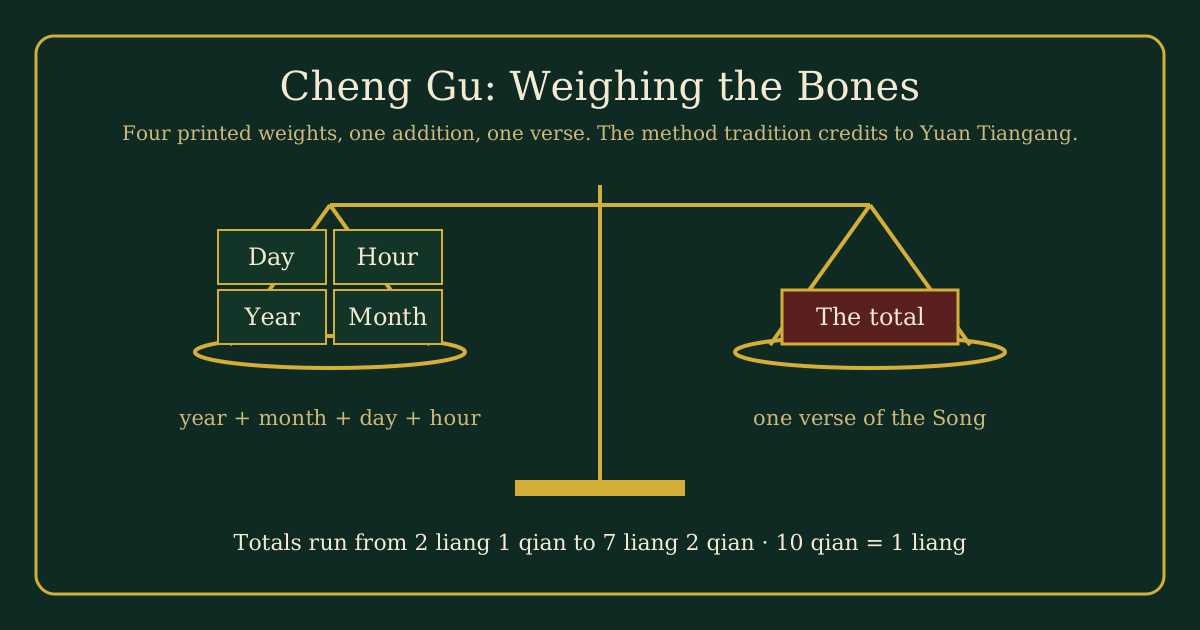
Tradition credits the method to Yuan Tiangang (573-645), the Tang dynasty reader whose face-reading fame is recorded in his own era and whose name later attached itself to the prophecy book Tui Bei Tu. The credit should be read the way this site reads all such credits: as the tradition's attribution, not a documented authorship. What is documented is the song's long life in print. Almanacs, the Tong Shu tradition this site's date-selection guide works from, carried the weighing tables and the verses where any household could reach them, and that placement explains the system's character. Cheng Gu is fortune telling built for a printed page at the back of a calendar, usable by a grandmother with no teacher in the room.
The four lookups
A bone weight has four ingredients, and each comes from a different table. The year table is keyed to the sixty stem-branch years, so it repeats every sixty years. The month table runs over the twelve lunar months. The day table runs over the thirty days of a lunar month. The hour table runs over the twelve double-hours. All four tables are printed below in the form the almanac tradition prints them, with weights given as decimals of a liang: 1.2 means 1 liang 2 qian, 0.7 means 7 qian.
The year table, by animal
Find your lunar birth year's stem-branch pair under its animal. The Gregorian years in brackets are the two most recent occurrences, given to help you locate the pair; the pair itself is what the table prices.
| Animal | The five stem-branch years and their weights |
|---|---|
| Rat | Jia Zi 1.2 · Bing Zi 1.6 · Wu Zi 1.5 · Geng Zi 0.7 · Ren Zi 0.5 |
| Ox | Yi Chou 0.9 · Ding Chou 0.8 · Ji Chou 0.7 · Xin Chou 0.7 · Gui Chou 0.7 |
| Tiger | Bing Yin 0.6 · Wu Yin 0.8 · Geng Yin 0.9 · Ren Yin 0.9 · Jia Yin 1.2 |
| Rabbit | Ding Mao 0.7 · Ji Mao 1.9 · Xin Mao 1.2 · Gui Mao 1.2 · Yi Mao 0.8 |
| Dragon | Wu Chen 1.2 · Geng Chen 1.2 · Ren Chen 1.0 · Jia Chen 0.8 · Bing Chen 0.8 |
| Snake | Ji Si 0.5 · Xin Si 0.6 · Gui Si 0.7 · Yi Si 0.7 · Ding Si 0.6 |
| Horse | Geng Wu 0.9 · Ren Wu 0.8 · Jia Wu 1.5 · Bing Wu 1.3 · Wu Wu 1.9 |
| Goat | Xin Wei 0.8 · Gui Wei 0.7 · Yi Wei 0.6 · Ding Wei 0.5 · Ji Wei 0.6 |
| Monkey | Ren Shen 0.7 · Jia Shen 0.5 · Bing Shen 0.5 · Wu Shen 1.4 · Geng Shen 0.8 |
| Rooster | Gui You 0.8 · Yi You 1.5 · Ding You 1.4 · Ji You 0.5 · Xin You 1.6 |
| Dog | Jia Xu 1.5 · Bing Xu 0.6 · Wu Xu 1.4 · Geng Xu 0.9 · Ren Xu 1.0 |
| Pig | Yi Hai 0.9 · Ding Hai 1.6 · Ji Hai 0.9 · Xin Hai 1.7 · Gui Hai 0.6 (see the variants note below) |
Two things are worth seeing in this table before you use it. First, the animal alone settles nothing: the five Rat years run from 0.5 to 1.6, a wider spread than the whole month table contains. The stem matters as much as the branch, which is the same lesson the elements guide teaches for the zodiac year. Second, the table has no pattern a reader can shortcut. Ji Mao and Wu Wu, an Earth Rabbit year and an Earth Horse year, tie at the top at 1.9, and the five 0.5 years scatter across Rat, Snake, Goat, and Monkey twice. The weights are a received list, not a formula, and they have to be looked up one by one.
The month table
| Lunar month | 1 | 2 | 3 | 4 | 5 | 6 | 7 | 8 | 9 | 10 | 11 | 12 |
|---|---|---|---|---|---|---|---|---|---|---|---|---|
| Weight | 0.6 | 0.7 | 1.8 | 0.9 | 0.5 | 1.6 | 0.9 | 1.5 | 1.8 | 0.8 | 0.9 | 0.5 |
The third and ninth months tie as the heaviest at 1.8, and the fifth and twelfth are the lightest at 0.5. The month is a lunar month, counted from Lunar New Year, not a Gregorian month and not a solar-term month of the kind BaZi chart work uses. A birth in a leap month follows the rule the calculators print: the first half of the leap month counts as that month, the second half as the next one.
The day table
| Lunar day | Weight | Lunar day | Weight | Lunar day | Weight |
|---|---|---|---|---|---|
| 1 | 0.5 | 11 | 0.9 | 21 | 1.0 |
| 2 | 1.0 | 12 | 1.7 | 22 | 0.9 |
| 3 | 0.8 | 13 | 0.8 | 23 | 0.8 |
| 4 | 1.5 | 14 | 1.7 | 24 | 0.9 |
| 5 | 1.6 | 15 | 1.0 | 25 | 1.5 |
| 6 | 1.5 | 16 | 0.8 | 26 | 1.8 |
| 7 | 0.8 | 17 | 0.9 | 27 | 0.7 |
| 8 | 1.6 | 18 | 1.8 | 28 | 0.8 |
| 9 | 0.8 | 19 | 0.5 | 29 | 1.6 |
| 10 | 1.6 | 20 | 1.5 | 30 | 0.6 |
The day table carries more weight than its size suggests. Its range, 0.5 to 1.8, is nearly the year table's range, so the day you were born moves a total almost as much as the year does. Days 18 and 26 are the heaviest at 1.8. Days 1 and 19 are the lightest at 0.5.
The hour table
| Double-hour | Branch | Clock time | Weight |
|---|---|---|---|
| Zi | Rat hour | 23:00-01:00 | 1.6 |
| Chou | Ox hour | 01:00-03:00 | 0.6 |
| Yin | Tiger hour | 03:00-05:00 | 0.7 |
| Mao | Rabbit hour | 05:00-07:00 | 1.0 |
| Chen | Dragon hour | 07:00-09:00 | 0.9 |
| Si | Snake hour | 09:00-11:00 | 1.6 |
| Wu | Horse hour | 11:00-13:00 | 1.0 |
| Wei | Goat hour | 13:00-15:00 | 0.8 |
| Shen | Monkey hour | 15:00-17:00 | 0.8 |
| You | Rooster hour | 17:00-19:00 | 0.9 |
| Xu | Dog hour | 19:00-21:00 | 0.6 |
| Hai | Pig hour | 21:00-23:00 | 0.6 |
The branch clock behind this table is the same one the birth hour guide sets out in full. Zi and Si tie as the heaviest hours at 1.6, and Zi needs its boundary rule stated: because it straddles midnight, the calculators that print this method count a birth from 23:00 to midnight under the next day's date, which changes the day weight too. If your birth falls in that hour, write down which side of midnight it fell on before you add anything.
Advertisement
Two worked examples
The example the sources themselves print. The worked example carried by the bone-weight references is a birth in the Jia Zi year, on the first day of the first lunar month, in the Zi double-hour, the small hours of the morning. The four lookups: Jia Zi year 1.2, first month 0.6, first day 0.5, Zi hour 1.6. The addition is 1.2 + 0.6 + 0.5 + 1.6 = 3.9, a bone weight of 3 liang 9 qian. Every figure in that example can be checked against the tables above, and the example is a good first test of any other table you meet: a chart that cannot reproduce 3.9 for this birth has a copying error in it somewhere.
A second example, labelled hypothetical. Take a birth in the Geng Wu year (1990 in the recent cycle), on the fifteenth day of the seventh lunar month, in the Wu double-hour, late morning. The four lookups: Geng Wu year 0.9, seventh month 0.9, fifteenth day 1.0, Wu hour 1.0. The addition is 0.9 + 0.9 + 1.0 + 1.0 = 3.8, a bone weight of 3 liang 8 qian. In the men's song set, the 3 liang 8 qian verse is one of the best known in the whole collection. In translation it runs, roughly: the bones of this life are of the purest and highest kind, the name enters the school registers early, and at about thirty-six the blue scholar's gown is exchanged for the red robe of office. Read it as the tradition's own picture of a promising start, a school register, an examination career, a promotion in the mid-thirties, and notice how much of the verse is the furniture of a Tang and Song dynasty life. The weighing took four lookups. The verse is doing period storytelling, and the two should not be confused.
Reading the total: the song sets and the three bands
The totals run in steps of one qian from 2 liang 1 qian upward, and each step has its own verse of four lines. The song circulates in two sets. The men's set carries a verse for every step from 2.1 to 7.2, fifty-two verses in all. The women's set runs from 2.1 to 7.1, fifty-one verses. The weighing never differs; only the book you open afterwards does.
Inside the tradition, the verses climb with the weight. The low verses describe hardship in plain terms, the middle verses describe work, setbacks, and a later steadiness, and the high verses describe rank, comfort, and ease. Later writers, sorting the song for quick reference, group the totals into three bands: 2 liang 1 qian to 3 liang 7 qian as light, 3 liang 8 qian to 5 liang 4 qian as middling, and 5 liang 5 qian upward as heavy. Those bands are a commentary habit, not part of the song itself, and the song's own texts are more varied than the bands suggest: some middling verses are cheerful and some high verses carry warnings about holding on to what was inherited. Anyone who tells you the system is simply heavier-is-better has read the bands and skipped the verses.
The two verse sets also deserve a plain description, because the difference between them is the most instructive thing in the whole system. The arithmetic is shared. The storytelling is not. The men's verses were written for a life the agrarian state could picture for a man: examinations, office, land, sons, a household founded. The women's verses were written for the life that same society assigned to a woman: marriage, the husband's family, children, the running of a home. The same 3 liang 9 qian that sends a man out to make his way sends a woman, in her verse, through a hard middle to a steadier end at home. Modern editions keep both sets because almanacs keep both sets. Read them the way you would read any period document, as evidence of what the world that wrote them valued, and the gender split stops being a mystery of the method and becomes a fact about its era.
The unreachable top verse
Here is a piece of arithmetic the song's printers appear never to have done, and it is the sharpest limit on the system that this guide can offer.
The heaviest entry in each table is fixed. The year table tops out at 1.9, reached by Ji Mao and by Wu Wu. The month table tops out at 1.8, in the third and ninth months. The day table tops out at 1.8, on the eighteenth and twenty-sixth days. The hour table tops out at 1.6, at Zi and at Si. Add the four maxima: 1.9 + 1.8 + 1.8 + 1.6 = 7.1. The heaviest bone weight the tables can actually produce is 7 liang 1 qian.
The men's song set nevertheless prints a verse at 7 liang 2 qian, and it is a famous one: in translation it says this grade is rarely born in the world, the product of ten generations of accumulated good, a life under the Purple Star's light fit to rule in peace. No birth the tables describe can receive it. The floor of the system is exact, by the same arithmetic: 0.5 + 0.5 + 0.5 + 0.6 = 2.1, which is precisely where the verses begin. The bottom of the song is reachable and the top is not, overshooting by a single qian, as if the verse list was drafted to a rounder ambition than the tables were. A system this simple can be audited completely, and when you audit it, that is what you find: fifty-two verses on the men's side, fifty-one of them reachable.
Where printed tables disagree
Cheng Gu tables have been copied by hand, by woodblock, by almanac printers, and now by websites copying websites, and the copies are not all identical. Three disagreements surfaced while the tables in this guide were being checked across independent printings, and a careful reader should know all three.
Gui Hai, the last year of the cycle. Most printings, including the almanac table this guide follows, give the Gui Hai year (1923, 1983) a weight of 0.6. A second family of printings gives 0.7. The split is old enough that at least one published table contradicts itself between its own summary list and its year-by-year list. If your birth year is Gui Hai, your total is one of two values a qian apart, and the verse it selects depends on which printing your reader used. Say which table you used.
Days 18 and 20. Chinese printings agree on 1.8 for the eighteenth day and 1.5 for the twentieth. Some English-language charts print 0.8 and 1.0 for those two days, which breaks the day table's own pattern and disagrees with the Chinese sources. This guide follows the Chinese printings.
Single outlier entries travel fast. Any one site can carry a typo that a hundred others then repeat, because Cheng Gu content is copied more than it is re-derived. The defence is the worked example in this guide: test any new table against the Jia Zi birth, which must come out at 3.9, and against the maximum, which must come out at 7.1. A table that fails either test has an error in it, wherever the error sits.
Cheng Gu next to BaZi: same birth, different question
Cheng Gu and BaZi start from the identical four facts, the year, month, day, and hour of a birth, and the BaZi guide on this site builds its whole reading from them. The kinship ends at the input. BaZi converts the four facts into eight characters and reads the relationships among them: which element the Day Master is, what supports it, what drains it, how the ten-year luck pillars move against it. Two births an hour apart can read very differently. Cheng Gu converts the same four facts into four numbers and adds them, and the reading is finished. The comparison guide on this site, Chinese fortune-telling methods compared, places Cheng Gu where it belongs in the family: at the shallow end, next to the almanac, a long way from the twelve palaces of Zi Wei Dou Shu.
The shallowness has a measurable size. The men's song set holds fifty-two verses, so the system sorts every birth it will ever see into fifty-two outcomes. Everyone born in the same double-hour of the same lunar day shares one total and one verse, whether they were born in Chengdu or Toronto. A BaZi reader would call that a first screen at best, and the tradition itself seems to agree: the almanacs that print the bone tables also print the machinery for fuller charts, and the bone weight sits in the quick-reference pages, not the chart pages. What Cheng Gu offers in exchange is total transparency. Every step can be checked by a reader with the tables in front of them, including the steps where the system fails its own audit, like the unreachable top verse. Few fortune-telling systems let you verify them that completely.
One more neighbour is worth naming. The Na Yin guide on this site explains the sixty-year cycle's second element layer, the melodic element each stem-branch pair carries. Cheng Gu uses the same sixty pairs and prices them, where Na Yin classifies them. A pair like Ji Mao is Earth by its stem, carries a Na Yin of Earth as well (city wall earth, in the traditional name), and weighs 1.9, the joint heaviest year in the bone table. The sixty pairs are a shared spine; each system hangs a different reading instrument on it.
Limits, stated plainly
This guide describes a tradition. The checkable parts were checked: the four tables were compared across independent Chinese and English printings before being set here, the worked examples were added from the printed values, the maximum and minimum were computed from the tables themselves, and Yuan Tiangang's dates and career are the ones his encyclopedia entry records. Where printings disagree, the disagreement is printed in the open, with the value this guide follows named.
The verses themselves are reported as the tradition's writing, never as findings about any reader. No evidence shows a birth date fixing a life, at any weight, and a total built from four calendar lookups has no mechanism by which it could. What the system genuinely documents is something else: a millennium of households wanting a fate they could compute at the kitchen table, in a form short enough to print at the back of a calendar. Read Cheng Gu as that document, weigh a birth or two for the pleasure of the arithmetic, and it gives you everything it has to give.