Short answer
A Tong Shu, also called a Chinese almanac or Huang Li, is a traditional calendar reference that layers dates with systems such as the sexagenary stem-and-branch cycle, solar terms, zodiac relationships, and the 12 Day Officers (Jian Chu). Readers often use it for reflection around weddings, moving, opening a business, travel, or family rituals. It is not evidence that a date determines a contract, a medical result, a relationship, a financial return, or someone’s safety.
The most useful modern practice is simple: use the almanac to learn the vocabulary and create a pause before an important event. Then make the real decision from availability, consent, legal requirements, health advice, budget, travel conditions, contracts, and the people involved. A date label should never pressure anyone to ignore those facts.
What people mean by Tong Shu, Tung Shing, and Huang Li
Names vary by language, place, publisher, and tradition. Tong Shu (通書) and Tong Sheng/Tung Shing (通勝) are common names for Chinese almanac publications; Huang Li (黃曆) is another widely used name. A printed or digital almanac can include calendar conversion, lunar dates, solar terms, a day’s stem-and-branch notation, zodiac labels, festival information, and traditional activity suggestions.
That breadth is why two apps can disagree while both call themselves a Chinese almanac. One may show a simplified 12 Officer label; another may add lunar mansions, personal chart details, local time, annual systems, or a publisher’s own rules. The Online Tong Shu Plotter is a useful current example: its output names the 12 Day Officers alongside solar-calendar, Na Yin, and 28-mansion layers. It is not a single universal method.
For a reader, the first job is to identify which layer a calendar is showing. A day labelled “Open,” for example, is not the same thing as a personal BaZi reading, a weather forecast, a legal deadline, or permission to sign an agreement without reading it.
The boundary that keeps a calendar useful
Treat traditional date-selection systems as cultural and interpretive.
- Do not delay emergency care, surgery, medication, or a health assessment because of an almanac label.
- Do not sign, invest, marry, buy property, resign, travel into hazardous conditions, or take legal action based on a “lucky” label alone.
- Do not tell another person that their zodiac, birth information, or a calendar day makes them unsafe, disloyal, ill, unlucky, or unsuitable.
- Do not treat a “caution” day as a reason to cancel an important commitment that has sound practical reasons to proceed.
The calendar can still be meaningful as a ritual, conversation, family preference, or planning prompt. Meaning and prediction are different claims.
The four calendar layers worth recognising
Many beginner guides jump directly to a green “good day” badge. That shortcut hides the structure a reader is trying to understand. Use this vocabulary map instead.
| Layer | What it records | What it can help you learn | What it cannot establish |
|---|---|---|---|
| Gregorian and lunar date | Calendar date and lunar-month context | How a printed almanac relates to an ordinary calendar | Whether an event will succeed |
| Solar terms (節氣) | Seasonal markers used in Chinese calendrical systems | Why some systems change their monthly context around a solar term rather than the first lunar day | A personal forecast or a medical recommendation |
| Stem-and-branch cycle | A repeating sequence combining 10 stems and 12 branches | The notation used to name years, months, days, and hours in many references | A personality diagnosis or financial advice |
| 12 Day Officers (建除十二神) | A repeating interpretive day label | The traditional vocabulary of Establish, Remove, Full, Balance, Stable, Hold, Break, Danger, Success, Receive, Open, and Close | A guarantee or prohibition for a real-world decision |
The 10 stems and 12 branches combine into a 60-step cycle. You do not need to memorise every combination to read a calendar. Start by recognising that a stem-branch label is a date notation and that the animal name is one of several associated symbols, not a complete reading of a person.
Why solar terms matter in some systems
A reader may assume a Chinese calendar changes months only on the lunar new moon. Some Tong Shu systems instead key particular calculations to the 24 solar terms (節氣). This is one reason a date can look different across an app, a printed almanac, and a personal chart method.
Do not “correct” one source with another until you know which convention each uses. Record the location, time zone, calendar basis, and method whenever the exact day matters to your tradition. If the occasion has legal, medical, travel, business, or family constraints, those details matter more than resolving a symbolic disagreement.
The 12 Day Officers: a study table, not a decision machine
The 12 Day Officers are often the first system a beginner notices. A common sequence is Establish, Remove, Full, Balance, Stable, Hold, Break, Danger, Success, Receive, Open, and Close. Traditional guides attach activity suggestions to each name. Contemporary references differ in how they calculate the officer and how strongly they treat the suggestion; IchingCheck’s overview explicitly frames the officers as an interpretive calendrical practice rather than a scientific prediction.
Use the table below as a reading aid. The middle column describes a traditional theme in plain language. The final column turns it into a safe planning question.
| Officer | Traditional theme in everyday language | A useful reflection prompt | Never use it to |
|---|---|---|---|
| Establish (建) | Beginning or setting a frame | What needs a clear start, scope, or first step? | Force a launch before it is ready |
| Remove (除) | Clearing, taking away, or maintenance | What can be retired, repaired, donated, or closed out? | Dispose of something essential impulsively |
| Full (滿) | Fullness, completion, or abundance imagery | Is the plan overfull, or is there enough time and capacity? | Claim that money or opportunities will appear |
| Balance (平) | Levelling, comparison, or adjustment | What trade-off needs an even comparison? | Avoid a necessary decision indefinitely |
| Stable (定) | Settling or making a commitment | What needs to be documented, confirmed, or made repeatable? | Sign a contract without independent review |
| Hold (執) | Maintaining, holding, or following through | What existing promise or routine needs attention? | Treat persistence as a reason to ignore harm |
| Break (破) | Breaking apart or ending | Is there a reversible way to test an old assumption? | Predict an accident, loss, or relationship end |
| Danger (危) | Caution, exposure, or heightened attention | What safety, backup, or contingency check is missing? | Delay urgent care or label a person as dangerous |
| Success (成) | Bringing a prepared effort to completion | What is already ready to finish? | Assume a project will succeed without preparation |
| Receive (收) | Collecting, receiving, or gathering | What information, payment, feedback, or materials need sorting? | Expect a windfall or a guaranteed outcome |
| Open (開) | Opening access or beginning an exchange | What conversation, invitation, or registration can be opened? | Start something without consent or due diligence |
| Close (閉) | Pausing, containing, or winding down | What boundary, archive, or recovery period is needed? | Withdraw from a responsibility that needs action |
The labels can make a planning conversation less vague. They do not change the underlying stakes. “Stable” is a good prompt to review a lease carefully; it does not make a lease safe. “Danger” is a good prompt to check weather, transport, equipment, and a backup plan; it does not forecast harm.
Advertisement
How to read a Tong Shu page without over-reading it
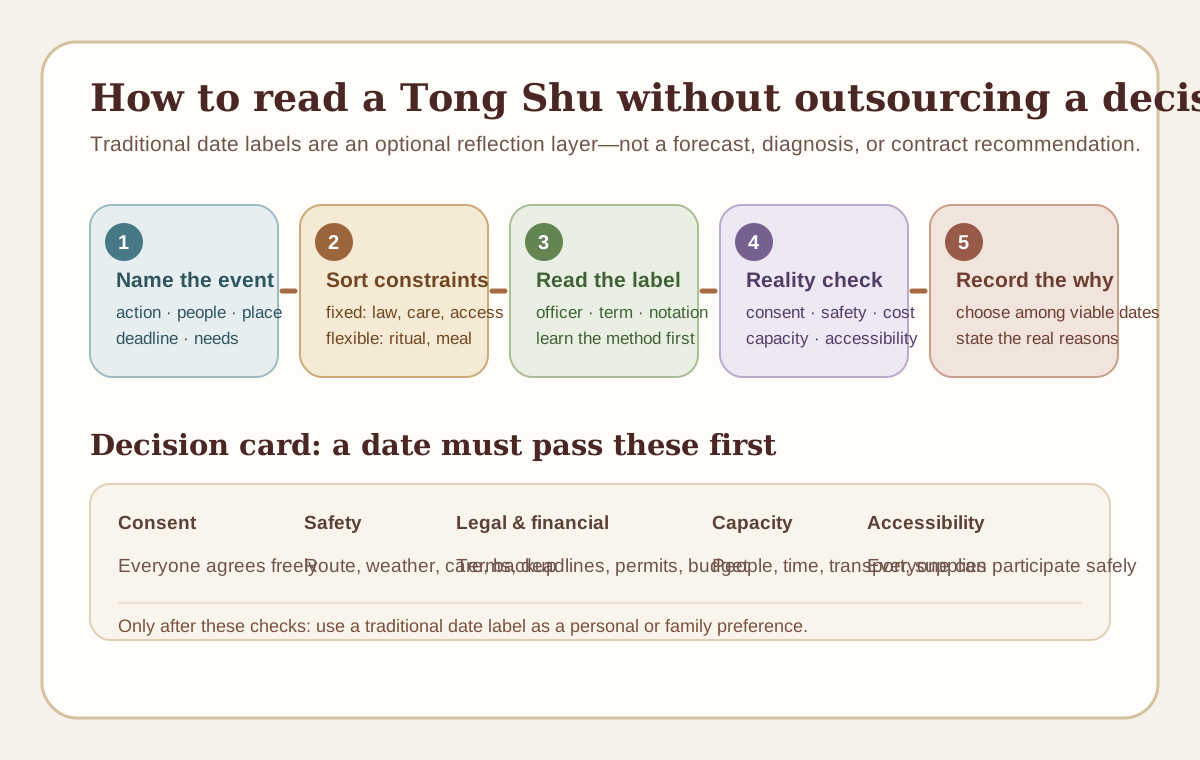
Use this five-step method when you open a calendar page or our Daily Almanac.
1. Name the event precisely
“Move house” may mean signing a lease, packing, collecting keys, arranging movers, turning on utilities, sleeping in the property, or holding a family meal. Those tasks have different constraints. Write the actual action, location, people, deadline, and non-negotiables.
Example: “Pick up keys from the landlord before 5 p.m.; elevator booking is only available Tuesday or Thursday; the child has school Wednesday; the insurance policy starts Thursday.” A date label is now one small preference inside a real plan.
2. Separate fixed dates from flexible dates
Put legal deadlines, medical appointments, visa rules, school schedules, contracts, weather windows, availability, budgets, and care needs in the fixed column. Put celebration, decoration, ceremonial timing, an optional dinner, or a private ritual in the flexible column.
This prevents an almanac from taking control of an event that cannot safely move. If a ceremony date is culturally important to a family, use it to choose among the already workable options—never to erase another person’s consent, access, work schedule, health requirement, or financial reality.
3. Read the calendar labels as prompts
Notice the date, solar term, day pillar, officer, and any publisher-provided activity list. Ask what each term is meant to represent in that system. Do not merge labels from several sites into a single score. A “good day” result from a simplified tool may not include the other layers a practitioner would use.
4. Run the practical decision card
Use this original Lucky Properties worksheet before you attach meaning to a date.
| Decision check | Yes / no question | If the answer is no |
|---|---|---|
| Consent | Has everyone who is affected agreed freely? | Pause the plan and talk, do not seek a more auspicious date |
| Safety | Are weather, travel, access, equipment, and health needs addressed? | Fix the risk or choose a safer plan |
| Legal and financial | Are permits, contract terms, insurance, deadlines, and payments understood? | Get qualified advice or more time |
| Capacity | Do the people, budget, transport, and supplies match the event? | Scale down, delegate, or reschedule |
| Accessibility | Can everyone enter, leave, rest, communicate, and participate? | Change the venue, route, timing, or support |
| Relationship | Have conflicts, expectations, and boundaries been discussed? | Have the conversation before treating the date as the problem |
| Tradition | Is there a calendar preference that matters to the people involved? | Choose among viable options or create a separate ritual |
The first six checks are not optional because the day has a pleasant label. The seventh makes space for tradition without pretending it overrules the others.
5. Record the choice and the reason
Write one sentence: “We chose Saturday because the venue is accessible, the family can attend, the contract is reviewed, and the Open-day label feels meaningful to us.” This keeps the calendar in proportion and gives you a clear explanation if someone asks why the date was selected.
A low-stakes way to make the calendar part of a routine
The safest way to begin with a Tong Shu is to use it on an event where changing the day has little cost: a family meal, a home-cleaning session, a letter to someone you miss, a small personal reset, or the order in which you complete household tasks. That lets you learn the language without attaching it to a high-stakes result.
Choose one officer label, write down its plain-language theme, and decide on a matching but ordinary action. On a “Remove” day, for instance, clear one drawer and note whether the task was actually manageable. On an “Open” day, invite a friend for a walk or open a folder you have been avoiding. On a “Close” day, archive one completed project and stop work at a planned time. The value comes from choosing a concrete action and noticing what helps you follow through; it does not come from proving the label caused a result.
| If you want to use the calendar for… | Try this | Keep the claim honest |
|---|---|---|
| A personal ritual | Pair a label with a short intention, meal, walk, or journal entry | “This day gave the ritual a shape,” not “the day changed my future” |
| Family conversation | Ask what each person wants the event to represent | “We chose a shared symbol,” not “one person’s chart decided for everyone” |
| Project planning | Use the label as a prompt to start, review, finish, or pause a task | “The prompt helped us schedule,” not “the calendar made the project succeed” |
| Learning Chinese calendrical vocabulary | Compare the app’s officer, solar term, and date notation over a month | “I learned how this tool presents the system,” not “I learned a universal verdict” |
This small-scale approach also makes disagreements easier to handle. If one relative values date selection deeply and another does not, a flexible ritual can honour the tradition without making a medical appointment, immigration deadline, or signed agreement into a symbolic conflict.
A one-month observation log
If you want to understand a particular calendar rather than simply collect favourable labels, keep a one-month log. Record the Gregorian date, the label shown by the tool, the one ordinary action you chose, and any practical condition that affected the day. A short note such as “Stable: prepared tax folder; the real obstacle was a missing receipt” is enough. At the end of the month, ask whether the labels helped you name a task, whether the routine was worth keeping, and whether any tool gave contradictory information.
Do not score the day as lucky or unlucky. A difficult day can still include a useful conversation, and an easy day can include a delayed train. The log is a way to learn how you relate to the calendar, not a test designed to prove that ordinary events are caused by a symbolic label.
Three date-selection examples
A wedding or partnership ceremony
The common search intent is “Which day is auspicious for a wedding?” The more important question is whether both people want the ceremony, can obtain the required documents, have an accessible venue, can afford the plan, and can include the people who matter.
Create a short list from practical availability first. If several dates work, compare their traditional labels together and choose the one that feels appropriate to the couple. Do not tell a couple they must wait, cancel, or take on debt because a calendar has a different preference. A “Success” or “Open” label can be a symbolic celebration of a prepared day, not a prediction that the relationship will be easy or permanent.
Moving into a home
For a move, safety and logistics lead: key collection, building rules, elevator slots, insurance, utility service, weather, medication, pets, children, accessible routes, and help with heavy items. A calendar can help a family choose a flexible meal, door-opening ritual, or first-night gathering after those pieces are settled.
Our front-door direction guide and small-condo entryway guide give practical ways to make the threshold visible, safe, and workable. No almanac label changes a stair, a lease, or a weather warning.
Signing a business or property document
Never use a Tong Shu label as financial, investment, or legal advice. Read the document, confirm authority, understand the price and obligations, use a qualified adviser where appropriate, and honour the actual deadline. If the signing date is flexible, a traditional “Stable” or “Open” label may be a personal preference. If it is not flexible, do not miss a material obligation waiting for a more auspicious calendar square.
This is where generic date-selection pages often become risky: they turn an interpretive system into a contract recommendation. Keep the system cultural and the professional advice professional.
What the Daily Almanac can and cannot do
The Daily Almanac is a reader tool for exploring date labels and traditional vocabulary. It can help you see how an officer, zodiac relationship, and activity tag are presented in the site’s simplified model. Use it for learning, journaling, family discussion, or an optional ritual prompt.
It cannot calculate a complete personal chart, verify a publisher’s interpretation, decide a medical date, evaluate a legal document, predict a financial result, or replace local knowledge. Do not use a daily “fortune” readout to make choices about care, credit, employment, safety, or another person.
If you want to compare event dates, open the Auspicious Dates study tool only after creating the practical shortlist. Treat its results as one cultural preference among the dates that already meet the real requirements.
Common Tong Shu questions
Is a Tong Shu the same as a Chinese lunar calendar?
Not exactly. A lunar or lunisolar calendar tells you dates and months. A Tong Shu is an almanac-style reference that may add traditional date-selection systems, activity labels, solar terms, and other layers. The contents vary by publisher and region.
Are the 12 Day Officers scientific?
No. They are part of a traditional interpretive calendar system, not a scientific test or a proven forecasting method. They can be meaningful as cultural vocabulary or a reflective prompt, but they do not establish whether an outcome will occur.
Can a “Danger” day predict an accident or illness?
No. Do not use it to predict harm or postpone needed medical care. If the label prompts you to check equipment, travel, weather, sleep, or a backup plan, that is a practical use of the moment of attention—not proof that the calendar foretells an event.
Can I choose an important date without a Tong Shu?
Yes. Most important events are already shaped by consent, availability, law, health, family, finance, climate, access, and logistics. A Tong Shu is optional. If it matters to you or your family, use it to choose among dates that meet those conditions.
Why do two Tong Shu apps give different answers?
They may use different time zones, solar-term boundaries, calendar conventions, calculation layers, translations, or publisher rules. Compare methods before comparing verdicts. Do not combine the most favourable parts of several systems into a false certainty.
Sources, method, and next steps
This guide’s decision card, examples, and reading sequence are original Lucky Properties editorial tools. The traditional vocabulary is presented as cultural context and is not evidence of outcomes.
- Online Tong Shu Plotter — a current example of a tool displaying 12 Officers, solar-calendar context, Na Yin, and 28-mansion layers.
- IchingCheck: 12 Day Officers explained — a clear modern description of the officer sequence and its interpretive status.
- Master Sean Chan: 28 Lunar Mansions and date-selection layers — an example of why a personal reading, if someone seeks one, is not reducible to a single daily label.
What to read next: For a practical arrival ritual after a move, use the small-condo entryway guide. For a personal study of Four Pillars vocabulary, the BaZi reading tool is a cultural exploration—not financial, health, relationship, or legal advice.